

TL;DR:
- Split offense is a basketball system that spaces players across the court to create scoring opportunities through cuts, screens, and ball movement. It relies on wide spacing to stretch defenses, generate attack angles, and keep players in defined zones, making it difficult for opponents to help quickly. The system requires disciplined timing and decision-making, with success developing gradually over several weeks of practice.
Split offense is defined as a basketball system that spaces players across the court to create coordinated scoring opportunities through cuts, screens, and ball movement. The core goal is simple: force the defense to cover more ground so your offense can attack open lanes and perimeter spots. This guide breaks down the split offense definition, how it works in practice, and why coaches at every level use it to build more dynamic teams. You will find player alignment details, scoring mechanics, strategic benefits, and real implementation steps.
What is split offense and how does it work?
Split offense is a spacing system built on the principle that wider player alignment creates attack angles that tight, traditional sets cannot generate. When players spread across the court, each defender must guard more space. That extra space is where the offense lives.
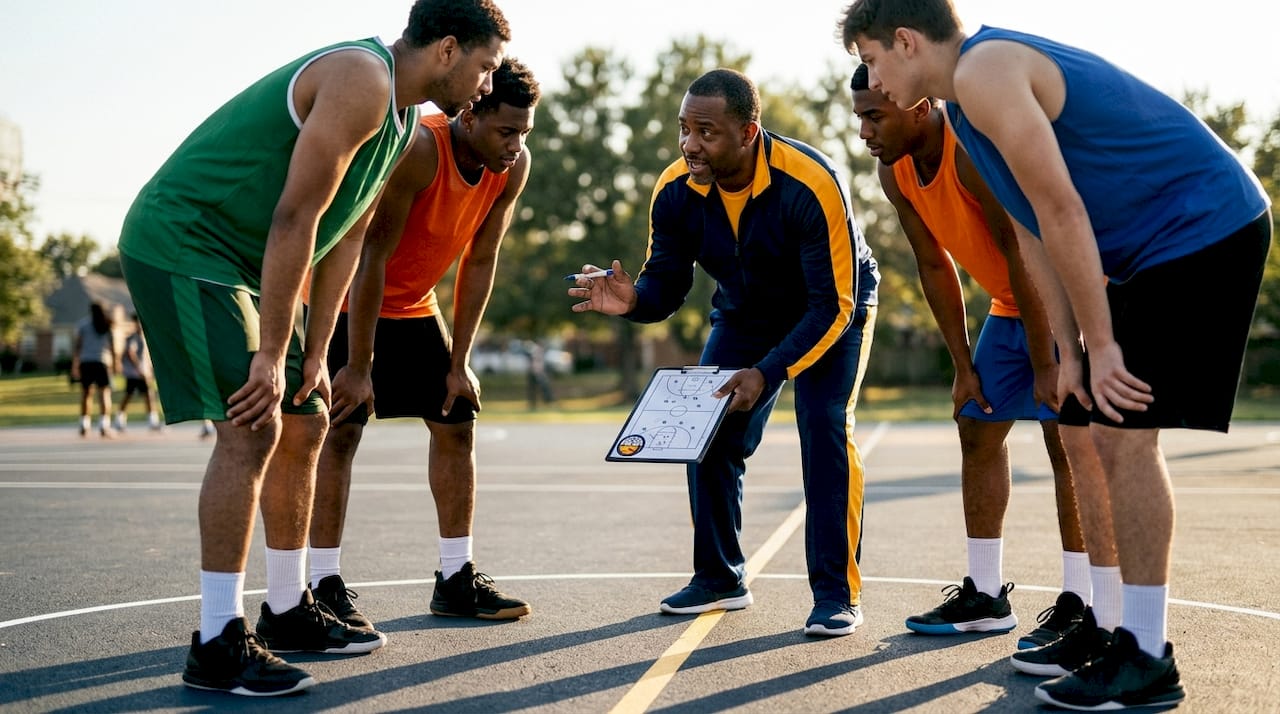
The term “split” refers to the way players divide the court into distinct zones. Each zone holds one offensive player, which prevents defensive help from arriving quickly. The ball moves between zones, and players react with cuts or screens based on where the defense shifts. This is not a rigid play call. It is a read-and-react system built on spacing rules.
The split offense blends traditional player roles with modern spacing principles to create motion and run-and-pass option opportunities. That combination is what separates it from older, post-heavy sets. The offense stays in constant motion, which keeps defenses from settling into comfortable rotations.
What are the key player positions in a split offense?
Player alignment is the foundation of the split offense strategy. Every position on the court has a defined zone, and each player must hold that zone until the ball or a cut triggers movement.
A standard split alignment looks like this:
- Point guard: Handles the ball at the top of the key and initiates the offense. The point guard reads the defense and decides whether to pass, drive, or trigger a screen action.
- Two guards or wings: Positioned on opposite sides of the three-point arc. They stretch the defense wide and are primary catch-and-shoot threats.
- Forwards: Set up near the elbows or short corners. They set screens, cut to the basket, and create mismatches against slower defenders.
- Center: Operates at the high post or as a screener. A mobile center who can step out to the perimeter adds a major spacing advantage.
The key rule is that no two players occupy the same zone at the same time. Crowding kills spacing, and spacing is the entire point of the system. Proper spacing strains defensive coverages, opening lanes for cuts and driving opportunities that defenses simply cannot close in time.
Pro Tip: Teach your players to “fill the gaps” after every cut or screen. When one player moves, another must replace that spot immediately. This keeps the spacing intact and prevents the defense from recovering.
How does the split offense create scoring opportunities?
The split offense generates scoring through three primary actions: cuts, screens, and ball reversal. Each action builds on the spacing already established by the alignment.
Here is how a typical split offense sequence unfolds:
- Ball entry: The point guard passes to a wing. The defense shifts toward the ball.
- Backcut: The opposite wing reads the defense and cuts hard to the basket. If the defender follows, the cutter gets a layup. If the defender sags, the cutter pops back out for a three-point look.
- Screen action: The forward sets a screen on the cutter’s defender or on the help defender. This creates a second scoring option off the same action.
- Ball reversal: If neither the cut nor the screen produces a shot, the ball swings to the other side. The defense must rotate again, creating a new set of attack angles.
- Second-side action: The same cut and screen sequence repeats on the new side, often catching the defense out of position from the first rotation.
Split action plays generate open looks on the perimeter and in the paint when executed correctly against man coverage. That dual threat is what makes the system hard to guard. The defense cannot load up on one area without giving up the other.
The Golden State Warriors built their offensive identity around coordinated split actions that challenge man defenses by forcing help defenders to choose between protecting the paint and closing out on shooters. That same principle applies at every level of the game.
Split offense also works as a psychological tool. Varying player splits confuses defenders and masks the true intentions of each play. A defense that cannot read the offense early is a defense that reacts late.
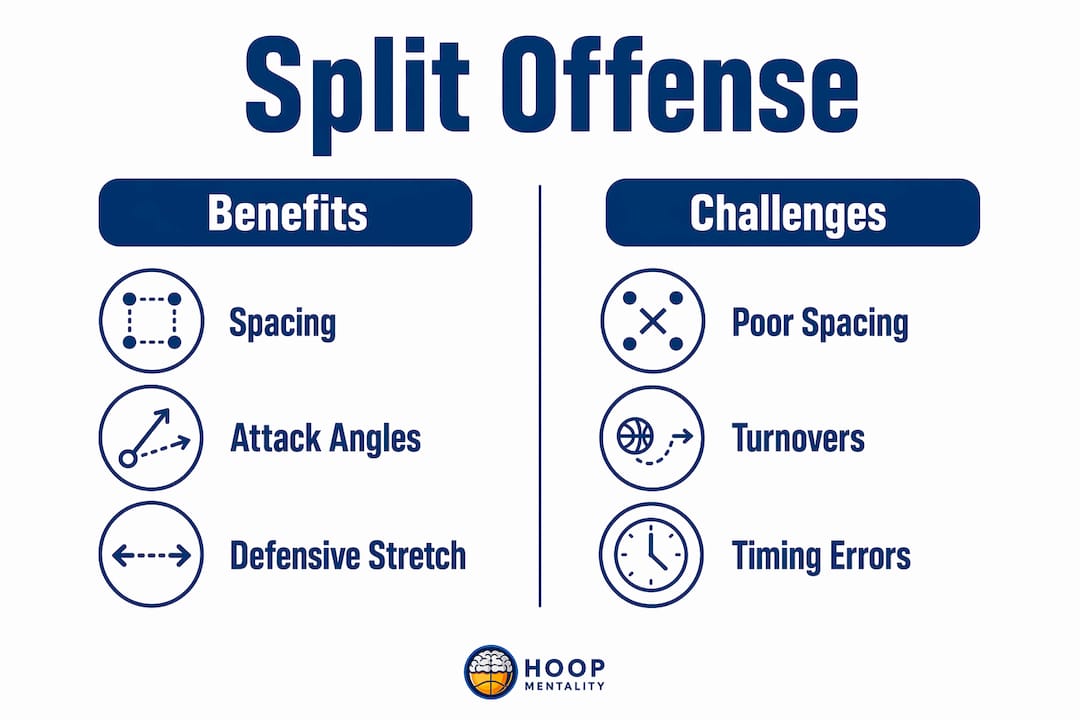
What are the strategic benefits and challenges of split offense?
The split offense delivers clear advantages, but it also demands discipline and preparation. Understanding both sides helps coaches set realistic expectations.
Strategic benefits
| Benefit | How it works |
|---|---|
| Defensive stretching | Wide spacing forces defenders to cover more ground, creating gaps in coverage. |
| Mismatch creation | Screen actions put slower defenders on quicker players and vice versa. |
| Multiple scoring options | Every action produces at least two read options, reducing predictability. |
| Adaptability | The system adjusts to player strengths without changing the core structure. |
Common challenges
The biggest risk in the split offense is poor spacing execution. When players drift out of their zones or stand still after passing, the spacing collapses and the defense recovers easily. Timing and decision-making discipline are non-negotiable for split offense success.
Turnovers are the second major risk. The system relies on quick reads and sharp passes. A player who hesitates or forces a pass into traffic will give the defense an easy transition opportunity. Coaches must train decision-making as deliberately as they train footwork.
Pro Tip: Run “freeze drill” sessions where you pause the offense mid-action and ask each player to identify their zone and their next read. This builds spatial awareness faster than repetition alone.
Mastering split offense requires integrating timing with spatial awareness to force defenses into difficult reactions. That integration takes time, but it pays off in game situations where the defense cannot keep up with the movement.
How can coaches implement split offense in practice and games?
Putting the split offense into a game plan starts with building the right habits in practice. Players need to internalize spacing rules before they can execute reads at game speed.
Start with these practice priorities:
- Spacing walks: Walk through the five-player alignment at half speed. Every player identifies their zone, their primary cut, and their screen responsibility before the drill speeds up.
- Two-man cutting drills: Pair a wing and a forward and run backcut and screen sequences repeatedly. This builds the timing between the two most common split offense partners.
- Ball reversal reps: Run five-on-zero ball reversal sequences until every player knows where to be after each pass. Speed up the drill only after the spacing holds at slow speed.
- Three-on-three reads: Use three-on-three live play to train decision-making in a smaller space. Players learn to read the defense faster when the court is condensed.
- Five-on-five with constraints: Limit the offense to two dribbles per possession. This forces players to pass quickly and trust their spacing, which is exactly what the split offense demands.
Structured practice routines that focus on cutting and screening improve player synergy within split offensive sets. The timing that feels awkward in week one becomes automatic by week four.
In games, the split offense works best against man-to-man defenses. Zone defenses can disrupt the spacing by clogging passing lanes, so coaches should prepare a zone-attack adjustment. A simple adjustment is to move the center to the high post and use skip passes to attack the gaps in the zone. The split spacing still applies. Only the reads change.
Adjusting split alignments dynamically also prevents defenses from predicting cuts and coverage. Change the starting positions of your wings or swap your center to the perimeter on select possessions. Small variations keep the defense guessing without requiring players to learn an entirely new system.
Key Takeaways
The split offense is most effective when spacing discipline, timing, and read-and-react decision-making work together as a single system.
| Point | Details |
|---|---|
| Spacing is the foundation | Players must hold their zones to keep defensive gaps open throughout each possession. |
| Cuts and screens drive scoring | Backcuts and screen actions create dual threats that defenses cannot cover simultaneously. |
| Discipline prevents turnovers | Quick reads and sharp passes are required; hesitation gives the defense time to recover. |
| Practice builds timing | Structured drills on cutting, screening, and ball reversal build the habits the system needs. |
| Adjust for zone defenses | Use high-post positioning and skip passes to attack zones without abandoning split principles. |
Why the split offense rewards patient coaches
Coaches who expect the split offense to produce results in week one will be disappointed. I have seen teams run the alignment perfectly in walk-throughs and fall apart the moment a live defender applies pressure. That gap between drill performance and game performance is not a flaw in the system. It is a training problem.
The split offense punishes impatience more than almost any other system. Players who rush their reads collapse the spacing. Players who freelance break the zone structure. The offense only works when every player trusts the system and waits for the read to develop. That trust takes repetition, and repetition takes time.
What I have found is that the teams who commit to the split offense for a full season end up with something more valuable than a set of plays. They develop court vision, spacing awareness, and decision-making habits that transfer to every other offensive system they run. The split offense is as much a training philosophy as it is a tactical scheme.
The mistake most coaches make is trying to install too many variations too soon. Start with one entry action, one cut option, and one screen option. Master those three before adding anything else. Complexity is the enemy of execution, especially early in the season.
— Dejan
Coaching resources to build your split offense system
Running the split offense well requires more than a whiteboard diagram. You need practice plans, alignment templates, and drill progressions that your players can follow from day one.

Hoop Mentality’s coaching template bundle gives you ready-to-use offensive alignment templates, practice plan structures, and drill progressions built around spacing and movement principles. The resources are designed for coaches who want to install a system without spending hours building materials from scratch. You also get access to the game preparation guide with a weekly practice plan that fits split offense training into a structured schedule. Less prep time. More coaching.
FAQ
What is the split offense in basketball?
Split offense is a spacing system where players position themselves across the court in defined zones to create cuts, screens, and ball movement opportunities. The goal is to stretch the defense and generate open scoring looks on the perimeter and in the paint.
Is split offense effective against zone defenses?
The split offense works best against man-to-man defenses, but coaches can adapt it against zones by using high-post positioning and skip passes to attack gaps. The spacing principles stay the same. Only the reads and entry points change.
How long does it take to install a split offense?
Most teams need four to six weeks of structured practice before the split offense runs smoothly at game speed. Coaches who start with one entry action and build gradually see faster results than those who install the full system at once.
What are the biggest mistakes teams make with split offense?
Poor spacing discipline and rushed decision-making are the two most common problems. Players who leave their zones or force passes into traffic break the system and give the defense easy recovery time.
How does split offense differ from motion offense?
Motion offense gives players more freedom to read and react without fixed zones. Split offense uses defined alignment zones as the starting point for every action. Motion offense principles and split offense overlap significantly, but split offense is more structured in its spacing rules.