

TL;DR:
- The 5-out offense emphasizes spacing by placing all players beyond the three-point line.
- Proper spacing creates open driving lanes, better decision-making, and ongoing player development.
- Focus on principle-based drills and habits leads to long-term basketball IQ improvements.
Most youth basketball teams lose scoring opportunities before a single play is even called. Players clump together, driving lanes disappear, and the ball stalls. The result is predictable offense that any defense can stop. The 5-out offense is a direct fix for this problem. It spreads all five players beyond the three-point line, opens the paint, and forces every defender to make a choice. For youth coaches who want better spacing, more player development, and a system that actually creates shots, the 5-out is worth understanding inside and out.
Table of Contents
- What is the 5-out offense?
- How spacing drives scoring and development
- Core actions and options in the 5-out
- Drills and practice tips for teaching the 5-out offense
- Why the 5-out offense unlocks the modern game — and what most coaches miss
- Take your 5-out offense to the next level with Hoop Mentality
- Frequently asked questions
Key Takeaways
| Point | Details |
|---|---|
| Emphasize spacing | Proper spacing unlocks easy scoring opportunities and individual improvement. |
| Teach core actions | Focus on simple, repeatable movements to build player confidence and team flow. |
| Progress step-by-step | Start with basics before adding more complex reads and options for young athletes. |
| Drill with purpose | Use targeted drills to reinforce spacing, movement, and smart decisions consistently. |
What is the 5-out offense?
Now that we’ve seen the downsides of traditional, crowded offenses, let’s break down exactly what the 5-out system is all about.
The 5-out offense, also called “open post” or “5-out motion,” places all five players on or beyond the three-point arc at all times. There is no designated post player camped in the paint. There is no “big” standing under the basket waiting for a dump-off pass. Every player starts on the perimeter and reads the defense to decide whether to cut, drive, pass, or shoot.
This is a sharp contrast from traditional “post up” offenses, where one or two players set up inside and the others orbit around them. It’s also different from the popular “4-out, 1-in” alignment, where one player stays in the post. In 5-out, the paint is intentionally empty. That empty space is the weapon.
The motion offense basics behind the 5-out are simple. Players read what the defense gives them and react. There are no rigid sets that must be executed perfectly every trip down the floor. Instead, players learn reads and principles. This is exactly why the types of motion offense that fall under the 5-out umbrella work so well for youth development. The benefits for youth players include more touches, better decision-making practice, and positions every player can contribute from equally.
Here is a quick comparison to clarify the differences:
| Feature | 5-out offense | 4-out, 1-in | Traditional post offense |
|---|---|---|---|
| Paint occupancy | Empty | One post player | One or two post players |
| Perimeter players | Five | Four | Three |
| Driving lanes | Wide open | Moderate | Often congested |
| Player versatility | All players rotate equally | Mixed roles | Fixed roles |
| Best for | Youth and developing teams | Teams with a skilled big | Teams with dominant post player |
Signs 5-out is right for your team:
- No clear dominant post player
- Guards who can attack off the dribble
- Players still learning all aspects of the game
- A roster with similar skill levels across positions
Pro Tip: Youth teams benefit from 5-out more than older squads because none of your players are yet locked into a single role. Teaching them to function in all five spots builds total players, not specialists.
How spacing drives scoring and development
With the basics of 5-out clear, it’s vital to understand why spacing is at the heart of this system.
Spacing is not just a tactical preference. It is the core reason the 5-out offense creates scoring. When all five players stand on or beyond the arc, the defense must spread out to guard them. That spreading creates room in the paint. When the paint is open, a player who beats their defender off the dribble has a clear path to the basket or a clean look at a mid-range shot.
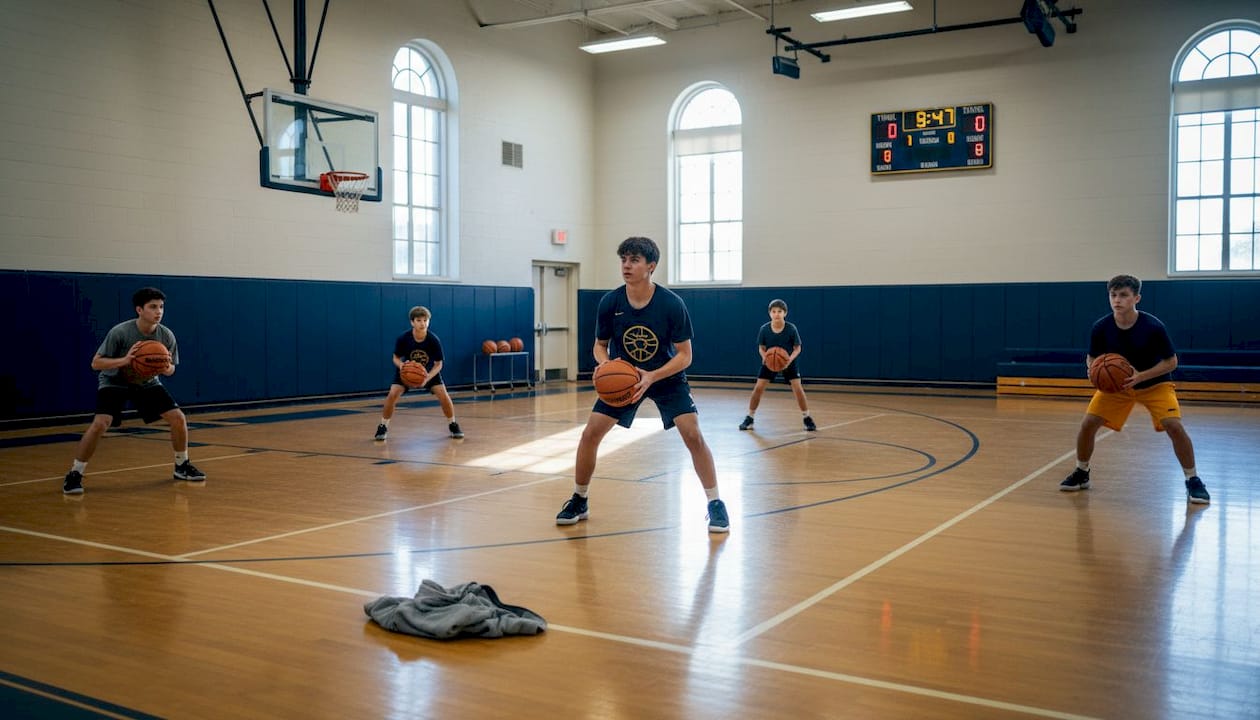
The importance of basketball spacing cannot be understated. Proper spacing creates at least 12 to 15 feet between perimeter players, which is enough distance to make defensive help coverage slower and more difficult. When defenders have to close that gap, they risk leaving their own player open. The read is always there.
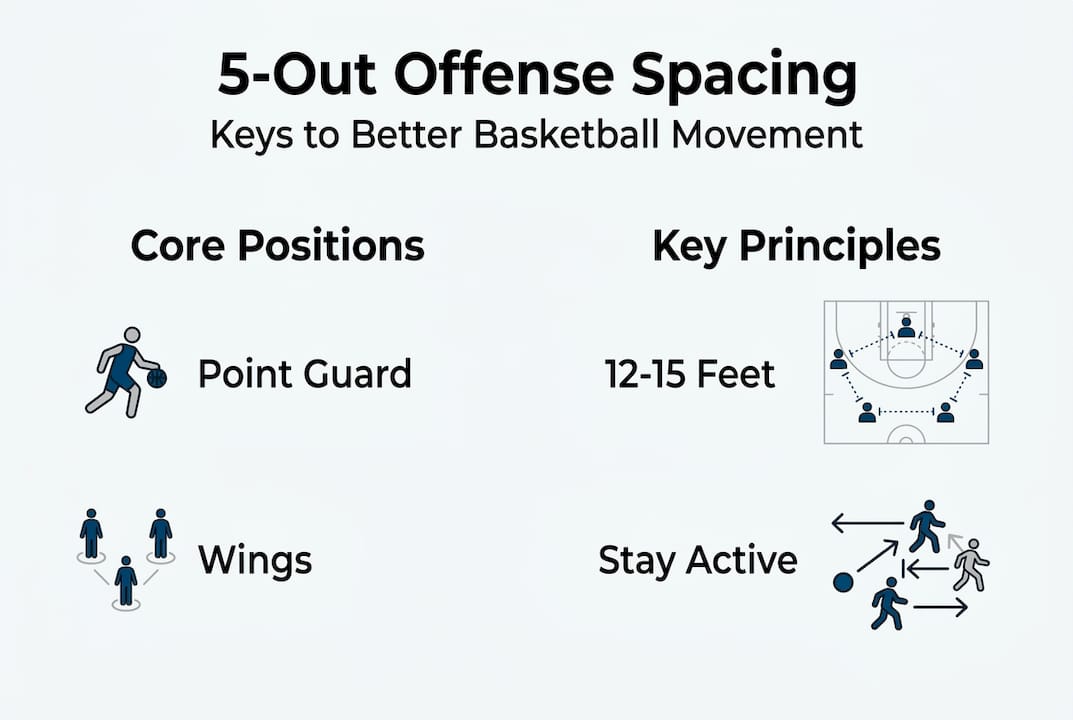
Here is what spaced offense versus crowded offense actually looks like in game outcomes:
| Metric | Spaced offense (5-out) | Crowded offense |
|---|---|---|
| Open driving lanes per possession | 2 to 3 | 0 to 1 |
| Corner three opportunities | Frequent | Rare |
| Help defense arrival time | Slower | Faster |
| Kick-out pass options | Multiple | Limited |
| Turnovers from traffic | Lower | Higher |
Beyond scoring, the development impact is just as real. In a traditional offense, your center rarely handles the ball above the elbow. In 5-out, every player catches passes, makes decisions, and attacks the basket. A 12-year-old who spends two seasons in a 5-out system will have more ball-handling reps, more defensive reads, and better court vision than a player locked into a static post role.
“Great spacing does not just create shots. It creates habits. Players who learn to space the floor young will instinctively look for open gaps at every level they play.”
The complete guide to spacing outlines how coaches can establish spacing habits through simple rules and repeated practice patterns. Consistency matters. Players need to see the same spacing principles applied in every drill, every scrimmage, and every game.
Signs your team needs better spacing:
- Defenders are able to guard two players at once
- The same player dominates the ball while others stand still
- Driving players run into traffic every time they attack
- Shooters are receiving passes with defenders already closing out
- The paint is rarely empty or open for cutters
Fixing these issues starts with intentional practice. Address spacing as a non-negotiable habit, not a nice-to-have.
Core actions and options in the 5-out
Once you understand spacing, it’s time to focus on the essential actions players need to run a great 5-out offense.
The 5-out offense relies on a set of core actions that every player must know. These actions are not complicated, but they must be practiced until they are automatic. The goal is for players to see the defense and respond correctly without being told what to do.
The four main actions in 5-out:
- Pass and cut: After passing, the player attacks the basket looking for a return pass. If the cut does not produce a shot, the cutter fills an open spot on the perimeter.
- Dribble drive: A player attacks a gap in the defense off the dribble. Their teammates relocate to maintain spacing and be ready for kick-out passes.
- Ball screen: A perimeter player sets a screen for the ball handler. This creates two-on-one situations and forces defensive decisions.
- Backdoor cut: When a defender overplays and denies the passing lane, the offensive player cuts back door to receive a lob or bounce pass.
The offense techniques for players cover these actions in detail and explain exactly when each one is the right call. Learning to read which option is available is what separates good 5-out teams from great ones. The man-to-man offense tips also show how these actions translate directly into advantages against common defensive schemes.
A basic 5-out motion sequence:
- Player 1 enters the ball to Player 2 on the wing.
- Player 1 makes a basket cut looking for a return pass.
- If no pass is available, Player 1 fills the opposite corner.
- Player 2 reads the defense. If the lane is open, Player 2 attacks.
- Players 3, 4, and 5 shift to maintain spacing and create passing options.
- Player 2 drives, draws help defense, and kicks out to the open corner player.
- The corner player catches and shoots or drives if their defender has rotated away.
This sequence can repeat and vary based on reads. No single sequence must happen the same way twice. The principles guide the action, not a scripted play.
Player reads to emphasize:
- Defender’s position: Is the defender overplaying? Cut backdoor.
- Help defense: Did a help defender collapse? Kick out for the open shot.
- Driving gaps: Is there space between defenders? Attack it now.
- Teammate movement: Did a cutter clear the lane? Follow with the next action.
Pro Tip: The most common mistake new 5-out players make is standing and watching after they pass. Emphasize this rule: after every pass, move with purpose. Either cut, set a screen, or relocate to maintain spacing. Standing still kills the offense.
Drills and practice tips for teaching the 5-out offense
It’s not enough to know what to do. You need action steps to teach your players these concepts and turn them into habits.
Drilling the 5-out offense means drilling spacing, movement, and decision-making together. Isolated dribbling or shooting drills are not enough. Players need to practice reading the defense and reacting in real-time situations as often as possible.
Essential 5-out drills for youth teams:
- 5-out shell drill: Walk through spacing positions with no defense, then add passive defenders. Players practice maintaining their spots and moving when a teammate cuts or drives.
- Pass and cut drill: Two players practice the pass-and-cut action repeatedly. The cutter learns to read the return pass or fill the opposite spot.
- Dribble drive kick-out: The ball handler drives a designated lane while two wing players shift to proper kick-out positions. The driver practices the pass, the wings practice catching and shooting quickly.
- Backdoor recognition drill: A defender is told to overplay. The offensive player must recognize it and cut backdoor. The passer must read the cut and deliver.
- 3v0 to 3v3 progression: Teams run 5-out principles with no defense first, then add one passive defender, then full defense. Each step adds pressure while reinforcing spacing habits.
The transition drills for fast break connect directly to 5-out because transition offense is where spacing habits are built at full speed. Teaching players to sprint to their perimeter spots in transition reinforces the same principles used in half-court 5-out offense. The offensive sets workflow can help you design a logical practice plan that builds from simple skills to full team offense over the course of a season.
Practice structure tips:
- Spend at least 10 minutes every practice on spacing-only drills with no shooting pressure.
- Add defense in stages. Start passive, then competitive.
- Use constraints. For example, tell players they must pass before they can drive. This builds decision-making habits faster than free-form scrimmage.
- Debrief after scrimmages. Point out spacing mistakes immediately while players can still visualize them.
Pro Tip: For players under 12, keep the rules simple. Start with one rule: after you pass, cut or move. Do not add ball screens or complex reads until every player understands pass-and-cut and can maintain their spacing position consistently. Build layers based on what your team actually masters, not what you planned to teach by week four.
Why the 5-out offense unlocks the modern game — and what most coaches miss
Here is the honest truth most coaching articles skip. The 5-out offense is not hard to understand. It is hard to implement with patience. Most youth coaches want results by the second game. They draw up plays, add screens, and install reads before their players can maintain basic spacing for five seconds. The system falls apart, and coaches blame the offense instead of the timeline.
The real value of the 5-out is not the plays it creates. It is the basketball IQ it builds in every single player on your roster. When a point guard spends two years in a traditional offense, they learn how to be a point guard. When they spend two years in a 5-out system, they learn how to play basketball. That difference shows up in high school and beyond.
The best youth coaches running 5-out do one thing differently. They prioritize small-sided games and constraint-based drills over scripted plays. A 3v3 half-court game with a “one pass before you drive” rule teaches spacing, decision-making, and movement better than any whiteboard session. Constraints force habits. Habits become instincts.
The motion offense benefits go well beyond the tactical advantages. Player engagement increases when everyone is involved. Bench depth improves when every player understands every role. And coaching becomes more manageable when you teach principles instead of policing a specific play every possession.
The coaches who get the most out of 5-out are not the ones with the most complex playbooks. They are the ones who commit to spacing rules, use small-sided games constantly, and build complexity only after mastery is proven. That approach takes discipline. Most coaches skip it. Do not skip it.
Take your 5-out offense to the next level with Hoop Mentality
Ready to put these ideas into action? Equip yourself with the right tools for successful practices and games.
Hoop Mentality has resources built specifically for coaches running or learning the 5-out system.

Use the Big Man Dual Action Drill to develop players who can function in all five spots, a necessity in any 5-out system. For full practice organization, the Game Preparation Guide gives you a structured weekly plan to build spacing habits and offensive principles into every session.
- Practice plans designed for 5-out spacing development
- Drills that match youth learning stages
- Game prep tools that save you time and cut confusion
Explore the full resource library at Hoop Mentality and build a coaching system that gets results.
Frequently asked questions
Is the 5-out offense suitable for all youth teams?
Yes, the 5-out offense is highly adaptable and works well for players at all skill levels. The adaptability for youth players makes it especially effective for younger athletes who benefit most from learning every position rather than specializing early.
What common mistakes do coaches make when teaching the 5-out offense?
The most frequent mistake is adding complexity before players can master basic spacing and simple pass-and-cut movements. The essential offense techniques outline a progressive approach that builds skills in the right order.
How does the 5-out offense help with player development?
Every player gets equal ball-handling reps, reads, and decision-making opportunities, which builds complete players faster. Strong basketball spacing habits developed through 5-out translate to better performance at every future level.
Does the 5-out offense require all players to shoot well from outside?
No. Outside shooting helps, but the system’s real strength is creating driving lanes, open cuts, and kick-out opportunities for teammates. Players who struggle to shoot from outside still contribute by spacing the floor and cutting hard to keep the defense honest.