

TL;DR:
- Motion offense is based on principles, not scripts, allowing for adaptability and smarter play.
- It develops players’ decision-making, reading defenses, and communication skills over time.
- Consistent long-term implementation and tracking metrics lead to improved team performance.
Motion offense has a reputation problem. Coaches at every level hear “motion offense” and picture five players freelancing with no structure, no accountability, and no clear shots. That fear is understandable. But it’s wrong. Motion offense, when built on clear principles, produces smarter players, better ball movement, and stronger team communication than most rigid set-play systems ever will. This guide breaks down what motion offense actually is, why it develops players faster, how to adapt it for any roster, and how to build the habits that make it stick on game night.
Table of Contents
- Understanding motion offense fundamentals
- Why coaches choose motion: Development and teamwork
- Types of motion offense and adaptability
- Building motion offense habits: Practice and drills
- Why most coaches underestimate motion offense
- Enhance your team’s offense with proven tools
- Frequently asked questions
Key Takeaways
| Point | Details |
|---|---|
| Movement and spacing | Motion offense relies on constant movement and 15-18 foot spacing to create scoring opportunities. |
| Team development | Running motion offense boosts player IQ, communication, and teamwork for all skill levels. |
| Practice builds habits | Effective implementation depends on regular, targeted drills and progressive instructional layers. |
| Adaptable strategies | Coaches can modify motion systems to fit age group, team talent, and competitive goals. |
Understanding motion offense fundamentals
Motion offense is not the absence of structure. It is a different kind of structure, one built around principles instead of scripted plays.
In a traditional structured offense, players follow a predetermined sequence. Player A passes to Player B, who sets a screen for Player C. Everyone knows the script. The problem is that defenses know the script too. Once a team scouts your set plays, your offense becomes predictable.
Motion offense flips that model. Instead of memorizing sequences, players learn rules. Move when you pass. Space the floor. Read the defense. Share the ball. Those rules create an offense that adapts in real time because players are making decisions, not following a script.
The what is motion offense concept is often misread as “just play pickup.” It is not. Motion offense has clear boundaries.
Core motion offense principles:
- No player stands still for more than 2 to 3 seconds
- Spacing principles require 15 to 18 feet between players
- Players read the defense before cutting or screening
- Ball movement is shared; no one player dominates possession
- Cuts and screens are triggered by reads, not by a play call
Motion offense vs. structured offense: a quick comparison
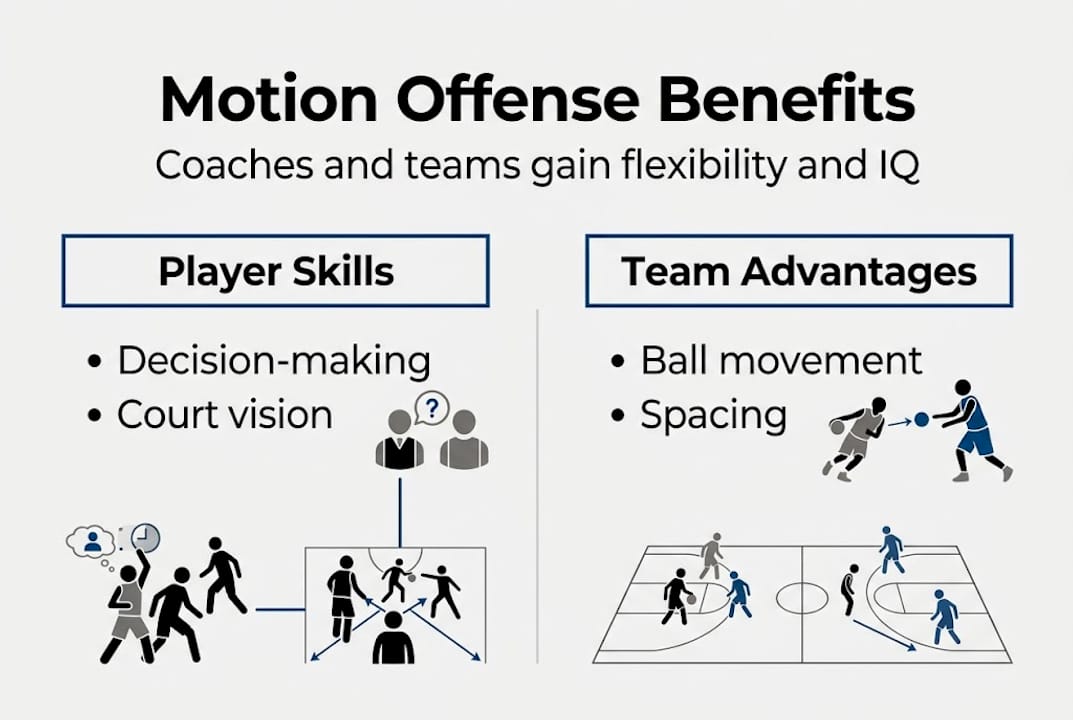
| Feature | Motion offense | Structured offense |
|---|---|---|
| Decision-making | Player-driven | Coach-scripted |
| Adaptability | High | Low |
| Learning curve | Moderate | Low initially |
| Long-term development | Strong | Limited |
| Defensive predictability | Low | High |
Pro Tip: Give players freedom within a framework. Define the rules clearly before you remove the script. Players need to know what they are free to do, not just what they are free from.
The shift from set plays to motion principles takes time. But once players internalize the rules, the offense runs itself. That is the goal.
Why coaches choose motion: Development and teamwork
Motion offense is not just a tactical choice. It is a player development tool.
When players run set plays, they develop one skill: execution. They get good at running the play. When players run motion offense, they develop three skills simultaneously: reading the defense, communicating with teammates, and making decisions under pressure. Those skills transfer everywhere on the court.
Player IQ and decision-making
Motion offense forces players to process information constantly. Where is the defense? Where is my teammate? Is the lane open? Should I cut or screen? That mental load, repeated across hundreds of possessions in practice, builds building basketball IQ faster than any drill in isolation.
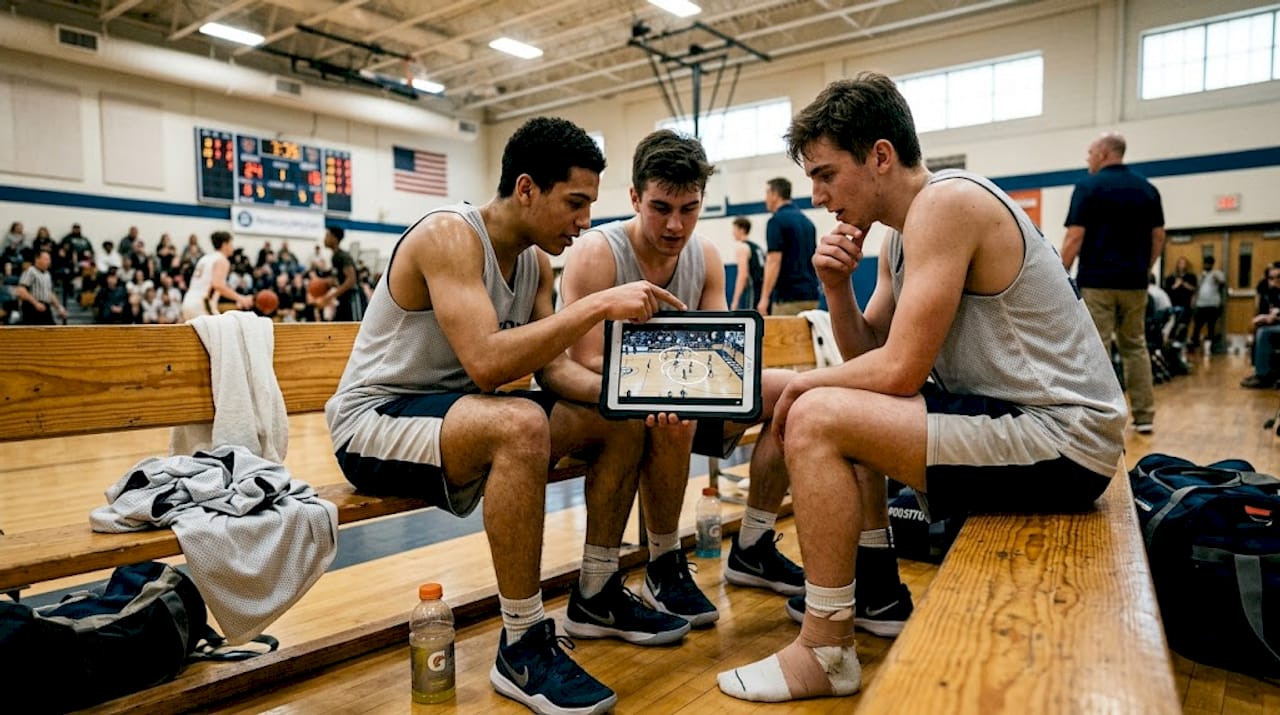
Players who grow up in motion systems tend to make better decisions in late-game situations because they have been making decisions all season, not just running plays.
Communication and teamwork
Constant movement requires constant communication. Players call out screens. They signal cuts. They make eye contact before passing. That verbal and nonverbal communication becomes automatic over time. The result is a team that talks on both ends of the floor, not just offense.
“Motion offense enhances communication and teamwork. Track metrics like ball movement speed, passing accuracy, spacing consistency, and shooting percentage to measure implementation success.” How to implement motion offense
Metrics to track progress:
- Passing accuracy percentage per game
- Average passes before a shot attempt
- Spacing consistency (measured by average distance between players)
- Shooting percentage from motion-generated looks
- Turnovers per possession
Coaches who track these numbers see a clear trend. Early in the season, the numbers look rough. By midseason, ball movement improves. By playoffs, the team is making reads that no set play could have scripted. That is team success with basketball IQ in action.
Types of motion offense and adaptability
One of the biggest strengths of motion offense is that it scales. You can run a version of it with 10-year-olds or with college athletes. The principles stay the same. The complexity adjusts.
Common motion offense variations:
- 5-out motion: All five players positioned on the perimeter. Maximizes spacing and dribble penetration. Best for teams with versatile, ball-handling players.
- 4-out, 1-in: Four perimeter players, one post player. Balances inside and outside threats. Works well with a skilled big.
- Flow motion: A continuous motion system where every action triggers the next. Used by coaches like D3 champion coach Matt Lewis for smarter players and better shots.
- Warriors-style motion: Blends off-ball movement, screening, and spacing with pick-and-roll actions for modern NBA efficiency.
These
How to layer motion offense for youth teams:
- Start with basic spacing rules only. No screens, no complex cuts.
- Add one action at a time, such as the basket cut after a pass.
- Introduce the dribble handoff once spacing is consistent.
- Layer in basic screens after players understand cutting reads.
- Progress to full motion principles once all individual actions are automatic.
For motion offense for youth, the goal is not to run the full system in week one. The goal is to build the habits that make the full system possible later.
At the NBA level, mastering motion offense means blending motion principles with pick-and-roll efficiency. Top teams do not run pure motion. They blend concepts to maximize what their roster does best.
Building motion offense habits: Practice and drills
You cannot install motion offense with a whiteboard session. Players have to feel it, make mistakes, and self-correct. That happens through structured practice.
Step-by-step practice progression:
- Teach spacing first. Use 5-on-0 walkthroughs. No defense, no pressure. Just movement and spacing.
- Add 3v3 reads. Small-sided games force quicker decisions. Players learn to read faster because there is less noise.
- Run 4v4 with rules. Require a set number of passes before a shot. This enforces ball movement.
- Progress to controlled scrimmage. Add defense but limit its intensity. Focus on reading, not winning.
- Full 5v5 with feedback. Now let it run. Pause to correct reads, not just results.
Implementing motion offense well means teaching reads through 3v3 and 4v4 drills before you ever run full 5v5 sets. Start simple for youth, then layer screens and cuts as players develop.
Key drills for communication and decision-making:
- Read-and-react 3v3: No set plays. Players must talk and react to the defense.
- Spacing check drill: Freeze the offense mid-possession and measure distances. Correct spacing on the spot.
- Pass-and-cut series: Every pass triggers a basket cut. Builds the habit automatically.
- Competitive 4v4 with scoring rules: Award extra points for passes that lead directly to open shots.
Pro Tip: Film one practice per week and review ball movement and spacing data with your players. Seeing the gaps on video is more powerful than hearing about them in a timeout.
Keep player safety in mind during high-intensity drills. Proper warm-ups and load management reduce sports injury risk during fast-paced motion sessions.
For younger players, a simple youth offense guide can help you sequence the right actions at the right time. And basketball spacing tips give you specific tools to correct the most common spacing errors before they become habits.
Why most coaches underestimate motion offense
Here is the uncomfortable truth: most coaches who struggle with motion offense are not struggling because the system is too complex. They are struggling because they never fully committed to it.
Running motion offense halfway is worse than not running it at all. If you install motion principles but keep calling set plays when the game gets tight, your players learn that the principles do not really matter. The system collapses under pressure because it was never truly trusted.
The coaches who get the most out of motion offense treat it as a long-term investment. Early in the season, the offense looks rough. That is normal. Motion offense expert nuance confirms that the system improves over the season as players develop reads and trust each other. The coaches who stick with it see the payoff in January and February, not October.
The other mistake is confusing motion offense with no offense. Motion is conceptual, not rigid. But it still has rules. Spacing, timing, cutting, and screening are all teachable. The motion offense explained framework gives players a decision tree, not a blank canvas.
Track your metrics. Build coach-player trust. Stay consistent. The teams that do those three things see real improvement, season over season.
Enhance your team’s offense with proven tools
You have the strategy. Now you need the tools to bring it to practice.
Hoop Mentality offers resources built specifically for coaches running motion offense systems. The basketball practice plan template helps you structure every session around motion principles, from spacing walkthroughs to competitive 4v4 reads. The big man dual action drill develops the post actions that make 4-out motion more effective. Browse all coaching tools at Hoop Mentality and find resources that match your system, your roster, and your timeline.
Frequently asked questions
Is motion offense suitable for youth teams?
Yes. Starting simple with motion offense helps young players communicate and develop court awareness before you layer in screens and cuts. Youth implementation works best when you begin with spacing rules only and add one action at a time.
Does motion offense improve team performance?
Motion offense enhances teamwork and communication, which leads to better ball movement and smarter shot selection. Coaching metrics like passing accuracy, spacing consistency, and shooting percentage all improve with consistent implementation.
What are common challenges when implementing motion offense?
The biggest challenge is avoiding chaos by balancing player freedom with clear principles and gradual layering of complexity. Coaches who try to install the full system too fast lose player confidence before the habits form.
How can coaches measure the effectiveness of motion offense?
Track passing accuracy, ball movement speed, spacing consistency, and shooting percentage each week. Those four numbers give you a clear picture of whether your motion principles are taking hold.
Are NBA teams using motion offense?
NBA teams blend motion concepts with pick-and-roll and spacing strategies for optimal offense. Teams like the Warriors have built championship-level systems around motion principles combined with modern spacing and ball movement efficiency. Top offenses prioritize pick-and-roll efficiency within a motion framework.