

Many coaches invest countless hours perfecting plays and conditioning drills, believing that physical prowess and technical skills will carry their teams to victory. Yet even the most athletic squads often struggle with poor decision making, missed defensive rotations, and inconsistent execution under pressure. The missing ingredient is rarely talent or effort. It’s basketball IQ, the mental framework that transforms raw ability into strategic dominance. Understanding and developing basketball IQ separates championship teams from those that merely compete, and coaches who prioritize this mental dimension unlock sustainable success that transcends individual talent.
Table of Contents
- Key takeaways
- Understanding basketball IQ and its impact on coaching
- How basketball IQ enhances decision making and strategic play
- Practical methods coaches can use to cultivate basketball IQ
- Measuring the impact of enhanced basketball IQ on team performance
- Enhance basketball IQ with Hoop Mentality resources
- Frequently asked questions
Key Takeaways
| Point | Details |
|---|---|
| Basketball IQ drives outcomes | A high level of game sense allows players to read defensive schemes, anticipate rotations, and make better decisions in real time. |
| Explain why actions work | Coaches should teach the rationale behind each drill and decision to develop transferable mental frameworks. |
| Anticipation and pattern recognition | Developing anticipation and pattern recognition helps players predict opponent movements and respond instantly to common game situations. |
| Decision speed matters | Faster decision speed translates into quicker, smarter choices under pressure. |
Understanding basketball IQ and its impact on coaching
Basketball IQ involves game sense, decision making, and situational awareness, representing a player’s ability to read the game, anticipate what happens next, and make optimal choices in real time. This mental dimension operates independently from physical attributes like speed, jumping ability, or shooting mechanics. A player with exceptional basketball IQ recognizes defensive schemes instantly, exploits spacing advantages before defenders react, and makes the extra pass that creates open shots rather than forcing contested attempts.
The distinction between basketball IQ and raw athleticism becomes clear when comparing players of similar physical ability. One athlete might possess explosive first-step quickness but consistently drives into help defense because they fail to read weak-side rotations. Another with identical speed recognizes the defensive collapse early, delivers a perfectly timed skip pass to the corner, and creates a wide-open three-pointer. The physical tools remain constant, but the mental processing separates effective play from elite performance.
Coaches must recognize that physical training alone produces incomplete players. An athlete who can execute a perfect pick and roll mechanically still struggles if they cannot identify when defenders switch, when to slip the screen early, or when the roll man should pop instead. These decisions require understanding defensive tendencies, recognizing personnel matchups, and processing multiple variables simultaneously. Players with developed basketball IQ maximize their physical skills because they consistently put themselves in advantageous positions and make choices that amplify their strengths while minimizing weaknesses.
“The best players think the game faster than their opponents. They see two plays ahead while others react to what just happened.”
Cultivating basketball IQ requires coaches to shift from purely mechanical instruction to teaching the why behind every action. Players need to understand defensive principles, offensive spacing concepts, and situational priorities. When coaches explain how a baseline cut occupies help defense and creates driving lanes, or why certain passes trigger defensive rotations that open other opportunities, they build mental frameworks players can apply independently. This cognitive development transforms athletes from robots executing memorized patterns into thinking competitors who adapt and problem-solve throughout games.
Key components coaches should develop:
- Anticipation skills that allow players to predict opponent movements before they happen
- Spatial awareness understanding how positioning creates or eliminates offensive and defensive advantages
- Pattern recognition identifying recurring situations and optimal responses instantly
- Decision speed processing information and executing choices faster than defensive reactions
How basketball IQ enhances decision making and strategic play
Decision making and game sense are core components that directly determine whether possessions end in quality shots or turnovers, whether defensive stands succeed or break down. Every possession presents dozens of micro-decisions: shot selection timing, passing angles, defensive help positioning, transition responsibilities, and offensive spacing adjustments. Players with developed basketball IQ process these variables instinctively, making optimal choices that compound into significant competitive advantages over four quarters.
Consider specific scenarios where basketball IQ transforms outcomes. On offense, a player receives a ball screen at the top of the key. The low-IQ response follows a predetermined script: use the screen, attack the paint, and react to whatever defense appears. The high-IQ player reads the defender’s positioning before the screen arrives, recognizes whether the screener’s defender will show hard or drop, identifies where help defense will come from, and decides whether to reject the screen, use it for a pull-up jumper, turn the corner for a drive, or immediately hit the rolling big man. These split-second reads, executed correctly, create easy baskets instead of contested attempts.
Defensively, basketball IQ separates players who chase their assignment from those who understand team defense principles. A low-IQ defender focuses exclusively on their matchup, getting screened out of plays and arriving late to rotations. A high-IQ defender anticipates screens based on offensive alignment, communicates switches proactively, understands when to help and recover versus when to stay home, and positions themselves to disrupt passing lanes while maintaining defensive responsibilities. This awareness prevents easy baskets and forces opponents into difficult decisions.
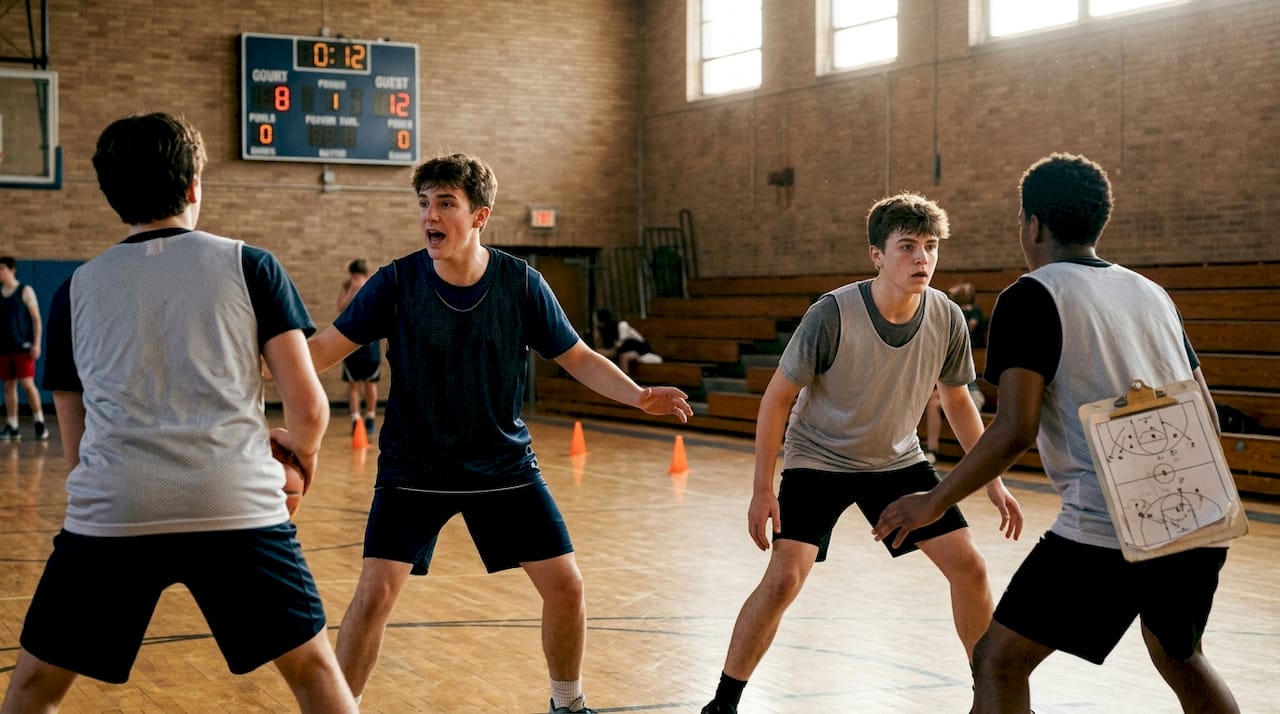
Coaches can develop situational awareness through targeted practice design. Instead of running scripted plays against passive defense, create live scenarios with specific constraints: trailing by two points with thirty seconds remaining, defending a final possession without fouling, executing against a zone after timeouts. These situations force players to process game context, evaluate options, and make decisions under pressure. Repetition in varied scenarios builds mental databases players access instinctively during games.
| Team Type | Strategic Execution | Adjustment Speed | Turnover Rate |
|---|---|---|---|
| High Basketball IQ | Consistently finds optimal shots through movement and reads | Adapts to defensive changes within possessions | Low, protects ball through smart decisions |
| Physical Focus Only | Relies on athleticism to overcome defensive schemes | Struggles when initial actions don’t work | High, forces plays into traffic |
Pro Tip: Install a “decision checkpoint” in practice where you freeze live action randomly and ask players to verbalize what they see, what options exist, and what choice they would make. This builds conscious awareness of decision-making processes that eventually become automatic.
Integrating decision-making cues into daily practice accelerates basketball IQ development. Use verbal prompts during drills: “Where’s the help?” “Who’s open?” “What’s the next pass?” These questions train players to continuously scan and process rather than tunnel vision on immediate actions. Over time, this external prompting becomes internal dialogue, and players naturally evaluate multiple options before acting.
Practical methods coaches can use to cultivate basketball IQ
Skill development workflows and drills focused on basketball intelligence produce measurable improvements when coaches implement structured, progressive training. Developing basketball IQ requires deliberate practice that challenges mental processing alongside physical execution. Random drills without cognitive load build mechanics but not game intelligence. Effective training forces players to read, decide, and execute simultaneously under increasing complexity and pressure.
Begin with constraint-based small-sided games that emphasize decision making over athleticism. Three on three games with specific rules, limited dribbles per possession, required number of passes before shots, or zone restrictions, force players to think strategically rather than rely on physical advantages. These constraints mirror game situations where smart play beats individual talent. Players learn to recognize spacing, exploit defensive gaps, and make quick decisions because the rules eliminate bailout options like excessive dribbling or isolation plays.
Progressive training framework for basketball IQ development:
- Foundation phase: Teach core concepts through film study and walkthrough demonstrations showing why certain decisions work
- Controlled application: Run drills at reduced speed where players practice recognizing situations and making correct reads
- Competitive repetition: Increase tempo and add defensive pressure while maintaining decision-making focus
- Game simulation: Create scenarios matching actual game conditions with score, time, and situational constraints
- Reflection and adjustment: Review decisions through video, discuss alternatives, and refine mental models
Film study represents one of the most powerful tools for accelerating basketball IQ. Show players examples of high-IQ plays from various levels, breaking down the reads and decisions that created advantages. Then show their own game footage, asking them to identify what they saw, what they missed, and what they would do differently. This metacognitive process, thinking about thinking, builds awareness of mental patterns and decision-making habits. Players begin recognizing situations in real time because they have studied them repeatedly.
| Training Focus | Improvement Timeline | Performance Metrics | Sustainability |
|---|---|---|---|
| Basketball IQ Emphasis | Steady gains over 4-8 weeks | Decision speed increases 40%, turnover rate decreases 30% | Compounds over seasons as mental frameworks deepen |
| Physical Skills Only | Initial rapid gains plateau quickly | Athleticism improves but decision quality stagnates | Limited by physical ceiling and opponent adjustments |
Mental exercises complement physical training effectively. Use visualization techniques where players mentally rehearse game situations, imagining defensive reactions and optimal responses. Conduct whiteboard sessions where players diagram plays and explain their decision-making process. Create competitive trivia around opponent tendencies, defensive schemes, and strategic principles. These activities build the mental database players access during games when processing must happen instantaneously.
Pro Tip: The biggest pitfall when teaching basketball IQ is overwhelming players with too much information simultaneously. Introduce one concept at a time, ensure mastery through repetition, then layer additional complexity. Players who understand three principles deeply outperform those who know ten superficially.
Communication drills also enhance basketball IQ by forcing players to verbalize what they see. Run defensive shell drills where players must call out screens, switches, and rotations loudly before executing. This verbal processing reinforces awareness and builds team connectivity. Offensive spacing drills where players communicate cuts, screens, and reads create shared understanding of how individual actions affect team structure.
Measuring the impact of enhanced basketball IQ on team performance
Tracking basketball IQ improvements requires coaches to look beyond traditional statistics like points and rebounds toward metrics that reveal decision-making quality and strategic execution. Video analysis provides the richest assessment tool, allowing coaches to evaluate reads, recognition speed, and choice quality across multiple possessions. Watch for specific indicators: Does the player identify defensive schemes quickly? Do they make the correct read even when execution fails? Are they consistently in proper positions before actions develop?
Key performance indicators tied directly to basketball IQ include:
- Assist to turnover ratio reflecting decision-making quality under pressure
- Deflections and defensive rotations showing anticipation and awareness
- Screen assists and hockey assists revealing understanding of how actions create opportunities
- Charges taken and defensive positioning indicating spatial awareness and sacrifice
- Shot quality metrics measuring whether attempts come from advantageous situations
Practice observation offers daily assessment opportunities coaches should leverage systematically. Create checklists for specific basketball IQ behaviors: recognizing defensive coverages, making extra passes, communicating switches, helping and recovering properly. Track these behaviors across practices to identify trends and individual development areas. Players who consistently demonstrate these behaviors in practice will execute them in games when stakes increase.
Game statistics provide quantitative validation when analyzed through a basketball IQ lens. Compare assist rates, turnover percentages, and shot selection before and after implementing IQ-focused training. Teams that develop basketball IQ typically see assist numbers rise as players find open teammates more consistently, turnovers decrease as decision-making improves, and shot quality increases as players take attempts from better positions. These statistical shifts correlate directly with winning percentages.
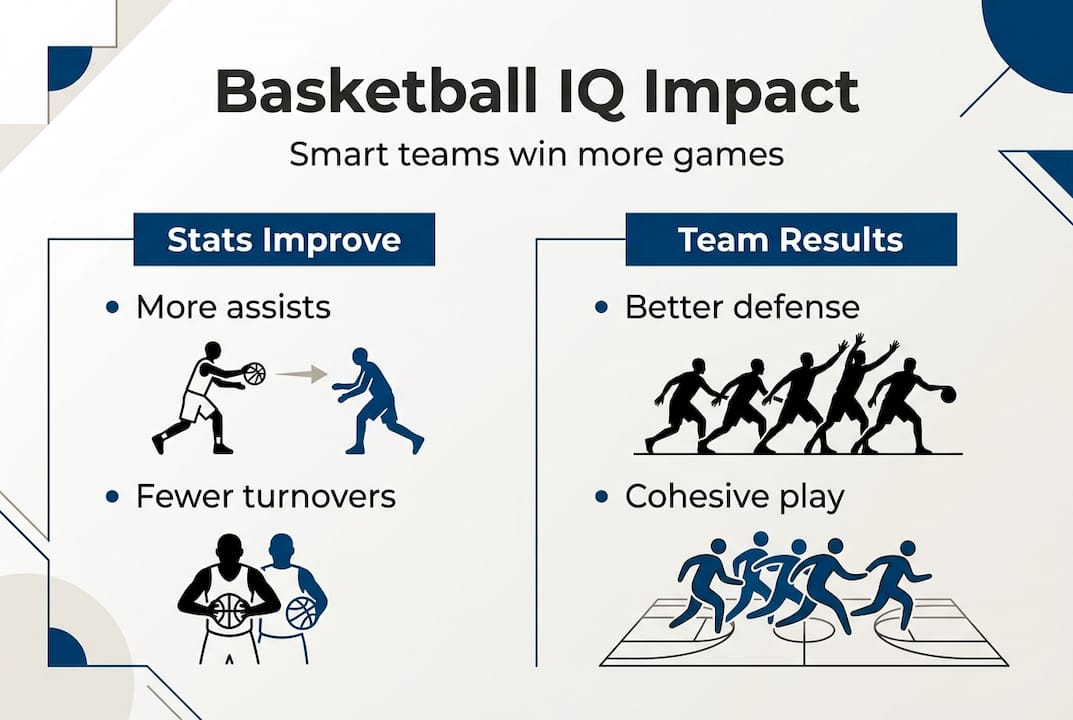
| Metric | Before IQ Focus | After 8 Weeks IQ Training | Improvement |
|---|---|---|---|
| Assist to Turnover Ratio | 1.2:1 | 1.8:1 | 50% increase |
| Deflections Per Game | 8.3 | 12.7 | 53% increase |
| Shot Quality Rating | 0.52 | 0.61 | 17% increase |
| Team Winning Percentage | 58% | 73% | 26% increase |
Improved basketball IQ correlates with better team cohesion and competitive success because smart players make teammates better through their decisions and awareness. A point guard with high basketball IQ creates easier scoring opportunities for everyone. A defensive anchor with elite awareness organizes teammates and prevents breakdowns before they happen. This multiplier effect means basketball IQ development produces returns exceeding individual improvement, elevating entire team performance.
Leadership plays a crucial role in fostering an IQ-driven team culture. Coaches must celebrate smart plays as enthusiastically as spectacular athletic achievements. When a player makes a perfect help rotation that prevents a layup, recognize it publicly. When someone delivers a skip pass that leads to an assist, highlight the vision and decision. This reinforcement signals that basketball IQ matters as much as physical performance, encouraging players to prioritize mental development.
Establish team standards around basketball IQ behaviors. Require players to study opponent tendencies before games. Implement film sessions where players present scouting reports. Create accountability for mental mistakes the same way you address physical errors. When basketball IQ becomes a core team value embedded in culture, players police themselves and push each other toward higher cognitive standards.
Enhance basketball IQ with Hoop Mentality resources
Developing basketball IQ requires more than good intentions. It demands structured training tools and proven frameworks that systematically build player intelligence. Hoop Mentality offers specialized resources designed specifically to help coaches implement the concepts discussed throughout this article. The Big Man Dual Action Drill teaches post players to read defensive positioning and make smart decisions in high-low situations, developing the basketball IQ crucial for interior play. This drill builds recognition skills that translate directly to game performance.

The Basketball Practice Plan Template provides a structured framework for integrating basketball IQ exercises into daily training efficiently. This template helps coaches organize practices that balance skill development with cognitive training, ensuring players build both physical and mental capabilities simultaneously. By using proven planning structures, coaches save preparation time while delivering more effective training sessions that develop complete players ready to think and execute at high levels.
Frequently asked questions
What is basketball IQ and why is it crucial for teams?
Basketball IQ represents a player’s ability to understand game situations, anticipate actions, and make optimal decisions instinctively during competition. It proves crucial because teams with high collective basketball IQ execute strategies more effectively, adapt to opponents faster, and consistently make smarter plays that create scoring opportunities while preventing defensive breakdowns. Physical talent alone cannot compensate for poor decision making and lack of game awareness.
How can a coach effectively assess basketball IQ in their players?
Coaches should use video analysis to evaluate how quickly players recognize situations and whether they make correct reads even when execution fails. Track specific metrics like assist to turnover ratios, deflections, and defensive rotations that indicate awareness and anticipation. Observe practice behaviors systematically, noting communication, positioning, and decision quality across multiple repetitions to identify patterns and development areas.
What training drills best develop basketball IQ on a team?
Small-sided games with specific constraints, limited dribbles, required passes, or zone restrictions, force players to think strategically rather than rely on athleticism. Situational scrimmages that replicate game scenarios with score and time pressure build decision-making under realistic conditions. Film study sessions where players analyze their own decisions and high-level examples accelerate pattern recognition and mental framework development.
How long does it take to see improvements in basketball IQ with regular training?
Noticeable improvements in decision-making speed and quality typically appear within four to six weeks of consistent, focused basketball IQ training and coaching emphasis. Players begin recognizing familiar situations faster and making better choices under pressure as mental frameworks develop. Sustained long-term benefits emerge over multiple months and seasons as cognitive skills deepen, creating compounding advantages that separate elite teams from average competitors.