

Watching a talented athlete struggle to make the right decision when the pressure rises is a familiar frustration for many high school basketball coaches. Developing strong basketball IQ is more than just teaching plays or improving speed; it means sharpening mental skills that drive quick thinking and smart choices. By focusing on strategies that build cognitive abilities like anticipation and pattern recognition, coaches can help every player elevate their understanding of the game regardless of physical skill set.
Table of Contents
- Understanding Basketball IQ: Core Concepts
- Types Of Basketball Intelligence On Court
- Key Traits Of High-IQ Basketball Players
- Practical Strategies To Raise Team IQ
- Common Myths And Coaching Pitfalls
Key Takeaways
| Point | Details |
|---|---|
| Understanding Basketball IQ | Basketball IQ is a player’s cognitive ability to interpret game dynamics, make strategic decisions, and anticipate plays, which enhances overall team performance. |
| Types of Basketball Intelligence | Key dimensions of basketball intelligence include Spatial, Tactical, Predictive, Adaptive, and Collaborative intelligences, each contributing to a player’s effectiveness on the court. |
| Developing Team IQ | Coaches should implement structured cognitive training, including film sessions and decision-making drills, to systematically improve team basketball intelligence. |
| Common Coaching Pitfalls | Myths surrounding physical abilities and one-size-fits-all training strategies can hinder the development of basketball IQ; personalized approaches are essential for success. |
Understanding Basketball IQ: Core Concepts
Basketball IQ represents a player’s cognitive ability to understand game dynamics, anticipate plays, and make intelligent decisions on the court. It transcends raw athletic talent and technical skills, focusing instead on mental acuity and strategic thinking.
At its core, basketball IQ involves several critical cognitive capabilities:
- Reading defensive and offensive formations quickly
- Anticipating opponent movements before they happen
- Understanding team strategy and individual player tendencies
- Making split-second decisions that maximize scoring opportunities
- Recognizing spatial relationships between players
Coaches recognize that decision-making skills fundamentally transform team play by enabling players to react more intelligently during high-pressure moments. A high basketball IQ allows athletes to leverage their intellectual understanding of the game, compensating for potential physical limitations.
Players with exceptional basketball IQ typically demonstrate superior court awareness, making them valuable team assets regardless of their specific athletic capabilities. They understand not just how to execute plays, but why certain strategies work and how to adapt in real-time.
Pro tip: Practice watching game film with a critical eye, analyzing player movements and strategic decisions to develop deeper basketball intelligence.
Types Of Basketball Intelligence On Court
Basketball intelligence encompasses multiple cognitive dimensions that go far beyond physical skills. Basketball tactical trends reveal sophisticated mental frameworks that players use to navigate complex game scenarios effectively.
The primary types of basketball intelligence include:
- Spatial Intelligence: Understanding player positioning and court geometry
- Tactical Intelligence: Reading defensive and offensive strategies in real-time
- Predictive Intelligence: Anticipating opponent movements and potential play developments
- Adaptive Intelligence: Quickly adjusting game strategy based on emerging situations
- Collaborative Intelligence: Reading teammates’ intentions and creating seamless team interactions
Researchers have identified four key dimensions of basketball intelligence that professional coaches consistently develop:
- Cognitive Processing Speed: How quickly a player can analyze and respond to game situations
- Strategic Awareness: Understanding complex team and individual playing patterns
- Emotional Regulation: Maintaining composure under high-pressure competitive environments
- Pattern Recognition: Identifying recurring gameplay sequences and potential strategic opportunities
Cognitive training now represents a critical component of modern basketball development, with teams investing significant resources in mental skill enhancement alongside traditional physical training methods.

Here’s how the main types of basketball intelligence compare in function and application:
| Intelligence Type | Focus Area | Typical Application |
|---|---|---|
| Spatial | Court positioning | Navigating congested lanes |
| Tactical | Strategic decisions | Adjusting offensive sets |
| Predictive | Anticipating plays | Intercepting passes |
| Adaptive | Reacting to change | Shifting to zone defense |
| Collaborative | Team coordination | Executing pick-and-rolls |
Pro tip: Develop your basketball intelligence by systematically reviewing game footage, analyzing player movements, and studying strategic play sequences.
Key Traits Of High-IQ Basketball Players
Advanced cognitive skills in basketball players distinguish exceptional athletes from average performers. These players demonstrate a remarkable ability to process complex game scenarios instantaneously, transforming mental agility into competitive advantage.
High basketball IQ players consistently exhibit the following critical traits:
- Exceptional situational awareness
- Rapid decision-making under pressure
- Strategic anticipation of opponent movements
- Ability to read and exploit defensive configurations
- Advanced pattern recognition skills
- Emotional composure during critical game moments
- Intuitive understanding of teammate dynamics
Cognitive research reveals that these players possess unique mental characteristics that extend beyond traditional physical skills. Their neural processing allows them to:
- Predict potential play developments before they occur
- Make split-second strategic adjustments
- Recognize emerging game patterns instantly
- Communicate complex tactical information nonverbally
Professional coaches recognize that basketball intelligence is not merely a talent but a trainable skill set. Mental conditioning, game film analysis, and strategic simulation can systematically improve a player’s cognitive capabilities.
Pro tip: Develop your basketball IQ by practicing mental visualization techniques and consistently analyzing game footage with a strategic mindset.
Practical Strategies To Raise Team IQ
Coaches can systematically enhance team basketball intelligence through structured training approaches. Team building activities create opportunities for developing collective cognitive skills that translate directly to on-court performance.
Key practical strategies for improving team basketball IQ include:
- Implementing regular film study sessions
- Designing complex decision-making drills
- Encouraging open communication during practice
- Creating scenarios that simulate game-time pressure
- Rotating player roles to broaden tactical understanding
- Developing non-verbal communication skills
- Practicing mental visualization techniques
Successful basketball teams focus on developing these critical cognitive training components:
- Scenario-based practice simulations
- Collaborative problem-solving exercises
- Strategic communication workshops
- Individual and collective mental skills development
Mental conditioning represents the cornerstone of elevating team basketball intelligence. Coaches must invest time in developing players’ cognitive capabilities, treating mental skills with the same rigor as physical training techniques.
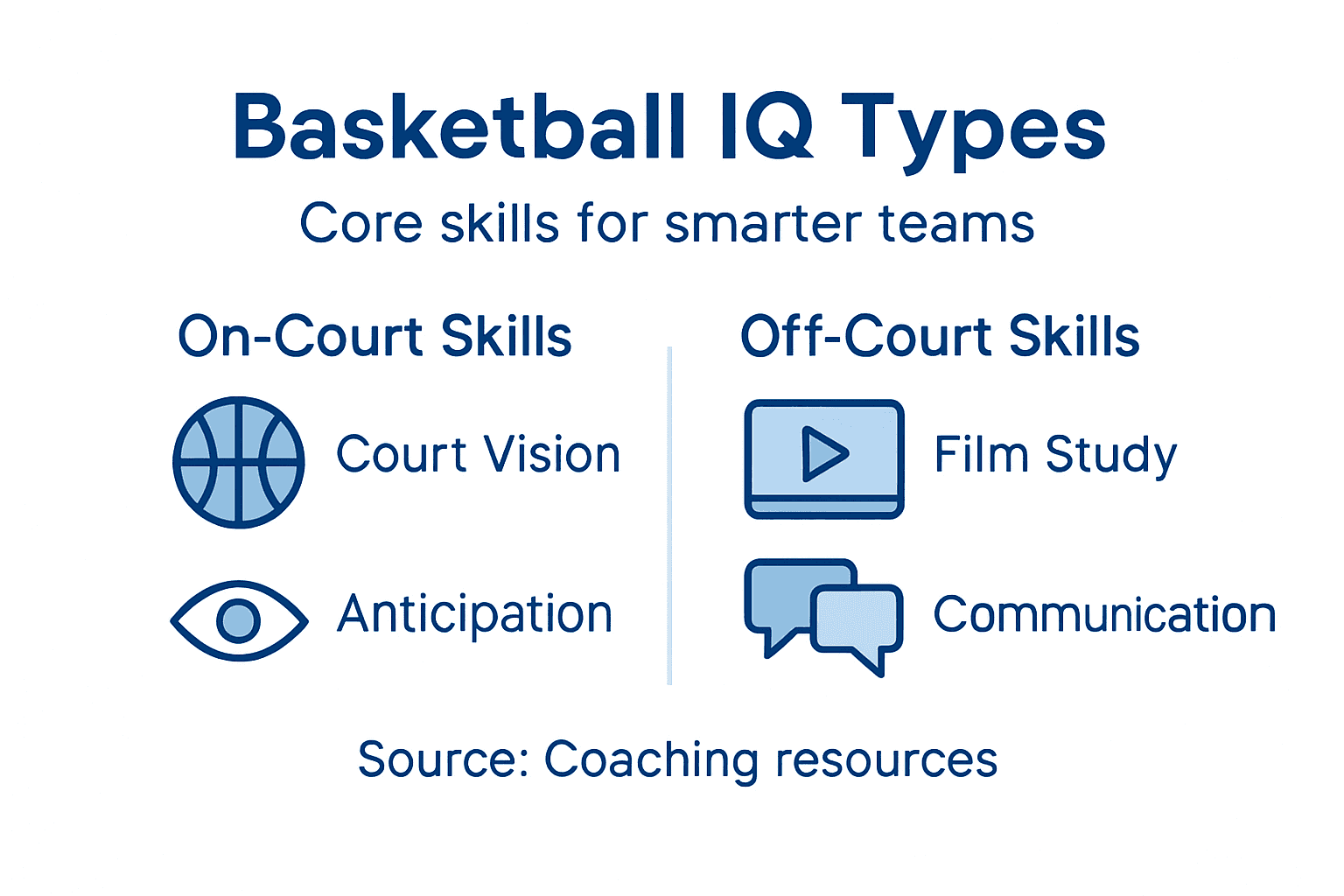
Pro tip: Design practice drills that deliberately challenge players’ decision-making skills by introducing unexpected variables and complex situational constraints.
Below is a summary of practical coaching strategies and their cognitive benefits for team basketball IQ:
| Strategy | Primary Benefit | Implementation Insight |
|---|---|---|
| Film study | Improves pattern recognition | Review successful and failed plays |
| Role rotation | Expands tactical awareness | Play different positions in practice |
| Decision drills | Accelerates processing speed | Use real-time scoring challenges |
| Visualization | Enhances anticipation | Practice mental walkthroughs |
Common Myths And Coaching Pitfalls
Basketball performance myths often mislead coaches into adopting counterproductive training strategies. Understanding these misconceptions is crucial for developing truly effective basketball intelligence in players.
Common myths that undermine team basketball IQ include:
- Believing physical height guarantees success
- Assuming only naturally athletic players can excel
- Thinking basketball IQ is an innate, unchangeable trait
- Overemphasizing individual skill over team dynamics
- Neglecting mental training in favor of physical drills
- Assuming all players learn and process information identically
- Believing complex strategies confuse young players
Coaches frequently fall into these critical pitfalls when developing team intelligence:
- Implementing one-size-fits-all training approaches
- Failing to personalize cognitive skill development
- Overlooking communication and strategic thinking
- Rushing skill acquisition without proper foundation
Effective coaching requires challenging these myths and creating adaptive, intelligent training environments that recognize each player’s unique cognitive potential.
Pro tip: Design individualized cognitive training plans that recognize players’ different learning styles and mental processing capabilities.
Elevate Your Team’s Basketball IQ with Proven Coaching Resources
Understanding and improving basketball IQ is crucial for building smarter teams that adapt quickly and make effective decisions on the court. If developing your players’ strategic awareness, decision-making speed, and team collaboration is your goal then leveraging structured practice plans and targeted drills can accelerate that growth. Hoop Mentality offers an extensive collection of Basketball Drills designed specifically to boost cognitive skills along with physical ability so your players learn how to read the game faster and respond with confidence.

Unlock your team’s potential by integrating mental skill development into every practice session. Explore our Basketball Workouts that combine physical conditioning with cognitive challenges. Start using our Basketball Templates to organize and communicate complex strategies clearly to your players. Visit Hoop Mentality today and transform your coaching approach with resources that save you time and sharpen your team’s basketball intelligence.
Frequently Asked Questions
What is basketball IQ?
Basketball IQ refers to a player’s cognitive ability to understand game dynamics, anticipate plays, and make intelligent decisions on the court. It emphasizes mental acuity and strategic thinking rather than just physical skills.
How can players improve their basketball IQ?
Players can improve their basketball IQ by watching game film critically, analyzing player movements and strategic decisions, and practicing mental visualization techniques to understand plays better.
What are the main types of basketball intelligence?
The main types of basketball intelligence include spatial intelligence, tactical intelligence, predictive intelligence, adaptive intelligence, and collaborative intelligence, each focusing on different cognitive aspects crucial for effective gameplay.
Why is team communication important for basketball IQ?
Team communication enhances basketball IQ by fostering collaborative intelligence, allowing players to read teammates’ intentions and make better collective decisions during games, ultimately improving overall team performance.