

Every coach has watched a promising possession unravel because players cluster too tightly or miss open teammates. In the fast pace of urban youth basketball, building a reliable motion offense means more than running set plays—it demands a clear plan and consistent teamwork. By focusing on specific, measurable goals and fundamental spacing, you can help your players move with purpose, spot opportunities, and turn scattered efforts into a dynamic, unified attack.
Table of Contents
- Step 1: Assess Team Needs And Set Clear Goals
- Step 2: Teach Motion Offense Fundamentals With Drills
- Step 3: Install Key Actions And Spacing Rules
- Step 4: Run Controlled Scrimmages To Reinforce Concepts
- Step 5: Evaluate Execution And Adjust Game Strategies
Quick Summary
| Key Point | Explanation |
|---|---|
| 1. Assess Team Needs First | Understand your team’s strengths and weaknesses to establish clear and achievable goals for improvement. |
| 2. Focus on Fundamental Drills | Use targeted drills to teach core motion offense principles, enhancing player skills and team cohesion. |
| 3. Implement Spacing and Movement | Establish rules for player positioning and coordinated movement to create offensive opportunities. |
| 4. Use Controlled Scrimmages | Simulate game scenarios to practice motion offense concepts and improve decision-making under pressure. |
| 5. Continuously Evaluate and Adapt | Monitor performance metrics and adjust strategies in real-time to optimize team effectiveness. |
Step 1: Assess Team Needs and Set Clear Goals
Successful motion offense implementation starts with understanding your team’s unique capabilities and establishing strategic objectives. Coaches must conduct a comprehensive evaluation of current team skills, player strengths, and performance gaps before designing an effective offensive strategy.
Begin by conducting a detailed assessment of individual player capabilities and team dynamics. Analyze past game footage, individual player statistics, and practice performance to identify specific areas for improvement. Look for key performance indicators that reveal your team’s offensive potential and limitations. This involves examining shooting percentages, ball movement efficiency, player positioning, and overall team chemistry.
Develop specific goals that are measurable and aligned with your team’s skill level. These objectives should challenge players while remaining achievable. Break down broader team goals into smaller milestones that players can track and understand. For instance, if your team struggles with spacing, set a goal to improve perimeter movement and passing accuracy by 15% over the next two months.
Pro Tip: Create visual goal tracking boards in your locker room to maintain player motivation and provide constant performance feedback.
Step 2: Teach Motion Offense Fundamentals with Drills
Teaching motion offense requires a structured approach that breaks down complex team strategies into digestible, practice-friendly components. Your goal is to develop players who understand not just the mechanics of movement, but the underlying principles of creating offensive opportunities.
Start by implementing core motion offense drills that focus on player communication, spacing, and continuous movement. These drills should emphasize fundamental skills like reading defensive alignments, making quick decisions, and maintaining proper court positioning. Practice exercises that teach players to cut without the ball, set effective screens, and create passing lanes will build the essential muscle memory required for a fluid motion offense.
Progress through increasingly complex drill sequences that challenge players to apply these fundamental skills in dynamic scenarios. Begin with basic two player pass and cut drills, then gradually introduce more players and more intricate movement patterns. Focus on teaching players to make instinctive decisions based on defensive reactions, ensuring they understand that motion offense is about creating and exploiting opportunities rather than following a rigid script.
Pro Tip: Record practice drills and review footage with players to help them visually understand their movement patterns and decision making processes.
Step 3: Install Key Actions and Spacing Rules
Successful motion offense depends on precise player positioning and coordinated movement that creates strategic offensive opportunities. Your primary objective is to develop a system where players intuitively understand their roles and maintain optimal court spacing.
Implement fundamental spacing principles that spread players around the 3-point line and create dynamic passing lanes. This approach prevents defensive congestion and allows players to read and react to defensive alignments quickly. Establish clear rules about player movement such as cutting after passing, maintaining proper distances between teammates, and creating triangular passing options that keep defenders constantly adjusting.
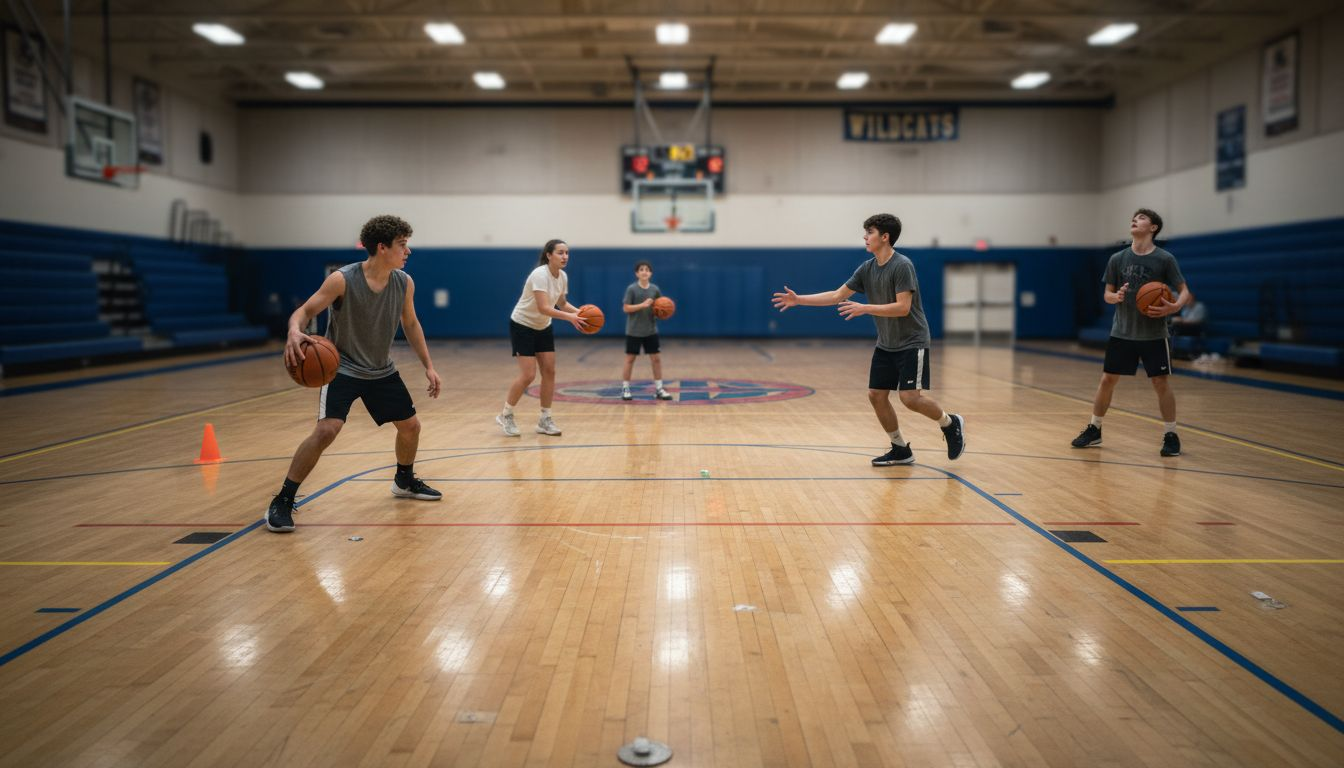
Progress by teaching players to recognize and exploit defensive gaps through deliberate movement patterns. Train athletes to understand that spacing is not just about physical positioning but about creating constant offensive pressure. Emphasize that each player should be prepared to move without the ball, set screens, and create opportunities for teammates by maintaining aggressive yet strategic court positioning.
Pro Tip: Use colored tape or markers on the court during practice to help players visually understand and internalize proper spacing zones.
Step 4: Run Controlled Scrimmages to Reinforce Concepts
Controlled scrimmages are the critical bridge between understanding motion offense concepts and executing them effectively during actual gameplay. Your objective is to create structured practice scenarios that allow players to apply learned skills in realistic game situations while providing immediate coaching feedback.
Design controlled scrimmage environments that simulate specific motion offense scenarios. Start with even sided game situations that emphasize the offensive principles you have been teaching. Pause play frequently to address tactical problems, demonstrate correct movement patterns, and facilitate player understanding. Encourage players to verbalize their decision making process during these interruptions to reinforce their comprehension of motion offense strategies.
Progress through increasingly complex scrimmage scenarios that gradually reduce coaching interventions. Begin with structured scenarios where players must execute specific actions like ball reversal or off ball movement, then transition to more open ended play that tests their ability to read defensive alignments and make independent decisions. Your goal is to transform theoretical knowledge into instinctive team behavior that emerges naturally during competitive situations.
Pro Tip: Record scrimmage footage to review with players, allowing them to visually analyze their movement and decision making patterns.
Step 5: Evaluate Execution and Adjust Game Strategies
Successful motion offense requires continuous assessment and strategic adaptation throughout gameplay. Your primary goal is to develop a dynamic coaching approach that responds quickly to emerging team performance patterns and defensive challenges.
Utilize strategic performance analysis to track offensive execution in real time. Monitor key metrics such as shot selection efficiency, ball movement speed, player positioning, and scoring percentages. Pay close attention to how well players implement motion offense principles under different defensive pressures. Look for consistent patterns that indicate where your team excels or struggles in executing the offensive strategy.
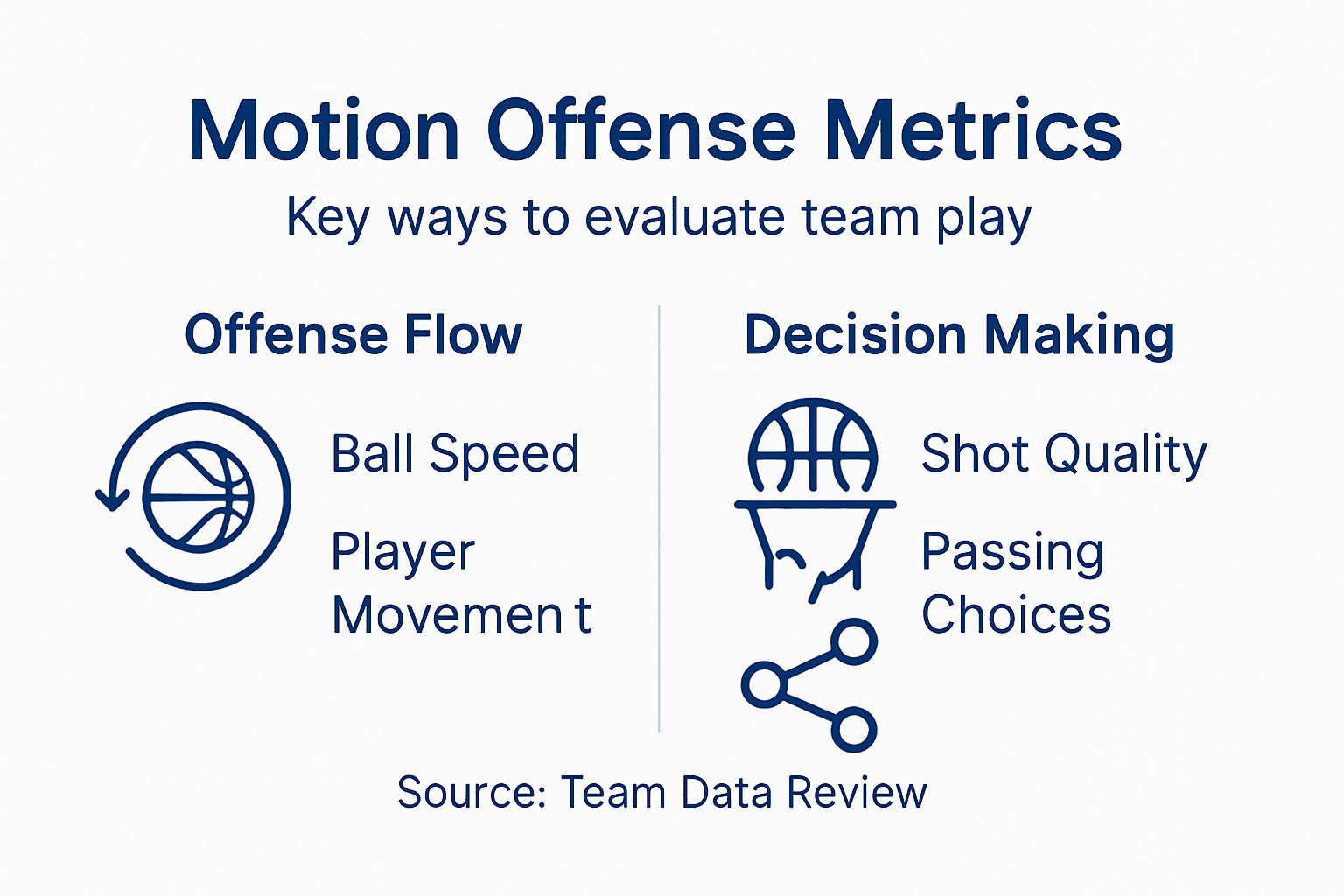
Develop a responsive coaching methodology that allows for immediate strategic adjustments. This means creating communication systems that enable players to quickly understand and implement tactical changes during gameplay. Focus on teaching players to read defensive alignments and make independent decisions that align with your motion offense philosophy. Be prepared to modify your approach based on opponent strategies, player energy levels, and individual performance dynamics.
Pro Tip: Create a quick reference chart with preset strategic adjustments that players can quickly recognize and implement during high pressure game situations.
Below is a quick reference table for typical motion offense metrics coaches can track:
| Metric | Why It Matters | How to Track |
|---|---|---|
| Ball Movement Speed | Faster passes disrupt defense | Stopwatch or video analysis |
| Shooting Percentage | Measures scoring efficiency | Shot charts and stats logs |
| Passing Accuracy | Reduces turnovers | Video review and stats |
| Spacing Consistency | Maintains offensive flow | Court maps or digital analysis |
Here’s a summary comparing key focuses for each motion offense implementation step:
| Step | Primary Focus | Core Outcome |
|---|---|---|
| Assess Needs & Set Goals | Identify strengths and set goals | Clear direction for development |
| Teach Fundamentals | Build skills with targeted drills | Strong fundamentals and teamwork |
| Install Actions & Spacing | Define movement and spacing rules | Better player positioning |
| Controlled Scrimmages | Practice concepts in game scenarios | Decision making under pressure |
| Evaluate & Adjust | Monitor performance, adapt strategy | Continuous improvement |
Elevate Your Team’s Motion Offense with Proven Coaching Resources
Implementing a dynamic motion offense requires clear goals, precise spacing, and consistent practice drills tailored to your team’s strengths. If you find it challenging to break down complex movement patterns or keep your players engaged with strategic drills, you are not alone. Many coaches struggle with turning theory into instinctive gameplay. Our collection of professional Basketball Drills and detailed Basketball Playbooks offers practical frameworks that simplify teaching and executing motion offense fundamentals.
Ready to transform your coaching approach and build a confident, cohesive offense that responds in real time? Visit Hoop Mentality today to explore tools designed to save time, enhance communication, and help your team thrive under pressure. Get started now and put your motion offense into action with clarity and confidence.
Frequently Asked Questions
How can I assess my team’s needs for implementing motion offense?
Start by evaluating individual player skills and team dynamics through game footage analysis and player statistics. Identify performance gaps and set measurable goals to address these areas, allowing you to tailor the motion offense to your team’s strengths over the next few weeks.
What are effective drills to teach the fundamentals of motion offense?
Implement core motion offense drills that focus on communication, spacing, and movement. Begin with basic drills like pass and cut, and progress to more complex scenarios to help players develop instincts for decision-making in real time.
How do I establish spacing rules for my motion offense?
Define clear guidelines regarding player positioning and movement to ensure proper spacing on the court. Teach players to maintain correct distances during play and to recognize opportunities for cuts and screens, enhancing offensive effectiveness in games.
What should I include in my controlled scrimmages to reinforce motion offense concepts?
Design scrimmages that simulate specific motion offense scenarios and emphasize principles you’ve taught. Start with structured plays to encourage correct execution, then gradually introduce less structured play to develop players’ decision-making skills.
How can I evaluate the execution of our motion offense during games?
Continuously monitor performance metrics such as shot selection and ball movement during games. Develop a responsive adjustment strategy that allows you to adapt your offense based on player performance and defensive challenges throughout the course of the game.
What metrics should I track to measure the success of my motion offense?
Focus on key metrics like ball movement speed, shooting percentages, and spacing consistency to assess offensive efficiency. Regularly analyze these statistics to identify areas for improvement and set actionable targets, such as increasing shot accuracy by 15% within the next month.