

TL;DR:
- Inverting the offense involves repositioning players into non-traditional roles to create defensive mismatches and strategic advantages. It enhances passing options and disrupts standard defensive coverages, but requires proper player roles, communication, and transition drills for effectiveness. Implementing inversion systematically improves both offensive unpredictability and defensive resilience, especially as rosters evolve towards more versatile lineups.
Inverting the offense is defined as repositioning players into non-traditional roles to force defensive mismatches, disrupt coverage rotations, and create numerical superiority in high-value scoring zones. The concept applies directly to basketball through tactics like the inverted ball screen, where a guard sets a screen for a big man instead of the conventional reverse. Charlotte Hornets and Orlando Magic coaching staffs have publicly noted that guard screening for big players generates defensive hesitation that opens downhill penetration lanes. Understanding why invert the offense works requires seeing it as a system of forced situational superiority, not just a single play call.
Why invert the offense: the core tactical case
Inverting the offense works because it converts an opponent’s defensive habits into liabilities. Most defenses are trained to recognize standard screening actions, conventional pick-and-roll assignments, and predictable player locations. When you flip those roles, defenders face a choice they have not rehearsed. The inverted ball screen is the clearest example in basketball: a guard setting a screen for a big creates a moment where the defense must decide instantly whether to switch, hedge, or stay home, and each option carries a different risk.
This principle connects directly to a broader strategic idea. Offensive inversion converts an opponent’s physical or tactical strengths into liabilities by exploiting the fixed commitment their strength demands. A defense built around protecting the paint against traditional big-man post-ups becomes vulnerable the moment that big man operates as a ball handler at the top of the key. The defense’s strength becomes its blind spot.
The motion offense framework provides a natural home for inversion principles, since it already demands positional interchangeability. Coaches who already run motion concepts will find offensive inversion a logical extension rather than a complete system overhaul.
How does inverting the offense create defensive confusion and mismatches?
Defensive confusion in inverted sets comes from one source: communication failure under pressure. When a guard sets a screen for a big, the two defenders guarding those players must instantly agree on coverage. That agreement requires clear verbal communication, shared recognition of the action, and trust in the assignment. All three break down at once when the action is unfamiliar.
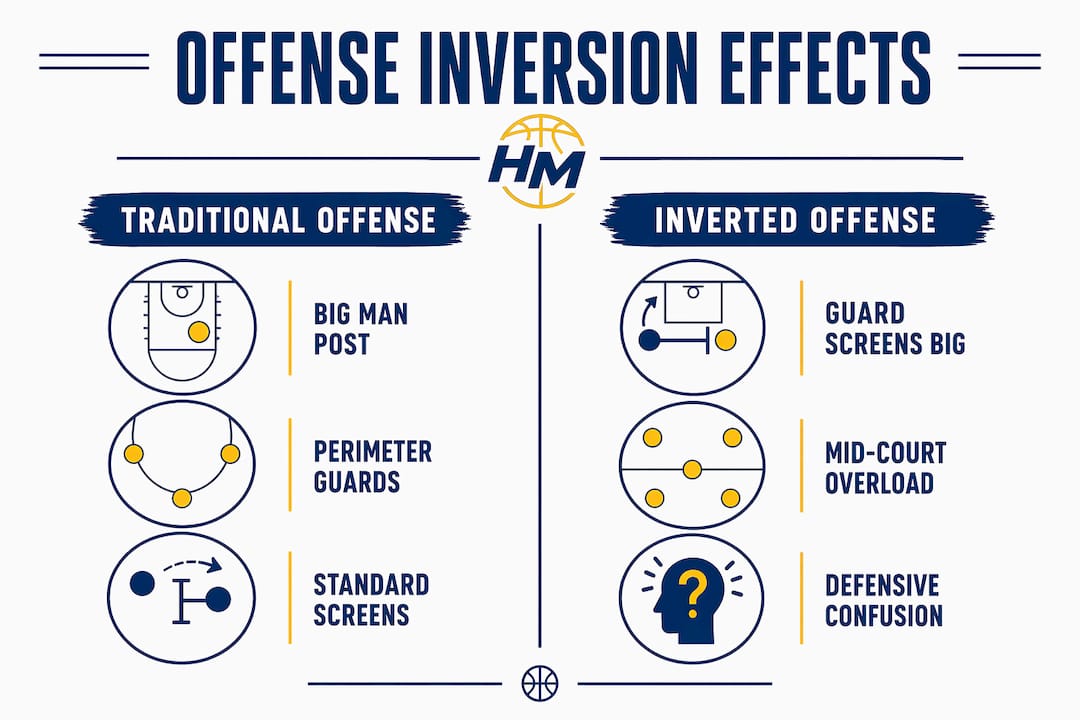
NBA coaches from the Charlotte Hornets and Orlando Magic have confirmed that defensive hesitation from inverted screens consistently leads to high-quality scoring chances. The hesitation is not random. It is a predictable byproduct of defenders processing an unconventional action in real time. That processing delay, even half a second, is enough for a skilled ball handler to attack the gap.
The specific mismatches that inversion creates include:
- A slower big man switched onto a guard in space, creating an isolation advantage
- A guard switched onto a big man in the post, creating a size and strength mismatch
- Help defenders rotating late because they anticipated a conventional action
- Secondary defenders caught between two threats when the primary coverage breaks down
Pro Tip: When installing inverted ball screen sets, film your opponents’ defensive communication in transition. Teams that switch everything are most vulnerable to inversion because the switch creates a predictable mismatch. Teams that hedge or drop are vulnerable to the big man’s pop or roll after the screen.
The types of basketball screens your players already know provide the foundation. Inversion does not require learning a new physical skill. It requires applying familiar screen mechanics in unfamiliar role combinations.
What are the key structural and numerical advantages of offensive inversion?
The structural case for offensive inversion centers on passing geometry. When perimeter players move centrally and big men operate at the perimeter, the passing triangles available to the ball handler multiply. Offensive inversion increases effective passing triangle formations by 30 to 50 percent compared to traditional wide structures. More triangles mean more angles of attack, more options on each possession, and more pressure distributed across the defense.
The structural shift also creates what tactical analysts call a midfield overload in soccer, and the basketball equivalent is a paint-area or elbow overload. When multiple skilled ball handlers operate in the same zone, the defense cannot assign one-to-one coverage without leaving another threat open. Inverting formations forces opposition defenders to choose between vacating space or collapsing their press, and both choices benefit the offense.
The table below shows the direct structural contrast between traditional and inverted offensive setups in basketball:
| Dimension | Traditional offense | Inverted offense |
|---|---|---|
| Big man location | Post, paint area | Perimeter, top of key |
| Guard location | Perimeter, ball screen user | Interior, screen setter |
| Defensive assignment clarity | High, roles are predictable | Low, roles are unfamiliar |
| Passing triangle density | Moderate | 30 to 50% higher |
| Mismatch creation frequency | Situational | Systematic |
| Defensive communication demand | Standard | Elevated significantly |
The numbers confirm what experienced coaches already sense: inversion does not just create one good play. It changes the structural math of the entire possession. Defenses that prepare for traditional role assignments face a different problem on every action.
What practical considerations and challenges come with inverting the offense?
Inversion is not a plug-and-play tactic. The most common mistake coaches make is installing inverted sets without preparing the team for what happens when possession is lost. Teams must pair offensive inversion with strong counter-pressing and defensive transition drills to avoid vulnerabilities on wide channels. When your big man is at the perimeter and your guard is in the paint, a turnover leaves your defense in non-standard positions.
The specific challenges coaches must address before running inversion consistently include:
- Positional fluidity: Players must be comfortable operating outside their traditional roles. A center who cannot handle ball pressure at the elbow becomes a liability, not an asset.
- Defensive transition responsibility: When the ball turns over, who covers the vacated wide areas? This assignment must be drilled explicitly, not assumed.
- Role adaptability: Inverted offenses demand dynamic role changing instead of static assignments. Players who default to their traditional spots undermine the entire system.
- Screening technique for guards: Guards setting screens for bigs need to understand angle, timing, and positioning. These are skills typically developed in big men, not perimeter players.
Pro Tip: Run 3-on-3 shell drills where guards practice setting screens for bigs and then immediately transition to defensive recovery positions. This builds the muscle memory for both the offensive action and the defensive responsibility that follows a turnover.
Player selection matters as much as scheme design. The most effective inverted offenses feature guards with above-average court vision and bigs with reliable perimeter ball handling. If your roster lacks one of those two qualities, inversion will create more problems than it solves. Assess your personnel honestly before committing to the system.
How to implement offensive inversion effectively in coaching practice
Implementation follows a clear progression. Coaches who try to install the full inverted system in one week typically see confusion and resistance. A phased approach produces better results and builds player confidence at each stage.
- Introduce the concept with film. Show players clips of inverted ball screen actions from NBA games, specifically Charlotte Hornets and Orlando Magic sets. Players understand new concepts faster when they see them executed at a high level before practicing them.
- Drill the inverted ball screen in isolation. Run 2-on-2 repetitions with a guard as the screener and a big as the ball handler. Focus on screen angle and the big’s decision after using the screen: attack, pull up, or kick out.
- Add a third player for decision-making. Introduce a wing as a secondary option. Now the big has two reads after using the screen, which mirrors game conditions more accurately.
- Practice defensive transition from inverted positions. After each offensive repetition, simulate a turnover and require players to sprint to their defensive assignments from non-traditional floor positions.
- Integrate into your existing system gradually. Add one or two inverted sets to your existing zone offense or motion framework rather than replacing your entire offense. This reduces cognitive load on players.
- Use video review weekly. Record practice repetitions and review them with players. Identifying communication breakdowns on film is faster and more effective than verbal correction during drills.
Player selection for inverted roles should prioritize basketball IQ over athleticism. The guard setting the screen needs to read the defense and communicate the action clearly. The big handling the ball needs composure under pressure. Both qualities are coachable, but they take time to develop.
How does offense inversion influence defensive strategies and team balance?
Inversion does not only benefit the offense. Successful coaches view inversion not only as an attacking tool but as a defensive foundation that provides improved compactness and counter-attack mitigation. When your big man is positioned at the perimeter, he is already closer to the defensive end when possession changes. That positioning shortens the recovery distance on transition defense.
The defensive benefits of running an inverted offense include:
- Better central defensive compactness because perimeter-positioned bigs can collapse toward the paint faster than traditional post players
- Reduced counter-attack exposure because the offense’s shape keeps more players between the ball and the opponent’s basket
- Faster defensive recovery in asymmetric inverted systems because players are already distributed across the floor rather than clustered in the paint
- Improved defensive rotations because players practicing positional fluidity on offense naturally develop better rotation habits on defense
Traditional wide offensive structures, where bigs stay near the basket and guards operate at the perimeter, leave the defense exposed to quick outlet passes and fast breaks. Inversion compresses the floor and reduces those gaps. The team that inverts the offense is harder to fast-break against because the floor spacing works against the transition attack, not in favor of it.
Key takeaways
Inverting the offense creates systematic mismatches and defensive communication failures that traditional offensive sets cannot generate, making it one of the most tactically disruptive tools available to basketball coaches.
| Point | Details |
|---|---|
| Core mechanism | Guard-to-big inverted screens force defensive hesitation and create predictable mismatches. |
| Structural advantage | Inversion increases passing triangle density by 30 to 50% compared to traditional wide sets. |
| Implementation requirement | Positional fluidity and counter-pressing drills are non-negotiable before running inversion in games. |
| Defensive benefit | Inverted setups improve central compactness and reduce transition defense exposure. |
| Coaching priority | Player selection based on basketball IQ, not athleticism, determines whether inversion succeeds. |
The real reason most coaches avoid inversion
I have watched coaches dismiss offensive inversion as a gimmick, and almost every time the real reason is the same: they do not want to have the uncomfortable conversation with their starting center about operating at the elbow. The tactical logic is sound. The personnel conversation is hard.
What I have found after working through inversion concepts with multiple teams is that the players who resist it most at the start become its biggest advocates once they experience a mismatch they created by setting a screen. The big man who pops to the three-point line after a guard screen and catches a clean look understands immediately why the system works. That moment of clarity is worth more than any film session.
The coaches who implement inversion most successfully treat it as a mindset shift, not a play call. They teach players that forced situational superiority is the goal of every possession, and inversion is one reliable method for creating it. The coaches who struggle treat it as a trick play they pull out occasionally. Occasional use produces occasional results.
The future of offensive inversion in basketball points toward more position-less lineups where the distinction between guard and big becomes increasingly irrelevant. Coaches who build fluency in inverted concepts now will have a structural advantage as rosters continue to evolve toward versatility. Start with one set. Master it. Then build from there.
— Dejan
Build your inversion system with Hoopmentality resources
Implementing offensive inversion requires structured practice time and clear session planning. Hoopmentality’s basketball practice plan template gives you a ready-to-use framework for organizing inverted ball screen drills, role-switching repetitions, and defensive transition work into a single coherent session.

The game preparation guide with weekly practice plan takes it further, providing a full tactical preparation structure that incorporates advanced offensive concepts including inversion sets. Both resources are built from real coaching experience and designed to save you time on planning so you can focus on execution.
FAQ
What does it mean to invert the offense in basketball?
Inverting the offense means placing players in non-traditional roles, specifically having guards set screens for big men and having bigs operate as ball handlers at the perimeter. This repositioning creates defensive mismatches and disrupts standard coverage assignments.
Why do inverted ball screens confuse defenses?
Inverted ball screens cause hesitation because defenders must communicate and execute a coverage decision for an action they rarely practice defending. That communication delay opens scoring lanes before the defense can recover.
What skills do players need for offensive inversion?
Guards need the ability to set effective screens and read defensive reactions. Big men need perimeter ball handling and composure under pressure. Positional fluidity and dynamic role adaptability are the two non-negotiable requirements for the entire system.
Does inverting the offense create defensive vulnerabilities?
Yes. Wide channels and transition defense become exposed when players are out of traditional positions after a turnover. Coaches must drill counter-pressing and defensive recovery explicitly to compensate for those vulnerabilities.
How long does it take to install an inverted offense?
A single inverted ball screen set can be installed in two to three practice sessions. A full system built around inversion principles typically requires four to six weeks of progressive drilling before it is game-ready at a consistent level.