

You watch your team play solid defense for 20 seconds, then a single missed rotation leaves a shooter wide open for three. This breakdown happens to coaches at every level, turning close games into losses. Effective defensive rotations require more than effort, they demand preparation, communication, and systematic execution. This guide delivers structured strategies to help you teach, implement, and refine rotations that protect the basket and shut down scoring opportunities.
Table of Contents
- Key takeaways
- Preparing your team for effective defensive rotations
- Step by step execution of defensive rotations
- Adapting rotations using advanced strategies and technology
- Troubleshooting and measuring success of your defensive rotations
- Enhance your defensive coaching with specialized drills and plans
- Frequently asked questions
Key Takeaways
| Point | Details |
|---|---|
| Defensive rotations | Effective rotations require preparation, communication, and systematic execution to protect the basket and deny easy scoring opportunities. |
| Communication discipline | Players must call out screens, warn about drives, and loudly announce rotations to preserve organization under pressure. |
| One pass away rule | If you are one pass away after rotating, your closeout must be aggressive and under control. |
| Film and conditioning | Film review helps players see correct timing and positioning while conditioning maintains high intensity through multiple rotation sequences. |
Preparing your team for effective defensive rotations
Before running rotation drills, you need to establish what rotations actually accomplish. Defensive rotations involve strategic movements to provide help defense when an offensive player beats their defender. This coordinated shift prevents easy baskets while maintaining coverage on other threats.
Player roles form the backbone of successful rotations. Your primary defender initiates the sequence by fighting through screens or recovering from drives. Help defenders must read this action and rotate to protect the basket. Weak side players then shift to cover the helpers’ assignments, creating a chain reaction across the floor.
Communication separates effective rotations from chaotic scrambles. Players must call out screens, warn teammates about drives, and announce their rotations loudly. Without constant verbal cues, even well-drilled rotations fall apart under game pressure.
Your players need specific physical and tactical skills before executing complex rotations:
- Quick lateral movement to close out on shooters after rotating
- Court awareness to track both ball and assignment simultaneously
- Anticipation skills to read offensive actions before they develop
- Stamina to maintain defensive intensity through multiple rotation sequences
Pro Tip: Start rotation teaching with three player drills before adding full five on five complexity. This builds confidence and allows players to master the basic movements without overwhelming them.
| Skill Category | Required Ability | Communication Element |
|---|---|---|
| Physical | Explosive closeouts | Call out rotation assignments |
| Mental | Read offensive patterns | Warn about screens early |
| Tactical | Understand help positioning | Communicate ball location |
| Conditioning | Sustain effort through possessions | Maintain vocal energy |
Understanding basketball coach responsibilities includes building these foundational elements through progressive practice design. You cannot skip preparation and expect game situations to teach rotations effectively.
Step by step execution of defensive rotations
Teaching proper defensive stance prevents the most common rotation failure. Players standing upright cannot react quickly enough to close out effectively. Demand a low, balanced stance with knees bent and hands active, ready to contest shots after rotating.
Follow this sequence when drilling rotation execution:
- Identify the trigger: offensive player drives baseline or attacks middle
- Help defender steps into the paint to stop penetration
- Weak side defender rotates to cover the helper’s assignment
- Original defender recovers to their man or next closest threat
- All players communicate their movements throughout the sequence
Film review transforms abstract concepts into concrete learning. Show your team examples of successful rotations and breakdowns, pausing to highlight communication, positioning, and timing. Players see exactly what proper execution looks like and recognize their own mistakes more clearly.
Balancing help defense with perimeter coverage creates the toughest coaching challenge. Over-helping leaves shooters open for easy threes, while under-helping allows layups. Teach players to provide just enough help to force a difficult shot, then recover immediately to their assignment.
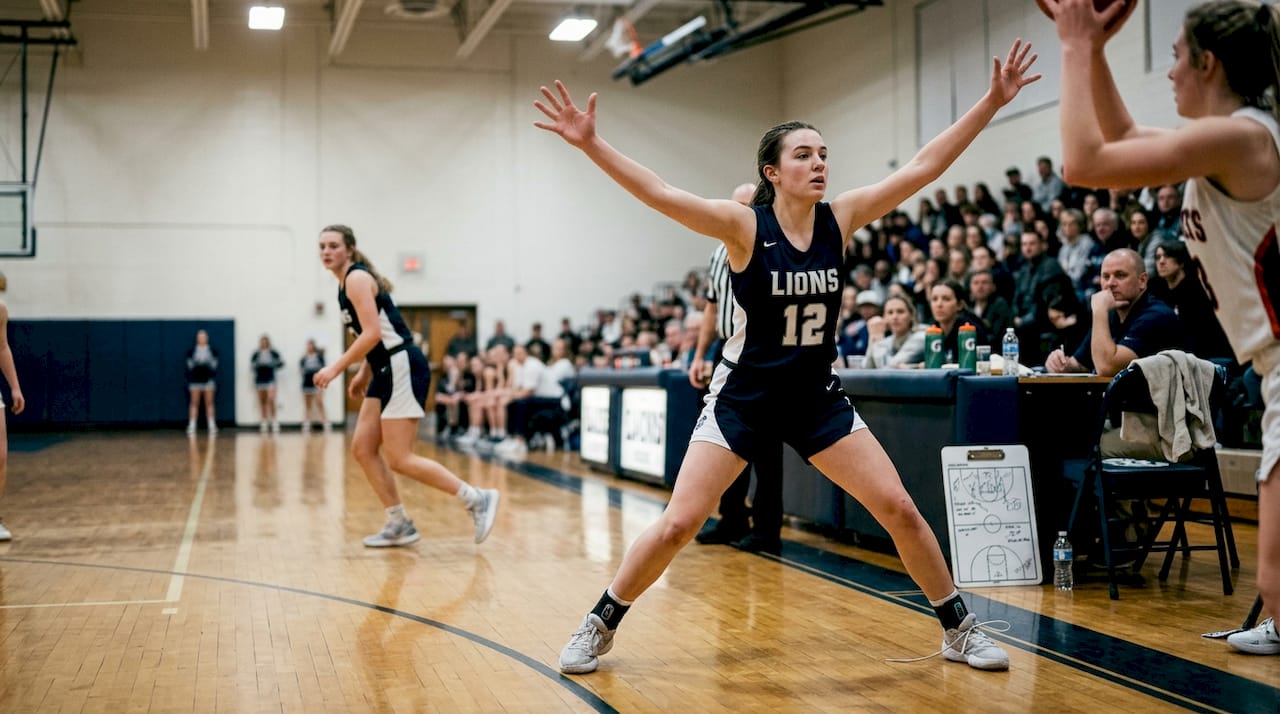
Pro Tip: Use the “one pass away” rule during rotations. If you are one pass from the ball after rotating, your closeout must be aggressive and under control. Two passes away allows a more measured recovery.
| Common Mistake | Consequence | Correction |
|---|---|---|
| Upright defensive stance | Slow rotations and weak closeouts | Drill low stance positioning daily |
| Poor communication | Confusion about assignments | Require constant verbal calls |
| Delayed help defense | Easy penetration baskets | Teach anticipation through film |
| Over-helping on drives | Open three point shots | Practice measured help positioning |
Implementing defensive adjustment tips during games requires recognizing these patterns quickly and making in-game corrections. Your ability to diagnose rotation breakdowns determines how fast your team improves.
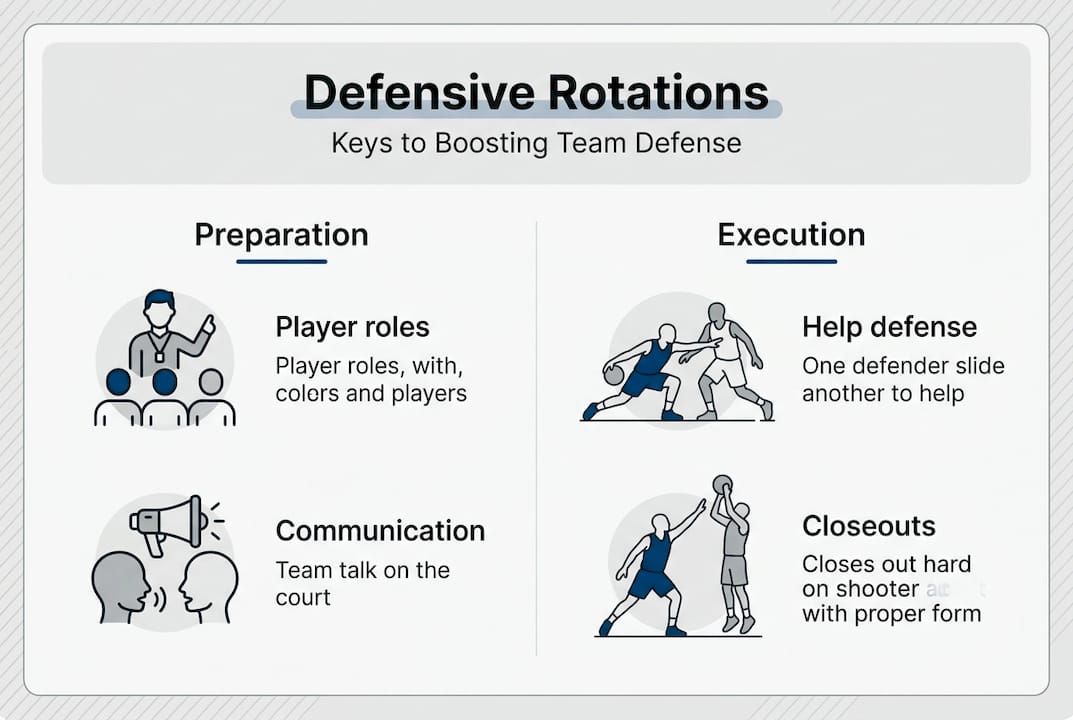
Conditioning directly impacts rotation quality in the fourth quarter. Tired players stand upright, communicate less, and take shortcuts that destroy defensive integrity. Build stamina through full court defensive drills that simulate game fatigue, then practice rotations when players are exhausted.
Teaching good defense fundamentals creates the foundation for advanced rotation schemes. Players who understand individual defense principles grasp team rotations faster and execute them more reliably under pressure.
Adapting rotations using advanced strategies and technology
Hybrid defenses blend man to man and zone principles, creating unique rotation challenges and opportunities. These systems allow you to adjust defensive coverage based on opponent strengths while maintaining rotation discipline. A hybrid approach might play man to man on the perimeter but zone principles in the paint, requiring modified rotation patterns.
Switching strategies fundamentally change rotation requirements. When your team switches all screens, rotations focus on recovering to size mismatches rather than traditional help positioning. This demands different communication patterns and awareness of who guards whom after each switch.
Machine learning models classify defensive strategies like switches and rotations with 91.4% accuracy using player tracking data. This technology helps coaches analyze rotation efficiency objectively, identifying which players struggle with specific rotation scenarios and which schemes work best against different offensive styles.
Technology assisted coaching provides several advantages:
- Objective measurement of rotation speed and accuracy
- Identification of players who consistently break rotation rules
- Comparison of rotation effectiveness against different offensive sets
- Data driven adjustment of defensive schemes based on opponent tendencies
Hybrid strategies resolve defensive trade-offs by adapting to opponent strengths. If you face a team with dominant post players but weak shooters, hybrid rotations can pack the paint while still maintaining some perimeter accountability. This flexibility makes rotations more complex but dramatically more effective.
Adaptive rotation strategies include:
- Loading help defense toward the opponent’s best scorer
- Adjusting rotation depth based on three point shooting ability
- Switching rotation responsibilities when mismatches develop
- Modifying help positioning for different offensive actions
Implementing essential basketball defense tips within these advanced frameworks requires systematic practice design. You cannot introduce hybrid concepts without first mastering basic rotation principles, but once your team demonstrates consistency, these advanced approaches unlock new defensive possibilities.
Data analysis reveals patterns invisible during live action. Tracking which rotations lead to opponent turnovers versus open shots guides your practice priorities and game planning. This evidence based approach removes guesswork from defensive preparation.
Troubleshooting and measuring success of your defensive rotations
Identifying rotation breakdowns starts with recognizing common trouble spots. Communication lapses occur most frequently during transition defense when players are tired and disorganized. Delayed help happens when defenders focus too much on their own assignment and ignore teammates getting beaten. Poor stance undermines even well-timed rotations because players cannot close out effectively from an upright position.
Corrective actions address each problem systematically:
- Communication lapses: Run competitive drills where silent rotations result in penalties
- Delayed help: Practice reading offensive actions earlier through film study
- Poor stance: Incorporate stance checks into every defensive drill
- Weak closeouts: Drill explosive movements from help position to shooter
Regular film review sessions create accountability and accelerate improvement. Schedule 15 minute video sessions twice weekly, focusing on three to four rotation sequences. Let players identify mistakes themselves before offering coaching points. This self-discovery builds deeper understanding than simply telling players what they did wrong.
Common rotation mistakes respond well to conditioning work and simplified teaching. When players struggle with complex rotation schemes, strip the system down to its essential elements and rebuild gradually. Complexity without mastery creates confusion, not better defense.
Performance measures validate your coaching approach:
- Opponent field goal percentage in the paint
- Three point attempts allowed per game
- Defensive rating during specific rotation scenarios
- Turnover rate when rotations force rushed passes
Continuous coaching through film review, targeted drills, and honest performance assessment transforms average defensive teams into elite units. Your commitment to systematic improvement determines whether rotations become a strength or remain a weakness.
Using defensive drills strategically can boost overall defensive performance significantly. The key lies in selecting drills that directly address your team’s specific rotation weaknesses rather than running generic defensive work.
Measuring improvement requires tracking metrics over time, not just evaluating single games. Compare your team’s rotation effectiveness across a month of competition to identify genuine progress versus random variation. This longitudinal approach reveals whether your coaching adjustments actually work.
Enhance your defensive coaching with specialized drills and plans
Mastering defensive rotations requires more than understanding concepts, you need practical drills that build these skills systematically. The big man dual action drill develops interior defensive movements that form the foundation of effective rotations, teaching post players how to protect the paint while maintaining awareness of perimeter threats.
Comprehensive preparation extends beyond individual drills to full practice organization. The game preparation guide with weekly practice plan helps you structure practices that build defensive rotations progressively throughout the week, ensuring your team enters games with clear understanding and confidence.
Explore the complete collection of coaching resources at Hoop Mentality, where you will find playbooks, scouting templates, and strategy guides designed by coaches for coaches. These tools complement the rotation strategies covered in this guide, giving you everything needed to develop elite team defense.
Frequently asked questions
What are defensive rotations in basketball?
Defensive rotations are coordinated player movements designed to provide help defense when an offensive player beats their assignment. The rotation creates a chain reaction where multiple defenders shift positions to protect the basket while maintaining coverage on other threats. Successful rotations require excellent communication, proper positioning, and understanding of team defensive principles.
How can coaches teach defensive rotations to youth players?
Start with simplified three player rotations before introducing full team concepts, allowing young players to master basic movements without confusion. Use positive reinforcement and clear demonstrations to build confidence. Film review helps youth players visualize proper execution and recognize their own improvement over time, making abstract concepts concrete and achievable.
What are common mistakes in defensive rotations and how to fix them?
Poor communication leads to confusion about assignments, fixed through drills that require constant verbal calls and penalize silence. Over-helping leaves shooters unguarded, corrected by teaching measured help defense that contests drives without abandoning perimeter coverage. Implementing defensive adjustment strategies during practice builds habits that transfer to game situations, reducing mistakes under pressure.
How does technology improve coaching of defensive rotations?
Advanced tracking systems classify defensive strategies with 91.4% accuracy, providing objective data about rotation effectiveness that reveals patterns invisible during live action. Coaches use this information to identify which players struggle with specific scenarios and tailor practice plans accordingly. Data driven analysis removes guesswork from defensive preparation, allowing evidence based decisions about scheme adjustments and personnel deployment.