

Watching your players scramble when an opponent drives past their man can feel frustrating for any youth basketball coach. Defensive breakdowns not only lead to easy baskets but also expose gaps in team trust and communication. Mastering defensive rotations transforms scattered efforts into a unified defense, giving every player confidence to help and recover together. This guide lays out clear strategies that can strengthen your team’s response to offensive pressure while sharpening both skills and teamwork.
Table of Contents
- Defining Defensive Rotations In Basketball
- Core Principles And Movement Patterns
- Types Of Rotations For Different Defenses
- Teaching Rotations To Young Players
- Common Mistakes And How To Correct Them
Key Takeaways
| Point | Details |
|---|---|
| Defensive Rotations Are Essential | They involve strategic player movements to counter offensive threats and prevent easy scoring. |
| Core Elements of Success | Effective rotations rely on positioning, communication, and anticipation among players. |
| Different Defensive Approaches | Rotations vary by defensive system (e.g., Man-to-Man, Zone) and demand tailored strategies for success. |
| Teaching Young Players | Focus on breaking down concepts with engaging, progressive drills to build confidence and muscle memory. |
Defining Defensive Rotations in Basketball
Defensive rotations represent a critical team defense strategy in basketball where players dynamically shift positions to counter offensive threats. These chain-reaction movements occur when an initial defensive assignment breaks down, requiring teammates to quickly adjust and provide help defense.
At its core, defensive rotations involve strategic positioning that enables players to protect the basket while maintaining coverage on potential scorers. The primary objectives include:
- Preventing easy scoring opportunities
- Maintaining defensive pressure
- Disrupting offensive player movement
- Closing passing and driving lanes
- Recovering quickly after initial defensive penetration
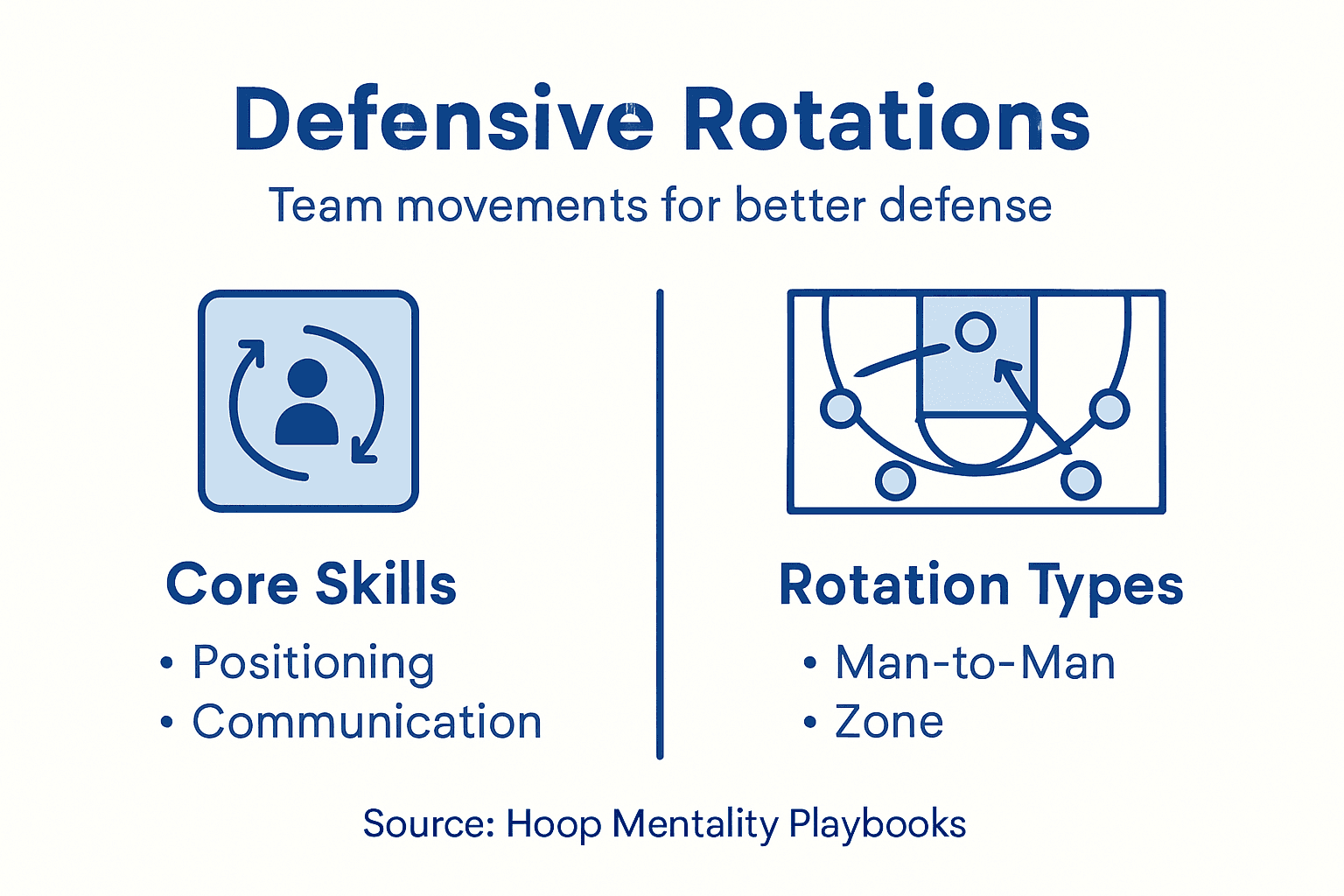
Successful defensive rotations depend on three fundamental elements: positioning, communication, and anticipation. Players must read the court quickly, understand their teammates’ movements, and make split-second decisions to effectively cover vulnerable areas.
Defensive rotations are not random movements but calculated responses designed to neutralize offensive strategies. When executed properly, they transform individual defensive efforts into a cohesive team defensive mechanism that can dramatically reduce opponent scoring opportunities.
Pro tip: Practice defensive rotation drills that simulate game-speed scenarios to help players develop muscle memory and rapid decision-making skills.
Core Principles and Movement Patterns
Defensive rotations are a complex system of strategic player movements that require precise coordination and understanding of fundamental basketball defensive principles. Help-side defensive positioning forms the cornerstone of effective team defense, enabling players to provide instant support when teammates are beaten off the dribble.
The core principles of defensive rotations revolve around three critical elements:
- Maintaining constant court awareness
- Understanding each player’s defensive responsibilities
- Developing rapid decision-making skills
In practice, defensive rotations follow a systematic approach where defenders continuously communicate and anticipate potential offensive threats. When one defender steps up to stop a drive, another teammate immediately shifts to cover the original defender’s assigned player - a principle known as help the helper.
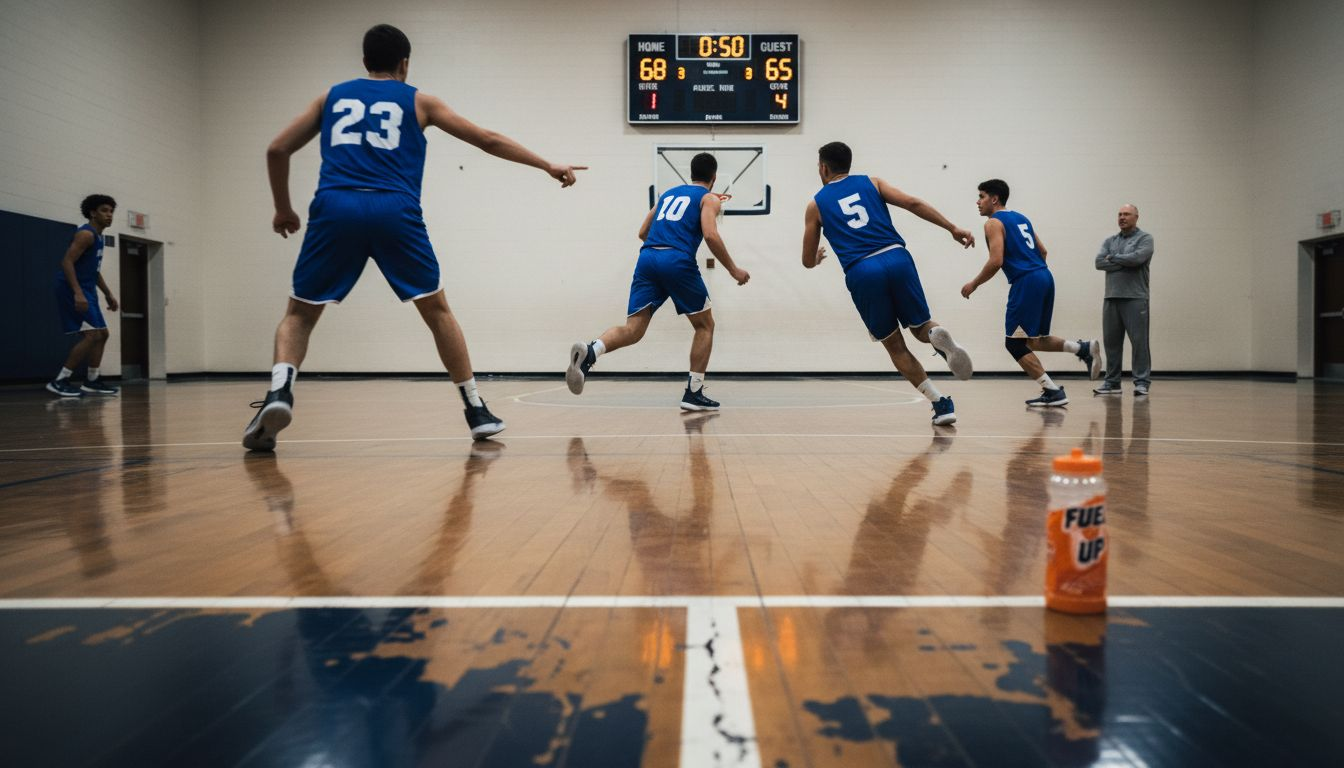
Successful defensive rotations require players to develop an almost intuitive understanding of team defensive mechanics. This involves reading offensive player movements, recognizing potential scoring threats, and executing split-second positional adjustments that prevent easy baskets.
The most effective defensive rotations transform individual defensive efforts into a synchronized team defensive mechanism. By practicing these movement patterns, teams can create a defensive system that is greater than the sum of its individual parts.
Pro tip: Practice defensive rotation drills that emphasize communication and quick positional shifts to build team defensive muscle memory.
Types of Rotations for Different Defenses
Defensive rotations are not one-size-fits-all strategies, but rather nuanced approaches that adapt to specific defensive system requirements. Each defensive alignment demands unique rotation mechanisms that protect the basket while maintaining strategic court coverage.
The primary defensive rotation types include:
-
Man-to-Man Defense Rotations
- Immediate help when direct matchup is beaten
- Quick switches to prevent scoring opportunities
- Constant communication between defenders
-
Zone Defense Rotations
- Area-based defensive positioning
- Fluid movement across designated zones
- Coordinated shifts when offensive players enter different areas
-
Press Defense Rotations
- Aggressive trapping strategies
- Rapid defensive repositioning
- High-pressure defensive movements
-
Hybrid Defense Rotations
- Combination of multiple defensive approaches
- Flexible defensive positioning
- Adaptable player movements
Successful rotation strategies require players to understand not just their individual defensive assignment, but the entire team’s defensive framework. This means anticipating offensive movements, reading player positioning, and making split-second decisions that maintain defensive integrity.
Each defensive system presents unique challenges. Man-to-man rotations focus on individual matchups and immediate help, while zone defenses prioritize area coverage and collective movement. Press defenses demand rapid, aggressive repositioning to disrupt offensive flow.
Here’s a quick comparison of defensive rotation types and their distinctive approaches:
| Rotation Type | Defensive Focus | Typical Movement | Team Impact |
|---|---|---|---|
| Man-to-Man | Individual matchups | Quick lateral shifts | Immediate help coverage |
| Zone | Area control | Fluid zone shifts | Strong basket protection |
| Press | Pressure and disruption | Aggressive traps | Forces turnovers, fast pace |
| Hybrid | Adaptive positioning | Flexible movement | Mixed strategy coverage |
Pro tip: Develop team defensive drills that simulate multiple rotation scenarios to build adaptive defensive muscle memory.
Teaching Rotations to Young Players
Teaching defensive rotations to young basketball players requires a patient, progressive approach that breaks down complex team defensive concepts into digestible, engaging learning experiences. Youth basketball skill development demands coaches create simplified, fun strategies that help players understand defensive positioning and movement.
Key teaching strategies for young players include:
-
Start with basic positioning fundamentals
- Teach stance and court awareness
- Demonstrate proper defensive positioning
- Emphasize watching the ball and opponent
-
Use visual and interactive learning techniques
- Create game-like defensive scenarios
- Use color-coded floor markers
- Implement rotation-based mini-games
-
Build communication skills alongside rotation techniques
- Encourage constant verbal communication
- Practice calling out defensive switches
- Develop team trust and understanding
Young players learn best through repetition and positive reinforcement. Coaches should focus on making defensive rotation drills engaging and low-pressure, allowing players to make mistakes and learn from them without fear of criticism. The goal is to develop muscle memory and an intuitive understanding of defensive movement.
Progressive learning means starting with simple one-on-one defensive concepts and gradually introducing more complex team rotation scenarios. By breaking down defensive rotations into small, manageable skills, coaches can help young players build confidence and develop a strong defensive foundation.
Pro tip: Design short, high-energy defensive rotation games that make learning feel like play, not practice.
Common Mistakes and How to Correct Them
Defensive rotations can quickly unravel when players make fundamental errors that compromise team defensive integrity. Coaching basketball defense requires identifying and systematically addressing these critical mistakes before they become ingrained habits.
Common defensive rotation mistakes include:
-
Positioning Errors
- Standing too upright
- Failing to maintain defensive stance
- Losing sight of both ball and assigned player
-
Communication Breakdowns
- Lack of verbal defensive signals
- Hesitation during rotation switches
- Unclear assignment handoffs
-
Anticipation Problems
- Slow reaction to offensive movements
- Overcommitting to initial defensive assignment
- Missing help-side defensive opportunities
Successful defensive correction requires coaches to implement targeted drills that expose and rectify these fundamental mistakes. Players must develop muscle memory through repetitive, game-realistic scenarios that challenge their defensive awareness and quick decision-making skills.
The table below summarizes frequent defensive rotation mistakes and effective correction strategies:
| Error Type | Common Cause | Correction Strategy |
|---|---|---|
| Poor Positioning | Upright stance, losing focus | Reinforce fundamentals, drills |
| Weak Communication | Lack of verbal signals | Practice call-outs, reviews |
| Slow Anticipation | Overcommitment or hesitation | Simulate game-speed decisions |
The most critical aspect of correcting defensive rotation mistakes is creating a team culture that values defensive communication and collective responsibility. Individual defensive errors become team defensive opportunities when players understand their interconnected roles and commit to supporting one another.
Pro tip: Record and review defensive rotation sequences during practice to help players visually identify and understand their positioning mistakes.
Take Your Team Defense to the Next Level with Proven Resources
Mastering defensive rotations is one of the biggest challenges coaches face when building a strong team defense. The key is developing players’ communication skills, positioning awareness, and quick anticipation through structured practice. If you want to transform your defensive system into a seamless, help-side machine that cuts down easy baskets and frustrates opponents, our curated Basketball Drills - Hoop Mentality offer targeted exercises designed for this exact purpose.

Explore our professional-grade Basketball Playbooks - Hoop Mentality along with comprehensive Basketball Guides – Hoop Mentality to gain deeper insights on teaching rotations and correcting common mistakes that undermine team defense. These resources are crafted from real coaching experience to save you time and improve communication so you can focus on winning games. Visit Hoop Mentality today and start building a defensive mindset that dominates every game.
Frequently Asked Questions
What are defensive rotations in basketball?
Defensive rotations in basketball refer to the strategic positional shifts players make to provide help defense when an initial assignment breaks down. This dynamic movement aims to protect the basket and maintain coverage on potential scorers.
Why are defensive rotations important for team defense?
Defensive rotations are crucial as they prevent easy scoring opportunities, maintain defensive pressure, disrupt offensive movements, and help close passing and driving lanes. Proper execution can significantly reduce opponent scoring chances.
How can I teach defensive rotations to young basketball players?
Teaching defensive rotations to young players involves simplifying the concepts, using visual aids, and encouraging interactive learning. Start with basic positioning, integrate fun drills, and foster communication skills to help players understand their roles smoothly.
What are common mistakes made during defensive rotations?
Common mistakes include poor positioning (standing too upright), communication breakdowns (lacking verbal signals), and anticipation problems (slow reactions to offensive movements). Addressing these errors through targeted drills can help players improve their defensive effectiveness.