

TL;DR:
- Transition offense is an organized attack immediately after gaining possession, aiming to score within the first 6-8 seconds. It relies on spacing, quick ball movement, and secondary triggers to create high-percentage shots like paint touches and open threes. Proper execution involves rapid decision-making, spreading the floor, and initiating secondary actions when no fast break advantage exists, maximizing scoring potential.
Transition offense is defined as the rapid shift from defense to offense, designed to create high-percentage scoring opportunities before the opposing defense can organize. The goal is simple: attack within the first 6-8 seconds of a possession, before defenders recover their positions. Transition offense includes the fast break, the secondary break, and conceptual systems like Coach Brent Tipton’s 2-Sided Break. Each approach targets the same three outcomes: early paint touches, open catch-and-shoot threes, and shots against off-balance defenders. Teams that master this phase score more points per possession than any other method in the game.
What is the transition offense definition in basketball?
Transition offense in basketball is the organized attack a team launches the moment it gains possession, whether through a defensive rebound, a steal, or a made basket by the opponent. The standard industry term for its most aggressive form is the fast break, but transition offense is the broader concept that covers all phases of attacking before the defense sets. Understanding this distinction matters because most teams can execute a fast break on a turnover. Far fewer can sustain offensive pressure when the fast break is not immediately available.
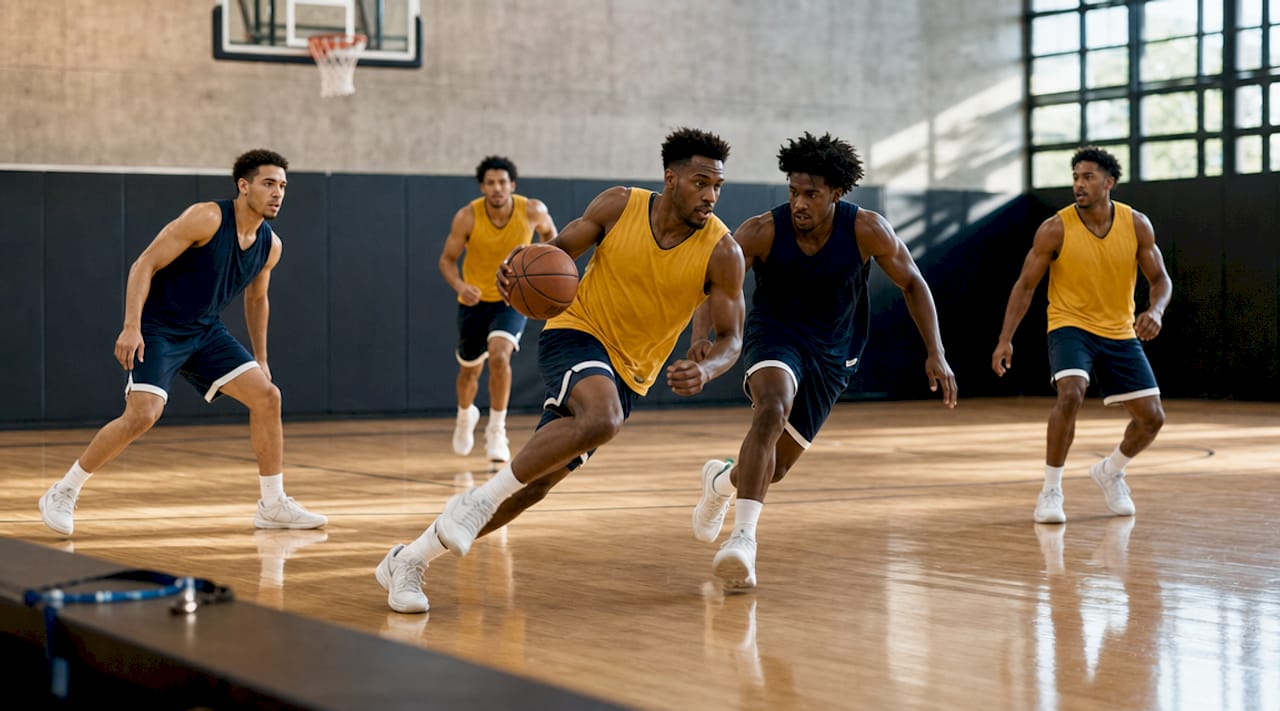
The three primary scoring objectives in transition are what coaches call “Key, Three, and Free.” Key refers to early paint touches. Three refers to open corner threes generated by spacing. Free refers to attacking off-balance defenders and drawing fouls. These three targets define every decision a player makes in the first moments of a possession. A team that consistently hits one or more of these targets in transition will outscore opponents without running a single set play.
Spacing is the engine behind all three objectives. When offensive players spread the floor immediately upon gaining possession, defenders are forced to cover more ground. That ground coverage creates the mismatches and open windows that lead to high-quality shots. The 2-Sided Break system built by Coach Tipton is designed specifically around this principle, using spacing and movement to disrupt defensive recovery rather than relying on raw speed alone.
“Traditional set-play transition allows defenses to set anchors. Conceptual systems force defenders to open their hips and slow their recovery.” — Coach Brent Tipton, A Quick Timeout
Pro Tip: Teach your players the three scoring targets before you teach any specific play. When players know what they are looking for, they make faster and better decisions in live transition situations.
How does transition offense differ from a fast break?
The fast break and transition offense are related but not the same. A fast break is a specific style within the broader transition offense concept. It describes a situation where the offense has a numerical advantage, typically two-on-one or three-on-two, and attacks at full speed before defenders can recover. Transition offense is the larger system that includes the fast break, the secondary break, and the half-court entry that follows when no immediate advantage exists.
| Style | Trigger | Primary goal | Best suited for |
|---|---|---|---|
| Fast break | Turnover or long rebound | Immediate basket before defense sets | Athletic, fast-paced rosters |
| Secondary break | No numerical advantage after half court | Create mismatch through spacing and screens | Skilled, well-coached teams |
| Conceptual system (2-Sided Break) | Any change of possession | Force defensive disorganization through spacing | Teams of any skill level |
| Walk-up offense | Controlled possession | Set half-court offense | Slower, deliberate teams |
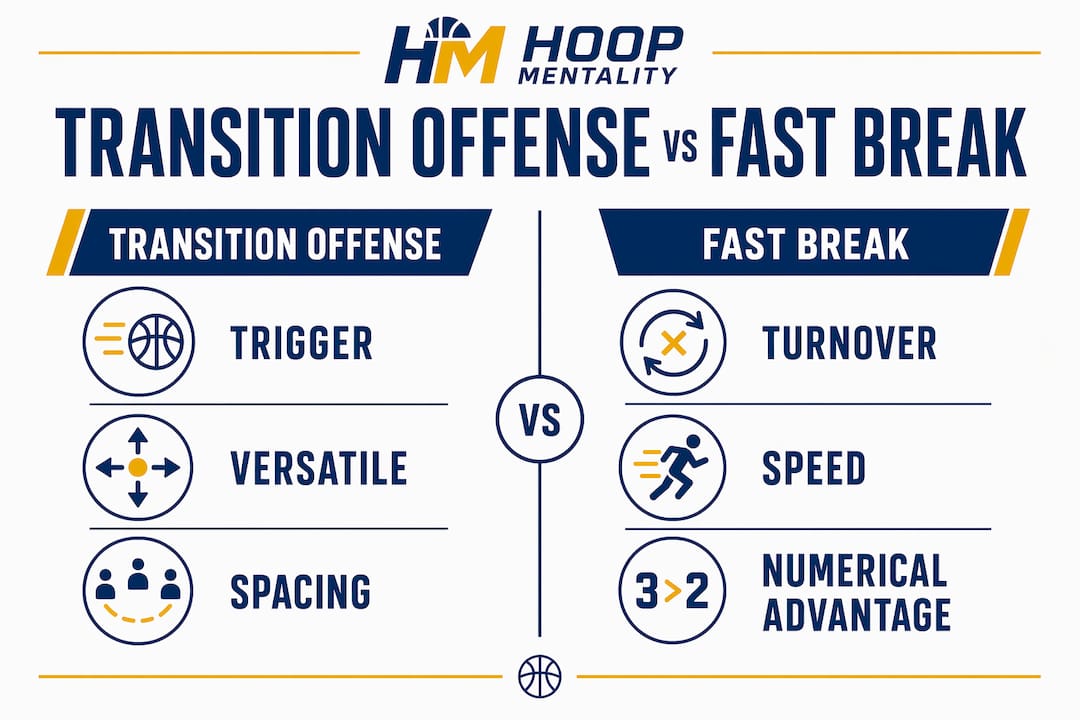
The secondary break is triggered when the initial fast break option is not available. Players cross half court, read the defense, and immediately initiate a secondary action such as a flare screen or ball screen. The secondary triggers must happen within three seconds of crossing half court to maintain offensive pressure. Waiting longer allows the defense to fully recover and eliminates the advantage gained from the transition.
Conceptual systems like the 2-Sided Break do not rely on a numerical advantage at all. They use spacing and the Diagonal Advance Pass to force defenders to adjust their positioning, which creates the same disorganization that a fast break creates through speed. This approach suits teams that lack elite athleticism but have players who understand spacing and decision-making.
Pro Tip: If your team struggles to finish fast breaks, the problem is usually spacing, not speed. Teach your wings to sprint wide to the corners on every possession change, not just when they see a clear lane.
How to execute transition offense effectively in game situations
Executing transition offense starts with securing the ball. A defensive rebound or a steal is the trigger. What happens in the next two seconds determines whether the offense generates an advantage or simply walks the ball up the court.
- Secure the rebound or turnover. The rebounder or ball-handler must immediately look up the court. Hesitation kills transition opportunities faster than any defensive scheme.
- Make the outlet pass quickly. Quick outlet passing after a rebound or steal starts the fastest and most effective transition opportunities. The outlet receiver should already be moving toward the sideline before the rebound is secured.
- Advance the ball with the Diagonal Advance Pass. The DAP moves the ball across the court immediately and forces defenders to adjust their hips, slowing their recovery. Precise timing and spatial awareness are required to execute this pass effectively.
- Spread the floor as the ball advances. Wings sprint to the corners. The trailing big fills the opposite elbow. The ball-handler attacks the middle of the floor. This spacing forces five defenders to cover the entire court simultaneously.
- Read the defense and identify the target. Is there an early paint touch available? Is a corner three open? Is a defender off-balance and vulnerable to attack? The first open target gets the ball.
- Initiate a secondary trigger within three seconds if no advantage exists. Players must recognize a neutral situation and initiate secondary actions quickly to sustain pressure. A flare screen for a shooter or a ball screen at the top of the key keeps the defense moving and prevents recovery.
- Flow into the half-court offense if the break is fully stopped. Transition offense does not end at the three-point line. The spacing and movement patterns used in transition should connect directly to the half-court system so players never have to stop and reset mentally.
Pro Tip: Film your team’s first four seconds after every change of possession for one week. You will immediately see whether your players are sprinting to spacing positions or drifting into the lane and clogging the paint.
How does spacing in transition affect defensive recovery?
Spacing is the single most important variable in transition offense. When offensive players spread wide immediately, defenders face a choice: recover to their assigned player or help stop the ball. They cannot do both at full speed. This forces what coaches call “opening the hips,” where a defender must turn their body away from the basket to close out on a shooter, which slows their recovery and creates a longer closeout.
Proper spacing leads directly to long defensive closeouts, which create better scoring opportunities including open catch-and-shoot threes from the corner. A corner three is the highest-value shot generated by transition spacing because it is a short distance from the basket relative to other three-point attempts, and it is created by defensive disorganization rather than individual skill.
The Diagonal Advance Pass amplifies the spacing effect. When the ball moves diagonally across the court, every defender must shift laterally. Defenders who are already running back in transition now have to change direction, which costs them speed and positioning. The offense gains a half-step advantage on every player on the court simultaneously.
Here is how spacing outcomes compare in transition situations:
| Spacing quality | Defensive closeout distance | Shot quality | Likely outcome |
|---|---|---|---|
| Poor (players clustered) | Short, controlled | Contested mid-range | Low percentage shot |
| Moderate (one side spread) | Medium | Partial open three | Moderate percentage shot |
| Strong (full floor spread) | Long, off-balance | Open corner three or paint touch | High percentage shot |
The tactical implication is direct. Coaches who teach spacing as a transition principle, not just a half-court concept, generate better shots without needing faster players. The defense does the work for you when the floor is spread correctly.
What drills build transition offense skills in practice?
Drills that develop transition offense must replicate the speed and decision-making demands of live game situations. Slow, controlled drills teach technique but do not build the habits players need when the game is moving at full pace.
- 3-on-2 to 2-on-1 continuous drill. Three offensive players attack two defenders. After the possession ends, two of the original defenders become the offense and attack one of the original offensive players. This drill builds fast break finishing and outlet passing habits simultaneously.
- Outlet passing progression. Start with a coach or manager tossing the ball off the backboard. The rebounder secures the ball, pivots, and makes a crisp outlet pass to a wing already in motion. Progress to live rebounding situations where the outlet receiver must time their movement to the rebound.
- Spacing sprint drill. On every made or missed basket in practice, all five offensive players must sprint to their transition spacing positions before the ball crosses half court. Stop play and reset if any player fails to reach their spot. This builds the habit faster than any verbal instruction.
- Secondary trigger recognition. Run half-court situations where the defense is set and the offense must initiate a flare screen or ball screen within three seconds of crossing half court. The constraint forces players to read and react rather than wait for a play call.
- Conditioned scrimmage with transition rules. Award two extra points for any basket scored within six seconds of a change of possession. This scoring incentive changes player behavior immediately and reinforces transition principles without additional coaching intervention.
- Video review sessions. Review transition possessions from the previous game and identify which of the three targets (Key, Three, Free) was available and whether the team attacked it. Video analysis reinforces concepts faster than any drill because players see their own decisions in real time.
Key takeaways
Transition offense generates the highest-quality scoring opportunities in basketball by attacking within the first 6-8 seconds of a possession through spacing, quick ball movement, and secondary triggers when no immediate advantage exists.
| Point | Details |
|---|---|
| Core definition | Transition offense is the organized attack launched immediately after gaining possession, before the defense sets. |
| Three scoring targets | Every transition possession aims for a paint touch, an open corner three, or a shot against an off-balance defender. |
| Spacing drives results | Wide floor spacing forces long defensive closeouts and creates high-percentage shots without requiring elite speed. |
| Secondary triggers matter | When no fast break advantage exists, initiate a flare or ball screen within three seconds of crossing half court. |
| Principles over plays | Teaching players the objectives of transition offense produces faster decisions than teaching fixed set plays. |
Why I think most coaches underuse transition offense
Most coaches treat transition offense as a bonus. They design their system around half-court sets and hope the fast break happens naturally. That is backwards. The first six seconds of every possession are the highest-leverage moments in the game, and most teams leave those moments to chance.
The 2-Sided Break changed how I think about this. The insight that spacing forces defenders to open their hips is not complicated, but it reframes the entire concept. You are not trying to outrun the defense. You are trying to make the defense move in ways that create openings. That is a principle any player at any level can understand and execute.
The biggest mistake I see coaches make is teaching transition as a set play. They diagram a specific action and expect players to run it in the chaos of a live game. It does not work. Players freeze when the play does not develop as drawn. Principle-based systems, where players know the three targets and understand how spacing creates them, produce far more consistent results because players can adapt to what the defense gives them.
The future of transition offense coaching is in video-assisted feedback and constraint-based drills. When players see their own spacing errors on film and feel the difference in a drill that rewards fast decisions, the learning accelerates. Coaches who combine clear principles with immediate feedback will develop transition offenses that opponents genuinely cannot prepare for.
— Dejan
Build your transition offense with Hoopmentality resources
Hoopmentality has the tools to put these concepts into practice right away.

The Big Man Dual Action Drill develops the screen and spacing mechanics that power secondary break situations, giving your big men the skills to set effective flare and ball screens in transition. The Basketball Practice Plan Template helps you organize practice sessions around transition principles, so every drill connects to the game objectives covered in this guide. Both resources are built from real coaching experience and designed to save you time while improving how your team executes in live game situations.
FAQ
What is the transition offense definition in basketball?
Transition offense is the organized attack a team runs immediately after gaining possession, targeting the first 6-8 seconds before the defense can set. It includes the fast break, secondary break, and conceptual systems that use spacing to create scoring opportunities.
How does a fast break differ from transition offense?
A fast break is a specific situation within transition offense where the offense has a numerical advantage and attacks at full speed. Transition offense is the broader system that covers all phases of attacking before the defense organizes, including secondary breaks when no numerical advantage exists.
What are the three main objectives of transition offense?
The three objectives are early paint touches, open catch-and-shoot threes (particularly from the corner), and attacking off-balance defenders to draw fouls. Every transition decision should target one of these three outcomes.
What is a secondary break in transition offense?
A secondary break is the action initiated when the initial fast break option is not available. Players must trigger a screen or spacing action within three seconds of crossing half court to maintain offensive pressure and prevent the defense from fully recovering.
Why does spacing matter so much in transition offense?
Spacing forces defenders to cover more ground and make longer closeouts, which slows their recovery and creates open shots. Without proper spacing, defenders can help stop the ball without leaving shooters open, which eliminates the advantage that transition offense is designed to create.