

Most coaches assume the team that runs the most fast breaks wins the most points. The reality is more nuanced. Elite teams win through conversion efficiency, not just pace, with a moderate correlation of r=0.54 between pace and transition scoring. That gap between opportunity and execution is where games are actually decided. This article breaks down exactly what transition offense is, why it creates such a measurable scoring edge, and how you can build it into your system at any level.
Table of Contents
- Defining transition offense in basketball
- Why transition offense matters: Efficiency, pace, and points
- Key principles and phases of transition offense
- Common challenges: Turnovers, discipline, and coach philosophies
- Applying transition offense for youth and advanced teams
- Sample drills and practice principles for transition offense
- Upgrade your team’s transition strategy
- Frequently asked questions
Key Takeaways
| Point | Details |
|---|---|
| Transition offense defined | Transition offense is the phase between defense and half-court offense that exploits quick-change opportunities for easy scores. |
| Efficiency advantage | Elite teams gain up to 0.10 more points per possession in transition than in half-court settings. |
| Execution is critical | Effective transition offense relies on speed, spacing, decision-making, and disciplined roles. |
| Youth need simplicity | Younger teams succeed by focusing on basic rules and layups during fast breaks. |
| Structured practice matters | Consistent drills and clear principles rapidly improve a team’s transition success. |
Defining transition offense in basketball
Transition offense is the phase of play between a defensive stop or change of possession and the moment the opposing defense fully sets. It is not the same as a half-court offense, which operates against an organized defense. Transition offense exploits the window of disorganization before defenders recover their positions.
Understanding this distinction matters because it changes how you teach the game. Half-court offense requires patience, spacing, and reads against set defenders. Transition offense rewards speed of decision, lane filling, and attacking before the defense can organize. These are different skills, and they need to be trained separately.
There are three types of transition opportunities you should recognize:
- Primary break: A clear numbers advantage immediately after a turnover or rebound, typically 2-on-1 or 3-on-2
- Secondary break: The offense pushes quickly but the defense has partially recovered, creating early post-ups or drive opportunities
- Early offense: No clear advantage exists, but the offense attacks before the defense fully sets, using motion or set actions
The sequence for any transition play follows a predictable path: defensive stop or rebound, outlet pass, first pass ahead, fill lanes, decision, and finish. Each step has a role attached to it, and every player on your roster needs to know their job in that chain.
“NBA elite transition generates approximately 1.20 points per possession, with transition shots at the rim occurring 49% of the time at a 64% field goal percentage. That is a significant edge over half-court averages.”
For coaches who want to dig deeper into building these habits, the fast break success guide at Hoop Mentality is a strong starting point. If your team already runs motion offense basics, you will find transition principles connect naturally to the reads your players already know.
Why transition offense matters: Efficiency, pace, and points
Numbers do not lie. Transition offense is simply more efficient than half-court offense at almost every level of the game. The table below shows why coaches who ignore transition are leaving points on the floor.
| Metric | Transition offense | Half-court offense |
|---|---|---|
| Points per possession | ~1.20 (elite) | ~1.05 to 1.10 |
| Shot location at rim | 49% | ~30% |
| Field goal % at rim | 64% | ~58% |
| Defensive recovery time | Incomplete | Fully set |
The rim access alone explains most of the efficiency gap. When defenders are scrambling back, your players get cleaner looks at the basket. Contested mid-range jumpers disappear. Layups and short floaters replace them.
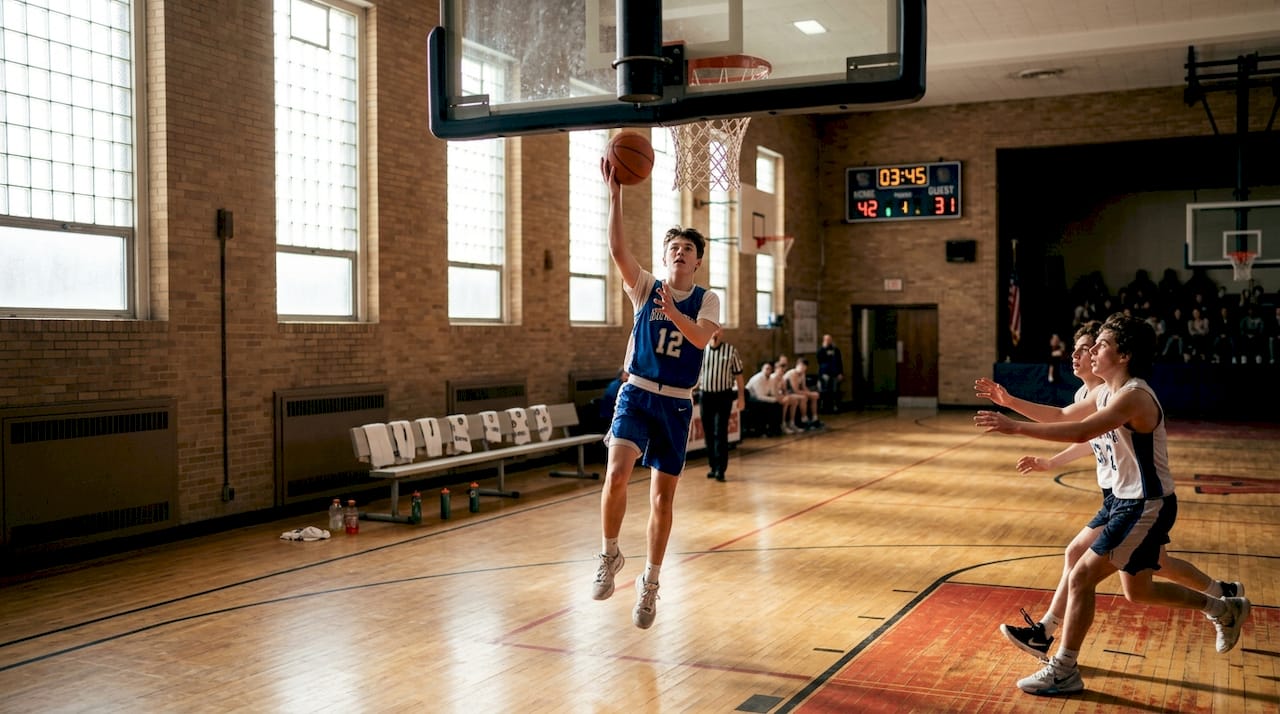
Key stat: Teams crossing half-court in four seconds or less gain more than seven points per game compared to teams that push slower. Seven points per game is the difference between a close loss and a comfortable win across a full season.
Transition offense also shifts momentum in ways that raw scoring does not capture. A quick layup after a turnover deflates the opposing bench, energizes your players, and forces the other coach to call a timeout. That psychological pressure compounds over 32 or 40 minutes.
For coaches focused on team scoring efficiency, transition offense is not a gimmick. It is a structural advantage built into how basketball is scored. Pairing it with strong offense techniques gives your team multiple ways to create quality shots in every possession.
Key principles and phases of transition offense
Knowing why transition works is only useful if you know how to run it. The best transition teams do not just run fast. They run with structure. Here is the sequence every player needs to internalize:
- Get the stop or rebound. Transition starts on defense. Box out, secure the ball, and protect possession.
- Outlet immediately. The rebounder finds the outlet guard quickly. Hesitation kills the advantage.
- Push the first pass ahead. The ball handler looks to advance the ball past the three-point line as fast as possible.
- Fill the lanes wide. Wings sprint to the sideline extended areas. Width stretches the defense and creates driving lanes.
- Make the decision. Attack the advantage if it exists. If not, flow into early offense or set your half-court action.
- Finish strong. Commit to the layup or the kick-out. Indecision leads to turnovers and wasted possessions.
Top NBA teams score over 1.36 points per possession in transition, which reflects how much structure matters at the highest level. It is not chaos. It is organized aggression.
Roles matter in each phase. Your ball handler controls pace and reads the defense. Wings fill wide and stay ready to catch and finish. Bigs have a critical job that many coaches overlook.
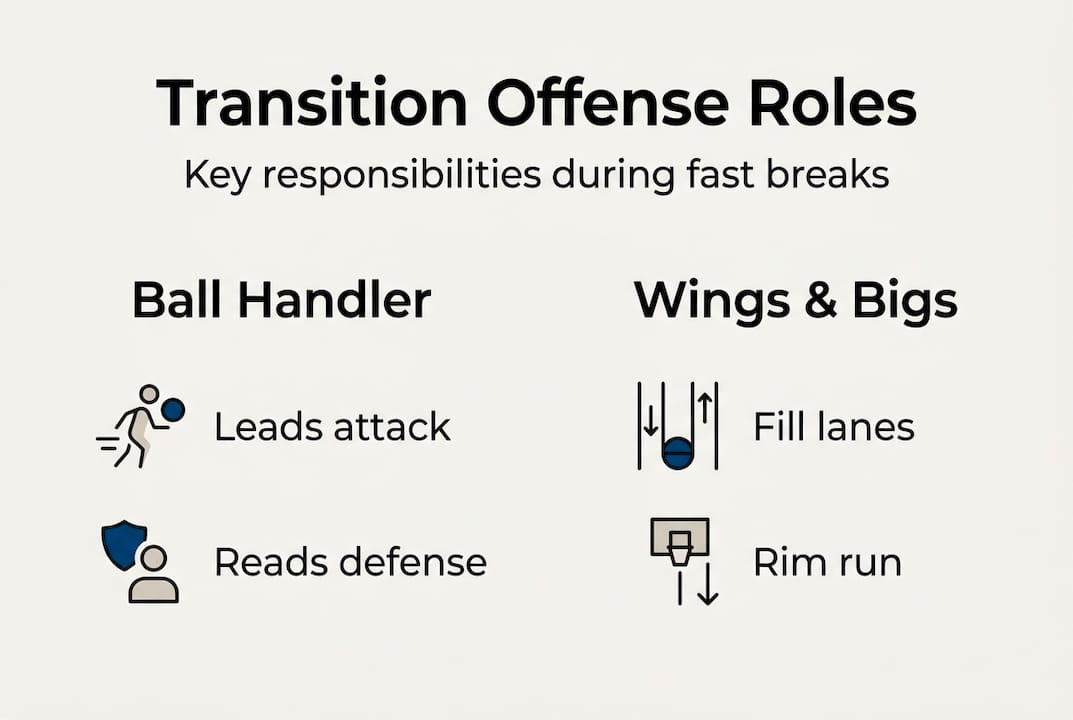
Pro Tip: Designate one big as your “rim runner” on every change of possession. Their job is to sprint the lane immediately, giving your ball handler a high-percentage target at the basket. This single adjustment can add two to four easy points per game.
For more structured transition drill frameworks, Hoop Mentality has resources that map directly to these phases. If you run man-to-man defense, the man-to-man offense tips resource also covers how transition connects to your defensive identity.
Common challenges: Turnovers, discipline, and coach philosophies
Transition offense is not without risk. Coaches who push pace without structure often find themselves giving up easy points on the other end. Here are the most common pitfalls:
- Turnovers from rushed decisions: Players try to make the highlight pass instead of the right pass
- Poor spacing: Wings cut to the middle instead of filling wide, clogging driving lanes
- Over-emphasis on speed: Players sprint without reading the defense, leading to bad shots or charges
- Weak finishing: Players rush layups they would make in a half-court set
- Lack of communication: No one calls out the numbers advantage, so the team misses the best option
Even at the NBA level, transition offense can backfire. The Phoenix Suns have generated elite steal numbers in recent seasons but struggled to convert those opportunities into efficient transition scoring. High steals do not automatically equal high transition points. Conversion discipline is the missing piece.
“The Suns’ experience shows that transition conversion requires more than just getting the ball. Decision-making under pressure separates teams that capitalize from teams that waste their advantages.”
Some coaches deliberately avoid transition offense. They prefer the control of half-court sets, especially when their roster lacks the athleticism or decision-making speed to execute fast breaks cleanly. That is a legitimate philosophy. But even those coaches benefit from having a secondary break or early offense option ready, because defenses will occasionally be caught out of position regardless of your pace preference.
Pro Tip: Set clear decision rules before the season. For example, “If we have a 2-on-1, we always attack. If we have a 3-on-2, the ball handler reads the first defender.” Simple rules reduce turnovers by removing in-the-moment guesswork. For a complete system, check out transition strategies against any defense.
Applying transition offense for youth and advanced teams
Transition offense looks different depending on who you are coaching. A 10-year-old and a high school junior need different instructions, even if the underlying principles are the same.
| Category | Youth teams | Advanced teams |
|---|---|---|
| Primary emphasis | Run wide, finish layups | Spacing, reads, decision freedom |
| Decision rules | Simple: attack every advantage | Conditional: read the defense |
| Ball handler role | Push and look for layup | Control pace, choose action |
| Big man role | Sprint the lane | Rim run or trail for three |
| Teaching focus | Habits and effort | Efficiency and recognition |
| Goal | Build fast-break instincts | Maximize points per possession |
For youth teams, the priority is building the right instincts. Keep the rules simple: run wide, look for the layup, and do not stop until you finish or the defense stops you. Complexity comes later. Right now, you want players who sprint every time there is a change of possession.
Advanced players can handle more nuance. They can read whether to attack or pull back, recognize when to trail for a three-pointer, and execute quick post-ups in the secondary break. The youth offense tips at Hoop Mentality give you a clear framework for the younger level, while motion offense implementation connects transition principles to more advanced half-court systems.
Sample drills and practice principles for transition offense
Transition offense is a habit, and habits are built in practice. Three core principles should guide every transition drill you run.
First, train decision speed. Players must recognize the advantage and act within one second. Hesitation is the enemy of transition offense. Second, demand communication. The ball handler should hear “numbers” or “advantage” called out by teammates. Verbal cues speed up decisions. Third, finish every rep. Never let players stop short of the basket. Finishing under fatigue is a skill that only develops through repetition.
Here are five drills that build these habits directly:
- 3-on-2 continuous: Three offensive players attack two defenders. After each possession, two defenders become attackers. Builds reading and finishing under pressure.
- 11-man fast break: A classic drill that simulates full-court transition with multiple groups. Emphasizes outlet passing, lane filling, and decision-making at speed.
- Advantage or disadvantage: Coach calls out the numbers situation as players cross half-court. Forces real-time recognition and adjustments.
- Rim runner drill: Bigs practice sprinting the lane from different defensive positions. Focuses on timing the catch and finishing at the rim.
- Shell to break: Start in a defensive shell drill, then trigger transition on a coach’s signal. Connects defensive stops directly to offensive execution.
Focus points for every drill session:
- Ball movement within two seconds of the outlet
- Wide lane filling, not cutting to the middle
- Finishing at the rim without slowing down
- Verbal communication on every possession
Elite teams practice rapid recognition and finishing in advantage situations as a core part of their daily routine. It is not an afterthought. For a full library of structured drills, the best transition drills resource at Hoop Mentality gives you ready-to-run sessions organized by skill level.
Upgrade your team’s transition strategy
You now have the framework. The next step is putting it into a practice structure your players can actually follow. A well-organized practice plan makes the difference between drills that stick and drills that get forgotten by the next game.

At Hoop Mentality, we have built resources specifically for coaches who want to implement transition offense with clarity and confidence. The practice plan template helps you schedule transition drills alongside your other priorities without losing time or focus. If your bigs are the weak link in your fast break, the big man dual action drill trains them to contribute in transition and half-court sets. Every resource is built from real coaching experience, designed to save you time and give your players a system they can trust.
Frequently asked questions
What is the main difference between transition offense and fast break?
A fast break is one specific type of transition offense focused on immediate scoring after a change of possession, while transition offense covers all actions from the defensive stop until the opposing defense fully sets. Think of fast break as a subset of the broader transition offense system.
How can youth coaches introduce transition offense effectively?
Start with two simple rules: fill the lanes wide and attack the basket for a layup. Keeping youth rules simple builds the right instincts before adding complexity.
Why do some coaches prefer half-court offense over transition offense?
Some coaches favor half-court offense because it offers more control and fewer turnovers, especially when their roster lacks the speed or decision-making discipline for consistent transition execution. It is a valid choice depending on your personnel.
How many points per possession do elite NBA teams score in transition?
NBA elite teams average around 1.20 points per transition possession, which outpaces most half-court offenses and explains why top programs prioritize fast-break opportunities.