

Every coach knows the challenge of getting five players to act in perfect sync under pressure. A continuity offense creates a pattern of cuts and screens that repeats like clockwork, providing structure while letting athletes read the game and react with confidence. For coaches looking to build a system their team can execute instinctively, learning how to define and implement these offenses can be the difference between frustration and sustained scoring success.
Table of Contents
- Defining Continuity Offense In Basketball
- Types Of Continuity Offenses And Key Differences
- Core Principles And Team Execution Steps
- Coaching Responsibilities And Player Roles
- Common Pitfalls And Solutions For Coaches
Key Takeaways
| Point | Details |
|---|---|
| Understanding Continuity Offense | A continuity offense relies on structured movement and repetition, enhancing player rhythm and predictability for consistent scoring opportunities. |
| Types of Continuity Offenses | Familiarize yourself with different systems like the Shuffle, Flex, Wheel, and UCLA High Post, matching them to player strengths for effective execution. |
| Core Principles | Emphasize spacing and ball movement, ensuring players perform actions automatically under game pressure to maximize offensive efficiency. |
| Coaching Responsibilities | Clearly define player roles and maintain consistent spacing, while addressing mistakes promptly to foster effective execution of the continuity offense. |
Defining Continuity Offense in Basketball
A continuity offense is a structured basketball system where players execute a repeating pattern of movement, cuts, screens, and passes that cycle back to the starting formation. Rather than relying on isolation plays or constant new designs, your team runs the same fundamental sequence over and over. This creates rhythm, predictability for your players, and consistent scoring opportunities.
The core strength of this approach lies in its sustainability. A continuity offense creates a pattern of cuts and screens that players can execute automatically, even under game pressure. Your players aren’t scrambling to remember complex sets each possession. They understand the flow, anticipate their teammates’ movements, and move in sync.
Common continuity systems include the shuffle offense, the flex offense, and the wheel offense. Each follows the same principle: establish a base alignment, execute cuts and screens in sequence, then return to that base to restart. John Wooden’s UCLA High Post Offense stands as perhaps the most famous example, generating decades of success through elegant, repeating movement.
Why does this matter for scoring efficiency? Continuity offenses breed familiarity. Your shooting guard knows the small forward will screen for them on the third cut. Your center understands when to slip the screen or pop out for a three. This reduces turnovers and creates shots from specific spots where players practice repeatedly.
These systems also stress ball movement and player spacing. Unlike isolation heavy offenses, continuity requires passing and relocating. This forces defenders to work harder, creates defensive breakdowns, and opens driving lanes. The constant motion frustrates zone defenses while creating weaknesses against man-to-man schemes.
Pro tip: Start implementing continuity offense with just three consecutive cuts and one screen, then add complexity once your players execute those foundational movements with precision and consistency.
Types of Continuity Offenses and Key Differences
Not all continuity offenses function identically. While each system circles back to a base formation, the movement patterns, screening angles, and scoring opportunities vary significantly. Understanding these differences helps you choose the right system for your personnel and playing style.
The shuffle offense relies on continuous screens between players moving along the baseline and perimeter. One player screens for another, then the screener cuts to the basket while the original cutter relocates. This creates constant motion and scoring chances near the basket. The shuffle works especially well when you have skilled cutters and post players who can finish in traffic.
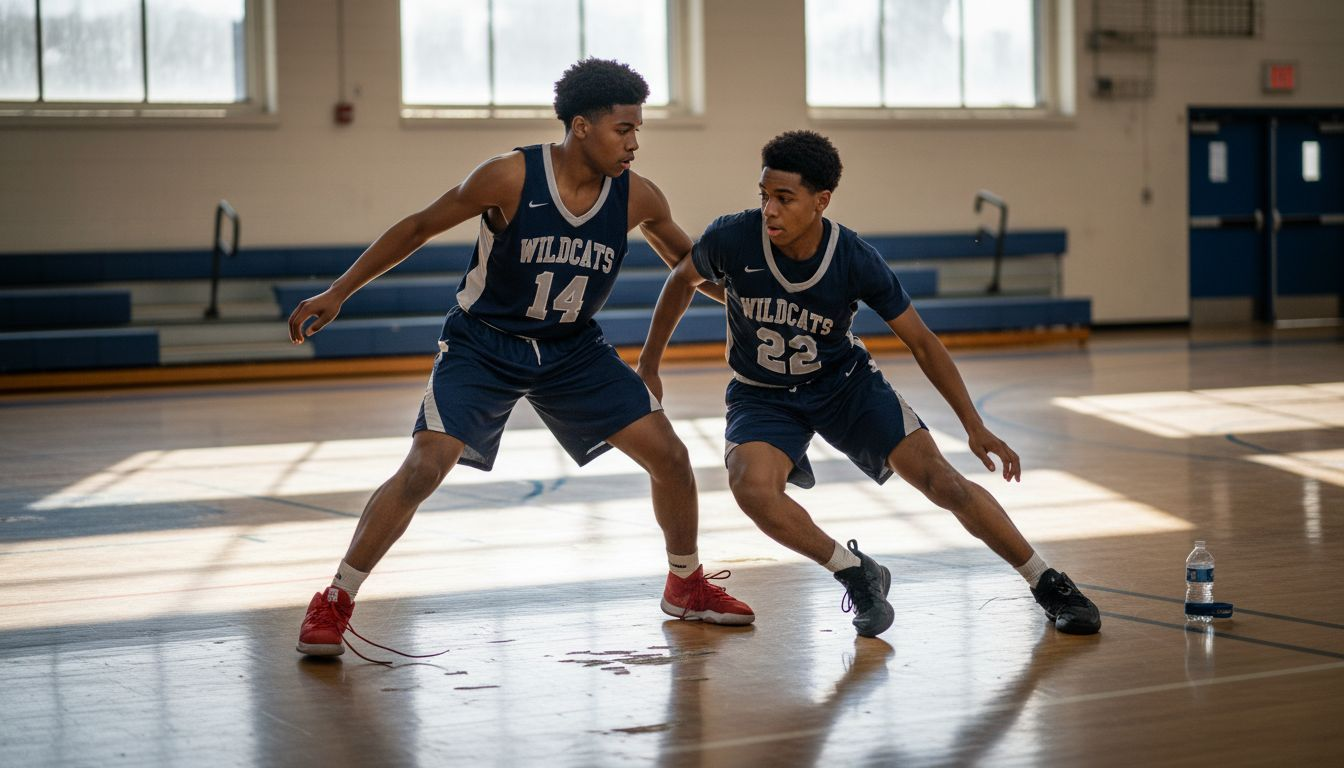
The flex offense emphasizes high-low ball movement with perimeter screens. After passing to the wing, the ball handler cuts through the lane while the forward at the high post provides a screen. A flex offense variation offers adaptability against different defensive looks. Teams using the flex typically have versatile forwards comfortable shooting from mid-range.
The wheel offense involves guards driving and kicking to wings, with constant back screens and relocations. It generates three-point opportunities through drive-and-kick actions combined with purposeful spacing. This system thrives with ball-handling guards and shooters who move without the basketball.
John Wooden’s UCLA High Post Offense stands apart for its elegance and effectiveness. It focuses on high post passes with immediate screening and cutting actions. The offense prioritizes ball movement to create open looks rather than relying on individual creation. Teams with strong passing bigs and disciplined shooters maximize this system’s potential.
The key difference between these systems lies in their primary scoring zones and player movement sequences. Some generate corner three-pointers, others create mid-range opportunities or baseline finishes. Your roster talent should dictate which continuity offense you implement.
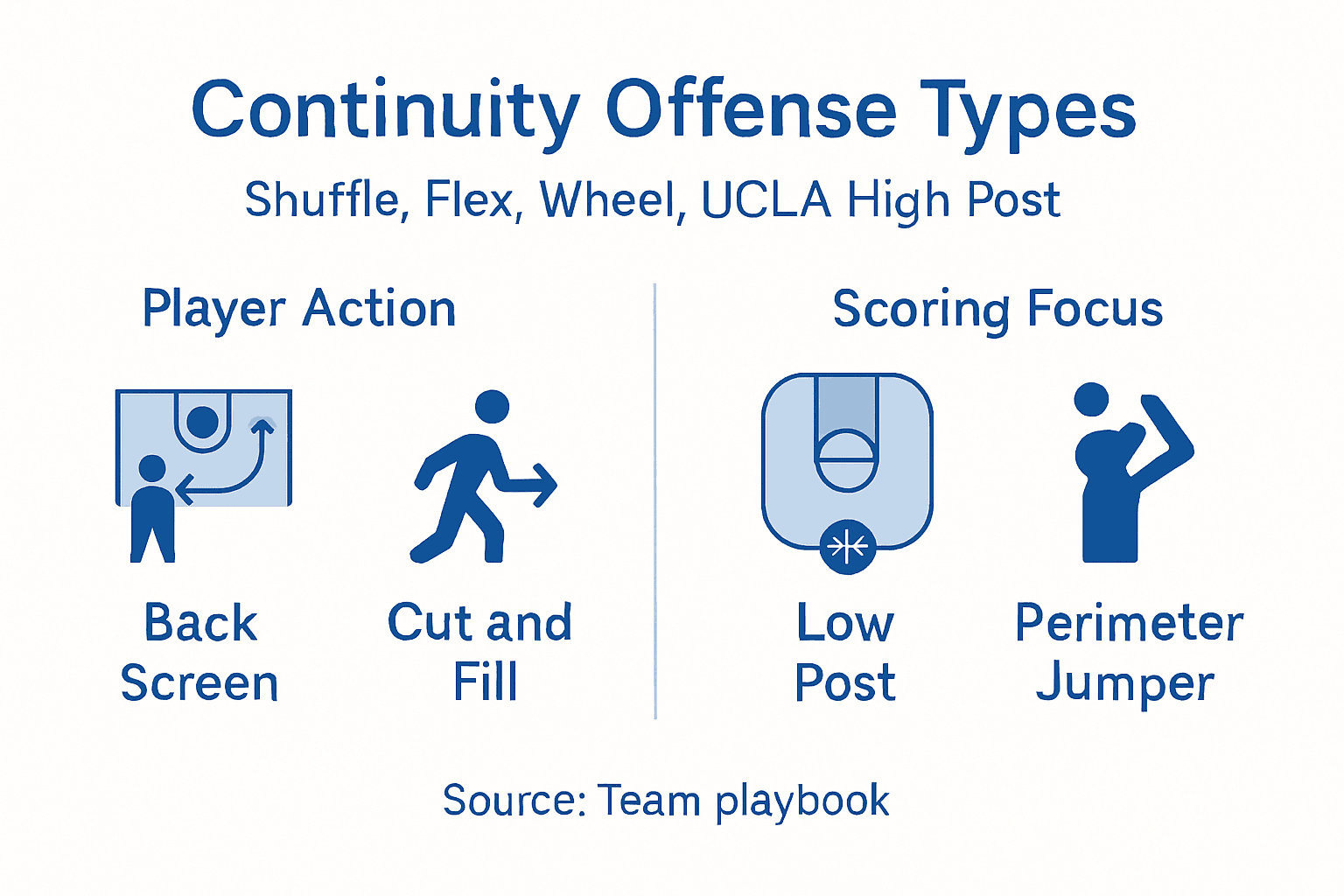
Here’s a comparison of popular continuity offenses and the player types they best utilize:
| Offense Type | Ideal Player Strengths | Typical Scoring Zones |
|---|---|---|
| Shuffle | Aggressive cutters, finishers | Near basket, short corners |
| Flex | Versatile forwards, shooters | Mid-range, elbows |
| Wheel | Ball-handling guards, wings | Three-point line, corners |
| UCLA High Post | Passing bigs, disciplined shooters | High post, wing spots |
Pro tip: Match your continuity offense type to your best players’ strengths, whether that’s floor spacing from guards, post passing ability from your center, or cutting ability from your forwards.
Core Principles and Team Execution Steps
Successfully implementing a continuity offense requires understanding the foundational principles that make it work. These principles guide every cut, screen, and pass your players execute. Without them, your offense becomes random movement instead of structured attacking.
The first principle is spacing. Your players must maintain proper distances from each other to create passing lanes and shooting opportunities. Tight spacing collapses the defense and eliminates cutting angles. Good spacing forces defenders to cover more ground, opening driving lanes for skilled ball handlers.
The second principle centers on ball movement. A continuity offense lives through quick, purposeful passing. Each pass should advance the ball closer to scoring opportunities or reset the offense for another sequence. Stagnant ball movement kills the rhythm your system depends on.
Execution requires consistent repetition in practice. Your players need to understand their roles in the sequence without thinking. When facing game pressure, muscle memory takes over. Players must know when to cut, when to screen, and when to relocate. This automaticity separates effective continuity offenses from broken ones.
Start with these execution steps:
- Install the base formation and teach players their starting positions
- Walk through the first three actions at half speed without defensive pressure
- Add defensive players once movement becomes automatic
- Progress to full-speed execution against live defense
- Reinforce spacing and ball movement standards daily
Building team chemistry for basketball success accelerates your continuity offense implementation. Players who trust each other execute cuts with confidence and pass with conviction. Chemistry creates the cohesion that transforms individual movements into fluid, connected sequences.
Pro tip: Practice your continuity offense at 50% speed for the first two weeks, focusing on spacing and floor positioning before introducing defensive resistance.
Coaching Responsibilities and Player Roles
A continuity offense succeeds or fails based on how clearly you define roles and teach execution. Your job as a coach involves more than installing the system. You must communicate expectations, monitor spacing, correct mistakes in real time, and hold players accountable to the process.
Start by assigning specific responsibilities within the continuity sequence. One guard initiates the offense. A forward sets the first screen. The center reads the defense and adjusts positioning. When every player knows their job, confusion disappears. Players execute with purpose instead of hesitating or guessing.
Your coaching responsibilities include daily reinforcement of spacing standards. Stand on the sideline and stop practice when spacing breaks down. Point out when a player drifts too close to a teammate, collapsing passing lanes. This constant feedback trains players to self-correct during games.
Understanding basketball player positions and their roles helps you assign continuity responsibilities that match natural player strengths. Guards comfortable with high-speed decision making should initiate. Shooters should occupy perimeter spots where they catch in rhythm. Post players strong on screens should position themselves early in sequences.
Track which players struggle with specific assignments. Does your shooting guard consistently cut too early? Does your power forward forget to screen? Create individual drill work addressing these gaps. Fifteen minutes of targeted practice fixes issues faster than general team drills.
Communication separates good continuity implementation from mediocre attempts. Hold film sessions where you rewind breakdowns frame by frame. Show players exactly where spacing failed or when someone missed a cutting opportunity. Players need to understand not just what they did wrong, but why it matters.
Below is a summary of key coaching responsibilities for effective continuity offense implementation:
| Task | Impact on Team Performance |
|---|---|
| Define specific player roles | Reduces confusion, improves execution |
| Reinforce spacing standards | Maintains offensive flow and options |
| Address mistakes immediately | Prevents bad habits, boosts accountability |
| Adjust to defensive schemes | Ensures offense remains effective |
| Use targeted individual drills | Accelerates correction of weaknesses |
Assigning Player Positions within the System
Position assignments within a continuity offense differ from traditional floor roles. Your point guard might not always initiate. Your center might handle the first screen instead of waiting in the post. Match player assignments to their strengths while maintaining proper spacing.
Pro tip: Create laminated position cards showing each player’s specific assignment in the continuity sequence, then review them briefly before every practice to ensure consistency and eliminate confusion.
Common Pitfalls and Solutions for Coaches
Implementing a continuity offense exposes coaches to predictable mistakes. Recognizing these pitfalls early lets you adjust course before your team develops bad habits. Most failures stem from inconsistent teaching or expecting too much too quickly.
The biggest pitfall is abandoning the system too early. Players need 2 to 3 weeks of consistent practice before continuity becomes automatic. When you switch systems after losing a few games, players never develop the muscle memory that makes the offense deadly. Stay committed to the process.
Another common mistake involves overcomplicating the initial sequence. Coaches often add too many options right away. Players become confused about which cut happens when, and spacing breaks down. Start with three simple actions that repeat. Add complexity only after players execute those actions flawlessly.
Spacing breakdowns destroy continuity offenses faster than anything else. Players drifting inward collapses passing lanes and eliminates cutting opportunities. You must monitor spacing obsessively during practice. Stop drills constantly and adjust player positioning. This repetitive correction trains players to self-police.
Many coaches fail to adjust the system when defensive looks change. A basic continuity sequence works against man-to-man defense but may struggle against aggressive zones. Build in counter actions your players can execute when specific defenses appear. This flexibility separates elite continuity teams from frustrated ones.
Common coaching mistakes often involve insufficient player accountability. When spacing fails or cuts happen late, you must address it immediately. Let slide and players assume the standard doesn’t matter. Consistency in your expectations creates consistency in execution.
Finally, avoid the trap of forcing your best individual scorers into rigid roles. Good continuity systems accommodate talent. A skilled ball handler might initiate more often. An elite scorer might occupy spots where they catch in rhythm. Adapt the system to your talent, not the reverse.
Pro tip: Film every continuity practice session and review 5 minute clips with your team daily, highlighting spacing errors and successful sequences to reinforce what works.
Elevate Your Team’s Scoring Efficiency with Proven Continuity Offense Tools
Struggling to instill consistent spacing and seamless ball movement in your offense? The article highlights the challenge coaches face implementing a continuity offense that relies on precise cuts, screens, and player roles. If your team is experiencing confusion or slow execution, you are not alone. Hoop Mentality offers basketball coaching resources designed to help you build muscle memory through clear practice plans and progressive drills focused on spacing and timing.

Unlock the full potential of systems like the shuffle, flex, or UCLA High Post offense by accessing easy-to-follow playbooks and strategy guides. Start transforming your practice sessions into structured, high-impact workouts that develop confident players who execute with precision under pressure. Visit Hoop Mentality to get the tools you need and bring clarity and rhythm to your continuity offense today.
Frequently Asked Questions
What is a continuity offense in basketball?
A continuity offense is a structured basketball system where players execute a repeating pattern of movements, cuts, screens, and passes that cycle back to a base formation, creating rhythm and consistency in scoring opportunities.
How does a continuity offense improve team scoring efficiency?
By promoting familiarity and predictability among players, a continuity offense reduces turnovers and creates specific scoring opportunities from practiced areas, enhancing overall scoring efficiency.
What are some common types of continuity offenses?
Common types of continuity offenses include the shuffle offense, flex offense, wheel offense, and UCLA High Post Offense, each with unique movement patterns and scoring opportunities.
What are the core principles for successfully implementing a continuity offense?
The core principles include maintaining proper spacing, ensuring quick ball movement, and achieving consistent execution through practice, allowing players to perform cuts, screens, and relocations effectively even under pressure.
Recommended
- 7 Essential Man-to-Man Offense Tips for Basketball Coaches – Hoop Mentality
- How to Implement Motion Offense for Dynamic Team Play – Hoop Mentality
- 7 Essential Tips for Off the Ball Movement Basketball – Hoop Mentality
- Basketball Offensive Concepts: A Modern Guide For Coaches – Hoop Mentality
- Four Big Takeaways From The Atlanta Hawks’ Concerning Loss Against The Miami Heat / Naijatipsland