

TL;DR:
- Effective basketball spacing combines smart formations with player decision-making, reading defenses, and coordinated reactions. Poor spacing leads to clogged lanes, stagnant play, turnovers, and low-quality shots, while good spacing creates driving lanes and open shots through continuous movement. Designing your system around your personnel and emphasizing off-ball motion and communication maximizes the advantages of modern spacing concepts.
Spacing is one of the most talked-about concepts in basketball, yet most teams still get it wrong. The popular belief is simple: spread the floor as wide as possible and good things happen. But elite coaches know the truth is more nuanced. Spacing without decision-making is just geometry. It does not create advantages on its own. What actually moves the needle is combining smart formation choices with player roles, reading defenses, and building a culture where all five players react together. This article gives you the specific tactics, systems, and insights to make spacing work for your team.
Table of Contents
- Why spacing matters: Modern offense foundations
- Key spacing systems: From 4-out to 5-out
- Player skills, roles, and finding shooting balance
- Creating advantages: The art of dynamic spacing
- Debates, adjustments, and the future of offensive spacing
- What most coaches overlook about offensive spacing
- Take your offensive spacing to the next level
- Frequently asked questions
Key Takeaways
| Point | Details |
|---|---|
| Spacing shapes offense | How and where players space affects every offensive action and decision. |
| Balance shooters and roles | Teams perform best when lineups balance shooting, driving, and decision-making skills. |
| Dynamic, not static | The best spacing adapts to situations, maximizing advantage through motion and read-based play. |
| Next-level coaching | Practicing advantage scenarios and embracing flexibility brings spacing principles to life. |
Why spacing matters: Modern offense foundations
Spacing is the deliberate positioning of offensive players to force defenders to cover more ground. When done well, it stretches the defense thin and creates gaps for drives, cuts, and open shots. When done poorly, players crowd each other and defenders can help freely without consequence.
Think about what happens when three players collapse into the same area of the floor. Defenders do not have to move at all. One help defender can cover two offensive players. That kills driving lanes, limits passing angles, and forces contested shots. Poor spacing is one of the fastest ways to stall an offense completely.
The positive impact on team flow and efficiency is well documented. When players occupy separate areas of the floor, each defender is pinned to their assignment. A single dribble penetration forces rotations. Rotations create open shooters. Open shooters force closeouts. Closeouts open driving lanes again. That is the chain reaction that good spacing enables.
Modern spacing-based offenses use a 4-out/5-out structure to generate driving lanes and open perimeter shots by forcing defenders to guard wider areas. This structure is now standard at every level of the game from youth leagues to the NBA.
“Spacing is not about where you stand. It is about where you stand relative to the defense, the ball, and what your teammates are about to do next.” This mindset separates coaches who teach positions from coaches who teach the game.
Here is what poor spacing produces on the court:
- Clogged driving lanes that force pull-up jumpers instead of layups
- Help defenders positioned to stop penetration before it starts
- Stagnant ball movement and predictable play patterns
- Forced passes into traffic that lead to turnovers
- Low-percentage shots late in the shot clock
Check out this complete guide to spacing for a deeper look at how these principles apply across different offensive systems.
With the value of spacing on the table, let us dig deeper into the specific formations making waves in modern offense.
Key spacing systems: From 4-out to 5-out
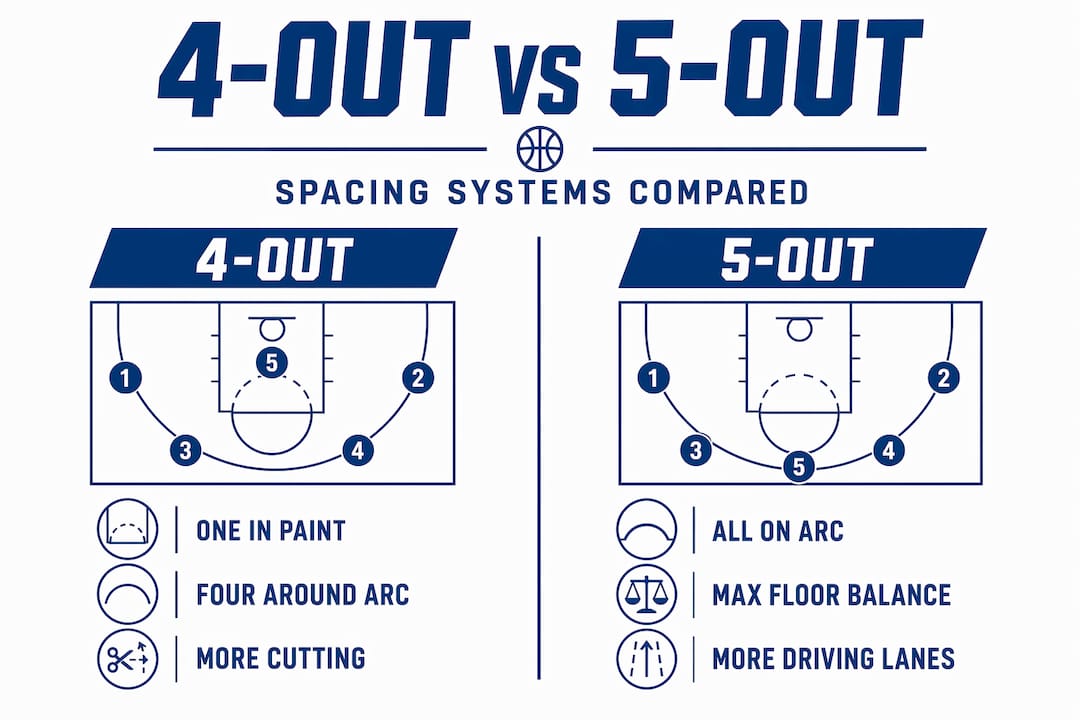
The two most widely used spacing formations today are 4-out and 5-out. Both keep multiple players on or beyond the three-point line, but the difference between them affects everything from defensive matchups to post-entry options.
Here is a direct comparison:
| Feature | 4-out | 5-out |
|---|---|---|
| Players on perimeter | 4 | 5 |
| Post presence | 1 player in paint | None |
| Driving lanes | Good | Maximum |
| Use of traditional big | Yes | No |
| Spacing requirement | Moderate | High |
| Best personnel fit | Teams with one skilled big | All-perimeter lineups |
The numbered breakdown below shows how each setup changes what your players are responsible for:
- In 4-out, one player (usually a forward or center) operates from the high or low post. The other four players spread the perimeter. This setup keeps a traditional scoring option in the paint while maintaining solid floor spacing.
- In 5-out, every player starts and operates on or beyond the arc. There is no designated post player. This maximizes driving lanes but requires all five players to be capable perimeter threats or willing cutters.
- Ball movement in 4-out often flows through the post as a hub. The big can catch, face up, pass out to shooters, or attack from the low block.
- Ball movement in 5-out relies on perimeter reads, skip passes, and continuous movement. When one player drives, the other four must relocate instantly to maintain spacing.
- Defensive adjustments differ significantly. Against 4-out, teams can still pack the lane with a help defender on the post player. Against 5-out, every defender must guard the arc and cannot sag freely.
As spacing-based offense research confirms, placing all players around the arc forces defenders to cover wider areas and directly increases the frequency of open looks.
Explore the full 5-out offense breakdown and 4-out offense strategies to understand how these systems fit different rosters.
Pro Tip: Do not choose your spacing system based on what looks modern. Choose it based on your personnel. If you have one skilled big who can score in the post, 4-out keeps that weapon active. If all five of your best players can handle the ball and shoot, 5-out unlocks maximum spacing. Forcing a system onto the wrong roster defeats the purpose entirely.
Understanding these formations sets up the bigger picture: how player skillsets interact with your spacing choices.
Player skills, roles, and finding shooting balance
Having the right formation is only part of the equation. The players who fill those spots determine how effective your spacing actually becomes. Research shows that spacing and shot efficiency interact directly: increasing the number of high-efficiency three-point shooters in a lineup is associated with higher offensive rating.
Here is a data summary coaches should understand:
| Shooters in lineup | Offensive rating impact | Defensive adjustment |
|---|---|---|
| 0 to 1 | Below average | Defenders sag freely |
| 2 | Average | Some help defense possible |
| 3 | Above average | Rotations stretched |
| 4 | High | Closeouts dominate |
| 5 | Maximum (if skilled) | Defense spread thin |
But here is the counterintuitive part. Stacking five three-point shooters does not automatically produce a great offense. If none of those players can create off the dribble, defenses simply go under screens and allow open looks without fear of drives. The threat of penetration is what makes spacing dangerous. Without it, spacing is just a formation.
The ideal roles to consider for maximum floor spacing include:
- Ball handler/creator: Drives into gaps and forces rotations. This player makes spacing dangerous.
- Spot-up shooters: Catch and shoot players who punish defenders who help. Two or three of these is ideal.
- Cutters and slashers: Players who move intelligently without the ball and attack close-outs.
- Stretch bigs: Forwards or centers who can shoot from beyond the arc and pull their defenders away from the paint.
- Post threat: Even one reliable post scorer changes how defenses position their help.
For youth teams, the goal should not be to copy pro systems. Youth players are still developing shooting mechanics. Prioritize proper spacing habits and floor awareness first. Shooting will come. If you force a 5-out system on a 12-year-old team with one shooter, you are setting up confusion, not success. The benefits of motion offense are particularly relevant here because motion systems teach spacing as a habit, not a rigid formation.
Once you have set the right system and skill balance, the next step is maximizing situational advantages through dynamic spacing.
Creating advantages: The art of dynamic spacing
Static spacing is a starting point. Dynamic spacing is what wins games. The goal is not just to spread out and wait. It is to use movement and positioning to create advantage situations where your offense outnumbers the defense in a specific area.
At the elite level, spacing-based coaching methodology emphasizes getting the defense to rotate and creating advantage situations such as 3-on-2, 4-on-3, or 5-on-4 reads rather than relying on scripted playbooks. Motion offense is the primary vehicle for teaching this.
Here is a numbered sequence of how spacing creates common advantage situations:
- Dribble penetration triggers the first rotation. A player attacks a gap and one help defender leaves their assignment to stop the drive.
- The first pass finds the open player. The driver kicks to a shooter or cutter in the vacated area.
- The second rotation creates another gap. The defense scrambles to recover and a second player becomes open.
- Spacing keeps the second player clean. Because all four other offensive players are spread out, only one additional defender can recover at a time.
- Decision-making decides the outcome. The player with the ball must read the rotation speed and choose correctly between the shot, the drive, or the next pass.
Motion offense trains players to flow into these reads naturally. It also prevents defenses from scripting their rotations because the offense does not run on a clock.
Pro Tip: Use small-sided games like 3-on-3 and 4-on-4 in practice with spacing rules enforced. For example, no two players can occupy the same zone simultaneously. This forces players to read each other and move to space automatically. It builds the habit faster than any walk-through drill.
Teaching players to fill behind a cutter, relocate after a dribble handoff, or rotate opposite to the ball handler’s penetration direction takes repetition. Use implementing motion offense as a reference for building those habits systematically.
With the main frameworks and strategies visible, it is time to consider deeper nuances and ongoing debates in basketball’s spacing evolution.
Debates, adjustments, and the future of offensive spacing
Spacing has transformed basketball over the past 15 years. Three-point attempts have skyrocketed. Teams now shoot more threes per game than at any point in NBA history. But not everyone believes this is purely a positive evolution.
“The game has become too predictable in some ways. When every team runs the same wide spacing and fires threes, the chess match disappears.” This critique, echoed by multiple longtime coaches and analysts, challenges the assumption that modern spacing represents the pinnacle of basketball strategy.
Phil Jackson and spacing critics have argued that today’s math-driven, wide-spacing approach can become mechanical and remove the creative elements that made the game compelling. Some proposals suggest altering court geometry, such as changing the corner three-point distance advantage, to reduce the incentive for stationary corner shooting and restore more dynamic interior play.
These debates matter for coaches because the rules around offense and defense do evolve. Leagues at youth and amateur levels regularly adjust three-point line distances and paint rules. What works in today’s pro game may not transfer directly to your level. Staying informed about these discussions helps you anticipate adjustments and build a system with enough flexibility to adapt.
The practical takeaway is this. Build spacing into your offense as a principle, not a script. Teams that understand why spacing works can adjust to rule changes or roster limitations far better than teams that just copy a formation they saw on TV.
Armed with these insights, here is our practical, hard-earned perspective on applying them to your coaching approach.
What most coaches overlook about offensive spacing
Here is the uncomfortable truth about spacing that many coaches do not want to hear. You can have perfect formation and still have terrible spacing. Spacing is a decision-making skill, not a floor position. If your point guard drives baseline and three players stand frozen at the arc waiting to see what happens, your spacing is broken even though everyone is technically “spread out.”
Real spacing means all five players are reading the same defense at the same time and moving in response to it. One player drives left. Another sees the help defender leave and cuts backdoor immediately. A third relocates to the vacated corner. A fourth lifts to the elbow to keep their defender occupied. That is coordinated spacing. That is what creates the open shot.
Many coaches over-index on formation and under-invest in off-ball teaching. Players who do not have the ball are the real engine of spacing. Their cuts, lifts, and relocations are what keep defenders busy and prevent help rotations.
Integrating creative sets and off-ball actions is also critical for preventing predictability. A team that only runs 5-out with spot-up shooters becomes very easy to defend once opponents scout it. Add back-cuts, pin-downs, and dribble handoffs into the spacing structure and defenders cannot cheat. Browse the motion offense types available to see how these off-ball actions integrate into a spacing-first system.
Finally, communication is underrated in spacing execution. Players need to talk. Quick verbal or hand signals that say “I’ve got corner” or “you go high” prevent two players from drifting to the same spot. Encourage improvisation within structure. Spacing works best when all five players are reading and reacting together, not waiting for permission to move.
Take your offensive spacing to the next level
Ready to put these spacing principles into action? Hoop Mentality has the tools you need to get started right away.

Build your spacing system with practical drills your players can run today. The Big Man Dual Action Drill develops the footwork and decision-making your post players need to operate effectively in 4-out systems. For full team implementation, the practice plan guide gives you a structured weekly framework to install spacing concepts progressively, so your players build the right habits without confusion. Both resources are built from real coaching experience and designed to save you time while giving your team a clear competitive edge.
Frequently asked questions
What is offensive spacing in basketball?
Offensive spacing is how players position themselves to maximize driving lanes, passing options, and open shots, making it harder for defenders to help and recover. 4-out/5-out structures are the most common modern approaches to achieving this.
How does spacing impact offensive efficiency?
Better spacing improves shot selection and offensive flow. Spacing and role fit interact directly, with more high-efficiency shooters correlating to higher offensive ratings, though balance between shooting threats and driving threats matters most.
Should youth teams focus on spacing like pro teams?
Youth teams should build spacing habits and floor awareness first, before worrying about matching pro formations. The goal at younger ages is developing the instinct to occupy the right areas, not replicating systems built around elite outside shooting.
What’s the debate about changing court geometry?
Some experts argue that today’s wide spacing and corner three-point advantage favors offense too heavily. Alternative geometry proposals suggest altering court dimensions or three-point distances to restore balance between offense and defense.