

TL;DR:
- The four-out offense combines perimeter spacing with a reliable inside threat, promoting balanced inside-out play. It emphasizes passing, cutting, and spacing discipline, making it adaptable across various levels and defensive systems. Proper implementation, focus on foundational rules, and consistent practice reveal its long-term tactical and player development benefits.
Many coaches spend hours debating spacing systems, running five-out sets one week and reverting to traditional post-heavy offenses the next. The confusion is real. The four-out offense, also called the 4-out-1-in, cuts through that noise by combining perimeter spacing with a reliable interior threat. This article breaks down exactly how four-out motion works, why it outperforms alternatives in key situations, how to adapt it for any level, and what pitfalls to avoid when you install it with your team.
Table of Contents
- What is four-out offense and how does it work?
- Key advantages: Why choose four-out over other spacing systems?
- Versatility: Adapting four-out offense for any team or defense
- Implementation pitfalls and coaching solutions
- Why most coaches underestimate four-out’s true value
- Take your offense further with Hoop Mentality resources
- Frequently asked questions
Key Takeaways
| Point | Details |
|---|---|
| Balanced inside-out attack | Four-out offense creates scoring chances both at the rim and from the perimeter by keeping one player inside. |
| Spacing principles matter | Proper spacing and disciplined cutting are essential for maximizing passing lanes and driving opportunities. |
| Versatility for all levels | The four-out offense adapts well to youth, high school, and advanced teams and excels against both man and zone defenses. |
| Avoid common pitfalls | Teaching and reinforcing off-ball movement rules prevent the typical spacing breakdowns that undermine the system. |
What is four-out offense and how does it work?
The four-out offense places four players on the perimeter and one player inside, typically in or near the post. That inside player is called the “one-in.” The perimeter players occupy the corners, wings, and guard spots, creating wide spacing that stretches the defense and opens driving lanes to the basket.
Understanding motion offense basics is a good starting point before running any four-out system. The four-out is a motion offense at its core, meaning the rules of player movement drive the offense rather than scripted plays. Players read defenders, make decisions based on what the defense gives them, and fill open spots created by their teammates.
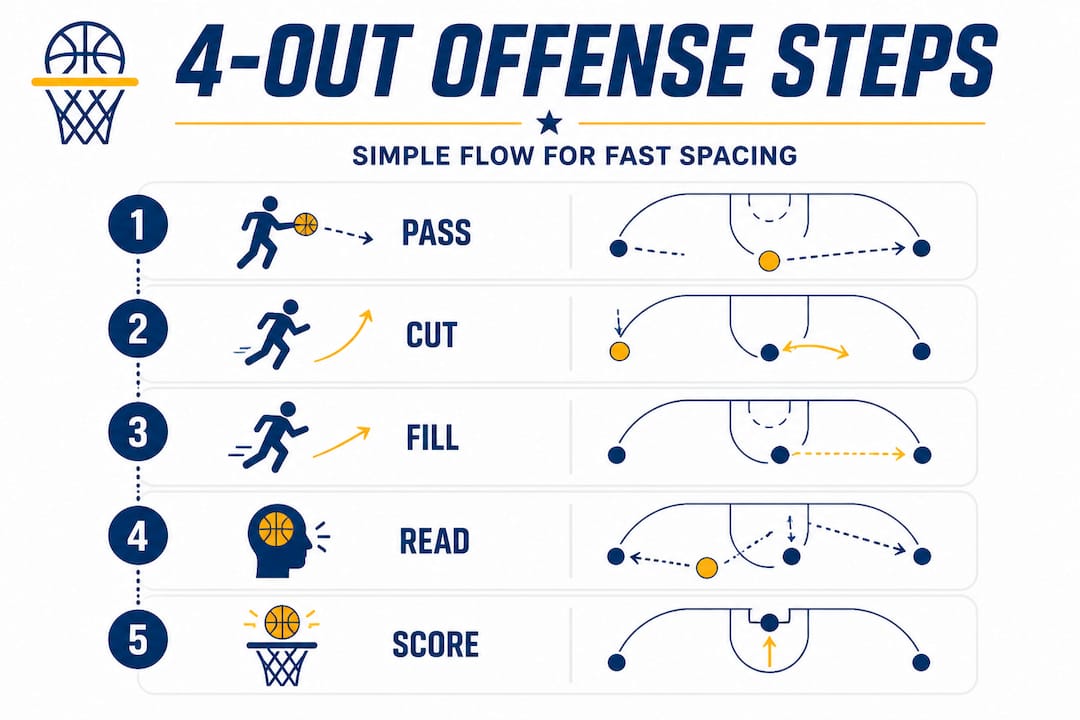
The foundational movement rule is simple: when you pass, you cut. After a perimeter player passes the ball, they basket cut toward the rim, looking for a return pass. If the pass does not come, they exit to the weak side and fill the empty spot. This keeps the floor balanced and the defense constantly reacting.
A few core actions define the system:
- Basket cut: After passing, the player attacks the rim directly, looking for a layup or short pass
- Fill: After cutting through, the player replaces an empty perimeter spot
- Backdoor cut: When a defender overplays, the perimeter player cuts behind them toward the basket
- Post feed and skip: The inside player receives post entry passes or becomes a skip pass relay to the weak side
As The Hoops Geek notes, a core methodology in many 4-out motion versions is disciplined off-ball movement tied to passing rules, including “when you pass, you must basket cut,” plus backdoor and curl-type actions to punish defenders who over-help.
Here is a quick breakdown of core actions and their purposes:
| Action | Trigger | Purpose |
|---|---|---|
| Basket cut | After any perimeter pass | Attack the rim, create easy scoring |
| Fill | After cutting through | Maintain floor balance |
| Backdoor cut | Defender overplays | Punish aggressive defense |
| Post feed | Guard to post entry | Inside scoring, draw double teams |
| Skip pass | Post catches, defense shifts | Attack weak side before defense rotates |
Teaching these actions in order matters. Start with simple pass-and-cut sequences before adding backdoor options and post feeds. Players who learn the rules step by step execute them under pressure far more consistently than those who try to absorb everything at once.
Key advantages: Why choose four-out over other spacing systems?
With the fundamentals in place, it is important to see why four-out might be the ideal choice over other formations.
The most direct comparison is four-out versus five-out. The 5-out offense removes all interior presence and spreads five players to the perimeter. That spacing can be devastating for teams with five perimeter threats, but most rosters do not have that depth. Four-out keeps at least one interior option, giving you a more flexible attacking structure.
According to The Hoops Geek, compared with a pure 5-out approach, 4-out offenses keep at least one interior scoring option available through post touches, which is important for teams that want a structured way to generate inside opportunities while still playing with perimeter spacing.
Here is a direct comparison:
| Feature | Four-out (4-out-1-in) | Five-out |
|---|---|---|
| Interior presence | Yes, one post player | None |
| Perimeter spacing | Strong (4 spots) | Maximum (5 spots) |
| Post scoring option | Available | Not available |
| Matchup flexibility | High | Requires 5 perimeter players |
| Defensive adjustment | Harder to double post | Easier to stay home on perimeter |
Three core advantages make four-out stand out:
- Inside-outside balance. The post player draws attention from the defense, which opens driving lanes and skip pass opportunities. You attack the rim and the three-point line from the same set.
- Versatile entry points. With four perimeter players, you have multiple ball handlers and passers who can initiate the offense. One player getting locked down does not shut you down.
- Built-in set play readiness. Because players occupy defined spots, running scripted actions like DHO (dribble handoff) sets, pin screens, or high ball screens off the four-out base is easy to signal and execute without resetting.
Pro Tip: Use your post player as a screener, not just a scorer. When the one-in sets flare screens for corner shooters or ball screens at the elbow, defenses face mismatches they did not prepare for. A post player who can screen and roll or screen and pop adds enormous unpredictability to the offense.
Versatility: Adapting four-out offense for any team or defense
With the advantages clear, let’s look at how the four-out approach scales across teams and against any defensive system.
One of the strongest arguments for the four-out offense is its adaptability. 4-out offenses are often chosen as a motion framework that can be run at multiple levels and can flex into different actions, including continuity, quick hitters, or screen-heavy sequences, while maintaining the base concepts of spacing and cutting.
Here is how it adapts across different levels and team types:
- Youth teams: Teach only pass-and-cut rules and basic fills. Keep the one-in role stationary until players understand perimeter movement. Simple reads, big rewards.
- Middle school teams: Add backdoor cuts and basic post feeds. Introduce the concept of reading the defender before cutting.
- High school teams: Layer in DHO actions, flare screens, and pin-down screens. Use the post player in pick-and-roll and pick-and-pop sets off the base.
- Advanced or college-level teams: Run quick-hitter sets out of four-out spacing, add secondary break options, and use the base to disguise plays within the motion framework.
- Small-roster or undersized teams: Place your most mobile big in the post role. The system does not require a traditional center if your player can catch, face up, and make simple passes.
Against man-to-man defense, the four-out punishes overplaying with backdoor cuts and exploits help defense rotations with skip passes. Check these man-to-man adaptation tips to sharpen your approach when facing aggressive defenders.

Against zone defense, the offense requires ball reversal speed and patience. Players must hit the gaps between zone defenders rather than cutting through traffic blindly. Quick passes stretch the zone’s rotation until a seam opens. For specific breakdowns, how to beat a 2-3 zone applies directly to four-out spacing principles.
As basketball.com.au notes, success versus zone depends on having perimeter players who can consistently maintain spacing and quickly reverse or pass to keep zone seams and closeouts rotating. That discipline is the difference between a four-out that cracks zones and one that stalls out.
Pro Tip: When facing a zone, add a “tag the elbow” rule. After a skip pass, the nearest perimeter player flashes to the high elbow. This pulls the top of the zone up and opens the baseline corner for a skip or the middle of the lane for a post feed.
Implementation pitfalls and coaching solutions
Understanding adaptability is crucial, but it is just as important to recognize where four-out systems often break down and how to coach through those challenges.
Three pitfalls show up repeatedly when coaches install the four-out offense:
- Spacing breaks. Players drift inside their spots, cluster near the ball, or forget to fill after cutting. When spacing collapses, driving lanes close and the entire movement system stalls. Defenders no longer have to rotate, which eliminates the main advantage of the offense.
- Over-dribbling. One player takes three or four dribbles before passing, which freezes off-ball movement. Other players stop their cuts because the timing is broken. The rule is simple: if you are not attacking the rim or initiating a screen action, pass and move.
- Poor timing of fills. Players cut and then hesitate before filling the open spot. That delay leaves gaps in the floor that the defense reads easily. Fills must happen immediately after a cut through, with urgency and decisiveness.
“The offense is vulnerable when spacing discipline breaks because the main advantage, creating driving lanes and backdoor angles, depends on defenders being stretched. Many coaching guides therefore stress teaching rules and progressions before adding options.” — The Hoops Geek
That quote captures the single most important installation principle. Build the foundation before the options. If players cannot execute simple teaching progressions for pass-and-cut reliably, adding screens and secondary actions only makes the problems worse.
Two practical solutions work well in practice. First, use shell drill variations where you reward correct spacing and movement with a point but reset on any spacing error. Players learn the standard quickly when it costs them. Second, use 3-on-3 or 4-on-4 small-sided games with the same movement rules. Removing one or two players forces everyone to fill spots and make decisions faster.
For more detailed offensive concepts for coaches, look at how spacing rules connect across different motion frameworks. And when you want to study offensive flow in practice, film your small-sided games and watch for the three pitfalls above. They are almost always visible within the first two possessions.
Pro Tip: Use constraints in practice to fix spacing breaks. Place cones on the floor marking the correct perimeter spots. If a player drifts inside a cone without actively cutting, stop play immediately. Physical markers make abstract spacing rules concrete and visible.
Why most coaches underestimate four-out’s true value
Here is the honest take, drawn from watching teams run this offense at every level. Most coaches who dismiss the four-out offense as a “beginner system” have never committed to running it the right way. They add too many options too early, skip the foundational progressions, and then blame the offense when it stalls.
The four-out is not simple. It looks simple because the setup is easy to draw. Four spots on the perimeter, one in the post. Clean. But the execution requires constant off-ball awareness, precise timing, and the willingness to make reads without the ball. That is harder to teach than any play diagram.
The coaches who get the most out of this offense are the ones who obsess over the rules, not the plays. They spend the first two weeks of installation doing nothing but pass-and-cut with no defense. They make spacing sacred. Only after that foundation is solid do they add screens, quick hitters, or zone adjustments.
There is also a mistaken belief that four-out does not work at higher levels because defenses get smarter. The opposite is true. Advanced defenses create the very conditions four-out is built to exploit. Aggressive help defense opens backdoor cuts. Overloading the post creates skip pass opportunities. The more a defense tries to take away one option, the more the others open up.
If you want to deepen this foundation further, the guide on implementing motion offense covers the progression steps that experienced coaches return to year after year, regardless of the system they run.
The real value of four-out is long-term. Teams that run it correctly develop players who can read the game, make decisions without the ball, and execute under pressure. Those are not just offensive skills. They are basketball skills that transfer to every system you will ever run.
Take your offense further with Hoop Mentality resources
If you are ready to implement four-out motion effectively, Hoop Mentality provides specialized tools and guides to help you coach with confidence.

Start with the Big Man Dual Action Drill to sharpen your post player’s ability to screen, cut, and finish, which are the exact skills your one-in needs to make the four-out system work. From there, the weekly practice guide helps you structure each session around your offense installation, spacing drills, and game preparation in a clear, organized format. Both resources are built by coaches for coaches, saving you time and keeping your team’s development on track.
Frequently asked questions
Is the four-out offense hard to teach at the youth or high school level?
No. The basic spacing and cutting rules can be taught progressively and are suitable for all levels. 4-out offenses are often chosen as a motion framework that runs at multiple levels when taught with the right progressions.
What skills do players need to run a four-out offense successfully?
Players should be able to make simple passes, read defensive positioning, and execute basket cuts and fills consistently. Disciplined off-ball movement and passing rules are the foundational requirements before adding any advanced actions.
How does four-out differ from five-out offense?
Four-out keeps one player inside as a post threat while five-out moves all players to the perimeter. As a result, four-out keeps at least one interior scoring option available, giving you more flexibility against defenses that take away the perimeter.
Can the four-out offense work against zone defenses?
Yes, but ball movement speed and perimeter discipline are essential. Success versus zone depends on perimeter players maintaining spacing and quickly reversing the ball to keep zone seams and closeout rotations open.