

Offensive rebounding is often dismissed as pure hustle, but this misconception overlooks the strategic depth behind securing second-chance points. Coaches who understand the technical aspects of positioning, timing, and teamwork can transform their team’s offensive rebounding from inconsistent effort into a reliable scoring weapon. This guide breaks down what offensive rebounding truly entails, reveals the key techniques that separate effective rebounders from average ones, and provides actionable drills to implement immediately. Whether you coach youth leagues or competitive programs, mastering these principles will give your team a measurable edge in controlling tempo and winning games.
Table of Contents
- What Is Offensive Rebounding And Why Does It Matter?
- Key Techniques And Skills For Offensive Rebounding Success
- Comparing Offensive And Defensive Rebounding: Strategies And Roles
- Effective Drills And Practice Plans To Improve Offensive Rebounding
- Enhance Your Coaching With Hoop Mentality Training Tools
- FAQ
Key takeaways
| Point | Details |
|---|---|
| Strategic skill | Offensive rebounding combines positioning, timing, and anticipation rather than relying solely on hustle. |
| Scoring impact | Securing offensive boards creates second-chance points that directly increase your team’s scoring efficiency. |
| Trainable techniques | Coaches can develop offensive rebounding through targeted drills focusing on boxing out, reading trajectories, and quick reactions. |
| Balanced approach | Integrating offensive and defensive rebounding strategies delivers optimal team performance and tempo control. |
What is offensive rebounding and why does it matter?
Offensive rebounding means securing the basketball after your own team misses a shot, giving you another opportunity to score without the opponent gaining possession. This skill directly impacts your ability to generate second-chance scoring opportunities and maintain offensive pressure throughout the game. Many coaches mistakenly view offensive rebounding as a pure effort play, something that happens when players simply want the ball more than their opponents. The reality involves technical elements like reading shot angles, anticipating where the ball will land, and using proper footwork to establish advantageous position before the ball comes off the rim.
Successful offensive rebounding accomplishes several critical objectives that extend beyond just getting extra shots. First, it demoralizes defensive teams who believe they’ve successfully stopped your initial offensive possession. Second, it reduces the number of possessions your opponent receives, effectively controlling game tempo in your favor. Third, it forces defenses to commit extra energy to boxing out, which can create fatigue and open up other offensive opportunities later in games. Teams that excel at offensive rebounding typically score 8 to 12 additional points per game compared to teams that struggle in this area.
The primary objectives of offensive rebounding include:
- Extending possessions to maximize scoring chances per trip down the floor
- Creating putback opportunities for high-percentage shots near the basket
- Drawing fouls on defenders who are out of position or reaching
- Disrupting opponent transition opportunities by keeping them in halfcourt defense
- Building offensive confidence and momentum during critical game moments
Understanding these objectives helps coaches design practice sessions that address the complete picture rather than just telling players to crash the boards harder. When you recognize offensive rebounding as a skill requiring basketball rebounding fundamentals like footwork, hand positioning, and spatial awareness, you can teach it systematically instead of hoping your players simply outwork the opposition.
Key techniques and skills for offensive rebounding success
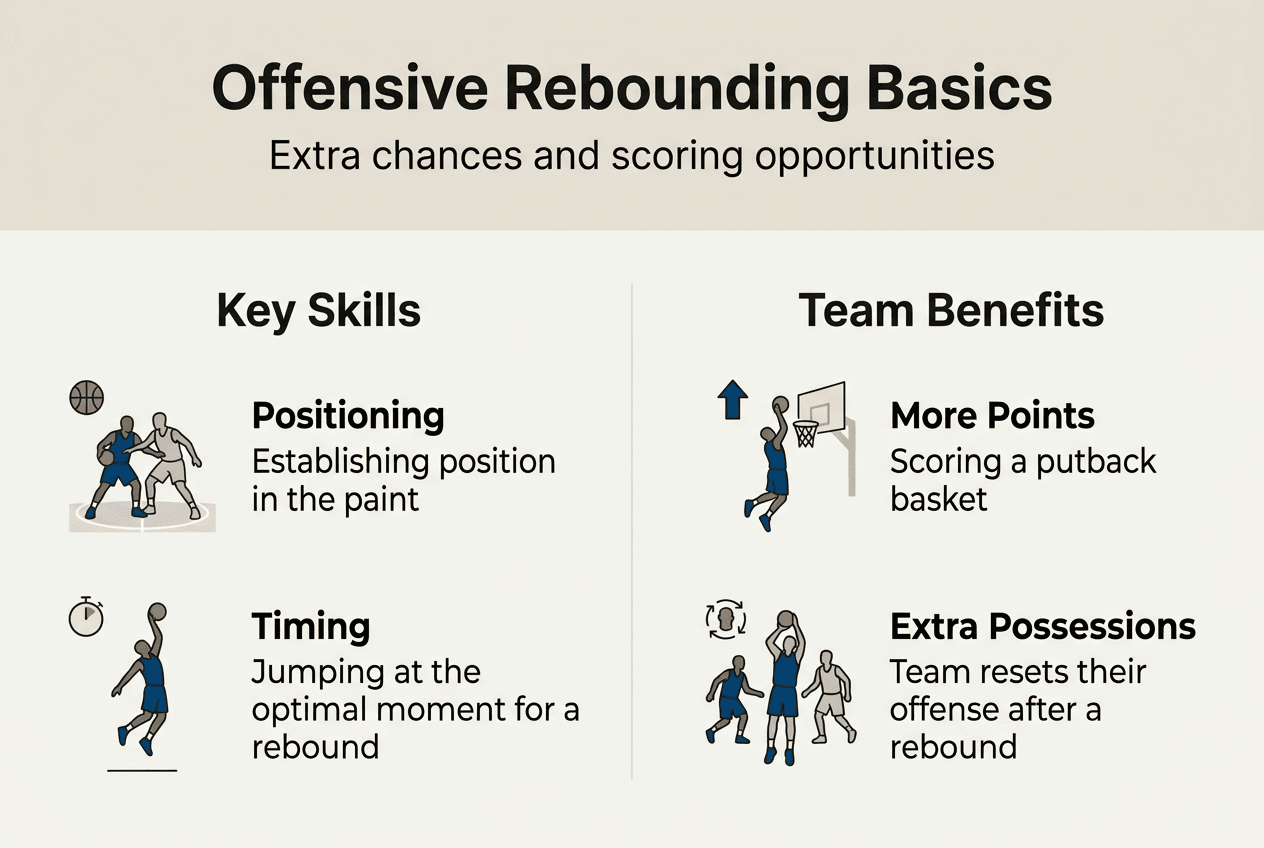
Developing elite offensive rebounders requires teaching specific techniques that give your players consistent advantages over defenders. The foundation starts with reading shot trajectory, which means recognizing whether a shot is short, long, or off to one side based on the shooter’s release point and arc. Players who master this skill position themselves where the ball will land rather than chasing it after the miss. This anticipation creates a half-step advantage that often makes the difference between securing the rebound and watching it bounce to a defender.
Boxing out works differently on offense than defense because you’re typically fighting against a defender who already has inside position. Offensive players must use essential basketball offense techniques like swim moves, where you quickly bring your arm over the defender’s shoulder to spin around them, or step-throughs that exploit gaps in their stance. Timing your move to coincide with the shot release prevents defenders from establishing solid contact before you make your counter move. Physical strength matters, but technique and timing matter more because even smaller players can secure offensive rebounds when they execute proper footwork and hand placement.
The essential skills every offensive rebounder must develop include:
- Hand-eye coordination to track the ball’s flight path and adjust position mid-movement
- Explosive jumping ability timed to reach the ball at its highest accessible point
- Quick second and third jumps to tip the ball back toward the basket or to teammates
- Spatial awareness to avoid offensive fouls while establishing rebounding position
- Communication skills to call out long rebounds that teammates are better positioned to secure
Pro Tip: Run quick reaction drills where you have players stand under the basket while a coach shoots from various spots, requiring them to read the trajectory and move to the landing spot within one second. This builds the anticipation skills that translate directly to game situations where split-second decisions determine rebounding success.
Positioning strategies separate good offensive rebounders from great ones. The triangle rebounding theory suggests that most missed shots rebound to one of three zones: weak side (opposite the shot), strong side (same side as the shot), or long (beyond the free throw line). Smart offensive rebounders identify which zone offers the best opportunity based on shot location and defensive positioning, then attack that space aggressively. Players who consistently position themselves in the right zone before the ball hits the rim secure far more offensive boards than athletes who simply rely on superior jumping ability or effort.
Comparing offensive and defensive rebounding: strategies and roles
Defensive rebounding focuses on securing possession after opponent misses to initiate your team’s transition offense and prevent second-chance points. The primary goal differs fundamentally because defensive rebounders already have inside position and aim to protect it, while offensive rebounders must create position against resistance. This positional advantage means defensive rebounding emphasizes maintaining contact and securing the ball cleanly, whereas offensive rebounding requires more aggressive pursuit and creative positioning tactics. Understanding these distinctions helps coaches teach appropriate techniques for each situation rather than applying a one-size-fits-all rebounding approach.
The strategic differences between offensive and defensive rebounding become clearer when examining specific aspects:
| Aspect | Offensive Rebounding | Defensive Rebounding |
|---|---|---|
| Primary Focus | Creating second-chance scoring opportunities | Ending opponent possessions and starting transition |
| Positioning | Attacking from outside position using counters | Maintaining inside position through contact |
| Timing | Anticipating miss location before shot release | Locating opponent and establishing box out |
| Physical Approach | Explosive moves to gain advantage | Sustained contact to deny access |
| Success Metric | Offensive rebound percentage and putback points | Defensive rebound percentage and fast break starts |
Balancing both rebounding types creates the most effective defensive rebounding strategies while maintaining offensive pressure. Teams that crash the offensive glass aggressively risk giving up transition opportunities if they fail to secure the rebound. Conversely, teams that send all five players back on defense sacrifice potential second-chance points and allow opponents to initiate their offense more quickly. The optimal approach typically involves designating specific players to pursue offensive rebounds based on their position when the shot goes up, while others retreat to prevent fast breaks.
Offensive rebounding provides several tempo advantages that complement strong defensive rebounding:
- Reduces total possessions in the game, which benefits teams with superior execution over athleticism
- Forces opponents to expend energy on boxing out rather than leaking out for transition opportunities
- Creates additional foul trouble for opponent big men who must defend multiple times per possession
- Generates momentum shifts that can swing close games during crucial moments
Coaches who teach players to recognize when to crash the offensive glass versus when to protect against transition develop more complete basketball IQ. This decision-making ability separates disciplined teams from those that either give up too many fast break points or fail to capitalize on second-chance opportunities. The key lies in establishing clear roles and communication systems that allow players to make split-second decisions based on game situations.
Effective drills and practice plans to improve offensive rebounding
Targeted drills accelerate the development of offensive rebounding skills by isolating specific techniques and creating repetition under game-like conditions. The following drills address the core competencies your players need to become effective offensive rebounders. Each drill should be performed with maximum intensity to simulate the physical contact and quick decisions required during actual games. Consistency matters more than occasional heroic efforts, so schedule these drills into your regular practice rotation rather than treating them as occasional add-ons.
Circle rebounding drill: Players form a circle around the basket while a coach or manager shoots from various spots. The player nearest where the ball lands must pursue it aggressively while others work to box them out. Rotate positions after each shot to ensure everyone practices both offensive and defensive techniques. This drill builds anticipation skills and teaches players to read shot trajectories quickly.
Two-on-two box out battles: Pair offensive and defensive players in the paint while a coach shoots from the perimeter. Offensive players must use proper technique to create rebounding position while defenders work to maintain their advantage. Emphasize legal contact and proper footwork rather than allowing pushing or holding. This controlled environment lets you correct technique issues immediately.
Tip drill progressions: Players line up on both sides of the basket and continuously tip the ball off the backboard without letting it touch the ground. Start with right hand only, then left hand only, then alternating hands. Progress to requiring players to jump and tip rather than reaching. This builds the hand-eye coordination and quick jumping ability essential for securing offensive rebounds in traffic.
| Drill Name | Duration | Focus Area | Player Count | Coaching Notes |
|---|---|---|---|---|
| Circle Rebounding | 8 minutes | Trajectory reading and pursuit | 6-8 players | Emphasize reading the shot before it hits rim |
| Box Out Battles | 10 minutes | Creating position against resistance | 4 players plus shooter | Correct illegal contact immediately |
| Tip Progressions | 6 minutes | Hand-eye coordination and jumping | 4-6 players | Require proper jumping form, not reaching |
| Weak Side Crash | 8 minutes | Weak side positioning and timing | 5 players plus shooter | Teach reading shot side to anticipate weak side |
| Putback Finishing | 10 minutes | Converting offensive rebounds to points | 3-4 players | Focus on quick, controlled finishes under pressure |
Structuring a complete practice session around offensive rebounding development:
- Begin with dynamic warmup including jumping and change of direction movements (5 minutes)
- Run tip drill progressions to activate hand-eye coordination and establish intensity (6 minutes)
- Execute circle rebounding drill to work on reading shots and pursuing aggressively (8 minutes)
- Progress to two-on-two box out battles for competitive positioning practice (10 minutes)
- Finish with five-on-five scrimmage emphasizing offensive rebounding with point rewards for secured boards (15 minutes)
- Cool down with free throws while discussing key teaching points from the session (5 minutes)
Pro Tip: Integrate offensive rebounding drills directly into your offensive sets during scrimmages by awarding bonus points for offensive rebounds or requiring teams to secure an offensive board before the possession counts. This creates game realism and reinforces that offensive rebounding is part of your offensive system, not a separate skill practiced in isolation.
Using a structured basketball practice plan template helps you organize these drills efficiently and track player progress over time. Document which players excel at specific techniques and which need additional work, then adjust your practice allocation accordingly. Consistent measurement and adjustment separate programs that improve steadily from those that plateau because they repeat the same drills without assessing effectiveness.
Enhance your coaching with Hoop Mentality training tools
Developing elite offensive rebounding requires more than understanding concepts. You need proven drills and organized practice plans that systematically build the skills your players need to dominate the glass. Hoop Mentality provides professional coaching resources specifically designed to help you implement effective training systems without spending hours creating materials from scratch.

Our big man dual action drill teaches post players the positioning and timing techniques that translate directly to offensive rebounding success. Combined with our comprehensive basketball practice plan template, you can structure efficient training sessions that maximize player development while keeping practices organized and purposeful. These resources are built from real coaching experience and designed to save you time while improving results. Visit Hoop Mentality to explore our complete collection of playbooks, drills, and strategy guides that help coaches at every level develop winning teams.
FAQ
What is offensive rebounding in basketball?
Offensive rebounding is recovering the ball after your own team misses a shot, creating additional scoring opportunities without giving possession to your opponent. It’s a fundamental skill for generating second-chance points and maintaining offensive pressure. Teams that excel at offensive rebounding typically score more points per game and control tempo more effectively than those that struggle in this area.
How can coaches train players to improve offensive rebounding?
Use drills that emphasize positioning, timing, and boxing out techniques specific to offensive situations. Incorporate game-like rebounding scenarios during scrimmages to build anticipation skills under pressure. The big man dual action drill provides an excellent framework for developing these skills systematically. Consistent practice with immediate feedback produces faster improvement than occasional emphasis.
What’s the difference between offensive and defensive rebounding?
Offensive rebounding focuses on regaining possession after your team’s missed shot by creating position against defenders who typically have inside advantage. Defensive rebounding prioritizes stopping opponent second-chance opportunities by maintaining inside position and securing the ball cleanly. The defensive rebounding guide explains how these complementary skills work together to create complete rebounding systems. Both require different techniques and mental approaches despite sharing some fundamental skills.
How important is offensive rebounding to winning games?
Effective offensive rebounding significantly increases second-chance points and game control, often providing the margin of victory in close contests. Teams that excel in offensive rebounding control tempo, demoralize opponents, and create additional scoring opportunities that compound throughout the game. Research shows teams with superior offensive rebounding percentages win at higher rates because they maximize possessions and limit opponent transition opportunities. The cumulative effect of extra possessions often determines outcomes in competitive games where execution matters most.