

Most american basketball teams underestimate how much a single rebound can shift momentum. Securing defensive rebounds is about more than size or height, yet even skilled players often lack fundamental technique. Mastering defensive rebounding turns chaos into opportunity and gives your team a measurable edge. This guide shows coaches exactly how to evaluate and strengthen every aspect of their team’s rebounding approach, drawing on proven methods that drive real improvement.
Table of Contents
- Step 1: Assess Your Team’s Rebounding Fundamentals
- Step 2: Establish Key Defensive Rebounding Positions
- Step 3: Teach Effective Box-Out and Pursuit Techniques
- Step 4: Implement Progressive Rebounding Drills in Practice
- Step 5: Evaluate and Reinforce Team Rebounding Performance
Quick Summary
| Essential Insight | Clarification |
|---|---|
| 1. Assess individual rebounding skills | Use drills to evaluate players’ rebounding techniques, including boxing out and vertical leap, for tailored coaching. |
| 2. Establish strategic player positioning | Arrange players in a triangular formation to optimize court coverage and improve rebounding effectiveness. |
| 3. Teach proactive box-out techniques | Focus on aggressive box-out movements, ensuring players understand they must compete for rebounds actively. |
| 4. Implement progressive practice drills | Design drills that gradually increase in complexity to build muscle memory and situational awareness during rebounds. |
| 5. Evaluate performance consistently | Combine statistical analysis with film reviews to assess individual and team rebounding effectiveness and enhance accountability. |
Step 1: Assess your team’s rebounding fundamentals
Assessing your team’s defensive rebounding skills requires a strategic and comprehensive approach. Coaches need a systematic method to evaluate their players’ current rebounding capabilities, identifying strengths and areas for improvement before implementing targeted training.
Start by conducting a comprehensive rebounding drill assessment that measures key performance metrics. Set up a specific drill where players practice boxing out and securing rebounds from various court positions. Track critical data points including rebound attempts, successful rebounds, positioning, vertical leap, and physical contact effectiveness. Focus on individual player performance as well as team coordination. Players should demonstrate fundamental techniques like proper body positioning, anticipating ball trajectory, using leverage, and maintaining aggressive mentality during rebound opportunities.
Another crucial assessment involves analyzing game film to understand real world rebounding performance. Review defensive sequences where rebounds occur, paying close attention to player positioning, reaction time, and execution of boxing out techniques. Basketball Defensive Concepts: Complete Guide for Coaches provides additional insights into defensive strategy that can enhance your rebounding evaluation process.
Warning: Never assume all players naturally understand rebounding fundamentals. Some athletes require explicit instruction and repetitive practice to develop consistent rebounding skills. Break down techniques into granular components and provide individualized feedback to help each player improve.
Step 2: Establish key defensive rebounding positions
Establishing strategic defensive rebounding positions is crucial for transforming your team’s ability to secure possession and control the game. This process requires careful placement and understanding of each player’s specific role during defensive rebounds.
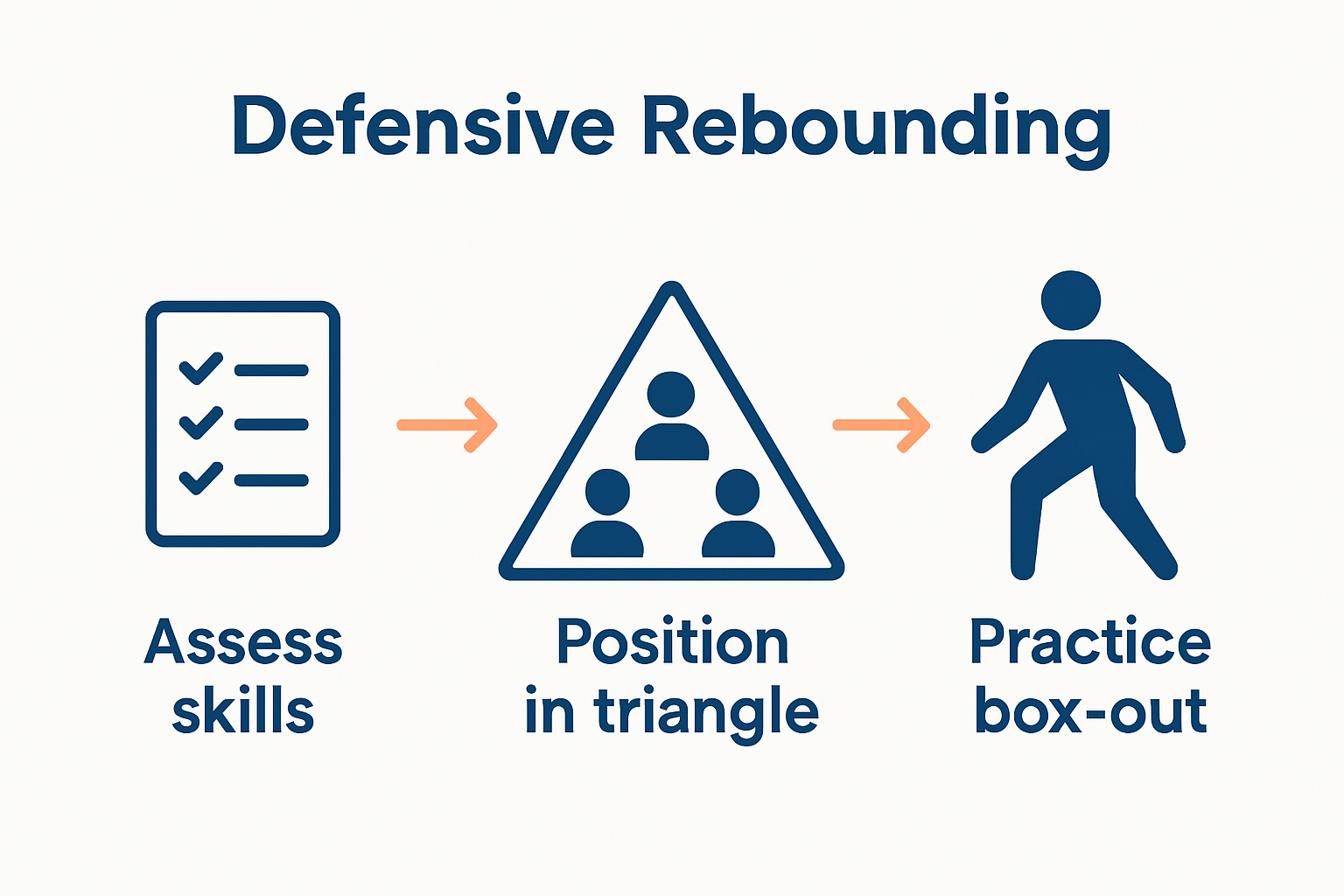
According to cdn2 Strategic Rebounding Document, effective defensive rebounding starts with precise player positioning. Players should be arranged in a triangular formation that maximizes court coverage. The center typically positions closest to the basket, responsible for blocking out larger opponents and securing immediate rebounds. Wing players should position themselves at 45degree angles from the basket, ready to box out perimeter players and quickly transition into potential fast break opportunities.
Implement a systematic approach to teaching these positioning techniques. Practice drills that simulate game scenarios, helping players understand their spatial relationships and develop muscle memory for optimal rebounding positioning. How to Teach Your Players to Play Good Defense in Basketball offers additional insights into defensive skill development.
Warning: Poor positioning can sabotage even the most athletic team’s rebounding efforts. Players must understand that successful rebounding is more about technique and anticipation than raw physical ability.
 Consistent practice and clear communication are key to mastering defensive rebounding positions.
Step 3: Teach effective box-out and pursuit techniques
Teaching effective box-out and pursuit techniques is fundamental to developing a strong defensive rebounding strategy. Coaches must focus on breaking down complex movements into simple, repeatable actions that players can quickly master and execute under game pressure.
Begin by demonstrating the core mechanics of boxing out. Players should learn to establish a wide, low stance with their back to the opponent, using their body as a physical barrier to prevent access to the potential rebound. Emphasize key technical points like keeping feet shoulder width apart, bending knees, and maintaining a strong core position. 7 Essential Basketball Defense Tips for Coaches provides additional context for developing defensive fundamentals.
Practice pursuit techniques through progressive drills that simulate game scenarios. Start with stationary box out drills, then progress to moving drills that require players to quickly change direction, maintain body position, and anticipate ball trajectory. Teach players to read the shooter, predict potential rebound angles, and react instantly.
Players must understand that successful rebounding combines physical technique with mental anticipation.
Warning: Avoid teaching box out techniques as passive blocking. Emphasize aggressive positioning that creates active opportunities for securing the basketball. The best defensive rebounders treat each potential rebound as a competitive moment requiring full commitment and explosive movement.
Step 4: Implement progressive rebounding drills in practice
Developing a comprehensive rebounding practice strategy requires methodical, progressive drills that challenge players and build muscle memory. Coaches must design a structured approach that gradually increases complexity and demands more sophisticated techniques from players.
Start with foundational stationary drills that focus on core rebounding mechanics. Begin with basic box out positions where players practice establishing proper body positioning without movement. Basketball Skills Development Workflow for Coaches recommends creating drill sequences that build from simple to complex skills. Progress to dynamic drills that introduce movement patterns like quick direction changes, maintaining defensive position while tracking the ball, and explosive jumping techniques.
Design multi phase drills that simulate real game scenarios. Include exercises that require players to rebound from different court positions, practice transitioning from defensive rebounding to offensive fast breaks, and develop situational awareness. Incorporate competitive elements by creating small sided games where players earn points for successful rebounds, boxing out, and creating team possession opportunities.
Warning: Avoid monotonous repetition. Players learn best when drills feel challenging and engage their competitive instincts. Mix up drill formats, introduce unexpected elements, and keep practice sessions dynamic to maintain player motivation and skill development.
Step 5: Evaluate and reinforce team rebounding performance
Evaluating team rebounding performance requires a systematic approach that combines quantitative metrics with qualitative observations. Coaches must develop a comprehensive assessment strategy that goes beyond basic statistical tracking and delves into the nuanced aspects of defensive rebounding effectiveness.
According to the cdn2 Strategic Rebounding Document, effective performance evaluation involves tracking individual and team rebounds per position, analyzing player positioning, and assessing overall court coverage. Implement a detailed tracking system that captures metrics like defensive rebound percentage, contested versus uncontested rebounds, and transition opportunities created from successful rebounds. Understanding Basketball Evaluation Criteria for Coaches can provide additional insights into comprehensive performance assessment.
Conduct regular film review sessions where players can visually analyze their rebounding techniques. Use these sessions to highlight successful defensive positioning, identify areas for improvement, and celebrate individual and team progress. Create a feedback loop that allows players to understand their specific strengths and weaknesses, promoting continuous skill development and team accountability.
Warning: Avoid reducing performance evaluation to pure numbers. While statistical tracking is important, the most effective coaches understand that rebounding is as much about technique, effort, and team chemistry as it is about raw statistical output. Emphasize the intangible qualities that make a great rebounder technical skill, anticipation, and competitive spirit.
Master Defensive Rebounding with Proven Coaching Resources
Struggling to develop consistent defensive rebounding skills and solid team positioning? This guide highlights how mastering fundamentals like box-out techniques and strategic placement can transform your defense but executing these concepts in practice requires clear drills and systematic evaluation. If your goal is to build a confident, aggressive rebounding squad that dominates possession, you need resources designed to save time and sharpen your coaching impact.

Discover detailed playbooks, progressive drills, and strategy guides in our Basketball Guides – Hoop Mentality and refine your athletes’ rebounding skills with targeted exercises from Basketball Drills - Hoop Mentality. Visit Hoop Mentality now to access professional coaching tools created from real experience. Take action today and empower your team to control the boards, improve communication, and win more games with confidence.
Frequently Asked Questions
How can I assess my team’s rebounding fundamentals effectively?
To assess your team’s rebounding fundamentals, conduct a comprehensive rebounding drill assessment focusing on key performance metrics. Implement drills that measure rebound attempts, successful rebounds, and player positioning. Track these metrics over several practices to identify areas for individual and team improvement.
What are the key defensive rebounding positions my players should know?
Players should be arranged in a triangular formation with the center closest to the basket and wing players positioned at 45-degree angles. Teach players their specific roles during defensive rebounds to maximize court coverage and position themselves correctly against opponents. Practice these positions regularly to build their spatial awareness.
How can I teach box-out and pursuit techniques to my players?
Begin by demonstrating core boxing-out techniques, emphasizing proper stance and aggressive positioning. Follow up with progressive drills that simulate game scenarios, allowing them to practice changing directions and anticipating ball trajectories. Reinforce these techniques consistently through practice sessions to build competency.
What types of drills should I implement to improve defensive rebounding?
Implement a structured practice regime that includes stationary drills for foundational skills, followed by dynamic drills that simulate game conditions. Create multi-phase drills that require players to transition from defense to offense after securing rebounds. Aim to keep drills engaging and challenging for optimal skill progression.
How should I evaluate my team’s rebounding performance over the season?
Evaluate your team’s rebounding performance by tracking metrics such as defensive rebound percentage and contested versus uncontested rebounds. Conduct regular film review sessions to visually analyze techniques, identifying strengths and weaknesses. Create a feedback loop to promote continuous development throughout the season.
How do I keep my players motivated during rebounding drills?
Keep players motivated by mixing up drill formats and introducing competitive elements to practice sessions. Incorporate small-sided games where players earn points for successful rebounds and boxing out. This approach keeps drills engaging and encourages healthy competition to enhance skill development.