

TL;DR:
- Early offense is a mental approach focused on attacking before the defense forms, applicable at all levels. It emphasizes quick decision-making, effective spacing, and reading advantage windows within seconds of gaining possession. Implementing structured drills and understanding its distinction from transition offense can significantly improve team offensive efficiency.
Early offense is one of the most misunderstood concepts in basketball coaching. Many coaches assume it belongs only to track-meet teams that want to push the pace at all costs. That is simply wrong. Early offense is about attacking the defense before it organizes, and that means reacting within seconds of gaining possession so your players get open looks instead of grinding through a set defense. Whether you coach youth basketball or a competitive high school program, the principles apply. This article gives you a clear framework, practical actions, and ready-to-use planning tools.
Table of Contents
- Understanding early offense: Definition and core principles
- Transition offense vs. early offense: Key differences
- Early offense actions: Building advantages before defenses set
- Integrating early offense into practice: Drills and planning tips
- Why early offense matters more now than ever
- Boost your team’s early offense with proven tools
- Frequently asked questions
Key Takeaways
| Point | Details |
|---|---|
| Attack before defense sets | Early offense means capitalizing before defenses can organize to get better shots. |
| Transition vs. early offense | Transition attacks seek fast break layups, while early offense extends quick play as defenses recover. |
| Actions create advantages | Quick screens, spacing, and passing are critical for converting early offense opportunities. |
| Drills embed good habits | Regularly practicing decision drills builds instincts to recognize and seize early offense windows. |
Understanding early offense: Definition and core principles
Early offense is not a style. It is a mindset. The goal is simple: attack before the defense has a chance to get organized and positioned.
Early offense advances the ball into front-court areas in 2 to 3 seconds after gaining possession, creating quick, uncontested scoring chances that a set defense would eliminate.
When you think about it that way, every possession becomes an opportunity. You rebound, you push, and within three seconds, your players are looking for the best available shot. That is very different from catching the ball, walking it up, and calling a set play.
The core principles every coach needs to understand are:
- Speed of decision, not speed of movement. Your slowest player can run early offense if they make fast decisions. Recognition matters more than athleticism.
- Ball advancement is the trigger. The moment you gain possession, the attack clock starts. The outlet pass, the push up the sideline, and the rim read all happen inside that 2 to 3 second window.
- Spacing creates the opportunity. Players off the ball need to fill lanes, not cluster near the ball. Open floor means open shots.
- Early offense connects directly to transition offense basics. If you already teach transition principles, early offense is the natural upgrade that gives those principles more structure.
One of the fastest ways to improve offensive efficiency is to stop defaulting to your half-court sets on every possession. When defenders are still backpedaling, your players should already be attacking the paint or pulling up for mid-range jumpers. That is where early offense creates its biggest advantage.
Transition offense vs. early offense: Key differences
Coaches often use these two terms interchangeably. They are related, but they are not the same thing. Getting this distinction right will sharpen your playbook and your teaching.
Here is a side-by-side look at how the two concepts differ:
| Feature | Transition offense | Early offense |
|---|---|---|
| Trigger | Change of possession | Any possession gain |
| Primary goal | Numbers advantage | Catch defense unsettled |
| Structure level | Low, react to what is there | Higher, recognized patterns |
| Timing | Immediate fast break | First 2 to 4 seconds |
| Flows into | Early offense or set play | Half-court set if needed |
| Best use case | Clear 3-on-2 or 2-on-1 | Defense recovering or disorganized |
Some coaches view early offense as transition-first, while others focus on exploiting half-court early advantages. Both approaches are valid, and mixing them is usually the most effective method.
Here is how the two concepts connect in a real possession sequence:
- Your team secures a defensive rebound or gains possession via turnover.
- The point guard receives the outlet pass and pushes quickly up the floor. This is transition offense.
- The defense scrambles back but is still recovering. Your players read the floor and attack mismatches or gaps. This is early offense.
- If the defense gets set before you create a good look, you flow into your half-court offense.
The key is teaching players to recognize which phase they are in. That recognition is what separates smart offensive teams from ones that either rush bad shots or stall unnecessarily into a set defense. Transition drills that build this recognition are essential for bridging the two phases.
Understanding when to push and when to settle is a skill. It takes deliberate repetition in practice before players read it instinctively in games.
Early offense actions: Building advantages before defenses set
Now we get into the specific actions your players can use. Early offense is not random. It has repeatable patterns that your team can learn and execute consistently.
Here are the most common early offense actions and what each one accomplishes:
| Action | Description | Advantage created |
|---|---|---|
| Drag screen | Big sets screen for ball handler in transition | Creates guard-big mismatch before defense sets |
| Quick post seal | Big seals their defender on the move | Forces defense to help, opens perimeter |
| Slot-to-slot pass | Fast skip pass across the top of the key | Shifts defense laterally, creates open catch-and-shoot |
| Rim run | Big sprints to the basket on the outlet pass | Forces rim attention, creates kick-out opportunities |
| Wing attack | Wing player attacks closeout from trailer pass | High-percentage penetration before help defense sets |
Early offense creates opportunities for quick jump shots, penetration layups, and kick-out passes to open shooters. Each action above targets one of those three outcomes directly.
Key principles for executing these actions well:
- Spacing first. Players must hit their designated lanes before the ball advances. Bunching kills every early offense action before it starts.
- Decision speed over dribble speed. Two hard dribbles and a quick pass beats three dribbles and a contested drive every time.
- Read the closeout. On a kick-out pass, the receiver should immediately read whether the defender is closing hard (drive) or hanging back (shoot).
- Big men must be mobile. The drag screen and rim run only work if your big is moving. This ties directly into implementing motion offense principles for your front-court players.
Your offensive system should define when players flow into offensive sets workflows if no early advantage appears. That transition from early offense to half-court play needs to be seamless and pre-rehearsed.
Pro Tip: During film sessions, pause possessions at the 2-second mark after your team gains possession. Ask players to identify whether an advantage window existed and whether it was taken. This single habit builds the recognition skill faster than any drill alone.
The best early offense teams are not the fastest. They are the most decisive. If you want man-to-man offense tips that complement early offense principles, the same decision-making framework applies across both contexts.
Integrating early offense into practice: Drills and planning tips
Theory only helps if your players can execute it on the floor. Here is a step-by-step approach to building early offense habits into your practice routine.
Step 1: Establish the language first. Before players can execute, they need shared vocabulary. Introduce terms like “outlet,” “push,” “slot,” “drag,” and “rim run” in your first early offense session. Use the whiteboard. Keep it simple. Clear language reduces decision time on the floor.
Step 2: Start with 3-man weave with quick outlet. Run the classic 3-man weave, but add a defensive rebounder who outlets immediately on catching the ball. This forces the three players to read the floor in real time after a simulated rebound. Keep score of how many times the first shot attempt comes within four seconds. That scoring mechanism adds competitive intensity.
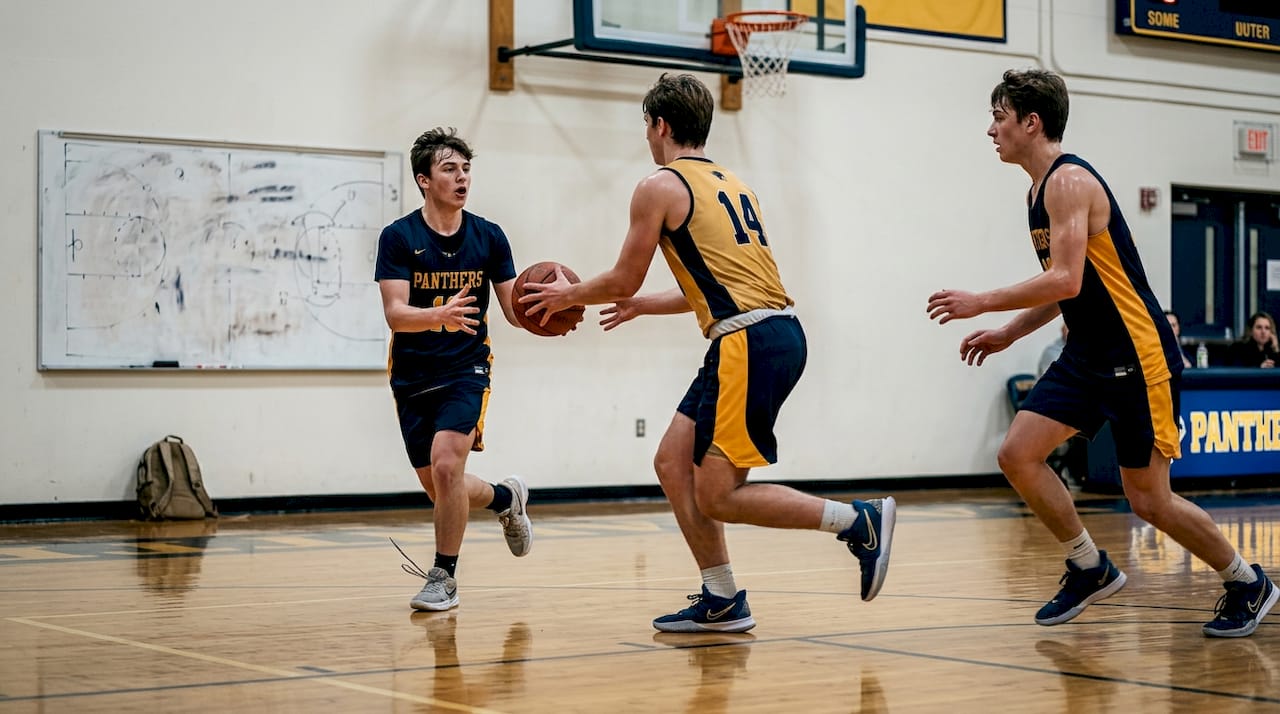
Step 3: Run 5-on-0 early offense flow. Five players simulate gaining possession at half-court, then execute your early offense actions in sequence without defense. Repetition here builds muscle memory for spacing and timing. Call out which action to trigger so players learn the decision process, not just the movement.
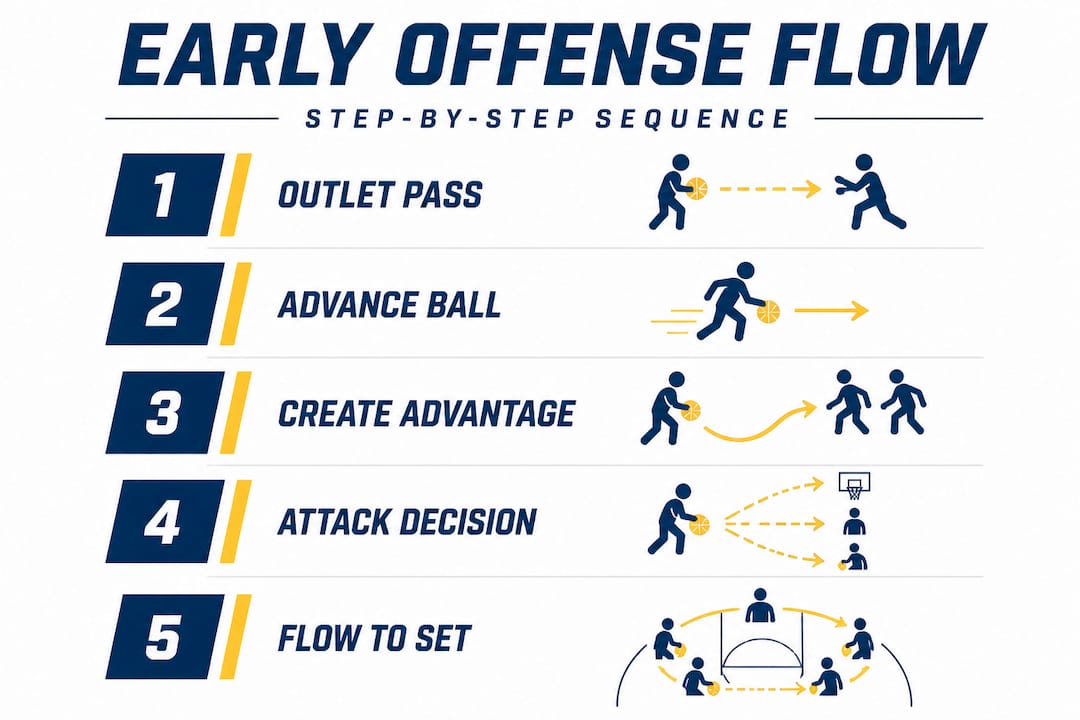
Step 4: Add time-to-score challenges. Set a 5-second shot clock from the moment the outlet pass is thrown. Any shot taken after 5 seconds is automatically a turnover. This constraint forces players to attack early and builds the urgency that translates to game pace.
Step 5: Introduce live reads with passive defense. Add defenders who contest but do not steal. Players practice reading the advantage window, making quick passes, and finishing under low-resistance pressure. Gradually increase defensive intensity over multiple practices.
Step 6: Use full live scrimmage with tracking. During scrimmages, have a coach track every possession for whether an early offense opportunity was available and whether it was used. Share those numbers after practice. Data drives awareness.
Early offense works best when players recognize quick-attack opportunities and make unselfish, decisive passes. Drills need to train both the recognition and the unselfishness simultaneously.
For adaptations by age group:
- Youth players (8 to 12): Focus on the outlet pass and one lane-fill action only. Keep it two options maximum. Connect drills to basketball warm-up drills to build habits early in practice before complexity increases.
- Middle school (12 to 15): Add the drag screen and rim run. Introduce reading closeouts on kick-out passes. Start tracking decision speed with the 5-second challenge.
- High school and above: Run the full action menu. Use film, player tracking, and decision cue drills to sharpen recognition. Explore fundamental offense techniques to make sure your players have the skill base to execute every action.
Conditioning matters too. Early offense demands players who can sprint, make decisions under fatigue, and recover quickly. Basketball cardio drills are a direct support tool, since players who fade physically also fade mentally in the advantage window.
Pro Tip: Create a “decision cue” drill where players call out the action they are choosing before they execute it. Saying “drag” or “slot” out loud before the action trains the conscious recognition pathways that eventually become automatic. It feels awkward at first. It works.
Why early offense matters more now than ever
Here is the part most coaching resources skip. Early offense is not a trend. It is a structural response to how defenses have evolved.
Old-school coaching wisdom treated early offense as risky. Coaches worried about turnovers, poor shot selection, and undisciplined play. And yes, unstructured pushing absolutely produces those outcomes. But the game has changed. Defenses are more organized, more physical, and more scheme-heavy than ever, even at the youth level. Grinding through a set defense is no longer the safe option. It is often the harder option.
Modern teams at every level are running more defensive schemes, switching on more actions, and scrambling faster to eliminate easy looks in the half-court. The real risk now is the opposite of what old-school coaches feared. If you always wait for the defense to set, you are giving them exactly what they need to execute their game plan against you.
Early offense flips that. You attack when they are disorganized. You create advantages that your half-court sets can never manufacture. You reduce the physical wear on your players by converting quick possessions instead of grinding through 15-pass sets. And you raise basketball IQ across your entire roster because players are making real reads in real time every possession.
The research and evolution in modern offense concepts backs this up. The best offensive teams are not the ones running the most sets. They are the ones reading the defense faster and acting on what they see.
Teaching early offense does not mean abandoning structure. It means adding a layer of intelligence before your structure kicks in. Players who learn to read advantage windows become better half-court players too, because they understand why certain actions create advantages, not just what actions to run.
If you have avoided early offense because your team is not athletic enough or fast enough, rethink that assumption. Early offense is a decision-making system, not a speed system. Any team can learn it. Most teams will score more because of it.
Boost your team’s early offense with proven tools
You have the framework. Now put it into action.

Hoop Mentality has the resources to help you move from concept to execution without spending hours building materials from scratch. The basketball practice plan template gives you a ready-to-use structure for organizing early offense drills, spacing work, and decision-cue training into a complete practice session. It saves time and keeps your team focused on development, not logistics. For coaches looking to develop front-court players who can run drag screens, rim runs, and post seals effectively, the Big Man Dual Action Drill is a direct-fit tool that builds those specific skills. Explore both resources and start building early offense habits today.
Frequently asked questions
What is the main purpose of early offense in basketball?
Early offense aims to catch the defense off guard and create high-percentage scoring chances before the opponent settles into their defensive scheme. The goal is simpler shots taken sooner, not just faster play.
How is early offense different from a fast break?
A fast break targets clear numerical advantages like 2-on-1 or 3-on-2, while early offense continues attacking even when numbers are even but the defense is still recovering and disorganized. Early offense is more structured and applies to a wider range of situations.
What are some easy drills to teach early offense?
Start with the 3-man weave with outlet reads, 5-on-0 early offense flow, and time-to-score challenges using a 5-second shot clock from the outlet pass. These three drills build lane recognition, spacing habits, and decision speed without needing complex setups.
Why do some coaches avoid early offense tactics?
Many coaches believe early offense creates turnovers or only works for athletic teams, but structured early offense is built on decision-making and spacing, not raw speed. Any squad at any level can increase scoring efficiency by learning to identify and attack advantage windows before the defense organizes.
Recommended
- How to Implement Motion Offense for Dynamic Team Play – Hoop Mentality
- Continuity Offense: Improving Team Scoring Efficiency – Hoop Mentality
- Basketball Offensive Sets Workflow for Team Success – Hoop Mentality
- Triangle Offense Explained: Benefits, Setup, Execution – Hoop Mentality
- How Smart Team Selection Transforms Fantasy Tennis