

TL;DR:
- Attacking the paint results in higher-percentage shots and more foul opportunities.
- Multiple offensive methods like transition, cuts, and dribble penetration make paint attacks effective.
- Tracking paint touches and efficiency helps evaluate and improve offensive paint strategies.
Paint attacks are the most underrated strategic tool in basketball offense. Coaches who prioritize getting to the rim consistently put their teams in better scoring positions than those who rely on pull-up jumpers or contested threes. Research confirms that paint shots outperform mid-range attempts in both standard and clutch game situations. Yet many teams still treat paint attacks as a secondary option. This guide breaks down why attacking the paint matters, how to execute it across multiple offensive methods, how to train it effectively, and how to measure results with real data.
Table of Contents
- Why attacking the paint matters in basketball offense
- Key methods for attacking the paint
- Teaching paint penetration: Drill design and practice strategies
- Analytics and tracking: Measuring paint attack effectiveness
- A fresh perspective: Beyond paint entry—coaching for efficiency, reads, and team identity
- Accelerate your team’s paint attack with Hoop Mentality resources
- Frequently asked questions
Key Takeaways
| Point | Details |
|---|---|
| Paint attacks boost scoring | Getting the ball into the paint reliably leads to higher shooting percentages and more scoring chances. |
| Multiple methods work | Effective paint attacks include drives, cuts, rebounding, and transition—not just post-ups. |
| Drill design is critical | Practice drills should mimic real game scenarios to teach true paint penetration and decision-making. |
| Efficiency trumps frequency | Tracking paint touch efficiency gives more actionable insights than simply counting entries. |
| Analytics drive improvement | Using data and tracking tools helps coaches pinpoint the impact of paint attacks on team performance. |
Why attacking the paint matters in basketball offense
Paint attacks are not just about posting up your biggest player. The term covers every offensive action that gets the ball or a player into the lane area near the basket. That includes transition runs, dribble penetration, back cuts, flashes to the elbow, and offensive rebounds. Each method creates a different defensive problem, and that variety is exactly what makes a strong paint-attack system so hard to stop.
The statistical case is clear. Paint shots convert at significantly higher rates than mid-range jumpers and are especially efficient in high-pressure moments during games. Mid-range attempts, often praised as “smart” basketball, actually produce some of the lowest points-per-possession numbers of any shot type. A layup or short floater in the lane simply gives your team a better chance to score on every single possession.
Here is a quick look at how shot location affects efficiency:
| Shot type | Approximate FG% | Points per attempt (est.) |
|---|---|---|
| At the rim (0 to 3 ft) | 60 to 70% | 1.20 to 1.40 |
| Short mid-range (3 to 10 ft) | 38 to 44% | 0.76 to 0.88 |
| Mid-range (10 to 16 ft) | 40 to 46% | 0.80 to 0.92 |
| Three-point (above the break) | 35 to 38% | 1.05 to 1.14 |
The rim area wins by a wide margin. And beyond the shot itself, paint attacks generate foul calls, which give your team free throws at one of the most efficient points-per-possession rates in the game.
“Getting into the paint changes what the defense can do. Every rotation opens a gap somewhere else on the floor.”
NBA paint touch tracking data shows exactly how often players enter the lane and what scoring outcomes follow. Teams and coaches at every level can use these benchmarks to assess whether their offense is actually generating high-value looks. At the team level, points in the paint per game are a widely used benchmark for identifying a team’s offensive identity and measuring offensive aggression over a full season.
Key reasons paint attacks shape your offense:
- They produce higher-percentage shots close to the rim
- They draw fouls and generate free throw opportunities
- They force help defenders to leave shooters and cutters open
- They create second-chance points through offensive rebounding
- They put psychological pressure on shot blockers and rim protectors
Connecting your paint attack to offensive rebounding strategies gives your team even more second-chance looks. And if you run a man-to-man offense, you can find specific alignment tips in these man-to-man offense tips to set up your paint entries more effectively.
Key methods for attacking the paint
Understanding why paint attacks work is only the starting point. The real question is how to execute them across different game situations. Paint attacks should never be reduced to static post-up plays. Multiple offensive actions can put the ball or a player in the paint, and coaches who use all of them are much harder to defend.
Here is a comparison of the main paint attack methods:
| Method | Best situation | Defensive problem it creates |
|---|---|---|
| Transition attack | After turnovers or makes | Defenders out of position |
| Dribble penetration | Vs. flat, sagging defense | Forces help and rotations |
| Cuts (backdoor, flash) | When the ball is reversed | Exploits lazy off-ball defenders |
| Post-ups | When size matchup favors you | Forces double teams |
| Offensive rebounds | After any missed shot | Disrupts set defensive rotations |
Each method applies in different situations, and the best offenses rotate between them based on what the defense gives up. A guard who drives hard forces a helper to leave a corner shooter. A big who flashes to the elbow forces a decision from the weak-side defender. A cutter who reads a closed passing lane changes direction and draws a foul.
The key execution framework for dribble penetration is especially important. Driving with a clear purpose and reading the defender’s reaction after the first step separates effective paint attackers from players who just drive and hope. Teach your players this sequence:
- Identify the gap. Before driving, the player must see whether the lane is open or whether the help defender is already cheating into the lane.
- Attack the gap with purpose. The drive should be direct and low, getting the shoulder past the on-ball defender quickly.
- Read the help defender. If help comes early, kick to the open shooter or cutter. If help is late, finish at the rim with contact.
- Make the decision early. Late decisions lead to turnovers and charge calls. The read should happen on the second or third dribble.
- Follow the shot or reset. After a kick-out pass, read whether to cut or set for the next action.
Pro Tip: Train your players to attack what the defense gives them, not what they hope the defense will give them. Reactive decision-making at game speed is what separates a great penetrator from a player who just creates turnovers in traffic.
For coaches running a dribble drive offense, these methods integrate directly into your base system. You can also layer in extra paint entries using offensive rebounding benefits to keep possessions alive after initial misses.
Teaching paint penetration: Drill design and practice strategies
Knowing the methods is one thing. Turning them into repeatable, game-speed skills takes deliberate, well-designed practice. Drills that translate to game success share a specific set of characteristics: they replicate real angles, include realistic defensive resistance, and force players to make decisions rather than just perform choreographed movements.
Isolated ball-handling drills without a defender have limited game value. Players who only practice driving against cones or shadows have not trained the most important skill in paint attacks, which is reading a live defender and choosing the right action in real time.
Effective paint attack drills include these components:
- Realistic angles. Drives from the wing, the top of the key, and the short corner all create different defender positions and kick-out options. Practice all of them.
- Active help defense. A help defender standing in the lane changes the entire decision tree. Even a passive, token defender forces the offensive player to see and react.
- Catch-and-go timing. Many paint attacks begin with a catch off a skip pass or a handoff. The first step after the catch often determines whether the lane opens up.
- Finish variety. Layups, floaters, pull-up short jumpers, and contact finishes all have a place in your drill rotation. Players who only practice one finish type are one-dimensional under pressure.
- Read and react options. Build in a corner shooter or a cutting big so players practice the kick-and-continue action, not just the individual drive.
- Repetition at game speed. Slow walk-throughs are useful for mechanics, but skill transfer happens at full speed with real resistance.
Pro Tip: Use 2-on-1 and 3-on-2 transition drills to simulate the exact moment when a paint attack is available. These situations force offensive players to decide quickly between finishing and passing, which mirrors in-game decision demands far better than isolated 1-on-0 drills.
Spacing and timing are also critical. A crowded lane makes every drive harder. Teaching your players to clear space before and during a drive is as important as teaching the drive itself. Use staggered spacing concepts from your dribble drive offense drills to reinforce the off-ball movement that makes on-ball penetration more effective.
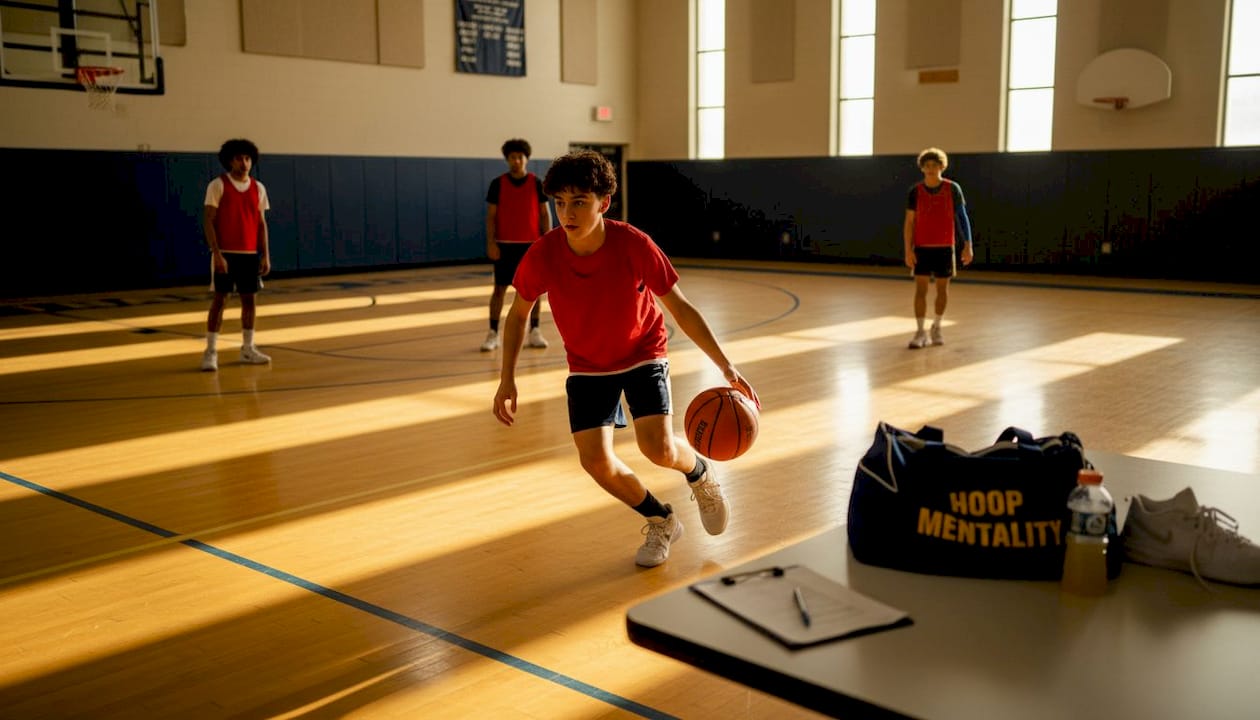
You can also look at defensive drill concepts from resources like defensive drills and basketball defense tips to understand how defenders are trained to stop paint attacks. Knowing what defenders practice helps you design offensive drills that actually stress those techniques. And if you want to understand rotational defense more deeply, defensive adjustment tips are a useful reference for building more complete offensive counters.
Analytics and tracking: Measuring paint attack effectiveness
Training and execution matter, but data tells you whether your paint attack system is actually working. Without measurement, you are guessing. Coaches who track the right metrics can quickly identify whether their offense is generating quality paint looks or just creating traffic in the lane that leads to turnovers and missed shots.
NBA paint touch tracking is the clearest starting point. Paint touches measure how often players enter the lane area on offense. This raw number tells you whether your team is attacking the paint at all. But paint touches alone are not enough.
The critical distinction is between entering the paint and scoring from it. Paint-touch shooting efficiency is the metric that actually reveals whether your players are making good decisions after entering the lane. A team with high paint touches but low efficiency is driving into traffic, drawing no fouls, and finishing poorly. That is worse than a team with fewer paint touches that converts at a high rate.
Here is a framework for evaluating your paint attack by the numbers:
| Metric | What it measures | Target goal |
|---|---|---|
| Paint touches per game | Frequency of lane entries | Higher is generally better |
| Points in paint per game | Volume of close-range scoring | Team benchmark comparison |
| Paint touch FG% | Conversion efficiency in the lane | 55% or above is strong |
| Free throw attempts from drives | Foul-drawing effectiveness | Tracks aggression and contact |
| Turnover rate from penetration | Decision quality under pressure | Lower is better |
The metrics that matter most for your coaching decisions:
- Paint touch count tells you if your system is generating lane entries
- Points in the paint per game gives you an absolute scoring volume benchmark
- Paint touch shooting efficiency shows whether entries are converting to points
- Free throw volume confirms that players are finishing with contact and drawing fouls
- Assist-to-turnover ratio on penetrations reveals whether kick-out reads are being executed
Using tools like charting player stats helps you collect this data at the high school and college level even without NBA-level tracking cameras. Simple charting systems can log paint touches, finish outcomes, and kick-out conversions over the course of a game. Over a full season, those numbers tell a clear story about your offense. For a broader analytical framework, the basketball analytics checklist and player performance evaluation guides provide structured methods for making data-driven coaching decisions.
A fresh perspective: Beyond paint entry—coaching for efficiency, reads, and team identity
Most coaches celebrate when their team attacks the paint frequently. That is a reasonable first step. But frequency without efficiency is just organized chaos.
The teams that build real offensive identity around paint attacks are not the ones that just drive the most. They are the ones who teach their players what to do after they get into the lane. Reading the help defender, deciding between the floater and the kick-out, finishing through contact instead of avoiding it, these decisions happen in half a second and they define whether a paint-heavy offense actually scores more.
Paint-touch shooting efficiency is the number that tells the real story. A coach whose team averages 14 paint touches per game and converts at 62% is outperforming a team with 20 paint touches converting at 44%. The second team is working harder for worse results.
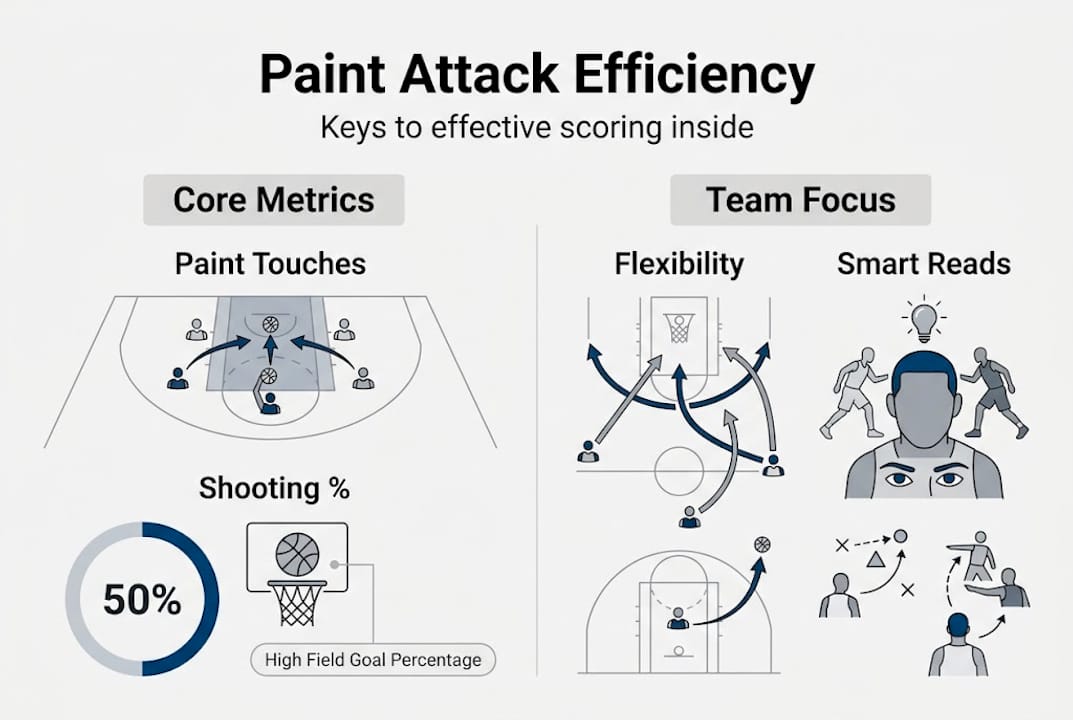
The other factor most coaches miss is flexibility. An offense built entirely around one entry method, for example, always driving from the wing, becomes predictable by the second half of the season. The best paint-attack teams mix transition runs, cuts, post-ups, and penetration in roughly equal measure so that defenders cannot sell out on a single pattern. Consider these offensive coaching tips to build that variety into your half-court sets from the ground up.
Efficiency, flexibility, and smart reads. Those are the real pillars of a paint-attack identity that holds up across a long season.
Accelerate your team’s paint attack with Hoop Mentality resources
You now have the strategic foundation, the drill structure, and the analytics framework for building a paint-attack offense. The next step is putting it into practice with tools built for coaches.

Hoop Mentality offers ready-to-use resources that cut your prep time and get your team working on the right things faster. The big man dual action drill is specifically designed to develop interior finishing skills and post-entry reads that translate directly to game situations. For organizing your practice time, the basketball practice plan template gives you a structured format to sequence paint attack drills alongside your other offensive priorities. Both tools are practical, coach-tested, and ready to use.
Frequently asked questions
What is meant by ‘attacking the paint’ in basketball coaching?
It means actively driving, cutting, or rebounding into the area near the basket to create high-percentage scoring chances and force defensive rotations that open up kick-out and cutter opportunities.
How can coaches measure their team’s effectiveness in attacking the paint?
Coaches should track paint touches, points in the paint, and paint-touch shooting efficiency using NBA paint touch data or simple in-game charting systems adapted for their level.
What types of drills help teach paint penetration?
Drills simulating in-game angles and decisions with active defensive resistance are most effective for translating paint attack skills to real game situations.
Does attacking the paint always lead to more points?
Attacking the paint increases the efficiency of scoring chances, but paint-touch shooting efficiency shows that converting those opportunities still depends on finishing skills, spacing, and smart reads under pressure.