

Finding ways to get every player involved and raise your team’s scoring is a constant challenge for High School basketball coaches across North America. The dribble drive offense stands out as a dynamic system that creates high percentage shots and opens the floor for smart decision-making. This approach gives your athletes freedom to attack, adjust, and stretch defenses, helping you build a more adaptable and effective offense from the first practice.
Table of Contents
- Defining Dribble Drive Offense In Basketball
- Core Concepts And Key Principles Explained
- Player Roles And Responsibilities On Offense
- How Dribble Drive Boosts Team Scoring
- Common Challenges And Mistakes To Avoid
Key Takeaways
| Point | Details |
|---|---|
| Player-Centric Approach | The Dribble Drive Offense relies on player decision-making rather than predetermined plays, allowing for adaptability based on defensive reactions. |
| Importance of Spacing | Maintaining consistent spacing with four perimeter players creates offensive advantages and facilitates scoring opportunities through driving lanes. |
| Continuous Movement | The offense emphasizes constant player movement, preventing defenders from settling and ensuring ongoing scoring options from multiple angles. |
| Skill Development | Focusing on penetrating skills, three-point shooting, and quick decision-making enhances overall player effectiveness and maximizes the offense’s potential. |
Defining Dribble Drive Offense in Basketball
The dribble drive offense is an aggressive, player-centered system that prioritizes penetration and spacing over rigid play-calling. Unlike traditional set plays with predetermined movements, this offense allows your players to read the floor and react to defensive positioning in real time.
At its core, dribble drive motion operates with four perimeter players spread around the three-point line and one post player anchoring the paint. This spacing immediately creates floor balance and forces defenders to make quick decisions. When a guard attacks downhill with the ball, the defense must respond—and that response creates opportunities.
How the spacing works:
- Four shooters on the perimeter pull defenders away from the rim
- One post player provides a scoring threat near the basket
- Dribble penetration forces help defenders to rotate
- Rotations create gaps for kick-out shooters or cutters
- Constant spacing keeps the floor stretched horizontally
When your point guard attacks the basket, three things happen. The primary defender commits, a secondary defender must help stop the drive, and suddenly someone becomes open. Your players then have simple read: finish at the rim, pass to the open teammate, or reset if nothing develops.
This system works because it removes the guesswork. Instead of teaching players “run this play on this signal,” you’re teaching decision-making. A player with the ball recognizes when a defender overplays one side. Another player reads when help is coming and relocates accordingly.
The beauty of dribble drive offense is that it creates scoring opportunities from player movement and court intelligence, not predetermined choreography.
Your guards must develop penetration skills and the ability to read rotations quickly. Shooters need consistent three-point range so defenses respect their spacing. The post player must be an active threat both offensively and as a screener or cutter.
Why does this matter for your program? High school players respond to offensive systems that reward decision-making and individual skill development. They want to make plays, not just execute instructions. The dribble drive offense also adapts naturally to your personnel—stronger athleticism leads to more rim attacks; better shooters mean more floor spacing; versatile bigs provide additional read options.
Pro tip: Start teaching dribble drive principles in half-court situations before implementing full-court spacing. Have guards practice simple read scenarios: drive, kick, or shoot within the first 2-3 seconds of attack.
Core Concepts and Key Principles Explained
The dribble drive offense rests on four foundational concepts that separate it from traditional offensive systems. Understanding these principles will help you teach the system effectively and adapt it to your roster.
Spacing creates offensive advantage. When four players occupy the perimeter at three-point distance, defenders must respect shooting range. This horizontal spacing prevents defensive help from collapsing on the ball handler, keeping lanes open for penetration. A packed defense cannot form the wall that stops drives.
Player decision-making replaces scripted plays. Your guards don’t run plays—they read defenses. When a help defender leaves their mark to stop a drive, that vacated space creates an open shooter or cutter. This is why basketball fundamentals matter so much; players must understand their reads before adding system complexity.
Five-on-five ball movement keeps defenses honest. The offense generates continuous motion from dribble penetration. When one player attacks, other players reposition to create shooting or cutting opportunities. No one stands still. This constant motion prevents defenders from settling into comfortable positions.
The post anchor provides secondary scoring. One big man stays near the basket as a scoring option, rebounder, and screener. This player isn’t just a catch-and-shoot threat—they’re an active participant in reads and floor spacing.
Key principles in practice:
- Penetration attacks the paint and forces defensive collapse
- Kick-outs reward movement and punish over-helping
- Spacing makes three-point shooting non-negotiable
- Player IQ elevates above pure athleticism
- Continuous motion prevents defensive sets from forming
- The offense works with your personnel, not against it
The dribble drive offense succeeds because it forces defenses to react rather than dictate. Your team controls the pace and flow.
This system emphasizes ball handler responsibility more than traditional offenses. The guard with the ball must make the correct read within 2-3 seconds. Too long, and the defense stabilizes. Your players need confidence and court awareness, not just handles.
Why this matters for North American high school programs: Most defenders at this level gamble on steals rather than play sound positional defense. The dribble drive offense punishes gambling by creating open teammates. Simultaneously, it develops young players into better decision-makers because every possession demands on-the-spot problem solving.
Pro tip: Start each practice with a “read and react” drill where one guard attacks against two rotating defenders, focusing on the decision within the first dribble rather than complex footwork.
Use this table to see how the dribble drive offense contrasts with traditional set-play offenses:
| Feature | Dribble Drive Offense | Traditional Set Plays |
|---|---|---|
| Offensive Basis | Player reads and reactions | Predetermined patterns |
| Spacing | Four wide, constant | Often compact, changes by set |
| Ball Movement | Continuous, attack-first | Structured, by design |
| Skill Development | Emphasizes all-around ability | Focuses on set roles |
Player Roles and Responsibilities on Offense
Every player in the dribble drive offense has a specific role, but those roles shift based on who has the ball. This fluidity separates the system from traditional positions where centers stay low and guards stay high.
The ball handler initiates the offense by attacking downhill. This player reads the defense within the first dribble, determining whether to finish at the rim, pass to an open cutter, or kick out to a shooter. Guards handle this responsibility most often, but in this system, any player capable of reading defenses and making quick decisions can initiate.
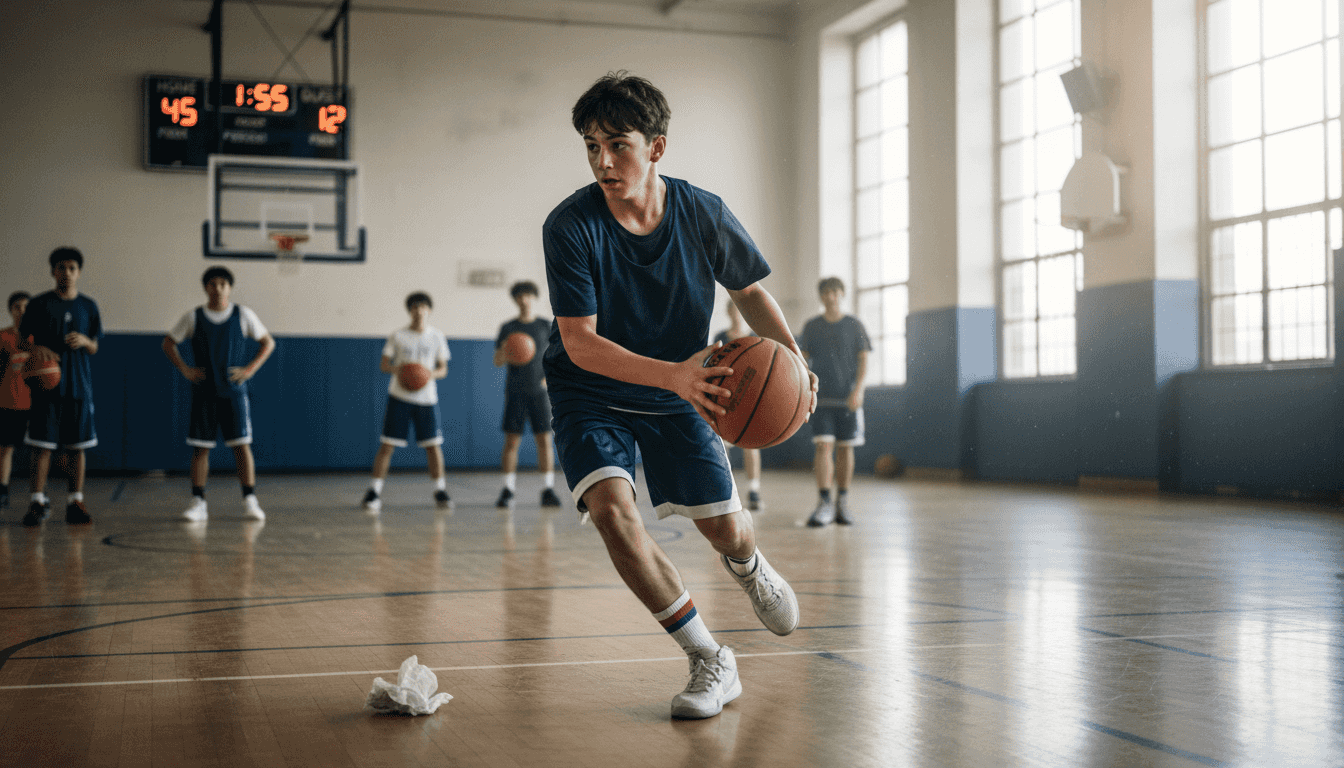
Perimeter players occupy the three-point line and must provide constant spacing. They position themselves as both shooters and cutters. When the ball handler attacks, perimeter players read whether help is coming their way. If a defender leaves to help, they stay ready to shoot. If their defender sags off, they cut toward the basket.
The post player anchors near the basket but remains active. This role requires movement—not standing in one spot. The post player moves to the weak side to maintain floor spacing, positions for offensive rebounds, and looks for lob passes when the guard penetrates successfully.
Role expectations by position:
- Guards: Attack with purpose, create for others, shoot when open
- Wings: Space the floor, cut aggressively, transition to defense quickly
- Post: Rebound, space the weak side, finish lobs and put-backs
- All players: Read rotations, make rapid decisions, move without the ball
In the dribble drive offense, your worst shooter must still be a spacing threat, and your post player must be willing to sprint the floor.
This demands versatility from your roster. Traditional big men who can only play in the post won’t survive in this system. You need players who can handle penetration reads, respect the three-point line, and move continuously.
Responsibility distribution matters more than position titles. Your best ball handler might be a shooting guard or a versatile forward. Your post player might be your best passer or your most athletic cutter. Build roles around your personnel rather than forcing players into traditional molds.
Why this approach works for high school programs: Most teams have one or two athletic playmakers. Rather than asking your point guard to do everything, the dribble drive offense lets your second and third ball handlers participate in ball handling and decision-making responsibilities, multiplying scoring options.
Pro tip: Rotate which players start the offense from the wing or post during practice, not just your traditional ball handlers, to build decision-making depth across your entire roster.
Here’s a summary of key player skills needed for a successful dribble drive offense:
| Role | Essential Skill | Impact on Offense |
|---|---|---|
| Ball Handler | Quick decision-making | Maintains offensive pace |
| Perimeter Shooter | Consistent long-range shooting | Maximizes spacing threat |
| Post Player | Mobile finishing and screening | Keeps paint options active |
| All Players | Court awareness and movement | Ensures effective rotations |
How Dribble Drive Boosts Team Scoring
The dribble drive offense generates scoring in three distinct ways. Understanding how each mechanism works helps you recognize when your system is functioning properly and where adjustments are needed.
Layups from aggressive penetration form the foundation of scoring. When your guard attacks downhill, defenders must respond. The closest defender commits to stopping the drive, but gaps open elsewhere on the floor. Creating high percentage shots through aggressive drives means your players finish near the basket where conversion rates exceed 60 percent.
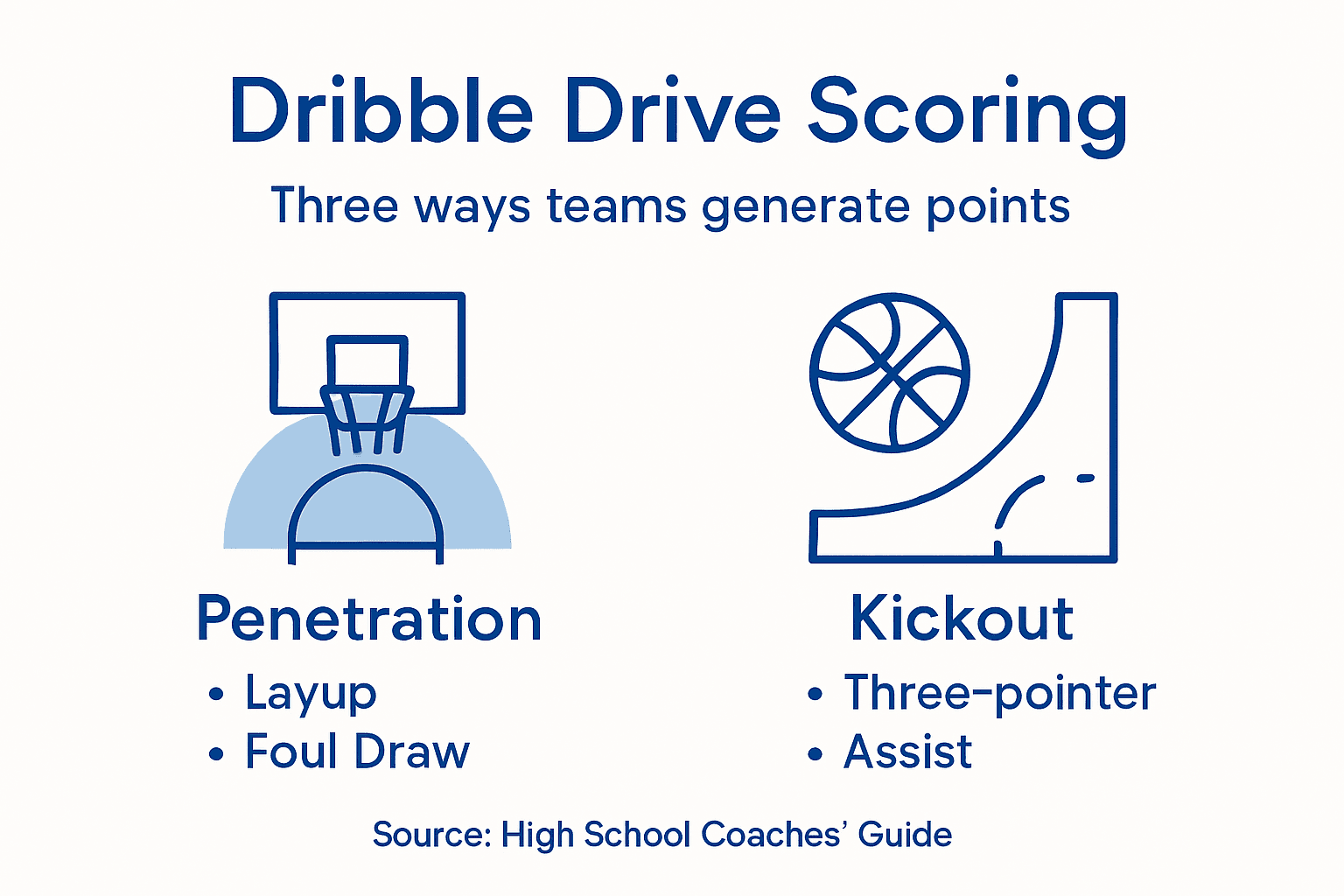
Penetration also generates foul opportunities. Defenders scramble to stop drivers, often reaching or overcommitting. Your best ball handlers draw three to four fouls per game in this system, putting opponents in foul trouble while adding free throw points to your total.
Kick-out three-pointers provide the second scoring avenue. When defensive help collapses on a penetrating driver, perimeter shooters become wide open. A defender leaving their assignment to stop a layup creates an uncontested three-pointer. This spacing advantage converts good shooters into elite volume scorers.
How scoring opportunities multiply:
- Guard attacks and either finishes or draws a foul
- Weak-side help leaves a three-point shooter open
- Post player gets a lob or offensive rebound opportunity
- Reset and attack from a different angle on the next possession
- Continuous motion prevents defense from settling
The dribble drive offense doesn’t create one scoring option per possession—it creates multiple reads and secondary options from a single attack.
Your offense increases pace and efficiency simultaneously. Traditional offenses run a play, execute it, then reset. The dribble drive keeps the ball moving and defenses rotating constantly. This pace advantage means more possessions and more scoring opportunities across a full game.
Measurable scoring improvements typically emerge within three weeks of implementation. Teams adding this system see point-per-possession increases of 8 to 12 percent as players internalize reads. The margin grows larger against defenses unprepared for constant motion and spacing.
Higher scoring volumes come from multiple contributors, not one star player. Your second and third scorers get quality looks because spacing and penetration benefit everyone. Ball handlers create for teammates rather than forcing shots, leading to better shot selection.
Pro tip: Track and-one opportunities during practice scrimmages to measure defensive desperation; increasing fouls on defenders indicates your spacing is forcing tough defensive decisions.
Common Challenges and Mistakes to Avoid
Implementing the dribble drive offense introduces new complexities that coaches must navigate carefully. Understanding common pitfalls prevents frustration and accelerates player development.
Lack of spacing discipline is the most frequent mistake. Players revert to traditional positioning, clustering near the basket or bunching on one side. When spacing breaks down, the entire system collapses because defenses no longer fear the perimeter threat. Enforce spacing consistently during early implementation or progress stalls.
Poor ball handler decision-making creates turnovers. Young players panic when defensive help arrives, forcing bad passes instead of resetting the offense. Players need repetition recognizing when to attack, when to kick out, and when to reset. This skill develops over weeks, not days.
Over-reliance on one ball handler limits offensive depth. Coaches sometimes designate their best player as the primary initiator, forgetting that the system requires multiple decision-makers. When that player sits, your offense disappears. Build secondary ball handlers through deliberate practice rotations.
Neglecting weak-side movement wastes spacing advantages. Perimeter players stand static watching the ball instead of relocating as defenses shift. Active movement keeps defenders occupied and creates better shooting opportunities.
Common mistakes that derail implementation:
- Teaching reads too early before spacing becomes automatic
- Forcing three-point shooting from non-shooters
- Allowing defensive help to congregate without consequences
- Calling timeouts to run plays instead of trusting reads
- Implementing without sufficient guard skill development
- Mixing dribble drive principles with traditional offensive sets
The dribble drive offense fails when coaches revert to rigid play-calling during pressure situations. Trust the system or abandon it entirely.
Common coaching mistakes often involve pace mismanagement. Some coaches slow the offense to create more structured looks, killing the system’s advantage. Others speed tempo too much, preventing execution of reads. The right pace—aggressive but controlled—develops naturally through practice.
Patience matters most. Teams need three to four weeks before the offense operates smoothly. Players make mistakes early. That’s normal. Coaches who expect immediate results abandon the system prematurely, leaving players confused about what failed.
Pro tip: Film every practice for the first month and watch footage focused solely on spacing and decision-making, not results; this identifies systematic issues before they become habits.
Unlock the Power of Dribble Drive Offense with Proven Coaching Resources
Implementing a dribble drive offense demands disciplined spacing and sharp decision-making to unlock your team’s full scoring potential. If you struggle with building player IQ, developing multiple ball handlers, or enforcing consistent spacing your challenges are exactly what many coaches face when adopting this dynamic system. At Hoop Mentality we understand how essential drills and playbooks tailored to dribble drive principles can accelerate your players’ learning curve while boosting team confidence.

Start transforming your practices today by exploring our Basketball Playbooks - Hoop Mentality designed to breakdown read-and-react scenarios and role responsibilities essential for the dribble drive offense. Combine these with targeted skill development drills from our Basketball Drills - Hoop Mentality collection to help your players master spacing discipline and rapid decision execution. Don’t let common mistakes stall your team’s progress visit Hoop Mentality now and discover tools that bring clarity structure and proven success to your coaching journey.
Frequently Asked Questions
What is dribble drive offense in basketball?
The dribble drive offense is a player-centered system that emphasizes penetration and spacing on the floor, allowing players to read defenses and make decisions in real time rather than following scripted plays.
How does spacing work in the dribble drive offense?
Spacing in the dribble drive offense involves four perimeter players positioned around the three-point line and one post player near the basket. This setup creates better floor balance, forcing defenders to make quick decisions while providing lanes for penetration and opportunities for shooters.
What are the key principles of the dribble drive offense?
The key principles of the dribble drive offense include spacing to create offensive advantages, player decision-making in place of scripted plays, continuous ball movement to keep defenders honest, and the active role of the post player in providing secondary scoring options.
Why is decision-making important in the dribble drive offense?
Decision-making is crucial in the dribble drive offense because players must quickly evaluate defensive responses to attacks. This system develops players’ court awareness and ability to make strong choices under pressure, enhancing their overall skills and adaptability on the court.
Recommended
- Master Scoring Off the Dribble for Basketball Success – Hoop Mentality
- 10 Essential Basketball Offense Techniques Every Player Should Master – Hoop Mentality
- What Is Motion Offense In Basketball? - Hoop Mentality
- Mastering Basketball Motion Offense: Essential Guide For Coaches – Hoop Mentality
- Mississippi State’s Familiar Problems Surface In Duke’s Mayo Bowl Loss / Naijatipsland