

Mastering off-the-dribble scoring is one difference maker that separates good youth athletes from great ones on American courts. With over 60 percent of youth basketball turnovers traced back to poor ball control and rushed moves, coaches know that building these skills is crucial for serious competition. This guide gives practical methods to help your players gain reliable, creative scoring instincts by sharpening their dribbling foundation, ball control, footwork, and decision-making under pressure.
Table of Contents
- Step 1: Set Up Dribble Foundations
- Step 2: Develop Ball Control and Footwork
- Step 3: Teach Effective Change of Pace
- Step 4: Implement Scoring Moves Under Pressure
- Step 5: Evaluate and Refine Scoring Techniques
Quick Summary
| Key Takeaway | Explanation |
|---|---|
| 1. Use Fingertips for Ball Control | Controlling the ball with your fingertips enhances precision and allows for quicker movements. |
| 2. Maintain an Athletic Stance | A low stance with bent knees supports better control and enables rapid direction changes. |
| 3. Practice Change of Pace | Shifting speed during dribbling keeps defenders guessing and creates scoring opportunities. |
| 4. Simulate Game Pressure | Introducing defensive challenges and time constraints during practice builds resilience and confidence. |
| 5. Analyze Scoring Performance | Reviewing game footage and tracking metrics helps identify strengths and areas for improvement. |
Step 1: Set Up Dribble Foundations
Building a rock solid dribbling foundation begins with understanding proper ball control techniques. Learning to manage the basketball effectively requires mastering several core mechanical skills that will transform your offensive game.
The key starts with controlling the ball using your fingertips instead of your palm. This gives you precision and allows quicker ball manipulation. Keep your head up while dribbling - a critical skill that enables you to scan the court, anticipate defensive movements, and create scoring opportunities. Professional basketball players develop this skill through consistent practice, training their muscle memory to handle the ball instinctively while maintaining court awareness.
Your dribbling stance matters significantly. Position your body low with knees slightly bent, maintaining a balanced athletic position that allows rapid direction changes. Practice protecting the ball with your off hand, creating a physical barrier between the basketball and potential defenders. This defensive posture prevents steals and gives you more control during dynamic game situations.
Pro Tip: Practice dribbling drills while watching television or during downtime to build muscle memory without additional training time.
Here is a summary of key dribbling foundations for basketball improvement:
| Skill Focus | Practical Benefit | Common Mistake | Correction Strategy |
|---|---|---|---|
| Fingertip Control | Better ball precision | Using palm | Practice finger-only dribbling |
| Head Up Dribbling | Improved court vision | Looking down | Focus away from ball during drills |
| Athletic Stance | Faster direction changes | Standing upright | Keep knees bent and body low |
| Ball Protection | Reduces turnovers and steals | Exposed ball | Use off hand for shielding |
Step 2: Develop Ball Control and Footwork
Advancing your basketball performance requires mastering nuanced ball control and strategic footwork techniques that distinguish exceptional players from average performers. Developing these skills demands deliberate practice and understanding the intricate relationship between mental awareness and physical execution.
Your ability to maintain precise ball control correlates directly with performance potential, particularly for guards and forwards seeking elite status. Start by practicing stationary ball handling drills that force you to manipulate the basketball using only your fingertips, wrists, and minimal arm movement. Focus on maintaining a low athletic stance with knees slightly bent, allowing rapid weight shifts and direction changes. This foundational position enables quicker responses and more dynamic offensive maneuvers.
Footwork serves as the critical infrastructure supporting your ball control skills. Practice side shuffles, crossover steps, and pivot techniques while maintaining ball control. Integrate complex movement patterns that challenge your coordination and muscle memory. The goal is developing an instinctive connection between your feet, body positioning, and basketball handling that feels seamless and natural during game situations.
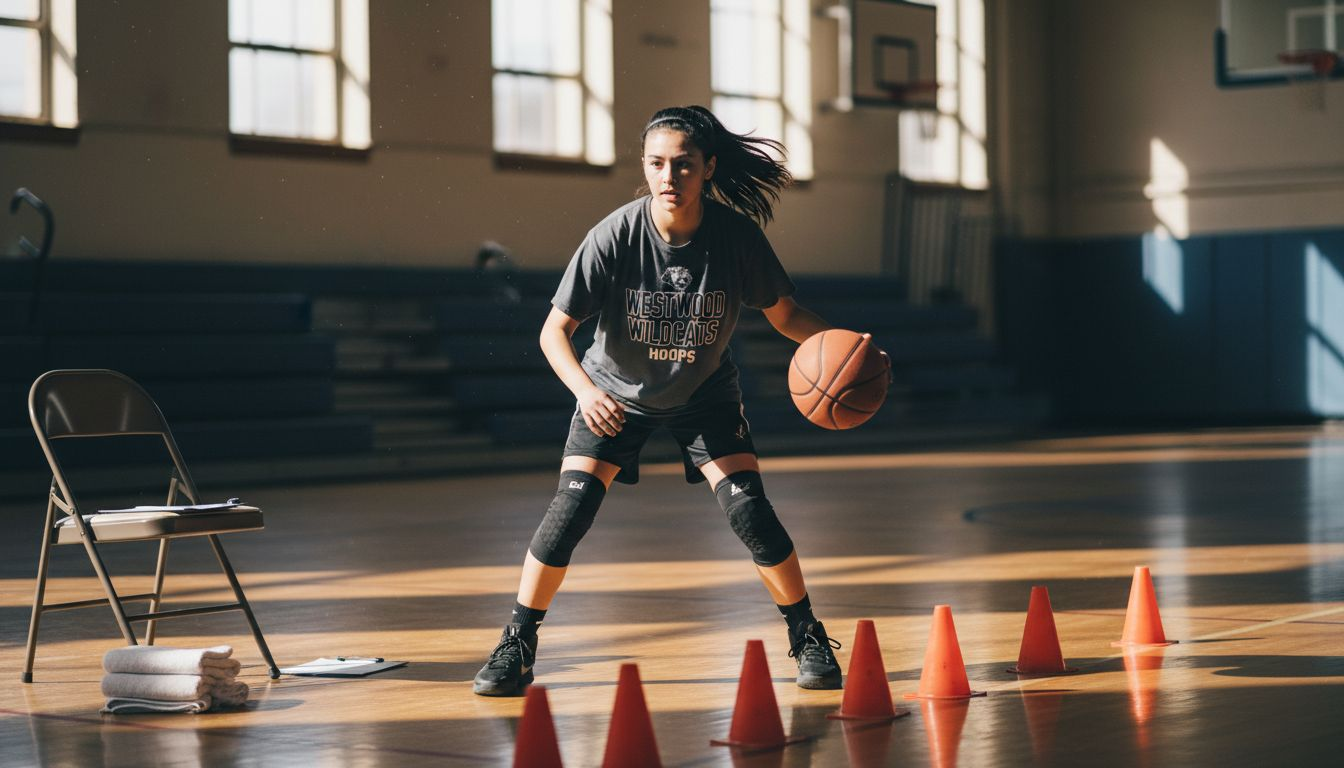
Pro Tip: Use household items like cones or chalk markings to create impromptu training spaces that help you consistently practice footwork and ball control drills.
Step 3: Teach Effective Change of Pace
Mastering change of pace represents a critical skill that can transform an average player into an exceptional offensive threat. Understanding how to manipulate speed and rhythm creates opportunities that leave defenders struggling to anticipate your next move.
Change of pace is fundamentally about creating strategic speed variations that disrupt defensive timing. Begin by practicing controlled dribbling techniques that allow you to shift between slow deliberate movements and explosive bursts of acceleration. The key is developing a smooth transition that appears seamless and natural. Practice hesitation moves where you momentarily pause or slow your dribble, then suddenly accelerate past your defender. This unpredictability forces defenders to constantly readjust their defensive positioning.
Effective change of pace requires developing muscle memory through consistent repetition. Start with stationary drills that focus on speed modulation and gradually progress to more complex movements that incorporate full court transitions. Work on your ability to read defenders reactions and timing your speed shifts precisely when they least expect it. Your goal is creating a sense of controlled chaos that keeps defenders perpetually off balance.
Pro Tip: Record your practice sessions and analyze your speed transitions to identify subtle improvements in your change of pace techniques.
Step 4: Implement Scoring Moves Under Pressure
Successful basketball players understand that scoring ability becomes truly valuable when performance remains consistent under intense competitive conditions. Developing mental resilience and technical precision can transform your offensive capabilities during high stakes moments.
Psychological factors significantly impact shooting performance under pressure, making mental preparation as crucial as physical skill development. Players with stronger inhibitory control can maintain composure and execute scoring moves more effectively when facing defensive intensity. Practice simulating game pressure by introducing time constraints, defensive challenges, and mental distractions during training sessions. This approach helps develop muscle memory and mental strategies that allow you to remain calm and focused when real game situations demand peak performance.
To build scoring confidence under pressure, gradually increase training complexity. Start with basic scoring drills where you practice moves against minimal resistance, then progressively add defensive pressure and time constraints. Incorporate scenario based training that mimics game situations such as shot clock challenges, defensive traps, and rapid defensive switches. Your objective is developing an intuitive ability to read defensive formations and respond with quick decisive scoring moves.
Pro Tip: Develop a consistent pre shot routine that helps you reset mentally and maintain focus during high pressure game moments.
Step 5: Evaluate and Refine Scoring Techniques
Successful basketball players understand that continuous improvement requires systematic self assessment and strategic skill refinement. Developing a structured approach to analyzing your scoring performance can unlock unprecedented growth and competitive advantage.
Performance analysis methods combine statistical insights with advanced analytics to comprehensively evaluate individual scoring techniques, providing coaches and players with powerful tools for skill development. Start by recording game footage and practice sessions that capture your full range of scoring moves. Break down each scoring attempt by examining key metrics such as shooting percentage, shot selection, movement efficiency, and defensive engagement. Look for patterns in your successful and unsuccessful attempts identify specific technical elements that contribute to your scoring effectiveness.
Create a systematic evaluation framework that tracks your scoring performance across different game scenarios. Develop a personal scoring profile that highlights your strengths and exposes areas requiring improvement. Focus on understanding the biomechanics of your shooting techniques adaptive decision making during offensive plays. Regularly compare your current performance against benchmark metrics and previous performance data. This data driven approach allows you to make precise adjustments to your scoring methodology and continuously elevate your offensive skills.
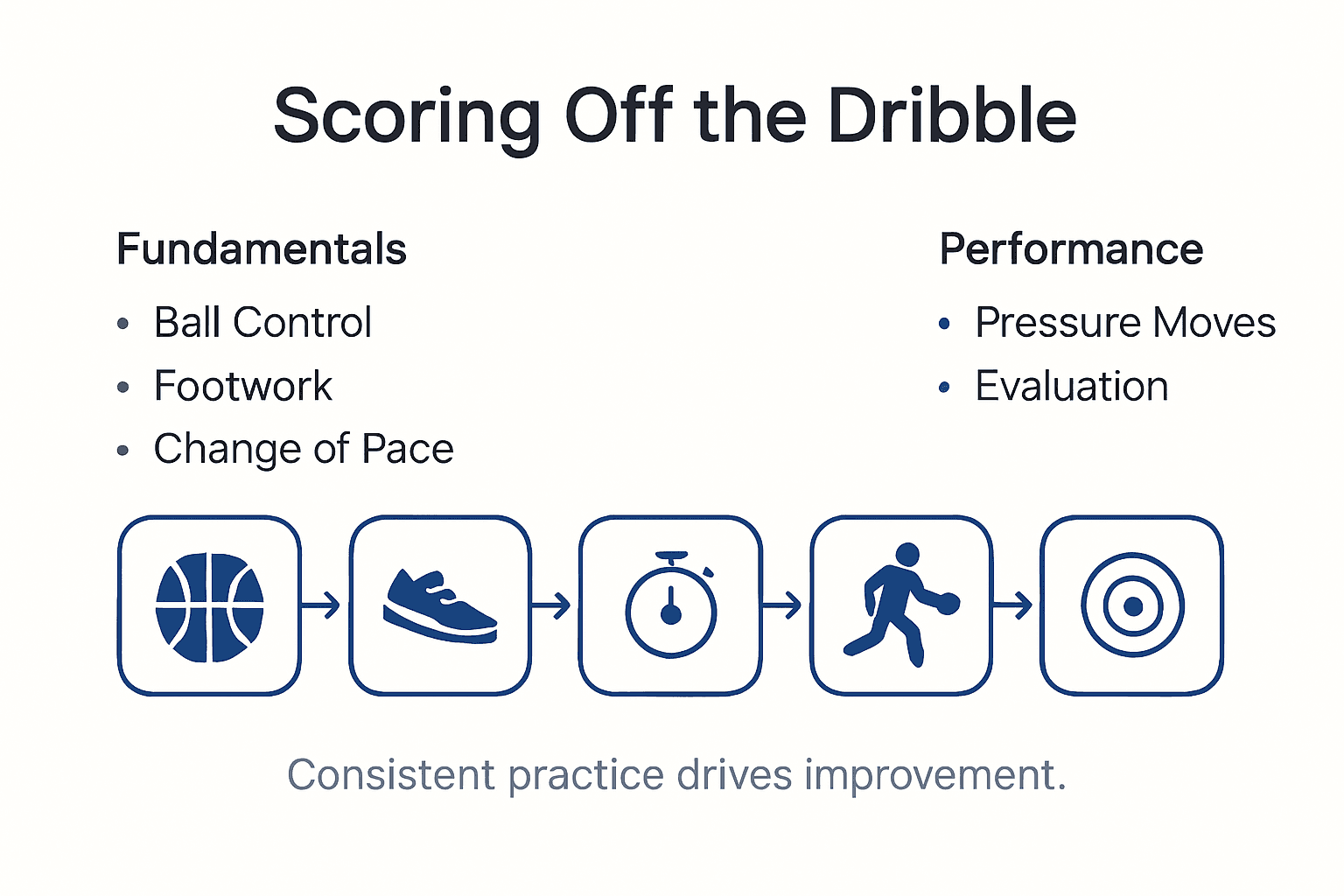
Pro Tip: Maintain a detailed scoring journal that documents your performance metrics technical observations to accelerate your skill improvement process.
Below is a quick reference table for evaluating and refining scoring techniques in basketball:
| Evaluation Method | Metric Used | Benefit to Player |
|---|---|---|
| Video Analysis | Movement efficiency | Identifies wasted motion |
| Statistical Tracking | Shooting percentage | Tracks consistency |
| Scenario Simulation | Decision making | Improves adaptability |
| Comparative Benchmark | Performance change | Monitors skill growth |
Elevate Your Scoring Off the Dribble With Proven Basketball Drills
Mastering scoring moves off the dribble requires more than just practice. The article highlights challenges like controlling the ball, effective footwork, and performing under pressure. If you are looking to sharpen skills like change of pace and scoring consistency, it is essential to train with drills that build muscle memory and mental resilience. At Hoop Mentality we understand the pain points of developing precise ball control and effective scoring under pressure. Our collection of Basketball Drills provides step-by-step exercises designed to improve your dribbling foundations, enhance footwork, and simulate game pressure.

Start transforming your offensive game now by accessing coaching resources that offer real solutions for basketball success. Explore our Basketball Workouts to integrate focused training plans built on proven methods. Whether you are a coach or player wanting to boost scoring confidence and execution, Hoop Mentality helps you save time while maximizing practice efficiency. Visit Hoop Mentality to get started and take the first step toward dominating scoring off the dribble.
Frequently Asked Questions
How can I improve my dribbling technique for scoring?
To improve your dribbling technique, focus on controlling the ball with your fingertips and maintaining a low athletic stance. Practice drills that reinforce these skills daily to enhance your overall ball control.
What drills can I use to practice change of pace while dribbling?
To practice change of pace, incorporate hesitation moves and speed modulation drills into your training. Start with stationary dribbling and shift between slow and explosive movements, aiming for consistent practice sessions each week.
How do I build scoring confidence when facing defensive pressure?
To build scoring confidence under pressure, simulate game-like conditions during practice by adding time constraints and defensive challenges. Gradually increase the difficulty of your drills to improve your performance in high-pressure situations.
What metrics should I track to evaluate my scoring performance?
Track metrics such as shooting percentage, shot selection, and movement efficiency to evaluate your scoring performance. Analyze this data after every practice or game to identify strengths and areas for improvement.
How important is footwork in scoring off the dribble?
Footwork is crucial for successful scoring off the dribble, as it supports your ball control and allows for quicker direction changes. Practice footwork drills like side shuffles and crossover steps to enhance your agility and effectiveness on the court.
What should I include in my pre-shot routine to enhance my scoring?
Include a consistent pre-shot routine that helps you mentally prepare for each scoring opportunity. For example, focus on your breathing and visualizing your shot before each attempt to maintain concentration.
Recommended
- 7 Essential Tips for Off the Ball Movement Basketball – Hoop Mentality
- 10 Essential Basketball Offense Techniques Every Player Should Master – Hoop Mentality
- 7 Essential Man-to-Man Offense Tips for Basketball Coaches – Hoop Mentality
- 7 Essential Types of Shooting Drills for Basketball Coaches – Hoop Mentality