

TL;DR:
- The high-low offense involves passing between a high post and a low post to create scoring opportunities by exploiting defensive choices. It remains relevant in modern basketball by emphasizing decision-making, spacing, and patience against various defenses. Proper execution requires active perimeter movement, disciplined passing, and teaching players to read defenders’ hips, not their eyes.
A high-low offense is defined as a basketball system built on coordinated passing between a high post player near the free-throw line and a low post player near the basket to create high-percentage scoring opportunities. The system exploits defensive mismatches through spacing, timing, and read-and-react decision-making. Coaches at every level use it within formations like 3-out, 2-in and 4-out, 1-in sets to attack both man and zone defenses. Recent coaching analyses confirm the high-low offense strategy remains relevant in 2026, even as pace-and-space systems dominate the modern game.
What is a high-low offense in basketball?
The high-low offense places two post players at different court levels to force defenders into impossible choices. The high post sets up near the free-throw line elbow. The low post positions close to the basket on the block. Every scoring opportunity begins with the tension between those two positions.
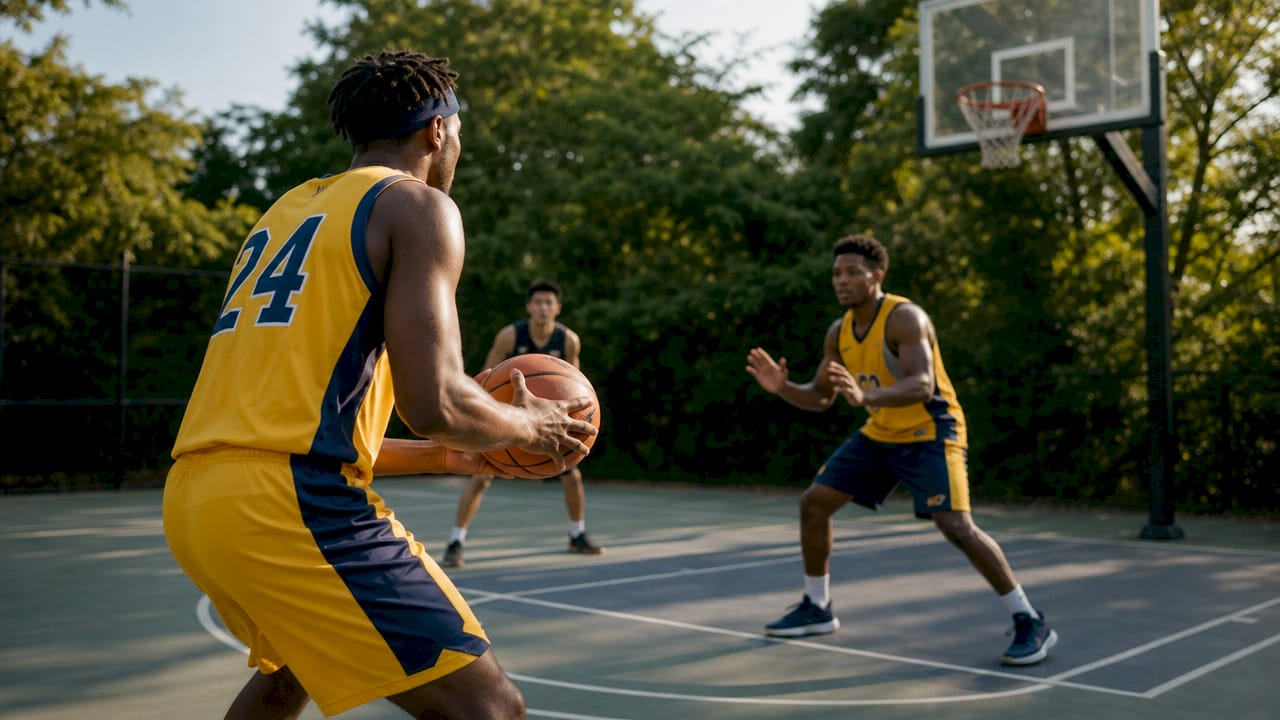
The high-post player acts as the quarterback, reading the defense and deciding whether to score, shoot, or pass to the low post. That decision depends entirely on how the defense reacts. If the defender sags to protect the low post, the high post shoots or drives. If the defender steps up to contest the high post, the pass goes down to the low post for a close-range finish.
Perimeter players are not spectators in this system. Constant movement and proper spacing by guards and wings pull defenders away from the paint, opening the passing lanes that make the high-low action work. Without active perimeter movement, defenders collapse and clog both post positions.
The high-low offense functions best as a dynamic read-and-react system rather than a scripted set play. That distinction matters. Coaches who run it as a rigid play get predictable results. Coaches who teach it as a decision-making framework get an offense that adapts to any defense.
Pro Tip: Teach your high post player to read the low post defender’s hips, not their eyes. Hip position reveals where the defender is committed, giving the high post a clear signal to pass or hold.
What offensive formations use high-low principles?
The high-low offense integrates naturally into several common team alignments. Each formation balances perimeter shooting with interior scoring in a different way.
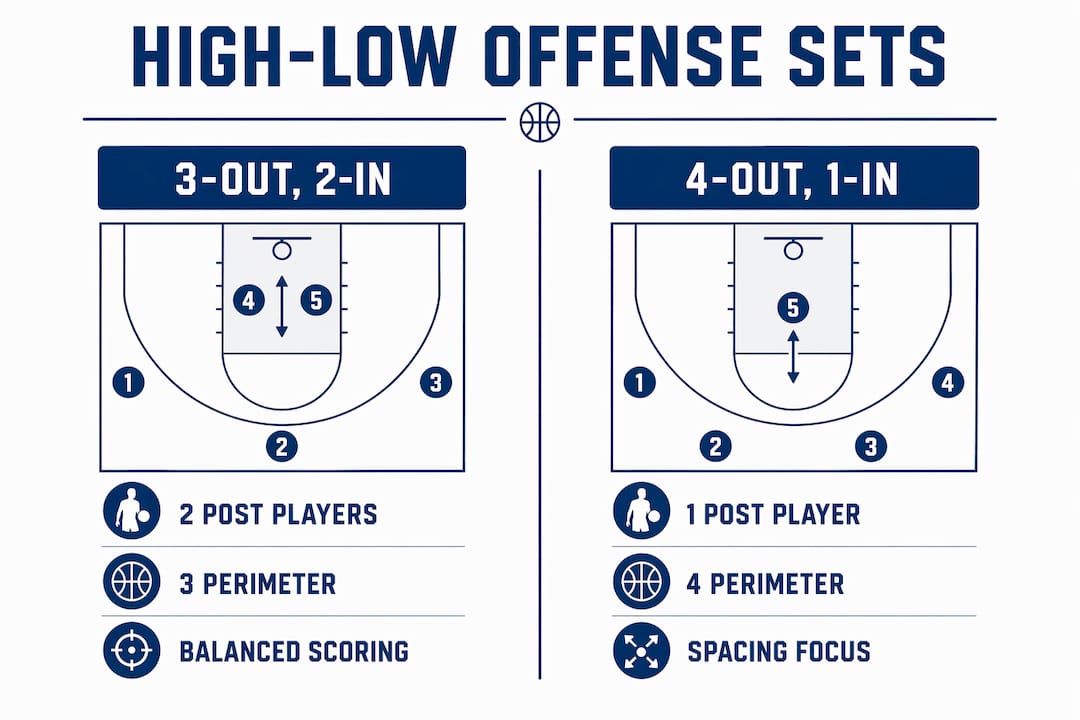
The 3-out, 2-in and 4-out, 1-in sets are the most common homes for high-low action. The 3-out, 2-in setup uses two post players simultaneously, creating the classic high-low pairing with three perimeter shooters spacing the floor. The 4-out, 1-in set uses one post player who rotates between high and low positions, forcing the defense to track a single player across two threat zones.
The five-out offense also incorporates high-low spacing principles. In a five-out set, any player who cuts to the elbow can function as a temporary high post, triggering a high-low read with a cutter to the block. This version suits teams without traditional post players but still demands the same timing and decision-making.
| Formation | Post Players | Perimeter Players | Primary Advantage |
|---|---|---|---|
| 3-out, 2-in | 2 (high and low post) | 3 | Classic high-low pairing with floor spacing |
| 4-out, 1-in | 1 (rotates high to low) | 4 | More perimeter shooting, flexible post movement |
| Five-out | 0 dedicated posts | 5 | Any player triggers high-low reads from elbow cuts |
| Motion with high-low | 1 or 2 | 3 or 4 | Combines free movement with structured post reads |
Each formation demands offensive spacing as its foundation. Without proper floor spacing, defenders can sag into the paint and eliminate both post threats at once.
How does the high-low offense compare to other systems?
The high-low offensive scheme is a structured, post-centered system. That makes it fundamentally different from the pace-and-space and motion offense systems that dominate modern basketball.
Pace-and-space offenses spread five shooters across the arc and attack in transition. They reward athleticism and three-point shooting. The high-low offense rewards patience, positioning, and interior skill. These are not competing philosophies. They are tools for different rosters and game situations.
Motion offense shares some DNA with the high-low system. Both require player movement and defensive reads. The key difference is that motion offense distributes decision-making across all five players, while the high-low offense centralizes decisions at the high post. That centralization creates clarity but also puts heavy responsibility on one player.
The flex offense runs scripted cuts and screens in a repeating pattern. The high-low offense is less scripted and more reactive. Against zone defenses, the high-low system holds a clear advantage. Zone defenses struggle when forced to cover both the high and low paint areas simultaneously, which is exactly what the high-low scheme demands.
- Use high-low against zone defenses. Zone defenders are assigned areas, not players. The high-low pass forces them to choose between two threats in the same vertical corridor.
- Use pace-and-space against man defense. Man defenders must chase shooters, creating driving lanes and mismatch opportunities at the arc.
- Use motion offense for roster versatility. When no dominant post player exists, motion principles distribute the offensive load across all five positions.
- Use high-low to control tempo. When your team needs to slow the game down and execute, the methodical nature of the high-low system is a direct advantage.
Pro Tip: Run high-low sets in the half-court to reset tempo after a run by the opponent. The deliberate pace forces the other team to reset defensively and stops momentum shifts.
What are the biggest challenges when running the high-low offense?
Execution breaks down at two points: the pass itself and player movement before the pass. Both are fixable with the right coaching focus.
The high-low pass travels through the heart of the defense. That makes it a high-risk delivery. The high post player must use fakes and timing to disrupt defensive focus before releasing the ball. A pass thrown without a fake gives the defender time to intercept or deflect it. Coaches must drill the fake-then-pass sequence until it becomes automatic.
Static positioning kills the high-low offense. When perimeter players stand still, defenders park in passing lanes and eliminate the interior threat entirely. Aggressive screens and constant cuts are not optional. They are the mechanism that makes the high-low action possible.
Player buy-in is the hardest problem to solve. Players conditioned toward pace-and-space and transition shots resist the methodical pace of the high-low system. Coaches must communicate the value of the approach clearly and connect it to outcomes players care about: open shots, easy baskets, and winning close games.
Common mistakes and how to fix them:
- Rushing the high-to-low pass. Fix: Require the high post to make eye contact and use one fake before every pass in practice.
- Perimeter players standing still. Fix: Run drills where perimeter players must complete two cuts before the high-low action is triggered.
- Low post player not sealing the defender. Fix: Bill Self’s high-low framework emphasizes reading defensive recovery speed. Teach low post players to seal only after the defender commits to a help position.
- High post holding the ball too long. Fix: Install a two-second rule. If no pass is available within two seconds, reset and re-enter.
- Ignoring the mid-range shot from the high post. Fix: Remind players that the high post jumper is a legitimate scoring option, not a last resort.
Pro Tip: Film your high-low sets and review them with your post players together. Seeing the same play from two perspectives builds shared understanding faster than any whiteboard session.
Key Takeaways
The high-low offense creates scoring opportunities by forcing defenders to cover two post threats simultaneously, and its success depends on high-post decision-making, perimeter movement, and disciplined pass timing.
| Point | Details |
|---|---|
| Core definition | Passing between high post and low post forces defenders into impossible coverage choices. |
| High post role | The high post player reads the defense and decides to score, pass, or shoot on every possession. |
| Formation fit | 3-out, 2-in and 4-out, 1-in sets are the most common homes for high-low action. |
| Zone defense advantage | High-low schemes attack zone defenses by splitting vertical coverage responsibilities. |
| Biggest execution risk | Rushed passes and static perimeter play are the two most common reasons the offense breaks down. |
Why the high-low offense still earns its place on the whiteboard
I have run high-low sets at multiple levels, and the honest truth is this: most coaches abandon it too early. They see players struggle with the pace, hear complaints about “not getting enough touches,” and switch to something faster. That is the wrong call.
The discipline required to run a high-low system correctly is exactly what makes it valuable. Bill Self’s approach at Kansas built a program around reading defensive recovery speed and executing with patience. That is not an accident. It is a philosophy. Teams that learn to wait for the right moment in a high-low set develop a basketball IQ that transfers to every other offensive system they run.
The modern objection is that pace-and-space has made post play obsolete. I disagree. What pace-and-space has done is make defenses predictable in a different way. Zone defenses are back. Help-side rotations are slower. A well-timed high-low pass against a sagging zone is still one of the highest-percentage plays in basketball.
The coaches who get the most from this system are the ones who teach it as a mindset, not a play. Patience, toughness, and the ability to read a defender’s hips. Those skills do not go out of style.
— Dejan
Hoopmentality resources for high-low offense development
Knowing the system is the first step. Building it takes repetition, structure, and the right drills.

Hoopmentality’s Big Man Dual Action Drill targets the exact skills post players need: coordination, timing, and decision-making under pressure. It is built for coaches who want their high and low post players to develop chemistry through structured repetition. The Game Preparation Guide with Weekly Practice Plan gives you a full framework for installing the high-low offense across a weekly practice schedule. Both resources are practical, ready to use, and built from real coaching experience.
FAQ
What is the high-low offense in simple terms?
The high-low offense is a basketball system where a player near the free-throw line passes to a player near the basket to create a close-range scoring opportunity. The defense is forced to choose between covering two post threats at different court levels.
How does the high-low offense beat a zone defense?
Zone defenders are assigned court areas, not individual players. The high-low scheme attacks zone defenses by placing threats in both the high and low paint simultaneously, forcing zone defenders to split their coverage and leaving one player open.
What skills does a high post player need in a high-low offense?
The high post player must read defensive positioning, use fakes to create passing windows, and decide quickly whether to pass low, shoot, or drive. Decision-making speed and court vision are more important than raw scoring ability in this role.
What is the biggest mistake teams make running the high-low offense?
Rushing the pass from high post to low post before the low post player has sealed the defender is the most common error. Proper timing requires the low post to establish position first, then signal readiness before the pass is thrown.
Can the high-low offense work without traditional post players?
Yes. In a five-out set, any player who cuts to the elbow can trigger a high-low read with a cutter to the block. The system requires the right spacing and timing, not necessarily a traditional center or power forward.