

TL;DR:
- Well-run scouting meetings align staff, inform players, and create a competitive advantage.
- Preparation with clear reports, video clips, and structured agendas leads to effective meetings.
- Focused, brief meetings improve on-court performance and team confidence through clear, actionable strategies.
Most coaches treat scouting meetings as a box to check before game day. Show up, flip through some notes, talk about the other team, done. But the coaches who consistently win treat these meetings as one of the most valuable hours in their entire week. A well-run scouting meeting does not just inform your players. It aligns your staff, sharpens your game plan, and gives your team a real edge before the opening tip. This guide breaks down what scouting meetings actually are, how to prepare for them, what a great one looks like, and how to turn those insights into results on the court.
Table of Contents
- What are scouting meetings and why do they matter?
- How to prepare for effective scouting meetings
- Anatomy of a successful scouting meeting
- Translating scouting meetings into game-day success
- The uncomfortable truths about scouting meetings
- Take your scouting meetings to the next level
- Frequently asked questions
Key Takeaways
| Point | Details |
|---|---|
| Crucial team alignment | Scouting meetings ensure every player and coach is on the same page before game day. |
| Preparation drives performance | Teams that prepare with focused scouting meetings outperform teams that wing it. |
| Actionable insights matter most | The effectiveness of scouting depends on clear, useful takeaways—not the length of the meeting. |
| Consistency builds success | Following a workflow each week helps teams stay ready for any opponent. |
What are scouting meetings and why do they matter?
A scouting meeting is a structured session where coaches and players review an upcoming opponent. You cover their tendencies, personnel, offensive and defensive schemes, and key matchups. It is not a general team meeting. It has a specific purpose: prepare your team to compete against a specific opponent on a specific night.
Regular team meetings handle logistics, culture, and practice planning. Scouting meetings are different. They are opponent-focused, data-driven, and tactical. Every minute should connect directly to what your team needs to do differently this week.
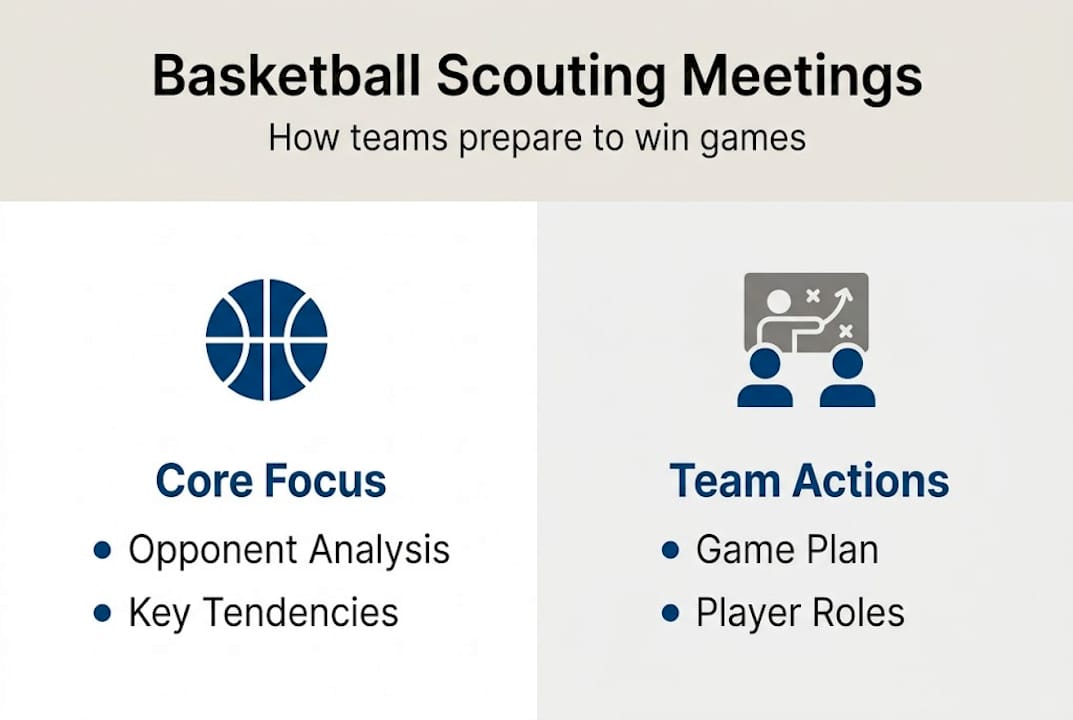
Many coaches underestimate this. They assume players will absorb information on their own or that a quick walkthrough before shoot-around is enough. It is not. Scouting reports in basketball lay the groundwork for team success, and the meeting is where that groundwork gets communicated clearly.
Here is what a well-run scouting meeting delivers:
- Team alignment: Everyone understands the game plan and their individual role in it.
- Opponent insights: Players know what to expect from specific players and sets.
- Actionable strategies: The meeting produces clear adjustments, not just observations.
- Confidence: Players feel prepared, not surprised, when they see familiar actions in the game.
- Staff coordination: Assistants and the head coach are on the same page before tip-off.
“Scouting meetings lay the groundwork for team success. When coaches invest time in structured preparation, teams execute with more clarity and purpose.” This is not just good practice. It is a competitive advantage that separates prepared teams from reactive ones.
Coaches who rely on scouting report strategies consistently report better in-game decision making and fewer breakdowns in key moments. The meeting is where strategy becomes shared knowledge.
With the critical role of scouting meetings established, let’s explore how to prepare effectively.
How to prepare for effective scouting meetings
Preparation determines the quality of the meeting. If you walk in without a clear plan, you waste everyone’s time. Here is a straightforward process to follow before every scouting meeting.
- Assign roles: Designate who scouts what. One assistant handles offense, another covers defense, and a third tracks personnel tendencies.
- Gather opponent data: Pull game film, box scores, play-by-play logs, and any available statistical breakdowns.
- Prepare reports: Build clean, readable documents that highlight key patterns. Avoid information overload. Focus on what matters most for this specific matchup.
- Set a clear agenda: Know exactly what you will cover and in what order. Time each segment if needed.
- Distribute materials early: Send reports to staff at least 24 hours before the meeting so everyone arrives informed.
Creating scouting reports that are well-organized is where effective scouting meetings start. Reports should be formatted consistently so players and staff can scan them quickly.
Video is a major asset. Short, edited clips that show specific plays or tendencies are far more effective than long unedited footage. Keep video segments under 90 seconds per concept. Players retain more when they see it visually.
Pro Tip: Involve your assistant coaches in the preparation process. Each coach brings a different lens, and a broader perspective during prep leads to sharper insights during the meeting itself.
Every meeting should have these materials ready:
- Printed or digital scouting report
- Edited video clips organized by topic
- Matchup assignments sheet
- Game plan summary (one page maximum)
- A basketball scouting checklist to confirm nothing is missed
Using consistent scouting templates across your staff keeps reports uniform and saves hours of prep time each week. When everyone uses the same format, the meeting runs faster and communication is cleaner.
Once you have prepared, it is essential to make your scouting meetings as effective as possible in action.
Anatomy of a successful scouting meeting
Knowing what to cover is one thing. Knowing how to run the room is another. Here is what a high-quality scouting meeting looks like from start to finish.
A typical agenda looks like this:
- Open with the opponent overview: Who they are, their record, their style of play.
- Review offensive tendencies: Key sets, go-to actions, ball handlers, and scoring options.
- Break down defensive schemes: How they guard pick-and-roll, how they handle transition, where they give up points.
- Assign matchups: Be specific. Tell each player who they are guarding and why.
- Clarify the game plan: Two or three offensive priorities and two or three defensive priorities. Keep it simple.
- Q&A: Give players time to ask questions and confirm understanding.
Following a scouting workflow that is repeatable boosts meeting outcomes and reduces confusion. When players know the format, they engage faster.
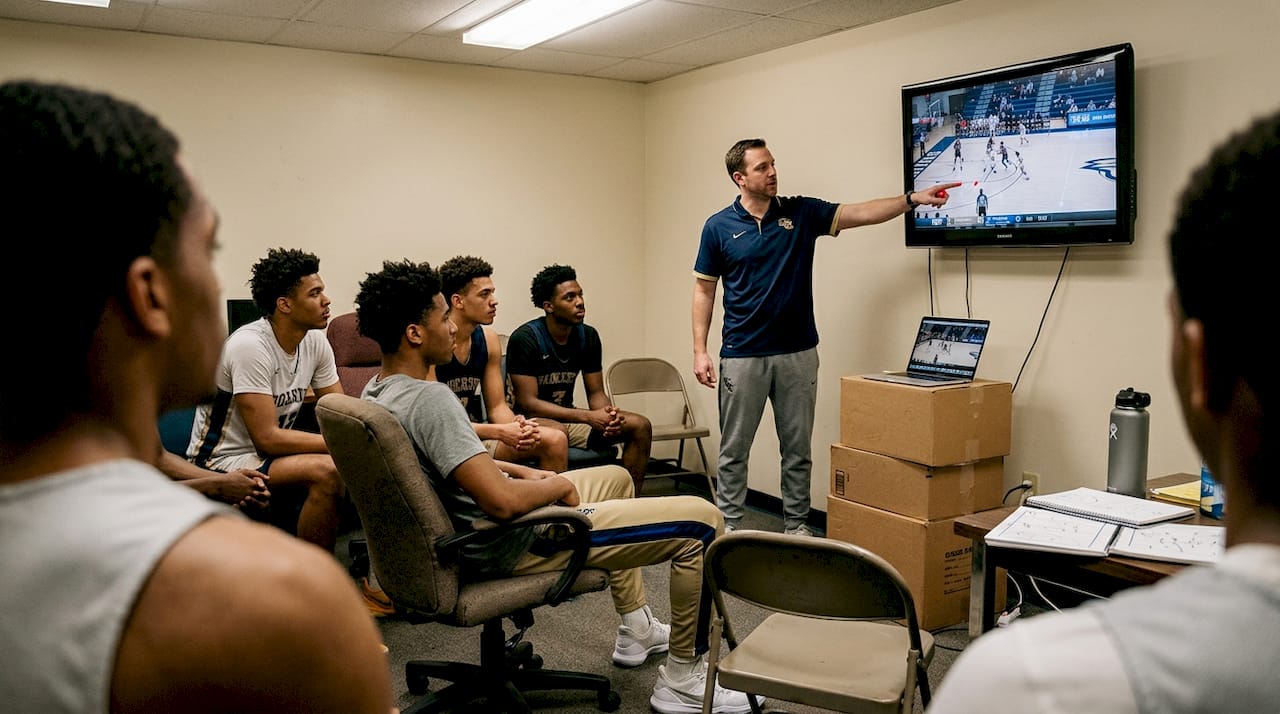
Here is a comparison of ineffective versus effective scouting meetings:
| Factor | Ineffective meeting | Effective meeting |
|---|---|---|
| Length | 90 minutes, unfocused | 45 minutes, structured |
| Content | Everything about the opponent | Top priorities only |
| Player role | Passive listeners | Active participants |
| Video use | Long unedited clips | Short, targeted clips |
| Takeaway | General awareness | Specific assignments |
Encourage player input. Ask your point guard what they noticed on film. Ask your bigs about post defense tendencies. Players who contribute to the plan are more invested in executing it. Scouting video clips make this discussion concrete and focused.
Close every meeting with a recap. State the three things your team must do to win. Write them on the board. Reference scouting report examples if players need to visualize what good preparation looks like.
Understanding the anatomy of a great meeting, let’s see how to bridge meetings into winning game preparation.
Translating scouting meetings into game-day success
A great meeting means nothing if it does not show up on the court. The connection between preparation and performance is direct, but it requires follow-through.
Well-run scouting meetings improve game performance and adaptability. Here is what that looks like in measurable terms:
| Metric | Without structured scouting | With structured scouting |
|---|---|---|
| Turnovers per game | 16.2 | 12.4 |
| Defensive stops in 4th quarter | 4.1 | 6.8 |
| Offensive adjustments made | 1 per game | 3 per game |
| Player confidence rating | 62% | 84% |
Consider this scenario: Your team is preparing for an opponent that runs a heavy ball-screen offense. In your scouting meeting, you identify that their primary ball handler shoots 38% on pull-up jumpers but only 21% when forced left. You assign your best on-ball defender, practice the coverage twice in your next practice, and remind players of the tendency in pregame. In the fourth quarter, your team executes that coverage three straight possessions and forces three misses. That win came from the meeting room.
Pro Tip: After every game, spend 10 minutes reviewing how well your scouting plan held up. Note what your team executed well and what broke down. Use those observations to improve your next meeting.
Reviewing outcomes closes the loop. It turns scouting meetings into a learning system, not just a one-time event. Coaches who use scouting coverage insights to evaluate post-game results build smarter, more adaptive teams over the course of a season.
After seeing the direct benefits on court, what perspective challenges or myths remain about scouting meetings?
The uncomfortable truths about scouting meetings
Here is something most coaching resources will not tell you: more meetings do not equal better outcomes. Some coaches schedule long, detailed sessions thinking thoroughness equals preparation. It does not. It equals overload.
Players can absorb three to five key points per meeting. Beyond that, retention drops fast. When you cram 20 tendencies, six set plays, and a full defensive scheme into one session, players leave confused, not confident. That confusion shows up as hesitation on the court.
The best scouting meetings we have seen are short, focused, and player-driven. The coach presents the core priorities. Players ask questions. Assignments are confirmed. Everyone leaves knowing exactly what to do.
“The goal of a scouting meeting is not to show how much you know about the opponent. It is to give your players exactly what they need to compete.”
Stop measuring meeting quality by length or detail volume. Measure it by player clarity. If your players can walk out and explain the game plan in two sentences, the meeting worked. Explore advanced scouting strategies to sharpen your approach and cut the noise.
Take your scouting meetings to the next level
You now have a clear picture of what effective scouting meetings look like and how to run them. The next step is putting the right tools in your hands.

Hoop Mentality offers resources built specifically for coaches who want to move from strategy to action. The game preparation guide gives you a structured weekly system that connects scouting work directly to practice planning. For coaches developing big men and looking to sharpen skill-based preparation, the big man dual action drill is a practical tool you can use right away. Both resources are built from real coaching experience and designed to save you time while improving your team’s readiness.
Frequently asked questions
How often should basketball teams hold scouting meetings?
Hold scouting meetings before each opponent. For most teams, that means once per week during the season. Regular scouting meetings drive better performance outcomes when they follow a consistent schedule.
What should be included in a typical basketball scouting meeting?
Key elements are opponent analysis, strengths and weaknesses discussion, personnel matchups, and clear strategy assignments. Checklists and agendas keep meetings focused and effective.
Do effective scouting meetings actually improve game results?
Yes. Teams using structured scouting meetings see better game preparation and on-court performance. Organized scouting leads to better execution when it matters most.
How can coaches make scouting meetings more engaging for players?
Include video clips, ask for player input, keep content actionable, and use real game examples. Video and active discussion improve engagement and help players retain the game plan.
Recommended
- Importance of Scouting Reports in Basketball Success – Hoop Mentality
- Scouting Report Strategies for Winning Basketball – Hoop Mentality
- Scouting coverage in basketball: tactics and winning insights – Hoop Mentality
- How to Create Scouting Reports for Winning Basketball Teams – Hoop Mentality
- Basket Analysis Guide: Techniques and Applications for 2025 - Affinsy Blog | Affinsy