

Coaches often struggle to evaluate players accurately when relying solely on basic statistics like points and assists. These traditional metrics miss crucial elements such as defensive impact, basketball IQ, and adaptability that separate good players from great ones. This guide provides basketball coaches with advanced scouting techniques for 2026, covering modern evaluation methods that reveal true player value. You’ll discover how to prepare comprehensive scouting systems, execute data-driven assessments, and verify your findings to build winning teams through smarter player evaluations.
Table of Contents
- Understanding The Scouting Problem: Why Traditional Metrics Fall Short
- Preparing Your Scouting Approach: Essentials For Effective Player Evaluation
- Executing Advanced Scouting: Integrating Analytics And Player Impact Models
- Verifying Scouting Effectiveness And Avoiding Common Pitfalls
- Explore Coaching Resources To Elevate Your Scouting In 2026
Key takeaways
| Point | Details |
|---|---|
| Traditional stats miss context | Assists and turnovers don’t reveal pass difficulty or defensive contributions that impact games |
| Three scouting types matter | Player, team, and opponent scouting create comprehensive evaluation frameworks for coaches |
| Advanced metrics boost accuracy | Season Rating models and impact analytics improve prediction success by 20-30% |
| Focus on intangibles | Adaptability, leadership, and work ethic often determine player development more than raw numbers |
| Select targeted KPIs | Choosing 3-5 key performance indicators aligned with team strategy prevents data overload |
Understanding the scouting problem: why traditional metrics fall short
Most coaches evaluate players using box score statistics that tell an incomplete story. Traditional passing evaluation in basketball scouting lacks depth, relying on assists and turnovers without considering the difficulty of passes or their impact on team success. A player who racks up assists by making simple passes to elite scorers receives the same statistical credit as one who creates opportunities through vision and timing in complex defensive schemes.
This limitation extends beyond passing. Basic statistics treat all contributions equally, ignoring context that determines actual value. A defensive stop that prevents a fast break opportunity doesn’t appear in traditional stats. A player who spaces the floor perfectly, creating driving lanes for teammates, goes unrecognized in box scores. These invisible contributions often separate championship teams from mediocre ones.
Scouts who focus exclusively on points, rebounds, and assists miss the complete picture of basketball scouting effectiveness. Consider two guards who both average 15 points and 5 assists per game. Traditional metrics suggest equal value, but one might create higher quality shots, defend multiple positions, and make better decisions under pressure. The other might accumulate stats in garbage time or against weak opponents.
Advanced metrics reveal these hidden differences by measuring true impact on team performance. Season Rating models, for example, capture how a player’s presence affects both offensive and defensive efficiency. These systems account for opponent strength, teammate quality, and situational factors that basic stats ignore.
“The best players aren’t always the ones with the highest scoring averages. They’re the ones who make everyone around them better through defense, spacing, and decision making that doesn’t show up in traditional box scores.”
Key limitations of traditional scouting include:
- Treating all assists equally regardless of pass difficulty or shot quality created
- Ignoring defensive positioning, communication, and off-ball contributions
- Missing contextual factors like opponent strength and game situation
- Failing to measure intangibles such as leadership and coachability
- Overlooking spacing value and gravity that creates opportunities for teammates
Coaches who recognize these gaps can build more accurate evaluation systems that identify undervalued players and predict future success more reliably.
Preparing your scouting approach: essentials for effective player evaluation
Effective scouting in 2026 requires understanding three distinct evaluation types. Basketball scouting encompasses player, team, and opponent scouting approaches, each serving different strategic purposes. Player scouting assesses individual talent and potential for recruitment or development. Team scouting analyzes your own squad’s collective strengths and weaknesses. Opponent scouting prepares you for specific matchups by identifying tactical vulnerabilities.
Building a comprehensive scouting checklist starts with identifying key attributes across five categories. Physical traits include height, wingspan, speed, and strength that determine positional fit. Offensive skills cover shooting mechanics, ball handling, passing vision, and scoring efficiency. Defensive capabilities encompass on-ball pressure, help defense awareness, rebounding positioning, and transition defense.
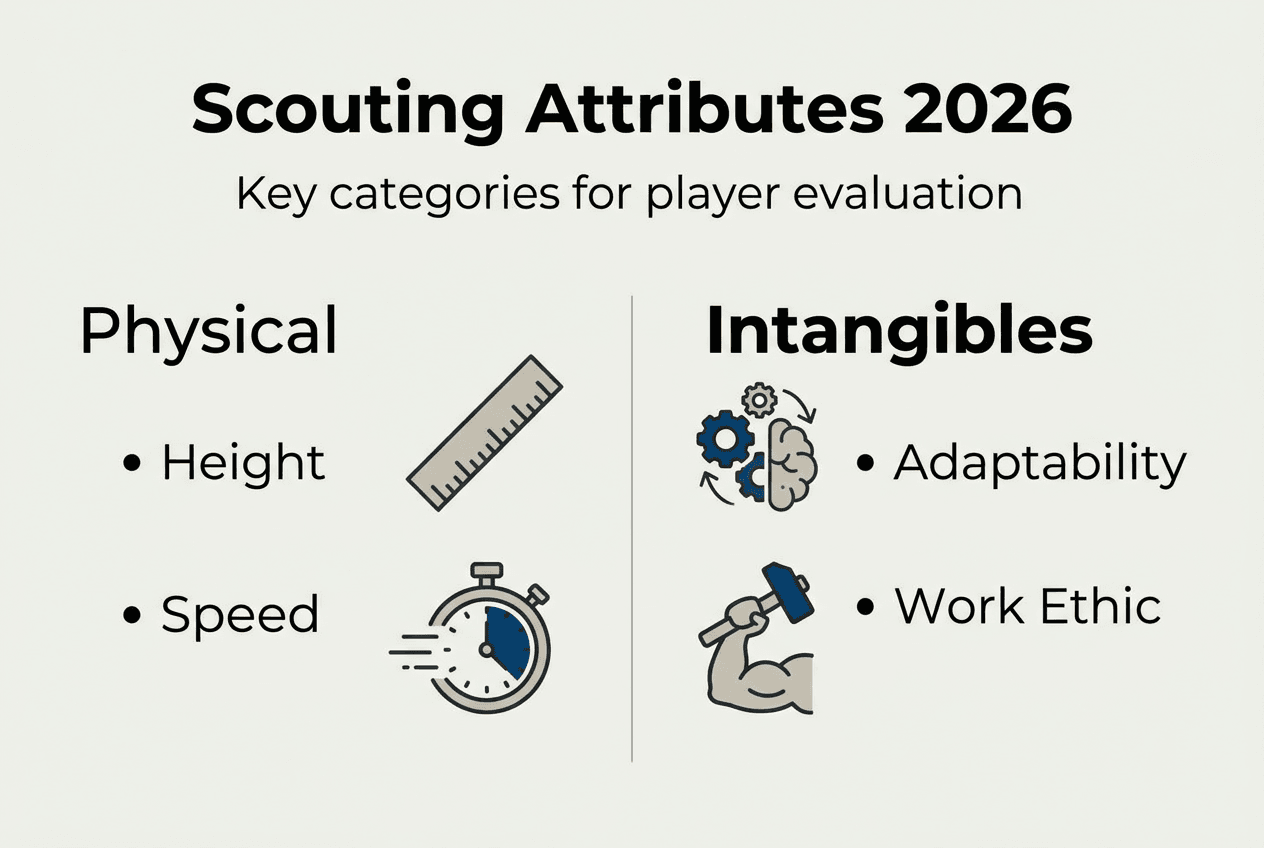
Adaptability measures how quickly players adjust to different schemes, opponents, and game situations. Intangibles capture leadership qualities, work ethic, basketball IQ, and emotional control under pressure. These less tangible factors often predict long-term success better than raw athletic ability.
Essential player evaluation categories:
| Category | Key Indicators | Evaluation Method |
|---|---|---|
| Physical | Height, wingspan, speed, strength | Measurements and athletic testing |
| Offensive | Shooting, passing, ball handling, scoring | Video analysis and efficiency metrics |
| Defensive | On-ball, help defense, rebounding | Impact stats and film breakdown |
| Adaptability | Scheme flexibility, learning speed | Multi-situation observations |
| Intangibles | Leadership, IQ, work ethic | Coach feedback and behavioral tracking |
Selecting the right key performance indicators prevents analysis paralysis. Rather than tracking every possible metric, focus on 3-5 KPIs aligned with your team’s strategic priorities. A team emphasizing transition offense might prioritize speed, decision making in the open court, and defensive rebounding. A half-court oriented squad might value shooting efficiency, spacing awareness, and post defense instead.
Equipping yourself with proper scouting tools streamlines the evaluation process. Video analysis software allows frame-by-frame breakdown of player movements and decisions. Statistical tracking platforms provide advanced metrics beyond basic box scores. Standardized report templates ensure consistent evaluation criteria across all prospects.
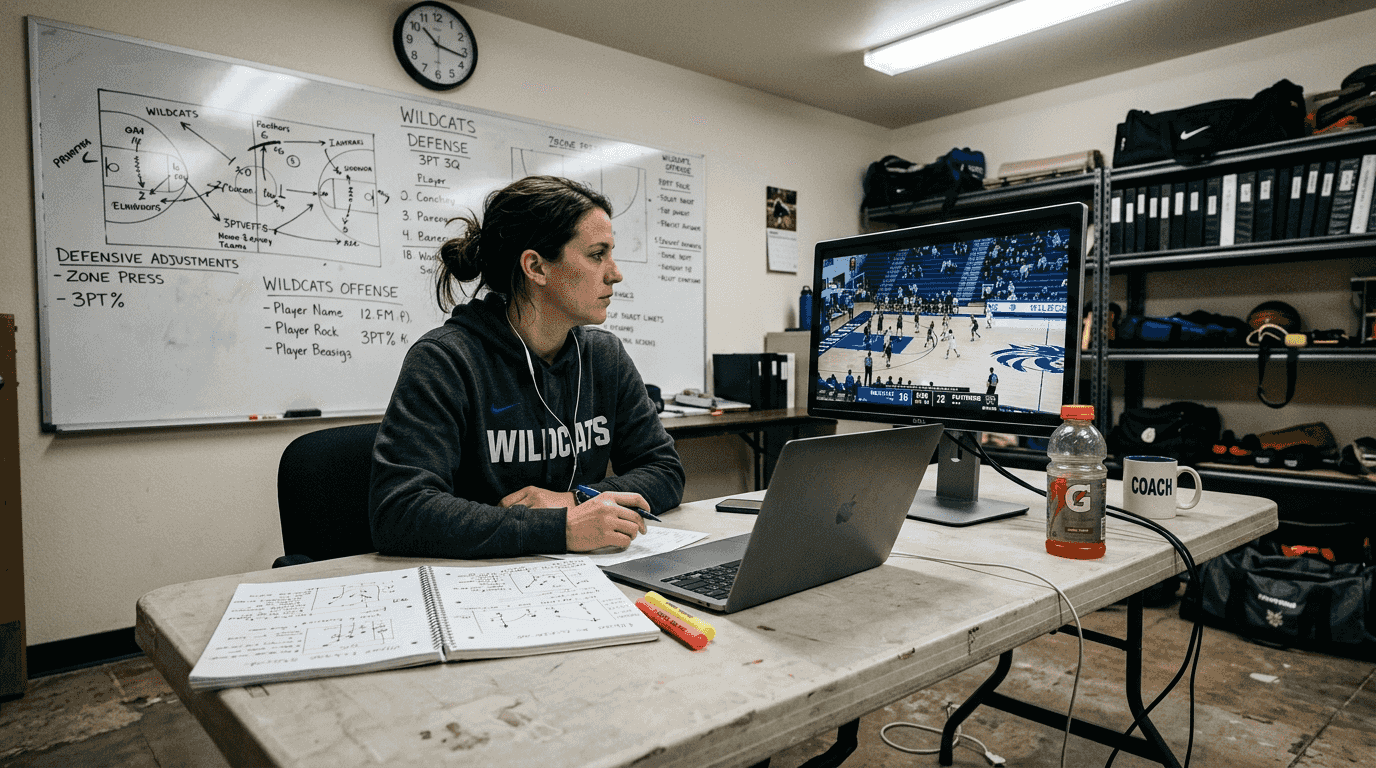
Pro Tip: Start with three KPIs that directly support your offensive and defensive systems, then add metrics only when you’ve mastered analyzing the initial set. More data doesn’t always mean better decisions, and tracking too many indicators dilutes focus on what truly matters for your team’s success.
Document your scouting process in writing so you can refine it over time. Note which indicators predicted player success accurately and which proved misleading. This feedback loop transforms scouting from guesswork into a systematic competitive advantage.
Executing advanced scouting: integrating analytics and player impact models
Implementing modern scouting techniques requires systematic integration of advanced metrics into your evaluation workflow. Season Rating models capture comprehensive offensive and defensive impact beyond box stats, measuring how a player’s presence affects team performance in both phases. These models account for teammate quality, opponent strength, and game context that traditional statistics ignore.
Follow this process to incorporate advanced analytics into your scouting:
- Establish baseline measurements using traditional stats to identify initial prospects
- Apply offensive Season Rating to evaluate scoring efficiency, shot creation, and playmaking impact
- Calculate defensive Season Rating to assess on-ball defense, help defense, and overall team defense improvement
- Compare advanced metrics against video analysis to validate statistical findings with observable skills
- Document intangibles and adaptability through multiple game observations in varied situations
- Synthesize quantitative and qualitative data into comprehensive player profiles
Advanced analytics significantly improve prediction accuracy compared to traditional methods. Studies show that impact-based metrics increase prediction of player success by 20-30% compared to basic box score statistics. This improvement comes from capturing hidden contributions that separate good players from elite ones.
Comparison of evaluation approaches:
| Evaluation Method | Data Sources | Prediction Accuracy | Key Strengths | Main Limitations |
|---|---|---|---|---|
| Basic Box Stats | Points, rebounds, assists | Baseline | Simple to understand | Misses context and impact |
| Advanced Metrics | Season Rating, efficiency | 20-30% higher | Captures true impact | Requires statistical knowledge |
| Video Analysis | Game film breakdown | High for skills | Shows technique details | Time intensive, subjective |
| Combined Approach | All sources integrated | Highest overall | Comprehensive evaluation | Demands systematic process |
When evaluating player performance, balance quantitative metrics with qualitative observations. A player might show excellent advanced stats but struggle with coachability or team chemistry. Another might have modest numbers yet elevate teammates through leadership and communication. Your scouting report strategies should capture both dimensions.
Include these elements in every comprehensive scouting report:
- Offensive impact metrics showing scoring efficiency and shot creation ability
- Defensive ratings revealing on-ball pressure and help defense contributions
- Adaptability assessment based on performance across different opponents and schemes
- Intangible factors including work ethic, coachability, and leadership qualities
- Development projection estimating improvement potential over 1-3 years
Pro Tip: Use advanced metrics to identify undervalued prospects, then verify findings through detailed video analysis. Numbers reveal patterns that eyes might miss, but film confirms whether statistical anomalies reflect genuine skill or situational luck. This two-step validation prevents both overlooking hidden gems and overrating statistical outliers.
Document your evaluation process consistently so you can refine it based on outcomes. Track which metrics proved most predictive for your specific team context and playing style. A system that works for an up-tempo pressing team might need adjustment for a deliberate half-court squad.
Verifying scouting effectiveness and avoiding common pitfalls
Validating your scouting accuracy ensures your evaluation system produces reliable results. Compare pre-game scouting reports against actual player performance to identify prediction gaps. Track whether players develop as projected over weeks and months. This feedback loop reveals which evaluation criteria predict success accurately and which need refinement.
Implement these verification steps systematically:
- Review post-game statistics and film against pre-game scouting predictions
- Document discrepancies between expected and actual player performance
- Analyze whether prediction errors stemmed from incomplete data or flawed evaluation criteria
- Adjust your scouting framework based on patterns in prediction accuracy
- Solicit feedback from assistant coaches who observe different aspects of player performance
- Track player development over multiple games to validate long-term projections
Common scouting mistakes undermine even well-intentioned evaluation systems. Over-reliance on raw stats without context can mislead scouting outcomes, causing coaches to overvalue high-volume scorers on weak teams or underestimate defensive specialists. Ignoring intangibles like leadership and work ethic leads to roster chemistry problems despite strong individual talent.
Avoid these frequent evaluation pitfalls:
- Evaluating players only against weak competition without adjusting for opponent quality
- Tracking too many performance indicators, creating analysis paralysis
- Dismissing players with modest stats who contribute through intangibles
- Failing to account for role differences when comparing players
- Neglecting to update scouting reports as players develop new skills
Adaptability and coachability serve as crucial verification criteria often overlooked in traditional scouting. A player who quickly adjusts to new defensive schemes demonstrates learning capacity that predicts long-term value. Someone who accepts coaching feedback and implements corrections shows growth potential beyond current skill level. These qualities often matter more than raw athletic ability for sustained success.
Refining your scouting report creation process requires regular system updates. Schedule monthly reviews of your evaluation framework, adjusting criteria based on prediction accuracy. Remove metrics that don’t correlate with actual performance. Add new indicators when you identify gaps in your assessment.
“The best scouts aren’t the ones who never make mistakes. They’re the ones who learn from every evaluation, refining their process to make better predictions next time. Systematic improvement beats natural talent in the long run.”
Collaborate with assistant coaches to capture multiple perspectives on player evaluation. Different observers notice different aspects of performance. One coach might excel at identifying defensive awareness while another spots offensive creativity. Combining these viewpoints creates more complete player profiles than any single evaluator could produce.
Pro Tip: Maintain a prediction journal documenting your pre-game expectations and post-game reality for every scouted player. After 20-30 evaluations, patterns emerge showing which aspects of your system work well and which need adjustment. This data-driven approach to improving your scouting beats relying on intuition alone.
Explore coaching resources to elevate your scouting in 2026
Take your player evaluation to the next level with specialized resources designed for modern basketball coaching. Hoop Mentality offers tools that complement advanced scouting techniques, helping you develop players more effectively once you’ve identified their strengths and weaknesses.
The Big Man Dual Action Drill targets post player development with progressive exercises that build the skills your scouting identifies as priorities. Our Game Preparation Guide provides structured frameworks for translating scouting insights into practice plans and game strategies. The Basketball Scouting Report Template offers customizable formats that incorporate both traditional stats and advanced metrics, ensuring consistent evaluation across all prospects. These resources save preparation time while improving the quality of your player assessments and team development.
FAQ
What is the difference between player, team, and opponent scouting?
Player scouting evaluates individual talent, skills, and potential for recruitment or roster decisions. Team scouting analyzes your own squad’s collective strengths, weaknesses, and chemistry to optimize lineups and strategies. Opponent scouting focuses on preparing for specific teams by identifying their tactical patterns, key players, and exploitable vulnerabilities.
How do advanced metrics improve player evaluations beyond traditional stats?
Advanced metrics capture context and true impact that basic statistics miss, such as defensive contributions and teammate elevation. They improve prediction of future player performance by 20-30% compared to traditional box scores. Season Rating and similar models provide a comprehensive picture of how players affect both offensive and defensive team efficiency.
What key player attributes should scouts prioritize for 2026?
Prioritize offensive skills including shooting efficiency, passing vision, and scoring versatility across different situations. Defensive abilities matter equally, covering on-ball pressure, help defense awareness, and rebounding positioning. Intangibles such as adaptability, leadership, basketball IQ, and work ethic often predict long-term success better than raw physical tools.
How can coaches avoid common mistakes in basketball scouting?
Avoid over-relying on raw statistics without considering opponent quality, role differences, and game context. Select 3-5 key performance indicators aligned with your team’s strategic goals to prevent analysis paralysis from tracking too many metrics. Always evaluate intangibles like coachability, leadership, and adaptability alongside quantitative data, as these factors significantly influence player development and team chemistry.
Recommended
- 7 Key Elements of a Basketball Scouting Checklist – Hoop Mentality
- Scouting Report Strategies for Winning Basketball – Hoop Mentality
- Basketball Scouting Workflow for Winning Team Preparation – Hoop Mentality
- Build a Basketball Team: Step-by-Step Guide for Coaches – Hoop Mentality
- How to use creatine for athletes: proven strategies 2026