

Every coach knows how unpredictable a basketball matchup can be when facing a new opponent. The ability to create a comprehensive scouting report is what separates preparation from guesswork, empowering coaches to tailor game plans that fit American youth teams’ unique needs. By combining detailed team and player information with clear, actionable insights, you will transform scouting data into practical strategies that drive both player growth and competitive success.
Table of Contents
- Step 1: Define Opponent and Key Data Points
- Step 2: Gather Essential Team and Player Information
- Step 3: Organize Data into Actionable Insights
- Step 4: Design Clear and Usable Scouting Report Formats
- Step 5: Review and Refine Scouting Reports for Accuracy
Quick Summary
| Key Insight | Explanation |
|---|---|
| 1. Collect Comprehensive Data | Gathering detailed statistics helps identify opponent strengths and weaknesses for better game strategies. |
| 2. Blend Quantitative and Qualitative Insights | Combining statistical analysis with game footage offers a holistic view of team dynamics and player behavior. |
| 3. Organize Data Effectively | Systematic categorization of data transforms raw statistics into actionable insights for game planning. |
| 4. Design User-Friendly Reports | Clear, visually intuitive reports facilitate quick understanding of key strategic insights among coaches and players. |
| 5. Regularly Review and Refine | Continual verification and updates enhance report accuracy and relevance, ensuring strategic recommendations are trustworthy. |
Step 1: Define Opponent and Key Data Points
Building a winning basketball scouting report starts with strategic opponent analysis. You’ll transform raw data into actionable insights that give your team a competitive edge.
To effectively define your opponent, focus on collecting comprehensive performance metrics that reveal their strengths, weaknesses, and strategic patterns. Begin by gathering key data points across multiple dimensions:
-
Offensive Performance
- Points per game
- Field goal percentage
- Three-point shooting accuracy
- Turnover rates
-
Defensive Capabilities
- Defensive rebounds
- Blocks per game
- Opponent field goal percentage
- Steals
-
Individual Player Statistics
- Key player scoring averages
- Player efficiency ratings
- Position-specific performance metrics
Data collection requires systematic research across multiple sources. Basketball reference databases provide comprehensive statistical archives that can help you build a detailed profile of your opponent’s performance trends.
Consider breaking down data into visual formats like charts or graphs to make patterns more apparent. This transformation from raw numbers to strategic insights allows coaches to develop targeted game plans that exploit opponent vulnerabilities.
The most successful scouting reports turn statistical data into actionable strategic knowledge.
Pro tip: Focus on collecting data from the last 5-7 games to ensure you’re analyzing the most recent performance trends.
Step 2: Gather Essential Team and Player Information
Successful basketball scouting demands a comprehensive approach to collecting detailed information about your opponent. Your goal is to build a nuanced understanding of both team dynamics and individual player capabilities that will inform your strategic game plan.
Basketball scouting techniques require systematic data collection across multiple performance dimensions. Begin by breaking down your research into key investigative areas:
-
Team Performance Metrics
- Overall win-loss record
- Recent game outcomes
- Home versus away performance
- Scoring consistency
-
Individual Player Analysis
- Shooting percentages
- Defensive capabilities
- Physical attributes
- Position-specific skills
-
Strategic Behavioral Patterns
- Offensive play styles
- Defensive formations
- Situational decision-making
- Player substitution patterns
Comprehensive scouting involves more than statistical analysis. Watch game footage, analyze player interactions, and look for subtle strategic nuances that numbers alone cannot reveal. Pay attention to team chemistry, individual player body language, and emotional responses under pressure.

Here is a summary comparing quantitative and qualitative scouting approaches:
| Approach Type | Example Data Sources | Insights Provided | Value to Team |
|---|---|---|---|
| Quantitative | Statistical databases, box scores | Identifies trends, performance gaps | Objective performance evaluation |
| Qualitative | Game footage, live observation | Reveals team chemistry, reactions | Context for strategic decisions |
The most effective scouting reports blend quantitative data with qualitative observations to provide a holistic view of the opponent.
Pro tip: Create a standardized observation template to ensure consistent and thorough data collection across multiple scouting sessions.
Step 3: Organize Data into Actionable Insights
Transforming raw basketball statistics into a strategic roadmap requires more than just collecting numbers. Your mission is to synthesize complex data into clear, executable game strategies that will give your team a competitive advantage.
Begin by developing a systematic data analysis approach that categorizes information into meaningful strategic layers:
-
Offensive Strategy Insights
- Scoring efficiency by play type
- Player shooting zones
- Ball movement patterns
- Turnover likelihood
-
Defensive Vulnerability Mapping
- Weak defensive zones
- Individual player defensive ratings
- Transition defense performance
- Foul tendency analysis
-
Performance Trend Visualization
- Comparative performance graphs
- Statistical regression analysis
- Performance consistency indicators
- Momentum shift patterns
Effective data organization transforms raw statistics into a narrative. Look beyond simple numbers to understand the story behind the data. Identify recurring patterns, unexpected strengths, and potential tactical vulnerabilities that can inform your game strategy.
The difference between good and great coaching is the ability to translate complex data into clear, actionable game plans.
Pro tip: Color-code your analysis documents to quickly distinguish between different performance categories and highlight critical insights.
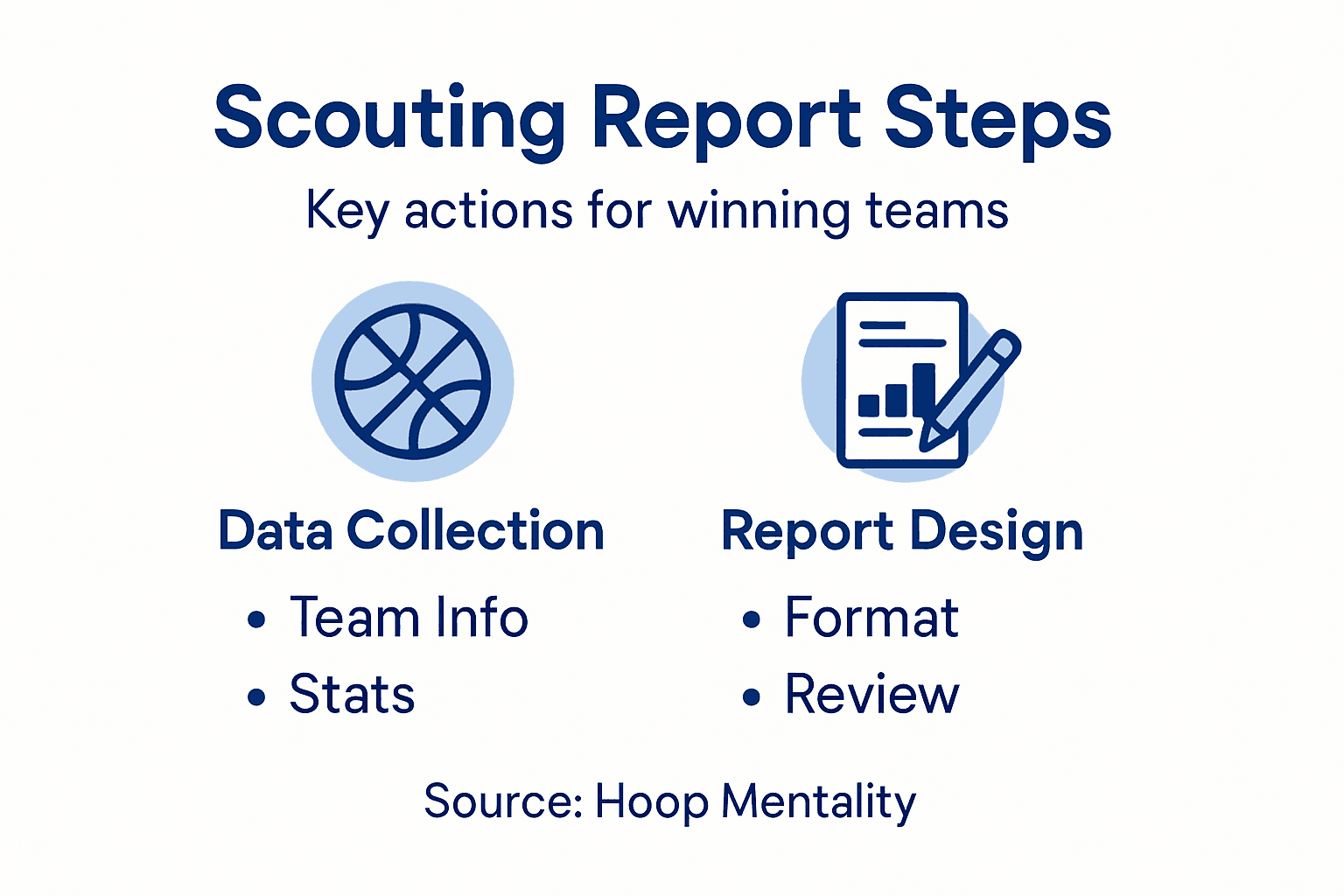
Step 4: Design Clear and Usable Scouting Report Formats
Creating an effective scouting report means transforming complex data into a visually intuitive and immediately actionable document. Your goal is to develop a format that allows coaches and players to rapidly understand key strategic insights without getting bogged down in unnecessary details.
Basketball scouting report design requires a strategic approach to information presentation:
-
Report Layout Essentials
- Clean, professional design
- Consistent typography
- Strategic white space
- Easy-to-read sections
-
Information Hierarchy
- Most critical insights first
- Logical flow of information
- Concise player summaries
- Performance highlights
-
Visual Communication Elements
- Color-coded performance indicators
- Graphical representations of data
- Quick reference summaries
- Comparative performance charts
Design your report to facilitate quick comprehension. Use visual breaks, bold headings, and clear section divisions that allow readers to scan and understand key information at a glance. The most effective reports feel like a strategic roadmap rather than a dense statistical document.
A great scouting report turns complex data into a clear game strategy that players and coaches can instantly understand.
Pro tip: Use consistent formatting across all reports to help your team develop a standardized approach to information absorption.
Step 5: Review and Refine Scouting Reports for Accuracy
Creating an exceptional scouting report requires more than initial data collection - it demands rigorous verification and continuous refinement. Your ultimate goal is to develop a document that provides laser-focused insights coaches and players can trust completely.
Utilize a systematic scouting report verification approach to validate your analysis:
-
Data Verification Strategies
- Cross-reference multiple statistical sources
- Confirm player performance metrics
- Validate recent game footage analysis
- Check for reporting date ranges
-
Accuracy Validation Techniques
- Compare current and historical data
- Identify potential reporting inconsistencies
- Review sample sizes for statistical significance
- Eliminate outdated or irrelevant information
-
Refinement Checkpoints
- Remove subjective language
- Standardize data presentation
- Align report with current team strategies
- Ensure numerical precision
Successful refinement transforms raw information into a strategic asset. Look beyond surface-level statistics to understand deeper performance trends and potential game-changing insights.
Below is a quick reference for key report refinement checkpoints and their impact:
| Refinement Checkpoint | What It Ensures | Strategic Impact |
|---|---|---|
| Cross-source verification | Data reliability and accuracy | Trusted recommendations |
| Standardized formatting | Clarity and professional look | Fast information absorption |
| Up-to-date sample sizes | Relevance to current performance | Actionable game planning |
| Elimination of bias | Objective reporting | Better decision-making |
Accuracy is not about perfection, but about providing the most reliable information possible for strategic decision-making.
Pro tip: Establish a consistent review timeline, such as checking and updating reports every 3-5 games to maintain maximum relevance.
Take Your Scouting Reports to the Next Level with Hoop Mentality
Creating detailed and accurate scouting reports is a crucial challenge for every basketball coach aiming to build winning teams. This article highlights the importance of transforming raw data into clear, actionable insights and the need for organized, visually intuitive report formats. If you find yourself overwhelmed by data collection, analysis, or report design, Hoop Mentality has the perfect solution to help you streamline your process and gain a competitive edge.
Explore our extensive range of Basketball Templates designed specifically for scouting and game preparation. These resources are built from real coaching experience to save you time while improving communication and strategy clarity.
Start transforming complex opponent analysis into winning game plans today. Visit Hoop Mentality and unlock professional-grade scouting tools, detailed playbooks, and step-by-step guides that empower you to organize practices and competition prep like never before. Don’t wait to elevate your team’s performance with resources trusted by coaches worldwide.
Frequently Asked Questions
How do I start creating a scouting report for my basketball team?
Begin by defining your opponent and collecting key data points such as offensive performance and defensive capabilities. Focus on gathering statistics from the last 5-7 games to capture the most recent trends.
What are the essential metrics to include in a basketball scouting report?
Include metrics like points per game, field goal percentage, turnover rates, and individual player statistics such as shooting accuracy and defensive ratings. Summarizing these metrics will provide clear insight into your opponent’s strengths and weaknesses.
How can I analyze player behavior and team dynamics effectively?
Watch game footage and observe player interactions during games to identify non-statistical elements such as emotional responses and team chemistry. Organize these observations systematically to enhance your understanding of strategic behaviors.
What should I consider when designing the layout of a scouting report?
Design your report with a clean and professional layout, ensuring it is easy to read and understand quickly. Use visual elements like charts and color-coded performance indicators to highlight crucial insights at a glance.
How often should I review and update my scouting reports?
Establish a routine to review and refine your scouting reports every 3-5 games to keep the information relevant and accurate. This will ensure your game strategies are based on the latest data and insights.
What is the importance of blending quantitative and qualitative data in a scouting report?
Combining quantitative data (like statistics) with qualitative observations (like player dynamics) enriches the scouting report, providing a holistic view of the opponent. This dual approach allows for better strategic planning and decision-making.
Recommended
- Scouting Report Strategies for Winning Basketball – Hoop Mentality
- How To Write A Scouting Report For Basketball - Hoop Mentality
- Basketball Scouting Workflow for Winning Team Preparation – Hoop Mentality
- What Is Basketball Scouting? Complete Overview – Hoop Mentality
- Guide to Sports Nutrition Basics for Optimal Results – MyGymSupplements