

Every American high school basketball coach knows the challenge of prepping for tough opponents when practice hours are limited. Winning more games isn’t just about running drills—it’s about turning raw performance data into a strategic advantage your players actually use. A well-crafted scouting report equips your team with actionable insights to counter rival strengths and exploit specific weaknesses, making every practice minute count and empowering smart game-day decisions.
Table of Contents
- Defining Scouting Reports In Basketball
- Types Of Scouting Reports And Key Elements
- How Scouting Reports Shape Game Strategy
- Best Practices For Implementing Scouting Insights
- Risks, Limitations, And Common Pitfalls
Key Takeaways
| Point | Details |
|---|---|
| Importance of Scouting Reports | Scouting reports provide crucial analytical insights that transform raw data into competitive strategies. They are essential for understanding opponent strengths and weaknesses. |
| Types of Scouting Reports | There are four main types: Opponent, Self-Scouting, Player-Specific, and Game Adjustment, each serving a unique purpose for effective game preparation. |
| Key Elements for Effectiveness | Quality reports must include personnel breakdowns, offensive and defensive tendencies, matchup insights, and video evidence to maximize player understanding. |
| Implementation Strategies | Successful scouting requires simplicity and context in practice drills, focusing on 3-4 critical adjustments that are directly linked to the opponent’s characteristics. |
Defining Scouting Reports in Basketball
A scouting report is a detailed document that collects and analyzes team and player performance data to improve competitive outcomes. It’s your playbook for understanding what you’re facing on game day.
Think of it as intelligence gathering. Just like a military scout returns with critical information about terrain and enemy positions, a basketball scout returns with actionable insights about opponents’ strengths, weaknesses, and tendencies.
What Goes Into a Scouting Report
Scouting reports contain multiple layers of information working together:
- Player data: Scoring patterns, shooting percentages, defensive tendencies, strengths, and weaknesses for key opponents
- Team statistics: Offensive pace, ball movement preferences, transition game frequency, and defensive schemes
- Game tendencies: What opponents do in specific situations (down 5 with 2 minutes left, trailing by 10 at halftime)
- Personnel matchups: How their players perform against different defensive approaches and body types
- Video analysis: Clip references that show exact examples of tendencies you’ve identified
A quality scouting report transforms raw data into strategic advantage, turning statistics into the difference between winning and losing close games.
How This Connects to Your Coaching Success
Scouting in basketball evolved from simple observation to systematic data analysis incorporating advanced technologies. Modern coaching requires more than gut feeling—it demands evidence-based preparation.
You’re already stretched thin managing practices, managing egos, and handling logistics. A proper scouting report saves you hours by giving you exactly what matters: the 3-4 critical adjustments your team needs to compete against this specific opponent.
Here’s what separates effective scouting reports from wasted paper:
- Focused on YOUR team’s defensive capabilities and offensive strengths
- Identifies matchup advantages you can actually exploit
- Highlights 2-3 key adjustments, not 20 overwhelming changes
- Includes video clips players can watch in 8-10 minutes
- Uses language your players understand, not coaching jargon
Why High School Coaches Need This Now
Your opponents are getting smarter. AAU programs share video. Regional programs analyze tendencies. If you’re operating on feel and experience alone, you’re leaving points on the floor.
A scouting report tells you whether their point guard attacking your weak-side defender is a weakness or their strength. It shows if their centers dominate only when playing alongside their backup power forward. It reveals if their zone is vulnerable to skip passes or reliant on one defender.
This is how you beat teams with more talent. You identify the angles they haven’t solved.
Pro tip: Start with just one opponent scouting report to test the process. Track if your team’s performance against that specific opponent improves when they know the tendencies beforehand—you’ll quickly see the competitive advantage.
Types of Scouting Reports and Key Elements
Not all scouting reports are created equal. Different game situations demand different types of reports, each designed to answer specific questions your team needs answered before tipoff.
Understanding which type of report you need saves preparation time and keeps your coaching focus sharp. You’re not writing reports to impress anyone—you’re writing them to win games.
The Four Main Types of Scouting Reports
Each type serves a distinct purpose in your competitive arsenal:
Opponent scouting reports break down what you’re facing. These analyze the other team’s offensive sets, defensive schemes, key personnel tendencies, and critical matchups. This is your primary defensive game plan.
Self-scouting reports evaluate your own team. You identify what your team does well, where you’re vulnerable, and how opponents might attack your weaknesses. This drives your offensive strategy selection.
Player-specific reports focus on individual opponents. Your point guard faces their best defender? That player gets a detailed profile covering how they pressure the ball, where they’re vulnerable, and what angles work against them.
Game adjustment reports are written during season after watching film. They update your understanding based on recent performance changes, new rotations, or evolved game plans from opponents.
Here’s a quick comparison of the four main types of basketball scouting reports and when each is most valuable:
| Scouting Report Type | Primary Focus | Typical Use Case | Most Useful For |
|---|---|---|---|
| Opponent | Analyze rival teams | Pre-game planning | Defensive strategy |
| Self-Scouting | Assess your own team | Ongoing performance reviews | Improving strengths/weaknesses |
| Player-Specific | Detail individual opponents | Special matchups or key players | Assignment adjustments |
| Game Adjustment | Respond to recent changes | During or after recent games | Adapting current strategy |
The most successful coaches treat scouting as an ongoing conversation with opponents’ film, not a one-time homework assignment before the game.
Key Elements Every Report Needs
Whether you’re analyzing an opponent or evaluating your own team, certain elements appear in every quality scouting report:
- Personnel breakdown: Names, jersey numbers, positions, strengths, and weaknesses for key players
- Offensive tendencies: Preferred sets, pick-and-roll frequency, three-point reliance, transition game style
- Defensive schemes: Whether they play man-to-man or zone, how they defend screens, pressure style
- Specific matchup notes: How their players perform against different body types, defensive styles, and your personnel
- Situation tendencies: What they do when ahead, behind, or in close games with limited time
- Video evidence: Specific game clips or timestamps showing tendencies you’ve identified
When you’re preparing key elements for your scouting checklist, remember that every element serves a strategic purpose—there’s no filler.
Why Organization Matters
Your players have 48 hours to absorb this information. If your report rambles, they’ll forget the critical adjustments. Structure matters as much as content.
Organize by position or by tactical focus. Show how their structure creates opportunities you can exploit. Make it visual with bullet points instead of dense paragraphs. Every element should answer: “Why does this matter to us?”
Pro tip: Record a 5-minute video walkthrough of your scouting report hitting only the 3-4 critical adjustments—this doubles information retention compared to written reports alone, and players will actually watch it.
Use this summary as a checklist for ensuring each scouting report is actionable and easy to absorb:
| Report Organization Tip | Benefit to Coaches | Benefit to Players |
|---|---|---|
| Structure by position/focus | Saves prep time, highlights roles | Clarifies responsibilities |
| Prioritize 3-4 key adjustments | Avoids information overload | Increases retention |
| Use visuals and clear language | Simplifies communication | Makes content player-friendly |
| Incorporate short video walkthroughs | Enhances preparation | Boosts engagement and recall |
How Scouting Reports Shape Game Strategy
A scouting report isn’t just information—it’s your strategic blueprint. Every decision you make on the sideline traces back to intelligence gathered from film. This is where theory becomes winning basketball.
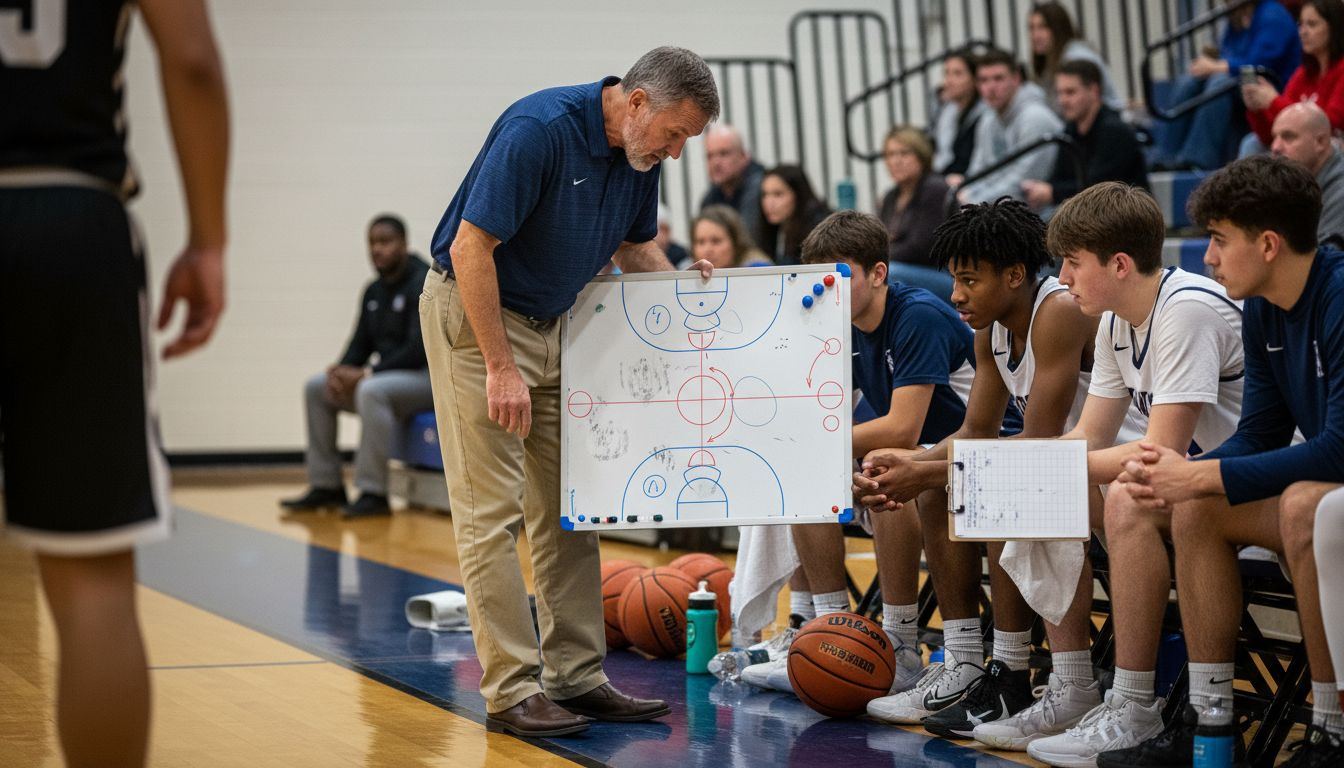
Effective scouting reports translate opponent intelligence into clear, actionable directives that players can execute during live competition. The report stops being useful the moment your team can’t act on it.
From Intelligence to Defensive Assignments
Your scouting report reveals defensive vulnerabilities you can exploit and strengths you must respect. This shapes your entire defensive game plan.
You’re not building a generic defense. You’re building a defense specifically designed to neutralize what this opponent does best. If they run pick-and-roll 40% of the time, your coverage accounts for it. If their best shooter is also their worst ball handler, you pressure the ball.
This means:
- Assigning defenders based on matchup strengths, not just position
- Positioning help defenders where opponents create most turnovers
- Choosing coverage types that exploit their weakness running specific sets
- Preparing switches and rotations they haven’t seen before
Your scouting report transforms defense from reactive to proactive—you’re not reacting to their offense, you’re suffocating it before it starts.
Offensive Opportunities Hidden in Film
Your scouting report doesn’t only tell you what they do. It tells you where they’re vulnerable when they’re playing defense.
Identify which defenders struggle guarding in space. Find which defensive schemes leave shooters open. Discover where their rotations create driving lanes. This is how you build offensive sets that attack specific weaknesses rather than just moving the ball around.
When you understand their defensive tendencies under pressure or in clutch moments, you can:
- Attack their weakest help defender consistently
- Run isolation plays against their worst perimeter defenders
- Use screens against defenders susceptible to screens
- Deploy specific player combinations that create favorable matchups
Allocating Your Limited Practice Time
You have limited hours. A quality scouting report directs every minute toward game preparation that matters.
Without scouting, you’re practicing general principles. With scouting, you’re installing specific counters to this specific opponent. Your team learns not just how to defend pick-and-roll—they learn how to defend this team’s pick-and-roll with their personnel.
Focus your installation on:
- Their three most common offensive sets
- Coverage against their top three scorers
- Situational adjustments (up, down, final minutes)
- How your best lineup neutralizes their best lineup
This laser focus multiplies practice efficiency. Your players understand why they’re doing every drill—it’s directly connected to Friday’s opponent.
Resource Allocation and Rotation Decisions
Scouting reports inform who plays and why. Your scouting reveals which players create matchup nightmares for your opponent.
If their center can’t defend in space, maybe your stretch forward gets significant minutes. If their perimeter defense is vulnerable, your best three-point shooter enters the rotation earlier. These aren’t emotional decisions—they’re strategic ones based on evidence.
Pro tip: Before installing offensive sets or defensive schemes, mark the three most critical scouting insights on a whiteboard during practice—players will retain strategy better when they understand the exact opponent weakness you’re attacking.
Best Practices for Implementing Scouting Insights
Knowing opponent tendencies means nothing if your team doesn’t execute on game day. The gap between scouting intelligence and winning basketball is implementation. This is where most coaches fail.
Your players need to understand not just what to do, but why they’re doing it. Connected players execute better than confused players. Every adjustment traces back to film evidence.
Keep It Simple and Specific
Don’t overwhelm your team with 15 defensive adjustments. Pick the three most critical insights and install those thoroughly.
When you focus on pick-and-roll defense, everyone understands the single adjustment. When you try to address their motion offense, their zone, their transition, and their post game, nothing sticks. Your team leaves the court confused instead of confident.
The best scouting implementations answer one question clearly:
- How do we stop their best player?
- How do we exploit their worst defender?
- How do we disrupt their most frequent set?
Implementation success depends on simplicity—players execute what they understand, and they understand what gets repeated.
Show Film Evidence, Not Just Words
When you say their point guard “struggles defending in space,” players nod. When you show three clips of them getting blown by in space, players believe it.
Film evidence transforms scouting from coaching theory into player understanding. Your guards will pressure more aggressively when they’ve watched opponents get hurt by pressure. Your forwards will rotate harder when they’ve seen the open three-pointer that results from lazy rotations.
Your implementation plan should include:
- 2-3 video clips showing the tendency you’re addressing
- One clip showing how your defensive adjustment stops it
- One clip showing what happens if you don’t make the adjustment
- Live repetition in practice matching the clips they watched
Connect Scouting to Practice Drills
Drills without context feel pointless to players. Drills connected to Friday’s opponent feel essential.
When you install a specific pick-and-roll coverage, the drill isn’t “pick-and-roll defense.” It’s “stop their 1-5 pick-and-roll that beat us last year.” When you practice defending their press, it’s not generic press offense—it’s their specific pressure looks from their film.
This connection multiplies drill effectiveness. Players understand exactly what they’re preparing for.
Build Adjustments Into Your System
Effective scouting strategies for basketball don’t require complete system overhauls. They work within your existing framework.
If you run man-to-man defense, your adjustments are coverage tweaks, not scheme changes. If you run a zone, your adjustments are positioning shifts, not structural changes. The best coaches adapt within their system rather than abandoning it.
Your adjustment checklist should cover:
- Ball screen coverage adjustments
- Transition defense assignments
- Perimeter shooting coverage tweaks
- Post defense positioning
- Rotation and help priorities
Communication During Games
Your scouting intelligence only helps if your team remembers it under game pressure. Use consistent terminology during timeouts.
If your scout report says “their power forward attacks left,” your sideline calls should reference that exact phrase. Consistency between practice and games ensures players execute what you’ve drilled.
Your timeout communications should focus on:
- One specific adjustment
- Reference to what you practiced
- What success looks like
Pro tip: Have your point guard repeat back the adjustment in a timeout before returning to the court—this forces processing and catches confusion before it costs you points.
Risks, Limitations, and Common Pitfalls
Scouting reports are powerful tools, but they’re not magic. Coaches who treat scouting as a complete solution often find themselves blindsided on game day. Understanding the real limitations keeps you grounded.
The best scouting implementation acknowledges what film can’t predict and prepares for it anyway. Your team still needs to execute. Your players still need to want to win.
Over-Reliance on Film Analysis
Film shows what opponents did. It doesn’t always predict what they’ll do Friday night.
Teams adjust. Players get injured. New lineups change everything. A point guard who dominated in film might foul out early, forcing their backup into the game. A defensive scheme that worked all season could get shredded by a single player making shots they haven’t made before.
When coaches obsess over film tendencies, they sometimes miss the obvious: your team might just need to execute better fundamentals. Perfect shot selection beats perfect scouting every time.
Common film-based mistakes:
- Assuming tendencies stay constant throughout the season
- Over-preparing for unlikely scenarios
- Ignoring your team’s actual defensive capabilities
- Building defenses around stopping what happened last year
Film shows the past. Basketball is played in the present. The best scouts stay flexible when reality changes the script.
The Time Investment Problem
Quality scouting demands hours. You have limited time as a high school coach juggling multiple responsibilities.
If you spend 10 hours creating a perfect scouting report, you’ve sacrificed 10 hours of practice preparation, drill design, or player development. Your time is genuinely finite. The best scouting balances insight with efficiency.
This is where many coaches fail: they create elaborate reports that take 15 hours to produce but only provide 2-3 actionable insights. The return diminishes quickly past a certain effort threshold.
Personnel Limitations
Your scouting report identifies what you need to do defensively. Your roster determines what you can actually do.
If their offense exploits perimeter shooting and you have no perimeter defenders, the perfect scouting report doesn’t matter. If they attack the paint and your centers can’t defend space, you’re limited. Scout reports don’t create the players you need—they work within the roster you have.
Your scouting should prioritize:
- What stops them using your best defenders
- Schemes matching your personnel strengths
- Realistic adjustments your team can execute
- Minimal installation time given your roster
Information Accuracy and Access
High school coaches often lack complete information on opponents. You might not have film of their most recent games. You might not understand their roster changes until game day.
Some coaches face opponents outside their conference with minimal available footage. Others scout teams that play in different regions with different rules interpretations. Your scouting is only as good as your information sources.
Work with what you can access:
- Recent game film from reliable sources
- Published statistics and roster information
- Conversations with coaches who’ve faced them
- Pre-game warmups and shootarounds
Opponent Adjustments
Coaches scouting you study your film too. Smart opponents know you’ll prepare for their tendencies and plan around it.
They might run sets you haven’t seen before in the tournament game. They might adjust their personnel matchups based on your expected defensive approach. Your scouting report becomes less valuable when opponents counter-scout against your counter.
This is why flexibility matters more than perfection. Scout their primary tendencies but maintain defensive principles that work against any system.
Pro tip: Create a “contingency adjustment” section in your scouting report—2-3 alternative defensive approaches if they show looks you didn’t expect, keeping your team flexible if film tendencies don’t appear.
Unlock Winning Strategies with Expert Scouting Support
The article highlights the challenge of transforming detailed scouting reports into clear, actionable game plans while managing limited time and player buy-in. You need focused adjustments, easy-to-understand language, and practical tools that save hours yet deliver key insights your team can execute confidently. Hoop Mentality understands these coaching hurdles and offers proven resources like scouting templates, practice plans, and strategy guides tailored to help you organize your scouting intelligence efficiently. These tools simplify incorporating your opponent analysis into drills and game adjustments so your players learn precisely what matters most.
Start winning more games today by turning complex scouting data into straightforward coaching actions with Hoop Mentality. Explore our full range of professional coaching solutions now at Hoop Mentality and experience how real coaching experience translates into practical benefits for your team. Don’t wait to elevate your preparation and communication—take control of your competitive edge now with scouting templates and strategy resources.
Frequently Asked Questions
What is the purpose of a scouting report in basketball?
A scouting report serves as a detailed analysis of team and player performance, providing insights on strengths, weaknesses, and tendencies to prepare for opponents effectively on game day.
What key elements should be included in a basketball scouting report?
A quality scouting report should include personnel breakdowns, offensive and defensive tendencies, matchup notes, situational tendencies, and relevant video evidence to provide actionable insights.
How can scouting reports improve my coaching strategy?
Scouting reports help coaches develop tailored game plans by identifying critical adjustments and insights specific to opponents, ultimately enhancing performance and game outcomes.
Why is it important for high school coaches to use scouting reports?
High school coaches need scouting reports to stay competitive. As opponents become more strategic, scouting helps identify vulnerabilities and leverages opportunities that give teams a tactical advantage.