

Even experienced coaches lose games because they misread or ignore how opponents defend. Scouting coverage, the detailed analysis of defensive schemes in opponent reports, is one of the most overlooked edges in basketball preparation. When you know exactly how a team defends pick-and-rolls, off-ball actions, and transition situations, you can design plays that attack those specific weaknesses. This guide breaks down what scouting coverage includes, explains every major defensive scheme, and gives you a clear framework to apply it all in practice and game planning.
Table of Contents
- What is scouting coverage in basketball?
- Core defensive coverages explained
- Strengths, weaknesses, and real-game examples
- How to scout and document defensive coverages
- Implementation: Translating coverage scouting into winning strategy
- Take your scouting and coverage mastery to the next level
- Frequently asked questions
Key Takeaways
| Point | Details |
|---|---|
| Scouting coverage basics | Understanding how teams play defense is essential for crafting effective offensive strategies. |
| Types of defensive coverages | Schemes like drop, hedge, and switch each have unique strengths and weaknesses to scout. |
| Actionable scouting methods | Combining film and stats gives the most complete picture for making game plans. |
| Integrate into practice | Focus on top tendencies and use concise reports to help players adapt quickly. |
What is scouting coverage in basketball?
Scouting coverage is not just watching film. It is a structured process of identifying, documenting, and communicating how an opponent defends specific actions. Scouting coverage refers to the detailed analysis in scouting reports of an opponent’s defensive coverages, particularly how they defend common actions like pick-and-rolls. That definition matters because it tells you exactly what to look for and what to record.
When you scout coverage, you are building a picture of opponent tendencies. That picture powers your practice plans and in-game adjustments. Here is what coaches typically document:
- Pick-and-roll coverages (drop, hedge, switch, ice, blitz)
- Off-ball defensive actions (help rotations, deny positions)
- Transition defense habits (who sprints back, who trails)
- Foul tendencies in specific coverage situations
- Personnel matchup preferences (who guards the ball handler vs. the screener)
Scouting coverage is not about collecting data. It is about finding the specific moments where an opponent’s defense breaks down and building your offense around those moments.
For coaches who want a step-by-step process, creating scouting reports is a skill that can be learned and systematized. The more structured your process, the faster you can turn film into a game plan.
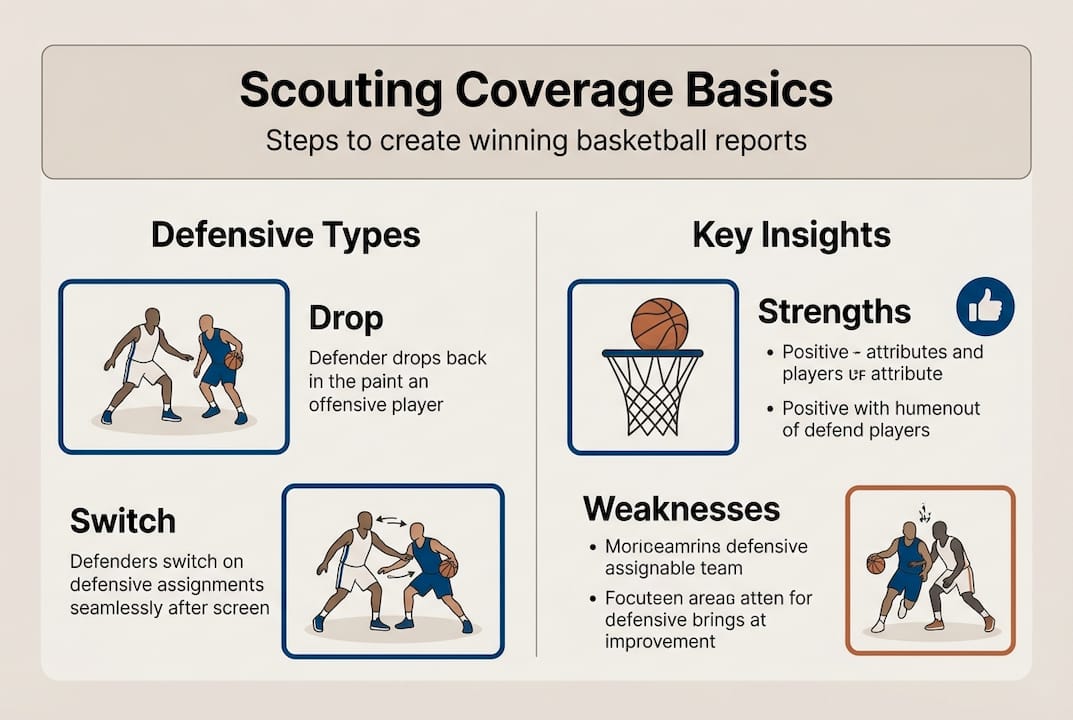
Core defensive coverages explained
There are seven main pick-and-roll coverages: low drop, high drop, ice, weak, hedge, blitz, and switch. Each one has a specific purpose, and each one has a specific vulnerability you can exploit. Knowing all seven is non-negotiable for serious scouting.
Here is a breakdown of each coverage and what it means for your offense:
- Low drop: The big defender drops below the level of the screen. Protects the rim. Vulnerable to pull-up jumpers and pick-and-pop actions.
- High drop: The big stays higher, closer to the free-throw line. Limits mid-range shots but still gives up some space.
- Ice (or push): The ball handler is forced baseline, away from the screen. Effective against middle pick-and-rolls but can be attacked with baseline drives.
- Weak: Similar to ice but used on the weak side. Limits the screener’s roll options.
- Hedge: The big steps out aggressively to slow the ball handler. Creates recovery time for the guard but risks leaving the roll man open.
- Blitz: Two defenders trap the ball handler hard. Forces quick decisions but leaves shooters open on rotations.
- Switch: Defenders trade assignments. Eliminates the advantage of the screen but creates mismatch opportunities.
For a deeper look at how these coverages interact with offensive actions, pick-and-roll defense principles is a resource worth reviewing. You can also study defensive strategies against pick-and-roll to see how teams at the highest level apply these schemes.
| Coverage | Primary strength | Key vulnerability |
|---|---|---|
| Low drop | Rim protection | Pull-up shooters |
| High drop | Limits mid-range | Elite ball handlers |
| Ice | Stops middle drives | Baseline attacks |
| Weak | Limits roll options | Corner shooters |
| Hedge | Slows ball handler | Roll man open |
| Blitz | Forces turnovers | Open shooters |
| Switch | Eliminates screen advantage | Mismatches |
Pro Tip: When watching film, look for moments when a team shifts from one coverage to another mid-possession. That shift often signals a disguised or hybrid coverage. Teams that mix drop with a late switch are trying to confuse your read. Tag those clips separately and show your players exactly what the trigger looks like.
Strengths, weaknesses, and real-game examples
Knowing what coverages exist is only part of the battle. You need to know how they perform under real game conditions and what the data says about their effectiveness.
Drop coverage allows opponents a 107.5 offensive rating for teams using it poorly, ranking last in the league in some cases. However, elite bigs like Rudy Gobert hold opponents to 48.2% on pick-and-roll field goals with drop coverage, showing that personnel matters as much as scheme. The coverage is only as good as the defender executing it.

Drop coverage is vulnerable to pick-and-pop actions and elite pull-up shooters, switching is weak to mismatches, and hedge or blitz schemes risk fouls and broken rotations. These are not opinions. They are patterns you will see repeatedly on film.
Here is how to act on that information:
- Against drop coverage: Run pick-and-pop actions with your best shooter. Attack the space between the big and the three-point line.
- Against switch coverage: Post up the smaller defender immediately after the switch. Or run a second action to force another switch and create a bigger mismatch.
- Against hedge or blitz: Prepare your ball handler to make a quick skip pass to the open shooter before the rotation closes.
- Against ice coverage: Use a counter action that brings the ball back to the middle, or attack the baseline with a strong driver.
For real examples of how these situations play out, scouting report examples show how coaches document and present this information to their teams. You can also study pick-and-roll defense explained for additional context on how coverages are designed and countered.
The goal is not to memorize every coverage. The goal is to identify the two or three moments in each game where the opponent’s coverage breaks down and build your best plays around those moments.
How to scout and document defensive coverages
A strong scouting process is repeatable and efficient. Here is a practical framework you can use right away.
- Watch film with a specific focus. Do not watch the whole game passively. Tag every pick-and-roll possession and note the coverage used.
- Record the coverage type for each possession. Use a simple spreadsheet or template. Note the coverage, the personnel involved, and the result.
- Calculate pick-and-roll field goal percentage allowed. This gives you a quick read on how effective their coverage is.
- Note rotation habits. Who helps? Who recovers? Where do gaps appear?
- Identify personnel-based tendencies. Does the coverage change when a specific defender is on the floor?
Blending quantitative stats like pick-and-roll field goal percentage with qualitative film gives you truly actionable scouting insights. Numbers tell you what is happening. Film tells you why.
Your coverage report should include:
- Primary coverage used (with percentage of possessions)
- Secondary or situational coverages
- Key personnel and their individual tendencies
- Specific plays or actions that expose the coverage
- Visual diagrams or tagged video clips
Pro Tip: Keep your report to one page per opponent if possible. Players retain information better when it is focused. Use diagrams and short bullet points instead of paragraphs. A clean, visual report gets read. A dense report gets ignored.
For more structure, scouting report strategies and a scouting checklist can help you standardize your process. You can also review a full scouting workflow to see how the pieces connect from film to practice. Additional basketball scouting strategies are available if you want to go deeper.
Implementation: Translating coverage scouting into winning strategy
A scouting report only has value if it changes what happens on the court. Here is how to bridge that gap.
- Start with a film session. Show players the exact clips that illustrate the opponent’s coverage. Keep it under 10 minutes. Focus on two or three key moments.
- Run walk-throughs before practice. Walk players through the specific actions you want to run against each coverage. Slow it down. Let them ask questions.
- Use scenario-based drills. Set up live situations in practice that mirror what you expect to see in the game. Repetition builds recognition.
- Limit the information. Effective scouting reports limit info to key tendencies and use visuals to foster athlete understanding and buy-in. Do not overwhelm players with every coverage detail. Pick the top two or three tendencies and drill those.
- Give specific feedback. Tell players exactly what to look for and what to do. “When you see the big drop below the screen, pull up” is more useful than “attack the coverage.”
For context on why this process matters, the importance of scouting reports covers how preparation directly connects to performance. You can also find a full list of scouting tools to support your workflow.
Pro Tip: After each game, go back to your coverage notes and check what the opponent actually ran versus what you scouted. Did they adjust? Did your players execute the counters? Update your report with those observations. That post-game review is where your scouting process gets sharper every week.
Take your scouting and coverage mastery to the next level
Coaches who scout coverage well do not just know more. They prepare better, communicate clearer, and win more games. If you are ready to put these concepts into action, Hoop Mentality has the tools to make it happen.

The Big Man Dual Action Drill is built to train your bigs to read and react to coverage situations in real time, exactly the skill set that makes your scouting work pay off on the court. Pair that with the Basketball Practice Plan Template to structure your sessions around the coverage counters you have identified. Both resources are practical, ready to use, and built from real coaching experience. Explore the full Hoop Mentality catalog to find templates, drills, and strategy guides that match where your team is right now.
Frequently asked questions
What does ‘drop coverage’ mean in basketball scouting?
Drop coverage is when the big defender retreats toward the rim during a pick-and-roll to protect against layups, forcing opponents into mid-range shots. It is one of the most common coverages at every level of the game.
How do you identify which defensive coverage an opponent is using?
You analyze film for consistent defender behaviors during pick-and-roll actions, looking for patterns like the big dropping, switching, or hedging. Scouting reports use video habits to identify coverages such as drop, switch, and hedge across multiple possessions.
Why is scouting coverage critical for game planning?
Understanding opponent coverages lets you design plays that directly target defensive weaknesses, giving your offense a structural advantage. Scouting coverage equips coaches to exploit opponent vulnerabilities before the game even starts.
How often should scouting coverage reports be updated?
Update your coverage reports after each game to catch opponent adjustments and keep your practice plans current. Best practice is to verify and update coverage info post-game so your team is always working from accurate information.