



TL;DR:
- Fatigue late in games is primarily caused by conditioning issues, not motivation.
- Effective basketball conditioning combines sport-specific HIIT, focusing on game-like movements and recovery.
- Regular assessment and individualized drills ensure optimal conditioning transfer and performance improvement.
Late-game fatigue is a real competitive problem. When your players lose intensity in the fourth quarter, it’s rarely a motivation issue. It’s a conditioning issue. Fatigue directly impacts performance late in games, affecting jumping, sprinting, and decision-making at the worst possible time. This guide walks you through a practical, evidence-based process for designing conditioning drills that actually transfer to game performance. You’ll learn how to assess your team, build drills around real game demands, and monitor progress over time. Adaptable to any level, from youth programs to competitive varsity squads.
Table of Contents
- Understanding the fundamentals of basketball conditioning
- Assessing your team’s conditioning needs
- Designing effective basketball conditioning drills
- Implementing, monitoring, and adapting your conditioning program
- A coach’s take: What really works with conditioning drills
- Bring conditioning success to your program
- Frequently asked questions
Key Takeaways
| Point | Details |
|---|---|
| Drills must be sport-specific | Design conditioning exercises that replicate real basketball movement patterns for greatest impact. |
| Assess before you assign | Use objective data like jump and sprint tests to set conditioning priorities for your team. |
| Individualization matters | Adapt drills to player position, maturity, and progress for best results and injury prevention. |
| Monitor and adjust regularly | Track conditioning improvements and be ready to adjust drills and plans based on ongoing player response. |
Understanding the fundamentals of basketball conditioning
Basketball is not a steady-state sport. Players sprint, stop, jump, cut, and change direction dozens of times per game. Generic running programs built around laps and steady jogging simply don’t match those demands. Understanding that gap is the first step toward building effective conditioning drills.
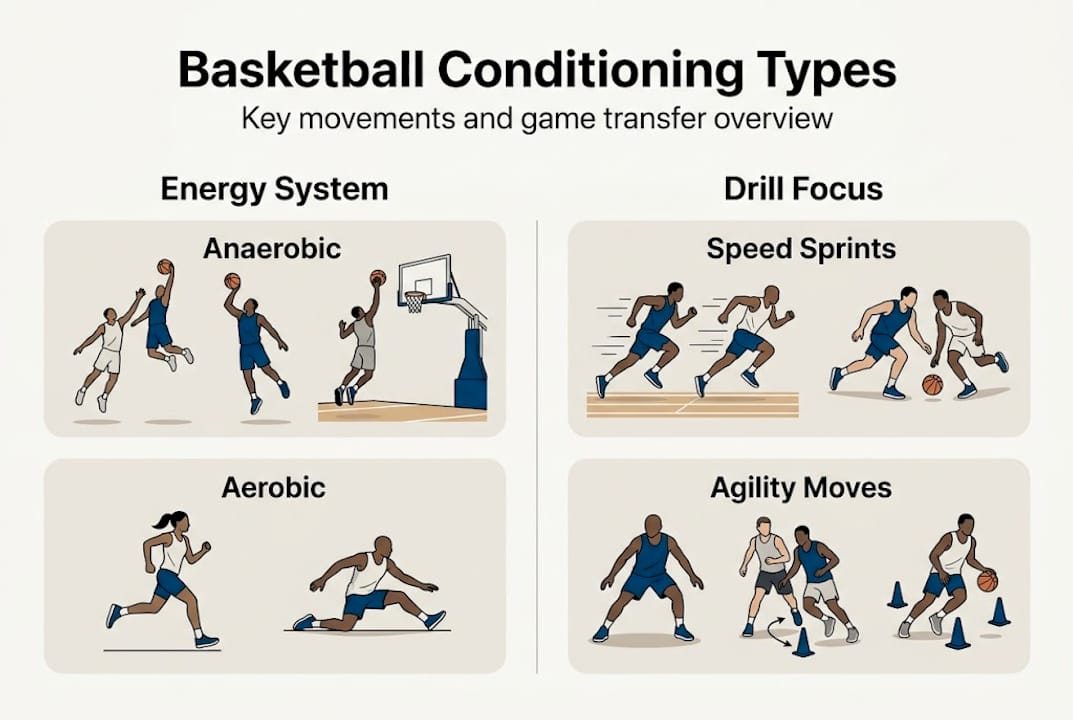
The sport pulls from two primary energy systems. Short bursts of explosive movement rely on the anaerobic system, while the ability to recover between plays depends on aerobic capacity. Effective conditioning trains both. The basketball conditioning benefits of sport-specific work are well documented: players who train to match actual game patterns recover faster and sustain intensity longer.
Here’s a simple comparison to clarify the difference:
| Conditioning type | Primary movement | Energy system | Game transfer |
|---|---|---|---|
| Long-distance running | Steady jog | Aerobic only | Low |
| Basketball-specific HIIT | Sprints, cuts, jumps | Aerobic + anaerobic | High |
| Generic circuit training | Mixed, non-sport | Mixed | Moderate |
| On-court interval drills | Game movements | Both systems | Very high |
The data supports moving away from long-distance running. Basketball-specific HIIT outperforms generic endurance work for players who need sport-relevant fitness gains. Guards in particular need short, explosive intervals that mirror the actual patterns of a real game.
Key concepts to keep in mind when designing drills:
- Work-to-rest ratios should reflect game intensity (roughly 1:3 for max-effort sprints)
- Movement specificity matters: use cuts, defensive slides, and jumps rather than straight-line running
- Recovery quality is as important as the work itself
- Progressive overload keeps players adapting without overtraining
Looking at youth basketball cardio drills gives you a useful baseline for scaling demands by age and experience level. NCAA jump benchmarks also provide useful data points for understanding what elite-level conditioning looks like across positions.
Pro Tip: Set your work intervals to mirror real game sequences. A 4-5 second sprint followed by 12-15 seconds of active recovery is a realistic game pattern. Build your drills around that rhythm and you’ll see faster transfer to actual competition.
Assessing your team’s conditioning needs
Once you grasp the core physical demands, you need to evaluate where your team currently stands. Skipping assessment is one of the most common coaching mistakes. Without baseline data, you’re guessing at what your players need.
Start with three core tests:
- Countermovement jump (CMJ): Measures explosive leg power. CMJ benchmarks and sprint improvements from preseason testing give you a concrete target to measure progress against.
- Sprint test (20 or 30 meters): Measures acceleration and straight-line speed.
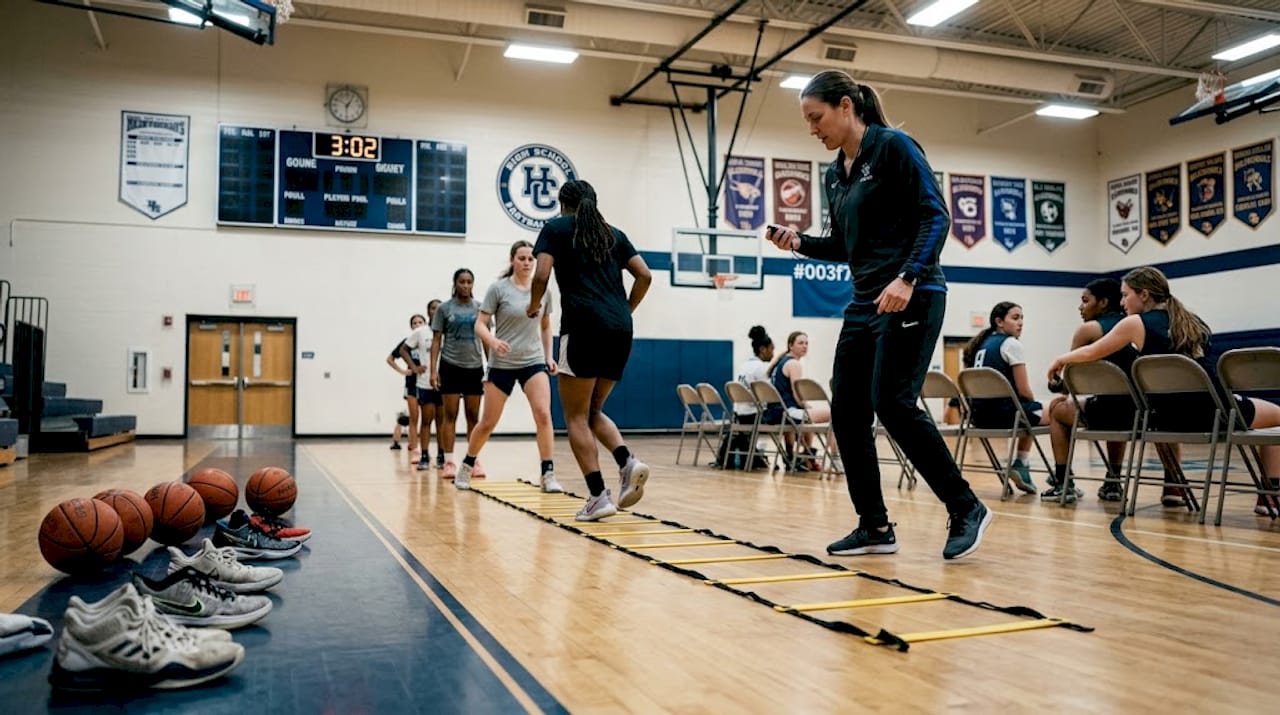
- Agility test (T-test or 5-10-5 shuttle): Measures change of direction, which is directly tied to defensive and transition performance.
Position matters. Guards typically post faster sprint times and higher agility scores. Big men focus more on jump height and vertical power. Individualize based on position and maturity rather than applying one standard to every player on your roster.
Here’s a simple benchmark table for reference:
| Test | Guard target | Forward/big target | When to retest |
|---|---|---|---|
| CMJ height | Higher relative output | Max vertical power | Every 4-6 weeks |
| 20m sprint | Under 3.0 seconds | Under 3.2 seconds | Preseason + midseason |
| T-test agility | Under 9.5 seconds | Under 10.5 seconds | Preseason + midseason |
Follow these steps to set up a functional testing protocol:
- Test before preseason begins to establish your baseline.
- Use consistent conditions: same surface, same time of day, rested players.
- Record all results in a shared log for each player.
- Compare results every four to six weeks.
- Use the data to adjust drill intensity and volume.
“Tracking individual fitness data over time is the most reliable way to know whether your conditioning program is creating real adaptation or just fatigue.”
For coaches focused on evaluating basketball performance more broadly, these conditioning benchmarks integrate well into a full player development framework. Preseason training consistently yields measurable gains in speed, agility, and jump performance when structured correctly. Use your basketball evaluation benchmarks as anchors to make sense of what the numbers actually mean in context.
Designing effective basketball conditioning drills
With assessment data in hand, you’re ready to build drills that address your team’s real needs. Good drill design follows clear principles. Without them, you end up with sessions that feel hard but don’t produce game-ready fitness.
Core principles for building drills:
- Game specificity first: Every drill should mirror a movement pattern that happens in games. Defensive slides, transition sprints, and rebounding jumps all qualify.
- Work/rest ratios tied to game pace: Match your intervals to the actual demands of the sport.
- Progressive overload over time: Start at 70-75% intensity and build across weeks. Jumping to full intensity in week one leads to injury and burnout.
- Recovery built into the structure: Rest is not wasted time. It’s part of the conditioning stimulus.
Expert recommendations from structured off-season plans support 16-week models that prioritize on-court transfer. That means drills finish with a skill component, not just a conditioning marker.
Sample drill framework:
- Drill name: Transition sprint + defensive close-out
- Duration: 6 seconds sprint, 15 seconds recovery
- Reps: 8-10 per set
- Sets: 3-4
- Skill element: Player receives ball after sprint and must execute a close-out on a coach or partner
Common pitfalls to avoid:
- Overusing straight-line running with no change of direction
- Ignoring recovery quality between sets
- Skipping the skill integration step
- Running the same drills week after week without progression
- Treating all players as if they have the same fitness starting point
Exploring positionless basketball development can help you think about conditioning in a more flexible way, especially as roles become more fluid. Modern basketball conditioning has shifted toward versatility, and your drill design should reflect that.
Pro Tip: Add a decision-making element to at least one conditioning drill per session. For example, after a sprint, the player must read and react to a coach signal before shooting or passing. This trains the mind and body together, which is exactly what happens in games.
Implementing, monitoring, and adapting your conditioning program
Designing drills is only half the battle. Implementing, monitoring, and tweaking them is what ensures sustainable results. A program that looks great on paper fails without consistent execution and honest evaluation.
Here’s what to track consistently:
- Player effort logs: Simple ratings (1-10) collected after each session
- Sprint and jump retests every 4-6 weeks: The numbers tell you whether adaptation is happening
- Observation during drills: Watch for form breakdown, which is a sign of fatigue or inadequate recovery
- Game performance data: Turnovers and missed assignments late in games often signal conditioning gaps
High individual variability means some players will respond faster than others. Don’t assume that one player’s progress is the team standard. Adjust volumes and intensities individually when the data supports it.
Warning signs to watch for:
- Persistent soreness that doesn’t clear within 48 hours
- Declining sprint or jump scores across retests
- Players losing focus or motivation mid-drill
- No improvement in late-game intensity after four weeks
Preseason periods consistently yield gains in speed, agility, and vertical power. But those gains only stick if you transition them properly into in-season maintenance. Reduce total volume during the season but preserve intensity to keep players sharp.
For season planning tips that connect conditioning to the full competitive calendar, you’ll want a structured approach from day one of preseason. Review your preseason readiness tips to make sure your conditioning block is timed correctly relative to your first game.
Pro Tip: Ask players to rate their readiness and energy levels before each session. A simple 1-5 scale takes 30 seconds and gives you real-time data on recovery. Players who report low scores two sessions in a row may need a modified load that day.
A coach’s take: What really works with conditioning drills
Let’s step back and consider what long-term coaching experience reveals about making conditioning truly work.
Cookie-cutter drill programs are the most common mistake coaches make. You see a popular drill online, run it with your team, and wonder why it’s not producing the results you expected. The problem is that the drill was built for a different roster, a different level, and a different set of goals.
The second mistake is copying load management trends without understanding the tradeoffs. Some coaches critique load management for quietly reducing practice fundamentals under the cover of injury prevention. Protecting players matters. But conditioning and skill work are not opposites. They reinforce each other when designed correctly.
Think about positionless basketball development as a lens for conditioning too. When roles blur, conditioning needs to match. Every player needs to cover more ground and make more decisions per possession.
Drills should transfer to performance, not just check a box on your practice plan. If a drill makes players tired but doesn’t make them better in games, it’s the wrong drill.
Bring conditioning success to your program
Ready to put these strategies into action? Here’s how to make next season your team’s best conditioned yet.
At Hoop Mentality, we build resources specifically for coaches who want structure without guesswork. Our tools are designed to save you time and give your players a clear, proven system to follow.

- Use the Big Man Dual Action Drill to combine conditioning and skill work for your frontcourt players.
- Start every season with a solid practice plan template that keeps your conditioning block on schedule.
- Browse the full resource library to find drills, playbooks, and practice plans built from real coaching experience.
Your players are ready to get in shape. Give them the right tools to do it.
Frequently asked questions
What are the best conditioning drills for basketball guards?
Basketball guards benefit most from HIIT and agility sprints that replicate game actions rather than long-distance running. Short, explosive intervals with change of direction are the most effective format.
How often should basketball teams do conditioning drills?
Most teams benefit from 2-3 dedicated sessions per week, adjusted based on NBSCA structured plans and whether you’re in preseason, in-season, or a recovery block.
How do you tell if conditioning drills are working?
Track repeat sprint and jump improvements every four to six weeks. Also monitor whether players are sustaining effort and intensity in the final minutes of games.
Should all players do the same conditioning drills?
No. High inter-individual variability means coaches should adjust drill intensity, volume, and type based on each player’s position, test results, and development stage.
Recommended
- Why use conditioning drills? Boost basketball performance – Hoop Mentality
- Why Drills Boost Basketball Development by 30% Faster – Hoop Mentality
- Competitive Drills Boost Decision Speed by 50% – Hoop Mentality
- Practice drills to boost basketball skills and performance – Hoop Mentality
- How to Build Workouts Faster with the Exercise Library & Slash Commands | TrainingPro