

Opening night losses rarely come down to talent alone. Most of the time, they trace back to a preseason that lacked structure, skipped key phases, or focused on conditioning while ignoring skill development. Structured phased preseason plans improve season performance by 15% and increase opener win rates by 20%. That gap between a team that looks ready and one that actually is ready comes down to how you plan the weeks before the first tip-off. This article gives you practical, proven tips to build a preseason that sets your team up to compete from day one.
Table of Contents
- Establish a phased preseason training plan
- Prioritize fundamentals and skill progression early
- Integrate smart conditioning and injury prevention
- Set measurable goals and track key metrics
- Analyze game-like scenarios and advanced metrics
- Bring elite preseason preparation to your team
- Frequently asked questions
Key Takeaways
| Point | Details |
|---|---|
| Phased planning boosts wins | A structured preseason plan improves opener win rates and sets up long-term team success. |
| Prioritize fundamentals early | Early focus on shooting, ball handling, and defense increases game performance by up to 20 percent. |
| Injury prevention is critical | Smart conditioning and neuromuscular warm-ups can cut preseason injuries by 30 percent or more. |
| Track advanced metrics | Monitoring defensive efficiency and usage rates predicts in-season and postseason success. |
| Make drills game-like | Simulating real situations in practice prepares players for the pressure and pace of actual games. |
Establish a phased preseason training plan
With the impact of preseason planning clear, let’s break down how to structure your training for greatest effect.
Most coaches know preseason matters. Fewer know how to organize it. A phased preseason plan removes the guesswork. It gives every week a purpose and every drill a place in a larger system. The result is a team that builds readiness progressively instead of scrambling to peak all at once.
Here is what a three-phase model looks like in practice:
- Foundation phase (2-3 weeks): Individual fundamentals, aerobic base building, and movement pattern development. This is where habits form.
- Integration phase (1-2 weeks): Small-group and team concepts, combining skills with system play. Intensity increases.
- Competition phase (1-2 weeks): Game-speed conditioning, scrimmages, and peak readiness. Simulate real game pressure.
Each phase builds directly on the last. Skipping the Foundation phase to jump into scrimmages is one of the most common preseason mistakes. Players end up running plays they cannot execute cleanly under pressure.
“The teams that skip foundational work in preseason are the same ones making correctable errors in March.” This is a pattern coaches at every level recognize.
Pro Tip: Youth teams may need 3-4 weeks in the Foundation phase. Elite or experienced rosters can compress it to 2 weeks. Adjust based on your roster’s baseline, not a fixed calendar. Good season planning tips will help you map this out before your first practice. A solid season planning workflow also keeps your staff aligned throughout the process. Consistent off-season workout consistency from your players makes the Foundation phase significantly more productive.
Prioritize fundamentals and skill progression early
Once you have set up your preseason structure, focusing first on core skills is critical to long-term team success.
Fundamentals are not glamorous. But they are the reason some teams shoot confidently in close games while others fall apart. Prioritizing foundational skills early improves shooting accuracy by 15-20% under game pressure. That is a significant edge, and it starts in week one.
Focus your early practices on these three areas:
- Shooting form: Repetition with correct mechanics before adding defensive pressure. Fix the release, the footwork, and the follow-through before adding speed.
- Ball handling: Daily touches with both hands. Use timed sequences to build comfort under fatigue.
- Defensive footwork: Lateral slides, closeouts, and positioning. Defense is often where preseason work pays off fastest.
The key is quality over volume. Fifty perfect repetitions beat five hundred sloppy ones. Use your basketball fundamentals guide to structure drill progressions that match your team’s current level. A fundamentals checklist helps you confirm no skill area gets skipped.
Pro Tip: Assess each player individually in week one. A quick skill evaluation tells you who needs remedial work and who is ready to progress. Tailor your drill groups accordingly. Coaches working with younger athletes can find targeted skill progressions for youth that match developmental stages without overwhelming players.
Integrate smart conditioning and injury prevention
With skills and fundamentals underway, smart physical preparation ensures your team not only performs but stays healthy.
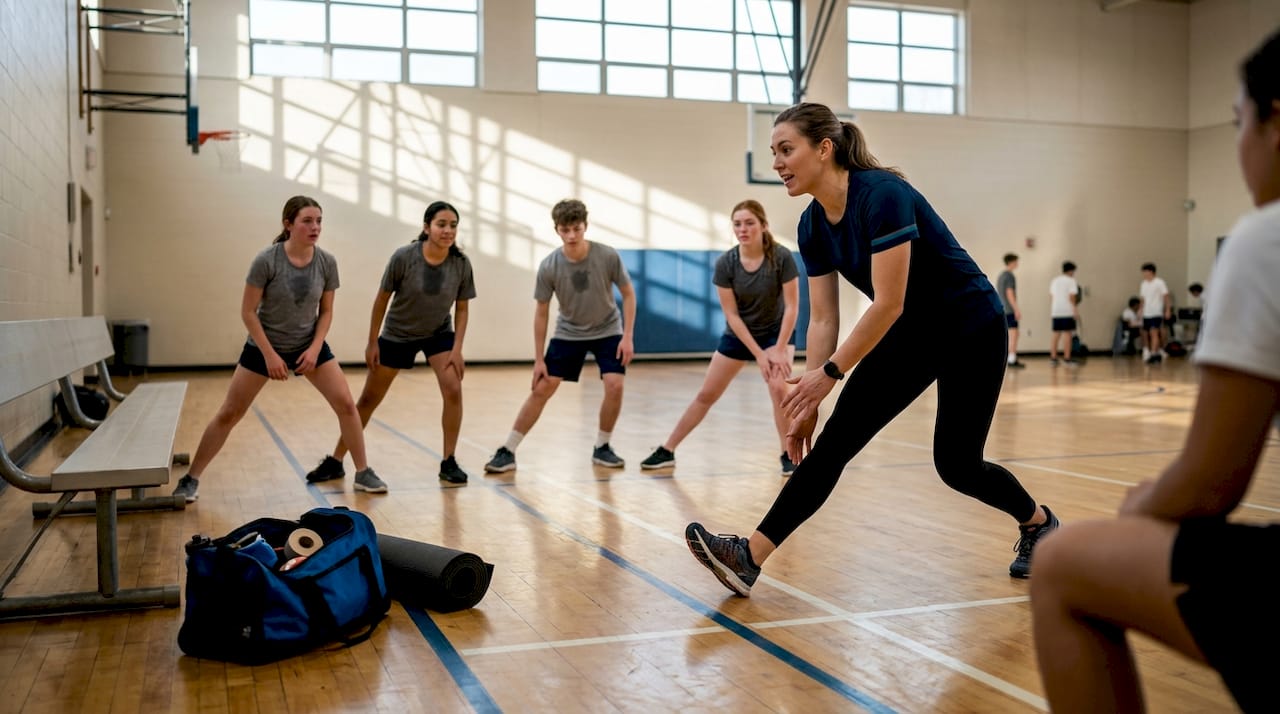
Conditioning without a plan creates fatigue. Fatigue creates injuries. Injuries end seasons. The goal is not to run your players into the ground in week one. It is to build a physical base that holds up over a full season.
Here is what smart conditioning looks like:
- Aerobic base first: Start with longer, lower-intensity runs and movement circuits. Build the engine before you push the throttle.
- Anaerobic work second: Sprints, interval training, and game-speed bursts come after the aerobic base is established.
- Neuromuscular training (NMT) throughout: Exercises that train the body to stabilize joints and react quickly. NMT reduces ACL injury risk by 50-67% and ankle sprain recurrence by up to 70%.
Integrated aerobic and anaerobic conditioning reduces season injuries by 30%. That number alone justifies building conditioning into your preseason plan rather than treating it as an afterthought.
“Structured warm-ups reduce youth injuries by 30%. A 10-minute warm-up protocol is one of the highest-return investments a coach can make.”
Design your warm-up to include dynamic stretching, balance work, and sport-specific movement patterns. This is not optional. It is the foundation of a healthy roster. Your off-season conditioning resources can help you build a progressive load plan that carries into the regular season.
Set measurable goals and track key metrics
Creating accountability and visibility throughout preseason accelerates results and buy-in across your roster.
Vague goals produce vague results. “Get better” is not a preseason target. “Improve team free throw percentage from 62% to 70% by week four” is. Measurable goals give players something to chase and give you data to coach from.
Here is a simple process to follow:
- Assess first. Before setting targets, evaluate player performance at the start of preseason. Baseline data makes every goal meaningful.
- Set individual and team targets. Shooting percentage, defensive stops per scrimmage, attendance, and conditioning benchmarks all work well.
- Track weekly. Use a simple tracker to log progress. Adjust drills and intensity based on what the numbers show.
- Share results with players. Visibility drives accountability. When players see their own progress, effort increases.
Here is a sample weekly progress tracker you can adapt:
| Metric | Week 1 baseline | Week 2 target | Week 3 target | Week 4 target |
|---|---|---|---|---|
| Team shooting % | 38% | 42% | 45% | 48% |
| Free throw % | 60% | 64% | 67% | 70% |
| Defensive stops (scrimmage) | 6/10 | 7/10 | 7/10 | 8/10 |
| Attendance rate | 85% | 90% | 95% | 95% |
| Player wellness (1-10 avg) | 7.2 | 7.5 | 7.8 | 8.0 |
Tracking wellness alongside performance metrics is often overlooked. A player who rates their energy at 4 out of 10 three days in a row is a player at risk. Catch it early.
Analyze game-like scenarios and advanced metrics
Fine-tuning your team for game situations means measuring what really predicts winning, not just what looks good on paper.
Box scores feel familiar. Points, rebounds, assists. But those numbers have a surprisingly weak connection to actual team success. Raw stats show low correlation with winning (r=0.18), while team defensive efficiency correlates at r=0.57. That is a massive difference in predictive value.
Here is a comparison of basic versus advanced metrics:
| Basic box score stats | Advanced metrics |
|---|---|
| Points per game | Defensive efficiency rating |
| Rebounds | Usage rate |
| Assists | True shooting percentage |
| Turnovers | Net rating (points scored vs. allowed per 100 possessions) |
| Steals | Assist-to-turnover ratio in game-speed drills |
Start tracking advanced NBA preseason metrics even at the youth or high school level. You do not need a full analytics system. A simple spreadsheet tracking defensive efficiency and true shooting percentage tells you far more than points per scrimmage.
Game-like drills are the other side of this equation. A drill is game-like when it includes decision-making, defensive resistance, and time or score pressure. Five-on-zero shooting is skill work. Five-on-five with a shot clock and a score is game preparation. Build more of the latter into your Integration and Competition phases.
Bring elite preseason preparation to your team
You do not have to build every drill and plan from scratch. Hoop Mentality has done the heavy lifting for you.

The Big Man Dual Action Drill is a ready-to-use resource that fits directly into your Foundation and Integration phases, targeting the post skills and footwork your big men need before the first game. For full-team preparation, the Game Preparation Guide includes a weekly practice plan that maps your preseason from day one to opening night. Both resources are built by coaches, for coaches. Explore more coaching resources to find playbooks, scouting templates, and drills that match your system and your timeline.
Frequently asked questions
How long should a basketball preseason last?
A typical basketball preseason runs 4-6 weeks. Plan for 2-3 weeks on individual fundamentals and aerobic base building, then shift to 1-2 weeks of game-speed integration and competition prep.
What preseason metric best predicts basketball team success?
Team defensive efficiency is the strongest predictor, with a correlation of r=0.57 to season success. Raw scoring stats show a much weaker connection at r=0.18, so track defense first.
How can I prevent injuries during basketball preseason?
Incorporate neuromuscular training from day one. Structured warm-ups and progressive conditioning loads reduce ACL injury risk by up to 67% and cut ankle sprain recurrence by 70%.
How should conditioning and skill work be balanced in preseason practices?
Build conditioning into your skill drills rather than separating them. Focus on quality repetitions at the correct intensity, and increase load gradually across each phase of your preseason plan.
Recommended
- Basketball preseason priorities 2026: 15% better performance – Hoop Mentality
- Basketball Preseason Tips and Priorities for Coaches – Hoop Mentality
- Basketball Pregame Preparation Guide: Maximize Game Readiness – Hoop Mentality
- How to Get Ready for a Basketball Game Mentally Effectively – Hoop Mentality
- Why sleep is very important for your young athlete? – Hazli Collection