

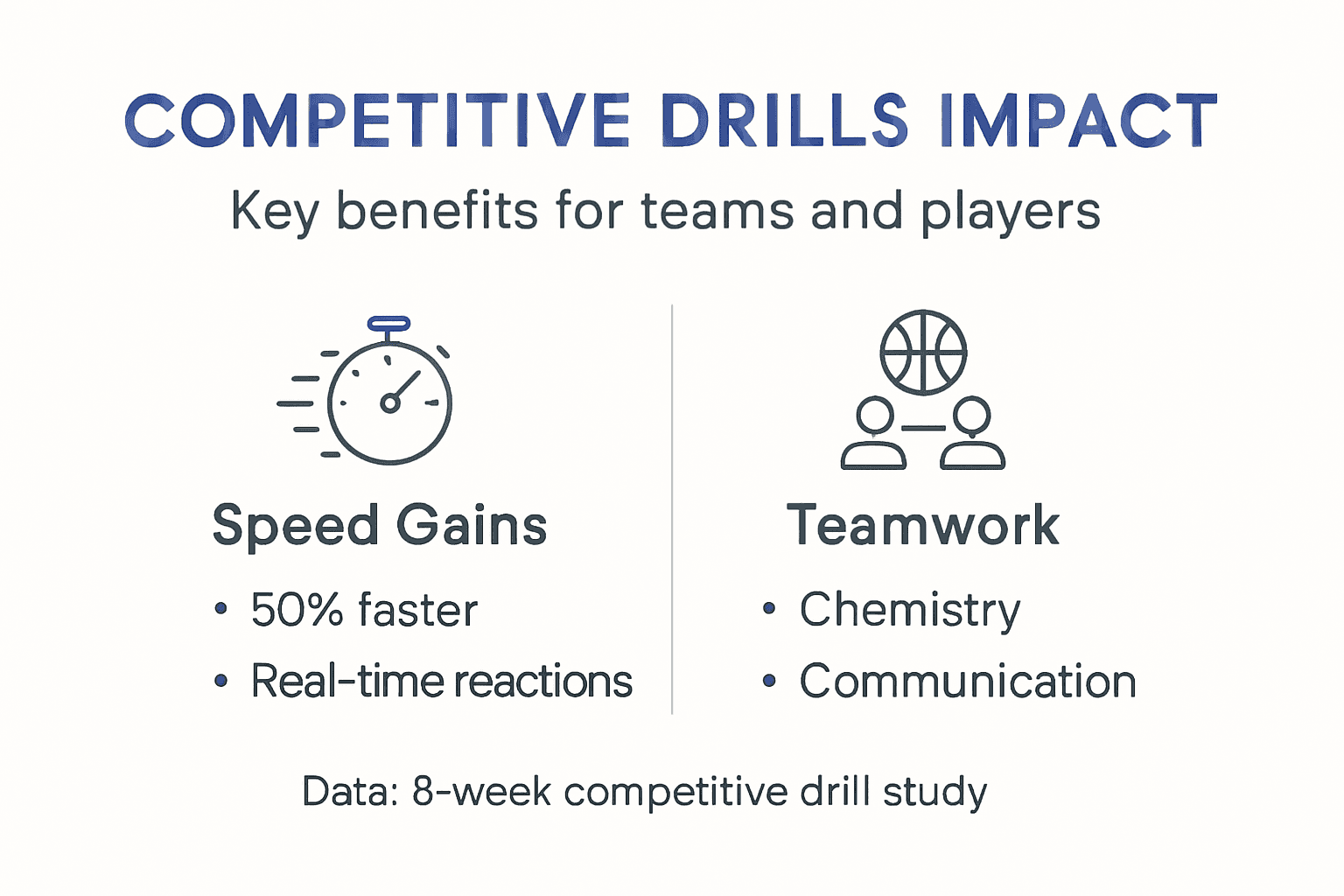
Competitive drills transform how players make decisions under pressure, with research showing they accelerate decision-making speed by up to 50% over eight weeks. Unlike traditional skill drills that isolate techniques, competitive drills mirror the chaos and intensity of real games, forcing players to think faster and adapt instantly. This creates athletes who don’t just execute skills well in controlled settings but perform confidently when the game is on the line.
Table of Contents
- Introduction To Competitive Drills In Basketball
- How Competitive Drills Simulate Game Situations And Improve Decision-Making
- Psychological Benefits: Building Mental Toughness And Motivation
- Common Misconceptions About Competitive Drills
- Framework For Designing And Selecting Effective Competitive Drills
- Examples Of Effective Competitive Drills And Their Benefits
- Leveraging Competitive Drills For Coaching Assessment And Team Development
- Conclusion: Implementing Competitive Drills To Enhance Team Performance
- Elevate Your Coaching With Hoop Mentality Resources
Key Takeaways
| Point | Details |
|---|---|
| Decision-making speed | Competitive drills improve decision speed by 50% compared to traditional methods within eight weeks. |
| Mental toughness | Players develop 35% greater mental resilience when training includes competitive elements. |
| Timing misconception | 60% of coaches delay competitive drills until late season, missing critical early development windows. |
| Design framework | Balance skill execution with realistic competition using age-appropriate criteria and progressive difficulty. |
| Proven results | 3-on-3 drills increase passing accuracy by 22% and defensive communication by 18%. |
Introduction to Competitive Drills in Basketball
Competitive drills are exercises that fuse skill practice with the pressure and unpredictability of live competition. They push players beyond mechanical repetition into scenarios where they must read opponents, communicate rapidly, and execute under stress. This approach stands in sharp contrast to traditional skill drills, which focus on perfecting isolated techniques like shooting form or dribbling patterns in controlled, low-pressure environments.
The purpose of competitive drills is to replicate game conditions so players develop the readiness actual competition demands. While skill drills build technical foundations, competitive drills teach players when and how to apply those skills against active resistance. Think of it this way: skill drills are learning the alphabet, while competitive drills are writing essays under a deadline.
Key distinctions between drill types include:
- Skill drills isolate one technique at a time with minimal decision-making required
- Competitive drills combine multiple skills and force rapid choices under defensive pressure
- Traditional drills emphasize perfect repetition; competitive drills prioritize adaptive performance
- Skill work happens in static setups; competitive scenarios involve constant movement and unpredictability
Understanding these differences helps coaches deliberately choose the right drill type for their practice goals. According to Basketball Drill Types Explained, recognizing when to use each approach prevents the common mistake of overemphasizing one at the expense of the other. Youth and high school players need both foundational skills and the ability to deploy them competitively, making balanced programming essential for comprehensive development.
How Competitive Drills Simulate Game Situations and Improve Decision-Making
Competitive drills recreate the tempo, chaos, and mental load players face during actual games. When defenders apply real pressure and teammates depend on quick choices, players can’t rely on rehearsed patterns. They must process visual information rapidly, anticipate movement, and commit to decisions with incomplete information, exactly as games demand.
This constant exposure to game-like stress produces measurable improvements in decision quality and speed. Research published in the Journal of Sport and Exercise Psychology found players using competitive drills improved decision-making speed by up to 50% over eight weeks compared to traditional training methods. The pressure environment forces neural pathways to adapt, making rapid processing automatic rather than deliberate.
Beyond individual decision-making, competitive scenarios strengthen team coordination. A study on team chemistry showed teams incorporating competitive drills reported 25% better communication ratings and 18% more assists per game. Players learn to read teammates’ intentions, call out defensive rotations, and coordinate movements without explicit instruction because the drill structure rewards effective collaboration.
| Metric | Improvement | Timeframe |
|---|---|---|
| Decision-making speed | 50% faster | 8 weeks |
| Team communication rating | 25% better | Season |
| Assists per game | 18% increase | Season |
| Passing accuracy | 22% higher | 8 weeks |
The benefits of competitive drills extend beyond statistics. Players become comfortable with discomfort, learning that mistakes under pressure are learning opportunities rather than failures. This psychological shift translates directly to improved decision-making during actual games, where confidence separates effective players from hesitant ones.
Competitive drill benefits include:
- Accelerated pattern recognition under defensive pressure
- Enhanced peripheral vision and court awareness
- Faster transition from thought to action
- Better calibration of risk versus reward in split-second choices
- Improved verbal and non-verbal teammate communication
Pro tip: Start with modified competition that emphasizes one decision type, like when to pass versus drive. As players master simpler choices, layer in additional variables like shot selection or help defense reads. This progression prevents overwhelm while steadily building decision-making capacity.
Psychological Benefits: Building Mental Toughness and Motivation
Competitive drills don’t just develop physical skills. They forge mental resilience by repeatedly exposing players to pressure situations where they must perform despite discomfort, fatigue, or the fear of making mistakes. Each repetition under stress teaches the brain that pressure is manageable, gradually rewiring anxiety responses into focused determination.
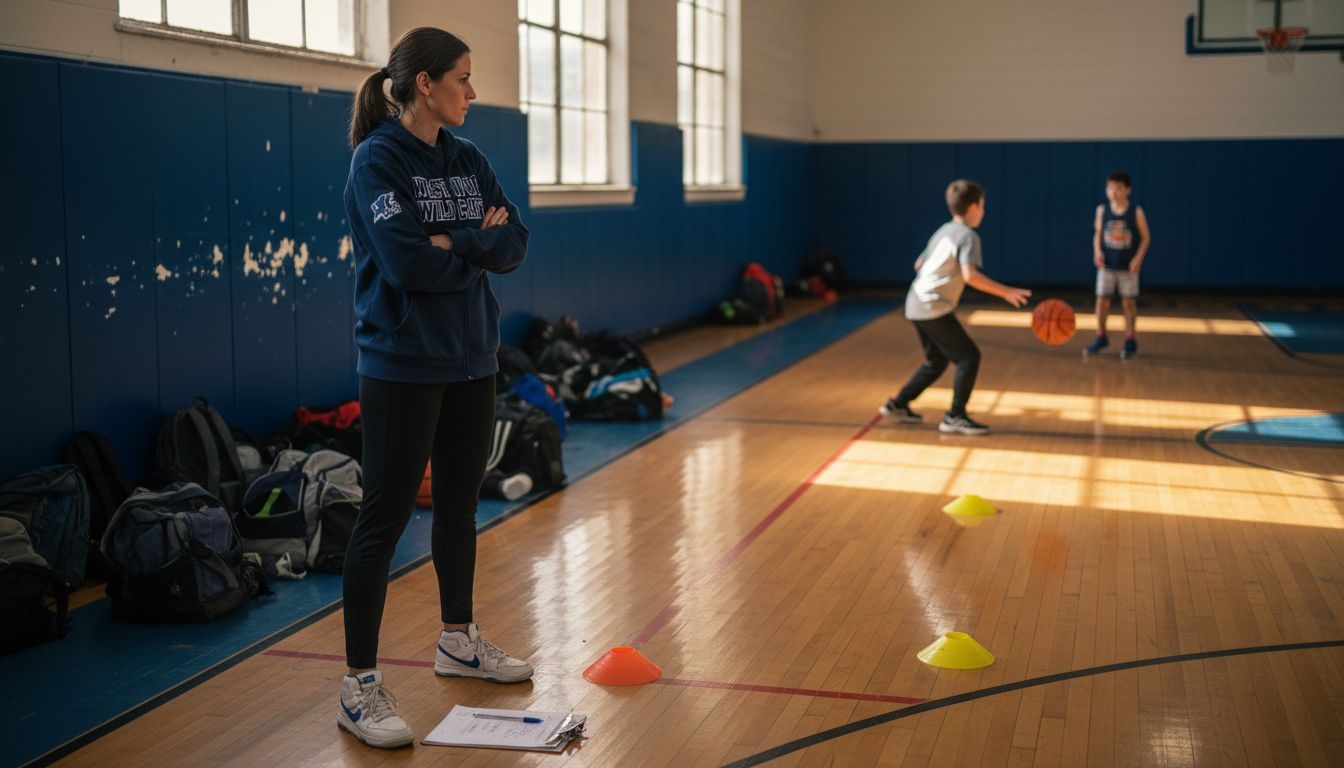
Research from Frontiers in Psychology demonstrates competitive drills enhance psychological resilience in youth basketball, with mental toughness improving 35% more compared to traditional training methods. This advantage stems from the drills’ ability to simulate the emotional challenges of real competition, giving players practice managing frustration, maintaining focus after errors, and sustaining effort when outcomes are uncertain.
Intrinsic motivation flourishes in competitive environments because players receive immediate feedback on their choices. Unlike passive instruction, competitive drills show players the direct consequences of their decisions, creating powerful learning moments that spark genuine engagement. When a defensive rotation leads to a steal or a well-timed cut produces an easy basket, players experience the satisfaction of effective execution in ways that lectures cannot replicate.
Psychological gains from competitive drills:
- Greater emotional regulation under game pressure
- Increased willingness to take calculated risks
- Higher practice engagement and intensity
- Better recovery mindset after mistakes
- Stronger competitive identity and self-belief
These mental benefits accumulate over time. Players who regularly train in competitive settings develop what coaches call “game readiness,” a state where the athlete’s mental approach matches the demands of competition. This readiness prevents the common problem where players perform well in practice but shrink when games begin, a disconnect that avoiding common coaching mistakes helps address.
“The psychological adaptation to competitive stress may be as important as physical skill development. Players who learn to embrace rather than avoid pressure situations develop a competitive advantage that extends beyond technical ability.” – Youth Basketball Psychology Research
Pro tip: Introduce competitive elements from the first practice. Even simple competitions like “first team to five successful passes” build mental toughness early, establishing a culture where pressure is normal rather than intimidating. This early integration prevents the shock some players experience when competition appears suddenly mid-season.
Common Misconceptions About Competitive Drills
Several persistent myths limit how coaches use competitive drills, often causing them to miss crucial development windows. Understanding what competitive drills actually accomplish versus what coaches assume helps optimize their deployment throughout the season.
-
Misconception: Traditional skill drills alone adequately prepare players for game situations. Reality: While skill drills build technical foundations, they don’t teach the rapid decision-making and adaptive thinking games require. Players need both technical mastery and the ability to apply skills under defensive pressure, making competitive drills essential rather than supplementary.
-
Misconception: Competitive drills should wait until late in the season when players have solid fundamentals. Reality: A survey of coaching practices found 60% of high school coaches delay or omit competitive drills until late season, missing critical early benefits. Early integration actually accelerates skill development because players immediately understand why specific techniques matter, creating purposeful practice rather than abstract repetition.
-
Misconception: Competitive drills primarily benefit advanced or elite players. Reality: Youth and developing players gain the most from competitive exposure because their decision-making frameworks are still forming. Early competitive experience teaches foundational patterns that become automatic, whereas introducing competition late requires unlearning passive habits developed through months of non-competitive drilling.
-
Misconception: Competitive drills create excessive pressure that harms young players. Reality: Age-appropriate competitive drills build healthy pressure tolerance. The key is scaling competition intensity to player readiness, not avoiding competition entirely. Players who never experience competitive pressure in practice face far greater stress when games begin.
-
Misconception: Winning competitive drills matters more than execution quality. Reality: The goal is learning under pressure, not just winning. Coaches should emphasize decision quality and effort over outcomes, using competition as a teaching tool rather than a pure performance test.
Recognizing these common misconceptions enables coaches to design practice plans that balance skill refinement with competitive application from day one. This integrated approach produces players who are both technically sound and mentally prepared for game demands.
Framework for Designing and Selecting Effective Competitive Drills
Creating balanced competitive drills requires a systematic approach that maintains skill development while introducing realistic game pressure. The framework below helps coaches design drills that challenge players appropriately without overwhelming them or sacrificing teaching opportunities.
The core principle is balancing skill execution with competitive intensity. Pure competition without skill focus becomes chaotic scrimmaging that reinforces bad habits. Pure skill work without competition creates players who look great in drills but freeze in games. The sweet spot combines both elements, adjusting their ratio based on season timing and player development.
Recommended competitive-to-skill drill ratios:
- Early season: 30% competitive, 70% skill-focused (building foundations with competitive context)
- Mid season: 50% competitive, 50% skill-focused (equal emphasis as techniques solidify)
- Late season: 70% competitive, 30% skill-focused (game preparation dominates)
When selecting or creating competitive drills, evaluate them against these criteria:
- Safety and age-appropriateness for your players’ physical development stage
- Clear skill objectives that players can identify and practice deliberately
- Realistic game situations that mirror what players will face in competition
- Measurable outcomes that let you track improvement over time
- High engagement that maintains player focus and motivation
| Aspect | Traditional Skill Drill | Balanced Competitive Drill |
|---|---|---|
| Primary focus | Technical perfection | Decision-making under pressure |
| Feedback source | Coach instruction | Game consequences plus coach guidance |
| Player motivation | External (coach direction) | Intrinsic (competitive drive) |
| Skill transfer | Indirect (practice to game gap) | Direct (simulates game conditions) |
| Mental load | Low (predictable patterns) | High (adaptive thinking required) |
The basketball skills development workflow emphasizes that balancing skill practice with competitive elements optimizes player growth and prevents burnout. This workflow approach treats competitive drills not as separate from skill development but as the context where skills become game-ready.
Avoid common drill design pitfalls like making drills too complex before players master basics or failing to connect drill objectives to actual game situations. Each competitive drill should answer the question: “When will players use this exact decision in a real game?”
Pro tip: Monitor player responses during competitive drills. If they look lost or frustrated, reduce complexity or competitive intensity temporarily. If they look bored or automatic, increase difficulty by adding constraints, speeding up tempo, or introducing new defensive schemes. Progressive adjustment keeps drills in the optimal learning zone.
Examples of Effective Competitive Drills and Their Benefits
Specific competitive drills have proven track records of improving both individual skills and team dynamics. Understanding which drills produce which outcomes helps coaches select exercises that target their team’s specific needs.
3-on-3 Half-Court: This drill forces constant decision-making in tight spaces where players must read defenders, time cuts, and communicate screening actions. According to research on team chemistry, 3-on-3 drills boost passing accuracy by 22% and defensive communication by 18%. The confined space eliminates the option to simply outrun defenders, requiring actual basketball IQ to succeed.
Shell Drill Progression: Starting with 4-on-4 defensive positioning, this drill adds competitive elements by awarding points for defensive stops and offensive scores. Players learn help defense rotations, closeout techniques, and offensive spacing simultaneously. The competitive scoring keeps intensity high while the structured setup ensures proper technique.
Small-Sided Games (2-on-2, 4-on-4): Reducing player count increases touches and decision opportunities for each athlete. Every player must contribute rather than hiding on the perimeter. These games develop court vision, spacing awareness, and the ability to read developing plays before they fully unfold.
Transition Advantage Drills (3-on-2, 4-on-3): These numbered advantages teach offensive players to attack before defenses set while defenders learn to slow transitions and prevent easy baskets. The constant advantage-disadvantage dynamic sharpens decision speed because windows of opportunity close rapidly.
Key benefits across these drills include:
- Immediate application of skills in game-like contexts
- Enhanced verbal communication and non-verbal signaling between teammates
- Better understanding of spacing principles and floor balance
- Improved defensive awareness and help rotations
- Increased player engagement through competitive motivation
When implementing competitive drills, introduce them early in practice while players are mentally fresh. Complex decision-making requires cognitive resources that decline with fatigue. Save pure conditioning or repetitive skill work for later in practice when mental sharpness naturally decreases.
Integration strategy:
- Warm up with skill-focused activities that preview the competitive drill’s techniques
- Run the competitive drill when players are fresh and focused
- Pause for brief coaching points without destroying competitive flow
- Track measurable outcomes like completion percentage or defensive stops
- Close with reflection where players identify what decisions worked and why
This structure ensures competitive drills serve as teaching tools rather than just hard scrimmages. The combination of pressure and guidance creates optimal learning conditions where mistakes become immediate lessons rather than just frustrations.
Leveraging Competitive Drills for Coaching Assessment and Team Development
Competitive drills serve a dual purpose beyond player development. They’re diagnostic tools that reveal exactly where players and teams need improvement, providing coaches with actionable intelligence that static drills cannot offer.
When players face game-like pressure, their true capabilities and limitations surface. A player who executes perfect form shooting in warmups but consistently makes poor shot selection in competitive drills reveals a decision-making issue rather than a technical one. This distinction matters because the coaching intervention differs completely: one requires judgment training, the other needs mechanical adjustment.
Coaches report improved ability to identify weaknesses and enhance team communication using competitive drills as assessment tools. The real-time feedback loop shows which players communicate effectively under stress, who maintains composure when plays break down, and where defensive rotations consistently fail. This information guides practice planning far better than assumptions or traditional evaluations.
Assessment capabilities competitive drills provide:
- Individual decision-making patterns under defensive pressure
- Communication breakdowns that occur in transition or broken plays
- Leadership emergence when teams face adversity during drills
- Conditioning gaps that appear when mental and physical fatigue combine
- Chemistry issues between specific player combinations
Beyond individual assessment, competitive drills build team chemistry by creating shared challenges. When players work together to solve competitive problems, they develop trust and understanding that passive drills cannot replicate. The emotional investment of competition bonds teammates through both success and failure, creating resilience that carries into games.
Using competitive drills for player performance evaluation means tracking specific metrics during drills rather than just observing casually. Record completion percentages, turnover rates, successful defensive stops, or communication frequency. These concrete numbers reveal trends invisible to casual observation and provide objective evidence for coaching decisions.
The assessment value extends to understanding team dynamics. Which player combinations communicate best? Do certain groups elevate or diminish competitive intensity? How does the team respond when drills go poorly? These insights shape lineup decisions, leadership development, and the overall team culture you’re building.
Conclusion: Implementing Competitive Drills to Enhance Team Performance
Competitive drills represent far more than practice variations. They’re essential tools for developing players who think faster, communicate better, and perform confidently under pressure. The evidence is clear: 50% improvements in decision speed, 35% gains in mental toughness, and measurable increases in teamwork metrics demonstrate competitive drills’ profound impact on player and team development.
The key is balanced, early integration rather than treating competitive elements as advanced supplements reserved for playoff preparation. Players develop game-ready skills fastest when they understand competitive context from day one, not after months of isolated technique work. This approach builds athletes who don’t just know how to execute skills but understand when and why to deploy them.
Coaches who systematically incorporate competitive drills using the frameworks outlined here gain multiple advantages. Their players develop faster, practices maintain higher engagement, and teams perform more cohesively because they’ve practiced making decisions together under pressure. The assessment insights competitive drills provide enable targeted interventions that address actual weaknesses rather than assumed ones.
Start implementing these drills immediately. Choose one or two from the examples provided, scale them appropriately for your team’s level, and track measurable outcomes over several weeks. You’ll see the decision-making improvements, mental toughness gains, and team chemistry development that research promises and successful coaches already experience.
Elevate Your Coaching with Hoop Mentality Resources
Transforming your practice plans with competitive drills becomes easier when you have proven frameworks and ready-to-use resources. Hoop Mentality provides comprehensive coaching guides that bridge the gap between theory and practical implementation, helping you design effective practices with confidence.
Our Basketball Fundamentals Guide breaks down essential concepts into actionable steps, while Essential Tips for First-Time Coaches addresses common challenges with practical solutions. Explore our Top Coaching Resources for playbooks, drill libraries, and practice planning templates that save preparation time while improving practice quality. These tools help you implement the competitive drill strategies discussed here with clarity and structure, letting you focus on developing players rather than reinventing coaching systems.
FAQ
What are competitive drills in basketball?
Competitive drills combine technical skill practice with game-like pressure and active competition. Unlike traditional drills that isolate techniques in controlled settings, competitive drills force players to make rapid decisions while defenders apply real pressure. This approach simulates actual game conditions, preparing players mentally and physically for competition.
How early should competitive drills be introduced in practice?
Competitive drills should appear from the first practice session, not just late in the season. Early integration builds mental toughness and helps players understand why specific skills matter in game contexts. Start with simplified competitive elements and gradually increase complexity as players develop, rather than waiting until fundamentals are perfect.
Which competitive drill improves teamwork most effectively?
The 3-on-3 half-court drill produces exceptional teamwork gains, increasing passing accuracy by 22% and defensive communication by 18% according to research. The confined space forces constant collaboration, requiring players to read teammates’ movements, communicate defensive rotations, and execute coordinated offensive actions. This drill develops both verbal and non-verbal team communication under realistic game pressure.
How can competitive drills help identify player weaknesses?
Competitive drills reveal true capabilities by replicating game stress that static drills cannot. When players face defensive pressure and must make rapid choices, their decision-making patterns, conditioning gaps, and technical limitations surface clearly. Coaches can track specific metrics like turnover rates, shot selection quality, and communication frequency to pinpoint exactly where individuals and the team need improvement, enabling targeted coaching interventions.
Recommended
- Why Use Skill Drills: Building Confident Players – Hoop Mentality
- Decision Making Basketball: Transforming Team Play – Hoop Mentality
- Skill Improving Infinite Loop Drills - Hoop Mentality
- Shell Drill in Basketball: Transforming Team Defense – Hoop Mentality
- Guillman’s Guide to Speed: Arcanepunk Sourcebook for D&D 5E – 1985 Games
- Step by Step Interview Preparation for Coding Success – MeetAssist | MeetAssist