

Coaches across North America know there’s no shortcut to building strong basketball fundamentals. Skill drills are more than just repetitive routines—they are the foundation for automatic, game-ready movement and confidence. While some worry these methods limit creativity, research shows that drills actually equip players with muscle memory and unlock a wider range of options during competition. This approach guides you through practical ways to use drills, bust myths, and set your team up for both skill mastery and dynamic performance.
Table of Contents
- Skill Drills Defined And Common Misconceptions
- Types Of Skill Drills For Youth Teams
- How Skill Drills Enhance Player Development
- Integrating Drills Into Effective Practices
- Common Mistakes And Best Practices For Coaches
Key Takeaways
| Point | Details |
|---|---|
| Skill Drills Build Fundamentals | Focused, repetitive practice helps players develop automatic responses in basketball skills, enhancing their ability to execute under pressure. |
| Creativity Arises from Mastery | Strong fundamentals gained through drills enable players to creatively apply their skills during competitions instead of limiting their adaptability. |
| Vary Drills for Engagement | Maintaining motivation in practice requires varied drills in short bursts rather than lengthy, monotonous sessions to keep players focused and engaged. |
| Immediate Feedback Enhances Learning | Providing timely, specific feedback during drills enables players to correct mistakes on the spot, reinforcing proper technique and building confidence. |
Skill drills defined and common misconceptions
A skill drill is a focused, repetitive practice activity designed to build automatic responses in specific basketball movements. Unlike scrimmages or game-speed drills, skill drills isolate one technique—a crossover dribble, a chest pass, a defensive slide—and repeat it until execution becomes second nature.
Think of it this way: you wouldn’t teach a player to shoot by throwing them into a game. You’d have them shoot from the same spot, at the same distance, with the same form, until their muscle memory takes over. That’s a skill drill.
What Makes a Skill Drill Different
Skill drills have three core characteristics:
- Repetitive structure: Same movement, performed multiple times in sequence
- Controlled conditions: Remove variables like game-speed pressure or complex decision-making
- Immediate feedback: You can correct form, footwork, or technique on the spot
When executed properly, repetitive practice and spaced repetition help players lock in motor patterns so they execute moves instinctively during games.
Common Misconception #1: Drills Kill Creativity
Coaches often worry that drilling the same moves over and over produces robotic players who can’t adapt. This isn’t how it works.
Drills build the foundation. Once players master a crossover dribble or a pick-and-roll read, they can apply that skill in creative ways during competition. A player who hasn’t drilled their footwork won’t have the confidence to create space off the dribble when it matters.
Strong fundamentals—built through skill drills—actually unlock creativity, not limit it. Players with solid mechanics have freedom to improvise.
The opposite is true: players without these fundamentals are limited because they’re focused on just executing the basic movement.
Common Misconception #2: Drills Are Just Boring Repetition
Yes, repetition is core to drills. But drills should be varied and short to maintain motivation and effectiveness in practice.
There’s a difference between:
- Running the same drill the exact same way for 20 minutes (boring, loses focus)
- Running four different variations of the same skill for 3-4 minutes each (maintains engagement, builds depth)
Change the tempo. Add defensive pressure. Shift the starting position. Keep the core movement the same, but adjust the context.
Common Misconception #3: Drills Don’t Teach Decision-Making
Skill drills isolate one piece. But basketball isn’t played in isolation. Players do need to learn when to use these skills in games.
This is where progression matters. Start with a drill focused purely on technique. Move to a drill where they decide which option to use. Then introduce game-speed conditions. The skill drill isn’t the end point; it’s the foundation.
Using quality drill instruction and feedback mechanisms ensures players develop both technical accuracy and the confidence to apply skills under pressure.
Pro tip: Drill no single skill for more than 5-7 minutes at a time. Rotate between 3-4 different skill-focused drills per practice to keep players engaged while building multiple foundational movements.
Types of skill drills for youth teams
Not all skill drills look the same. Different drills target different skills, engagement levels, and developmental stages. Understanding the main types helps you build a balanced practice that addresses your team’s specific needs.
The most effective youth basketball programs use multiple drill types, rotating between them to keep players challenged without overwhelming them.
Fundamental Technique Drills
These drills isolate the absolute basics: dribbling mechanics, footwork, shooting form, passing accuracy. A player stands in one spot—or moves in a straight line—and repeats the movement dozens of times.
Examples include:
- Stationary ball-handling drills (figure-8s, crossovers, between-the-legs)
- Form shooting from designated spots
- Footwork drills for defensive slides or pivot steps
- Passing accuracy drills against a wall or to a partner
These drills build muscle memory and give players confidence in the foundational movements they’ll use in games. Start every practice with 5-10 minutes of fundamental technique work.
Game-Situation Drills
Once players master basics, you need drills that replicate what actually happens in competition. These drills add pressure, decision-making, and game-speed conditions while still focusing on one specific skill.
Examples:
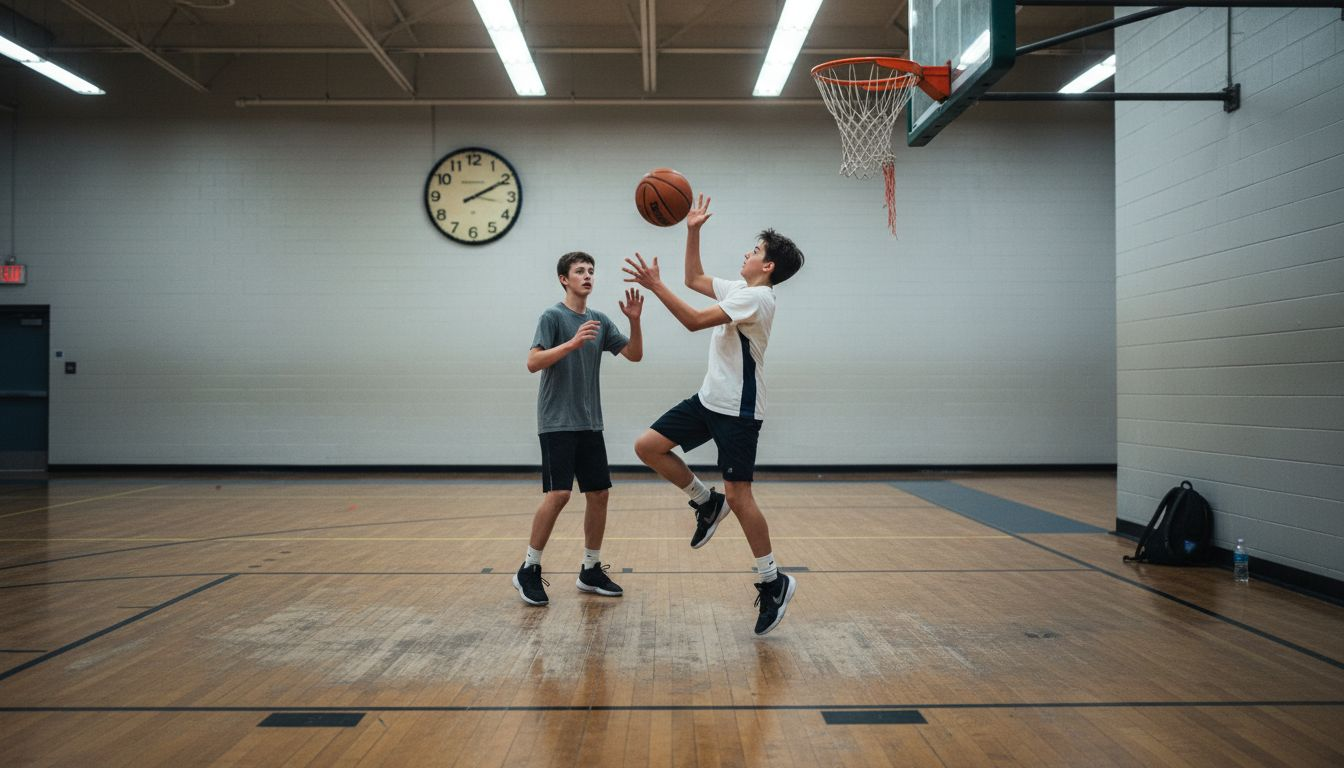
- One-on-one driving drills (offensive player tries to score past a defender)
- Transition drills (fast break scenarios with live defense)
- Screen-and-roll reads (offense decides where to go based on defensive reaction)
- Press-break drills (escaping defensive pressure to enter offense)
When selecting drills appropriate to skill mastery stages, match the game-situation difficulty to your players’ current abilities. Advanced teams can handle full-court press breaks; younger teams need simpler 2-on-2 scenarios.
Competitive Drills
These drills add scoring, winners and losers, or timed challenges. Players still focus on executing a specific skill, but now they’re competing against teammates or against the clock.
Examples include:
- Free-throw contests (most makes in 30 seconds)
- Dribble-relay races (speed and control combined)
- Three-point shooting competitions
- Defensive slide races
Competitive drills boost motivation and engagement. Players give maximum effort when something is on the line—even if it’s just bragging rights.
Youth players respond to competition. Use these drills strategically to finish practice or highlight skill work, but don’t overuse them. Two or three per practice is plenty.
Individual vs. Team Drills
Individual drills focus on one player at a time. Team drills involve groups working together on shared objectives.
Both matter. Individual drills let you identify weak spots and give specific feedback. Team drills teach communication and spacing.
A balanced practice includes both. Start with individual technique work, move to group game-situation drills, finish with competitive or team-focused drills.
Pro tip: Plan your drills based on your team’s skill gaps. If ball handling is weak, dedicate more practice time to dribbling drills across multiple difficulty levels. If your team struggles with defensive positioning, prioritize game-situation defensive drills that force players to make real-time reads.
Here’s a comparison of main skill drill types and their primary benefits for youth basketball:
| Drill Type | Focus Area | Engagement Level | Key Outcome |
|---|---|---|---|
| Fundamental Technique | Basic movements, form | Low to moderate | Builds muscle memory |
| Game-Situation | Skill under pressure | High | Develops decision-making |
| Competitive | Skill with scoring/timing | Very high | Increases motivation |
| Individual | Personal skill deficiency | Varies | Targeted feedback |
| Team | Group skill execution | Moderate to high | Enhances communication |
How skill drills enhance player development
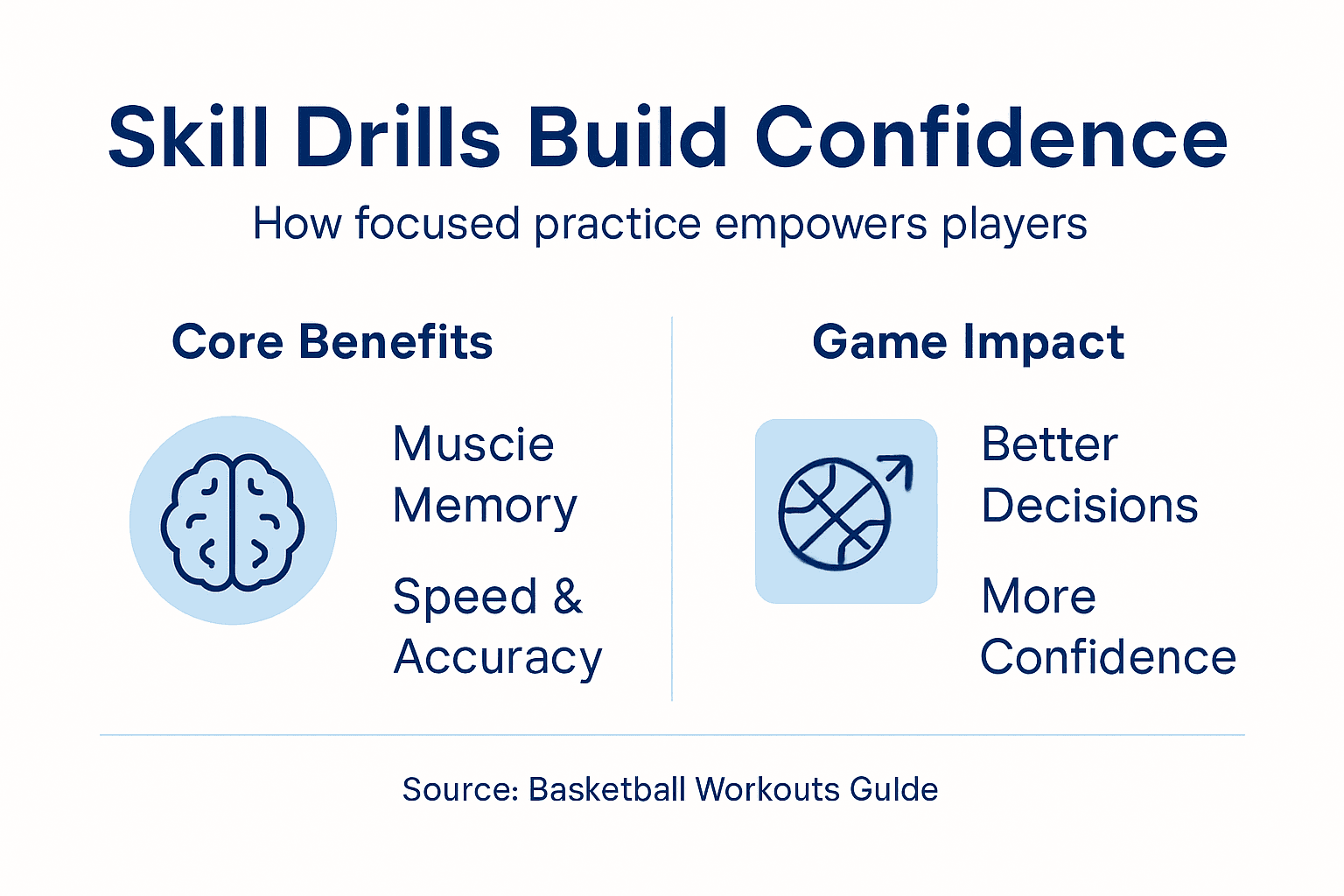
Skill drills work because they target the core mechanisms of athletic development: building automatic responses, strengthening weak areas, and creating the confidence players need to perform under pressure.
When you understand how drills drive development, you’ll design better practices and see faster improvement in your players.
Building Muscle Memory Through Repetition
Every time a player shoots, dribbles, or passes, their nervous system encodes that movement pattern. Repetition strengthens these neural pathways until the movement becomes automatic.
This is why repetition matters. A player who shoots 50 free throws in practice encodes that motion dozens of times. By game time, shooting a free throw requires no conscious thought.
Reinforcing muscle memory through repeated practice allows movements to become internalized, meaning players execute skills without overthinking them when the game speeds up.
Without drills, players rely on conscious thought during games. With drills, the movement is automatic.
Speed and Accuracy Improvements
Drills systematically improve how fast and how accurately players execute specific movements. A ball-handling drill starts at controlled speed, then gradually increases tempo as technique improves.
This progression matters. Players gain confidence at slower speeds first, then transfer that confidence to game-speed conditions.
Track improvements over time:
- Week 1: Player completes dribbling drill in 45 seconds
- Week 3: Same drill completed in 38 seconds
- Week 6: Drill executed with game-speed pressure
Visible progress builds confidence. Players see they’re getting better, and that motivates continued effort.
Isolating Specific Movement Problems
In games, multiple skills happen simultaneously. A pick-and-roll involves dribbling, reading the defense, making a decision, and executing the chosen action all at once.
Drills isolate one element. You can focus entirely on the footwork of setting a screen, or the reading mechanics of a pick-and-roll, without worrying about everything else.
Isolation drills let you diagnose and fix specific technical weaknesses that would be invisible during full-speed play.
Once isolated elements are solid, players integrate them back into game-speed situations with much better success.
Feedback and Assessment
During drills, you see exactly what each player can and cannot do. A player missing shots from one corner but making them from another reveals a footwork or alignment problem.
This clarity allows targeted feedback. You’re not guessing what needs improvement; you see it clearly.
Effective drill feedback includes:
- Specific correction (“Your shooting elbow is drifting right”)
- Immediate reps to reinforce the fix
- Acknowledgment of improvement
Players develop faster when they receive clear, immediate feedback during structured practice.
Building Confidence Through Mastery
Confident players take risks. They drive against defenders, shoot contested shots, and execute advanced moves because they’ve practiced them hundreds of times.
Drills create this confidence. A player who has completed 500 crossover dribbles in practice will confidently use that move in a game.
Confidence compounds. Early success in drills translates to game performance, which reinforces confidence, which drives more focused practice.
Pro tip: Start each season by drilling the five fundamental movements your team struggles with most. Dedicate the first two weeks to building automaticity in these core skills before adding game complexity. This foundation accelerates everything that follows.
Integrating drills into effective practices
Knowing which drills to use is one thing. Fitting them into practice so they actually develop players is another. Effective integration means timing, structure, and clear purpose.
The best coaches don’t randomly throw drills into practice. They build practice around skill development progressions.
Start With Practice Planning
Before practice starts, know exactly which drills you’re running and why. Write them down. Assign time to each.
A 90-minute practice might look like:
- Warm-up and stretching (10 minutes)
- Fundamental skill drills (15 minutes)
- Game-situation drills (25 minutes)
- Competitive or team-focused drills (20 minutes)
- Scrimmage or final drill (15 minutes)
- Cool-down (5 minutes)
This structure balances skill work with engagement and prepares players for competitive scenarios.
Match Drill Difficulty to Player Skill Levels
A drill that’s too hard frustrates players and builds bad habits. A drill that’s too easy wastes practice time. The sweet spot is challenging but achievable.
Planning drills matched to skill levels ensures players experience success while being pushed to improve.
Progress drills as your team improves. Week one focuses on form and technique. Week three introduces pressure. Week six replicates game speed.
Give Clear Instructions
Players execute better when they understand exactly what you want. Vague instructions waste time and create confusion.
Before running a drill, explain:
- What the objective is (“We’re working on quick ball movement”)
- How the drill works (“Three passes, then shoot”)
- What success looks like (“Make two out of three shots”)
- What you’ll be watching for (“Footwork on catch-and-shoot”)
Demonstrate it yourself or have a player demonstrate. Five minutes of clear explanation prevents 15 minutes of confusion.
Embed Immediate Feedback
Feedback during drills accelerates learning. Don’t wait until after practice to tell a player what they’re doing wrong.
Players improve fastest when they receive specific, immediate feedback and can apply corrections in the next rep.
Shout corrections from the sideline. Pause the drill to show a player the right footwork. Acknowledge improvement when you see it.
Connect Drills to Game Situations
Drills should feel relevant to actual games. A pick-and-roll drill that forces players to read defense and make real decisions is more valuable than a drill with no defensive pressure.
Progressively add game context: start stationary, add movement, add defense, add pressure, add game speed. This progression builds confidence and ensures skills transfer to competition.
Assess Progress and Adjust
After drills, assess what you saw. Which players executed well? Who struggled? What needs more work next practice?
Use this feedback to modify upcoming drills. If ball handling needs more work, dedicate more time to dribbling progressions. If shooting accuracy is weak, add form-shooting focus.
Assessment and modification of drills ensures your practice stays aligned with your team’s actual development needs.
Pro tip: Film your practices or track player performance in specific drills. Quantify improvement (faster completion times, higher accuracy percentages). Share these metrics with players so they see progress and stay motivated.
Common mistakes and best practices for coaches
Even well-intentioned coaches make mistakes with drills that undermine player development. Understanding these pitfalls helps you avoid them and maximize practice effectiveness.
The difference between good coaching and great coaching often comes down to these details.
Mistake #1: Running Drills Unsuitable for Skill Level
A common error is using drills that are too advanced or too basic for your players. Advanced drills frustrate struggling players and teach bad habits. Beginner drills bore skilled players who need challenge.
Match drill difficulty precisely to where your players actually are right now, not where you wish they were.
Selecting drills appropriate to skill proficiency ensures players experience productive struggle, not frustration or boredom.
Mistake #2: Giving Unclear Instructions
Vague explanations waste time and create confusion. A player running a drill they don’t understand is practicing the wrong thing.
Before starting, explain:
- The specific objective
- How the drill works step-by-step
- What success looks like
- What you’ll be correcting
Demonstrate. Show it live or have a skilled player show it. Let players ask questions. Five minutes of clarity beats fifteen minutes of confusion.
Mistake #3: Running Drills Too Long
Holding a drill past its effectiveness point causes engagement to drop. Players get bored, focus shifts, and you’re not building the skill anymore.
Keeping drills short and varying drill types maintains motivation and ensures active participation throughout practice.
Most drills work best in 3-7 minute blocks. Rotate to a different drill when focus starts to fade.
Mistake #4: Neglecting Game Conditions
Drills performed without defensive pressure or game-speed conditions don’t transfer to competition. A shooting drill without a defender is easier than actual games.
Progressively add game elements: start stationary, add movement, add defense, add pressure, add game speed. This builds confidence while ensuring skills work under real conditions.
Mistake #5: Skipping Immediate Feedback
Waiting until after practice to correct mistakes means players practice wrong form repeatedly. Feedback delays learning.
Provide feedback immediately during drills so players can correct mistakes in the next rep and reinforce the right technique.
Stop the drill. Show the player the correct movement. Have them repeat it correctly. Then resume.
Use this quick reference to identify common coaching mistakes and their ideal solutions:
| Common Mistake | Negative Impact | Best Solution |
|---|---|---|
| Drills too advanced/basic | Frustration or boredom | Match drills to skill level |
| Unclear instructions | Confusion and wasted time | Give step-by-step explanation |
| Drills run for too long | Drops in focus and performance | Rotate every 3-7 minutes |
| Ignoring game conditions | Poor skill transfer to games | Add defense and pressure |
| Delayed feedback | Incorrect habits formed | Give corrections immediately |
Best Practices That Work
Top coaches follow these principles consistently:
- Plan every drill with clear objectives
- Match difficulty to current skill level
- Give concise, specific instructions
- Stay engaged and provide real-time feedback
- Rotate drills before engagement drops
- Progress drills toward game conditions
- Track progress and adjust based on results
- Keep all players actively participating
Pro tip: Create a simple drill card for each practice listing drill name, objective, time allocation, and success criteria. Reference it during practice so you stay organized and coaches are all on the same page about drill purpose and execution standards.
Elevate Your Team’s Confidence With Targeted Skill Drills
Developing confident basketball players means building strong fundamentals through focused skill drills that cultivate muscle memory, decision-making, and game readiness. If you want to transform practice time into a growth engine with drills designed for maximum impact and player engagement you need resources that match your coaching goals. Hoop Mentality offers an extensive selection of professional Basketball Drills crafted to target the exact skills your team needs most.

Take charge of your practice planning with proven drills and comprehensive workout guides from Basketball Workouts that help you progress players step-by-step toward confidence under pressure. Stop guessing which drills work best and start using time-tested tools to build mastery and motivation. Visit Hoop Mentality today and get the structured coaching resources you need to develop confident players who excel when it counts. Don’t wait to unlock your team’s potential—start building a winning mentality now.
Frequently Asked Questions
What are skill drills in basketball?
Skill drills are focused, repetitive practice activities designed to build automatic responses in specific basketball movements, such as dribbling or shooting. They isolate one technique and enable players to practice it until it becomes second nature.
How do skill drills help build confidence in players?
Skill drills enhance confidence by allowing players to master fundamental skills through repetition. As they practice and improve their technique in drills, players become more comfortable executing these skills in actual game situations.
What types of skill drills are most effective for youth players?
Effective skill drills for youth players include fundamental technique drills, game-situation drills, competitive drills, individual drills, and team drills. Each type focuses on different skills, engagement levels, and developmental stages, ensuring a balanced practice.
How can coaches integrate skill drills into practice effectively?
Coaches can integrate skill drills by planning structured practices that balance different drill types, matching drill difficulty to player skill levels, giving clear instructions, providing immediate feedback, and progressively adding game conditions to enhance skill transfer.
Recommended
- 7 Key Benefits of Basketball Drills for Youth Coaches – Hoop Mentality
- Why Use Basketball Drills: The Essential Guide – Hoop Mentality
- How to Coach Youth Basketball for Team Success – Hoop Mentality
- 7 Essential Basketball Player Development Tips for Coaches – Hoop Mentality
- The Confidence Muscle - MK Marathon Weekend, Milton Keynes 3-4 May 2026