

Choosing the right practice drills separates good coaching from great coaching. Every coach faces the same challenge: limited practice time, diverse skill levels, and the pressure to show measurable improvement. The drills you select directly impact player development, team cohesion, and game-day performance. This article provides a practical framework for evaluating drills, backed by recent research showing how specific training methods improve foot speed, shooting accuracy, and decision making. You’ll discover actionable examples across footwork, shooting, and team coordination that fit real coaching scenarios and deliver results.
Table of Contents
- Key takeaways
- Evaluating practice drills: key criteria for coaches
- Footwork and agility drills to improve player quickness
- Shooting drills to boost accuracy and confidence
- Incorporating decision-making and team coordination drills
- Enhance your practice with expert-designed drills and plans
- FAQ
Key Takeaways
| Point | Details |
|---|---|
| Clear drill goals | Each drill should target a specific skill and align with the session objective to drive measurable progress. |
| Adaptability matters | Drills should be scalable during practice to adjust intensity and difficulty based on players’ responses. |
| Engagement drives learning | Active problem solving and competition outperform passive waiting and improve skill retention. |
| Film for refinement | Recording practice sessions helps spot timing and engagement issues to guide future drill selection. |
| Unpredictable cues boost speed | Using varied cues or color calls increases foot speed and decision making more than fixed ladder drills. |
Evaluating practice drills: key criteria for coaches
Before selecting any drill, you need a clear evaluation framework. Start by identifying your primary skill development goal for that practice session. Are you targeting defensive positioning, offensive spacing, or conditioning? Each drill should align with at least one specific objective. Player energy levels matter more than most coaches realize. A drill that works perfectly on Monday might fall flat on Friday when your team is mentally drained from school and previous games.
Adaptability separates effective drills from time wasters. The best drills allow you to scale difficulty up or down mid-practice based on how players respond. Experienced coaches adapt practice plans flexibly rather than rigidly following a predetermined schedule. If your point guard is struggling with a complex read-and-react drill, you should be able to simplify the decision tree without scrapping the entire exercise.
Player engagement directly correlates with skill retention. Watch for drills that create natural competition or require active problem solving. Passive drills where players stand in line waiting for their turn waste precious practice minutes. The benefits of basketball drills multiply when players stay mentally locked in throughout the entire session.
Consider these evaluation factors:
- Does the drill address a specific skill gap you’ve identified in games?
- Can you modify intensity and complexity on the fly?
- Are players actively engaged or passively waiting?
- Does the drill translate directly to game situations?
- Can you measure improvement objectively?
Pro Tip: Film your drills during practice and review them later. You’ll spot engagement issues and timing problems that aren’t obvious in the moment, helping you refine your drill selection for future sessions.
Footwork and agility drills to improve player quickness
Footwork creates separation on offense and prevents it on defense. Traditional ladder drills have dominated basketball training for decades, but recent research reveals more effective alternatives. Computerized agility training improved foot speed by 7.0% and choice reaction time by 6.9% compared to rope ladder training in collegiate players over just four weeks. This matters because basketball requires reactive agility, not just predetermined movement patterns.
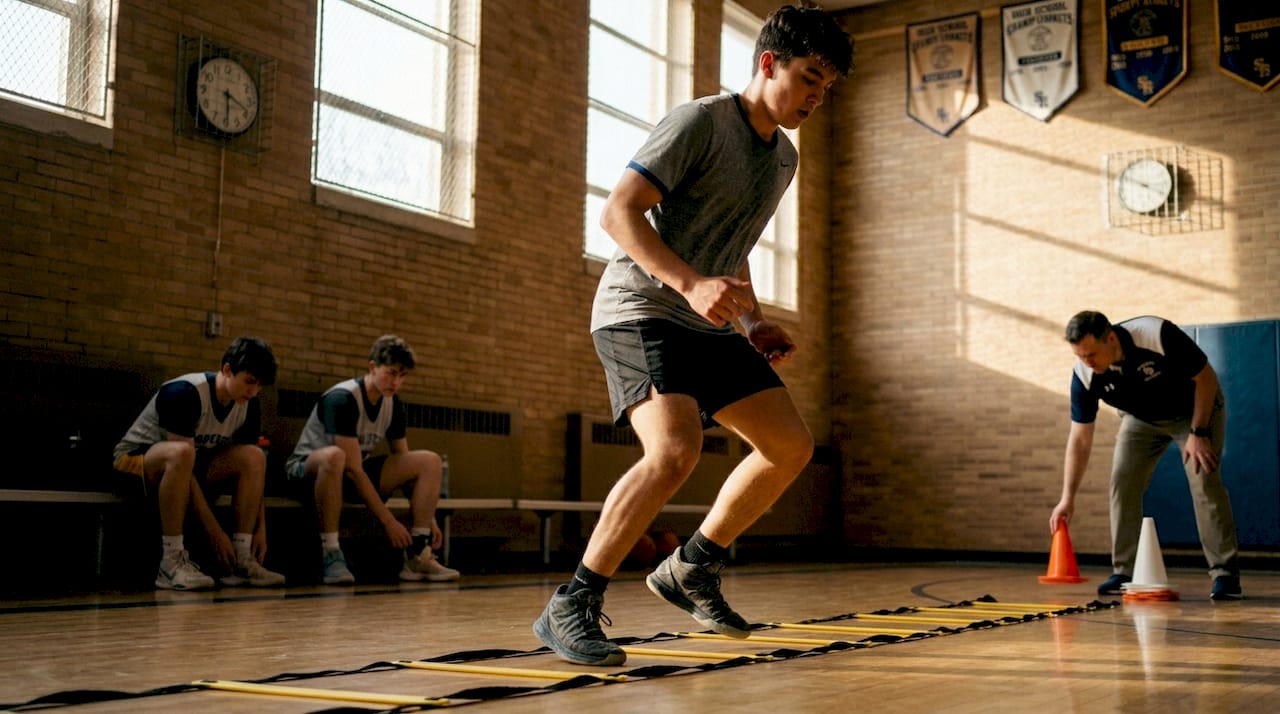
The key difference lies in cognitive load. Ladder drills follow fixed patterns that players memorize and execute on autopilot. Computer-guided agility exercises force players to react to unpredictable visual cues while moving, mirroring the chaos of actual game situations. You can replicate this approach without expensive equipment by using colored cones and calling out colors mid-drill, forcing players to change direction based on your commands.
Effective footwork drills for different skill levels:
- Beginners: Basic defensive slides with proper stance, focusing on not crossing feet
- Intermediate: Cone drills with directional changes every 2-3 seconds
- Advanced: Partner reactive drills where one player mirrors another’s movements
- Elite: Multi-directional agility with ball handling and decision making components
The 7% improvement in foot speed translates to measurable on-court advantages. A player who previously needed three steps to close out on a shooter might only need two, arriving in better defensive position. When practicing footwork, emphasize quality over quantity. Ten perfect repetitions with full effort beat fifty sloppy ones every time.
Pro Tip: Schedule agility work early in practice when players are fresh. Fatigue destroys footwork mechanics, and you’re teaching bad habits if players practice sloppy movements. Save conditioning drills for the end of practice.
Research shows: Computerized agility training produced 7.0% greater foot speed improvements compared to traditional rope ladder drills in just 4 weeks.
Shooting drills to boost accuracy and confidence
Shooting accuracy determines games, but traditional shooting drills often create robotic players who struggle with game-speed adjustments. Differential training improved 2-point shooting accuracy more than traditional training in youth players while lowering perceived exertion over eight weeks. This approach introduces controlled variability into shooting practice, forcing players to adapt their mechanics slightly with each repetition.
Instead of taking fifty identical spot-up shots from the corner, differential training has players shoot from slightly different positions within a small zone. One shot might be two feet behind the three-point line, the next one foot inside it, then back to the line. This variability strengthens the neural pathways that control shooting mechanics, making players more adaptable during games when perfect positioning rarely happens.
The reduced perceived exertion matters for practice planning. Players can maintain higher quality repetitions for longer periods without mental fatigue. You’ll get more productive shooting work in a 20-minute block using differential methods than in 30 minutes of traditional spot shooting. When teaching basketball skills to teach, shooting with variability should be a core component.
Structure your shooting practice with these elements:
- Warm-up: Form shooting close to the basket, focusing on follow-through
- Spot shooting: Five positions around the arc with positional variability
- Movement shooting: Catch-and-shoot coming off screens or cuts
- Fatigue shooting: Free throws or game-speed shots after conditioning work
- Game simulation: Contested shots with a defender closing out
Confidence grows from repetition with success. Start players at distances where they can maintain 60-70% accuracy, then gradually increase range. Missing repeatedly from NBA three-point range doesn’t help a middle school player develop confidence or proper mechanics.
Pro Tip: Track shooting percentages by drill type and distance. Data reveals which players need more work on specific shot types and helps you customize individual development plans efficiently.
Incorporating decision-making and team coordination drills
Basketball IQ separates championship teams from talented groups that underperform. Decision-making drills simulate the pressure and unpredictability of real games, forcing players to read defenses and react appropriately. These drills work best when you introduce constraints that mirror actual game situations. A 3-on-2 fast break drill teaches spacing and decision making better than any lecture about court vision.
Experienced coaches adapt practice plans flexibly based on how players respond to decision-making challenges. If your team struggles with a complex motion offense drill, simplify it to focus on one or two reads before adding layers of complexity. Cognitive overload leads to hesitation and mistakes that become bad habits.
Team coordination requires communication drills where players must talk constantly. Silent basketball doesn’t work. Your point guard should be calling out defensive rotations, your center should be communicating post position, and everyone should be talking on screens. Build this expectation into every drill by stopping play when communication breaks down.
Progression for decision-making drills:
- Introduce the drill with no defense, focusing on proper spacing and timing
- Add passive defense that contests but doesn’t aggressively disrupt
- Progress to live defense with game-speed intensity
- Incorporate score-keeping and consequences to increase pressure
- Add time constraints or possession limits to force quicker decisions
The read-and-react framework teaches players to make decisions based on what the defense gives them. Instead of running set plays that break down when defenses adjust, players learn principles that apply to any situation. This approach requires more practice time upfront but creates more adaptable players who perform better in playoff situations when opponents have scouted your tendencies.
| Drill type | Best for | Key benefit | Difficulty level |
|---|---|---|---|
| 3-on-2 fast break | Transition offense | Teaches spacing and quick decisions | Intermediate |
| 4-on-4 shell drill | Defensive rotations | Builds help defense communication | Beginner to advanced |
| Read-and-react motion | Offensive flow | Develops basketball IQ and spacing | Advanced |
| Closeout rotations | Defensive recovery | Improves team defensive coordination | Intermediate |
When coaching youth basketball success, start with simple decision-making scenarios before progressing to complex reads. A youth player who masters one or two reads will outperform a confused player trying to process five options simultaneously.
Enhance your practice with expert-designed drills and plans
Implementing effective drills requires planning and organization that many coaches struggle to maintain during busy seasons. Ready-made resources eliminate the guesswork and save hours of preparation time each week. The big man dual action drill targets position-specific skills that post players need to dominate inside, with clear progressions from basic to advanced techniques.

A well-structured practice plan template ensures you cover all essential skill areas while maintaining appropriate intensity throughout each session. These templates include timing guidelines, coaching points, and modifications for different skill levels, helping you run efficient practices that maximize player development. Professional resources provide the structure and expertise that transform good practices into great ones, giving your team a competitive advantage that shows up on game day.
FAQ
What are some quick drills to improve shooting accuracy?
Spot shooting from multiple distances with rapid repetitions builds muscle memory and confidence. Focus on five key positions around the three-point arc, taking 10 shots from each spot with minimal rest between locations. Differential training drills that introduce slight positional variability enhance skill retention better than identical repetitions from the exact same spot.
How do agility drills benefit basketball players?
Agility drills increase foot speed, coordination, and reaction time, which directly translate to better defensive positioning and offensive separation. Computerized agility training improved foot speed by 7.0% and reaction time by 6.9% in collegiate players over four weeks. Players who develop superior agility can guard quicker opponents, close out on shooters faster, and create more scoring opportunities through improved change-of-direction speed.
What’s the best way to include decision-making drills in practice?
Integrate drills that simulate game scenarios and require quick choices under pressure. Start with 3-on-2 fast breaks and shell drills that teach basic reads before progressing to more complex motion offense situations. Adjust difficulty and intensity based on team energy and experience levels, using the flexibility that experienced coaches employ to maximize learning. Stop drills immediately when players make poor decisions and explain better options, then replay the situation until they execute correctly.
How often should I change practice drills?
Maintain core drills for 3-4 weeks to allow skill development and proper evaluation of improvement. Introduce one or two new drills each week to keep practices fresh and address emerging weaknesses you notice in games. Complete overhauls of your practice structure confuse players and prevent mastery of fundamental skills. Balance consistency with variety by keeping 70% of drills the same while rotating the remaining 30% based on upcoming opponents and areas needing attention.
Can I use the same drills for different age groups?
Most drills work across age groups with appropriate modifications to complexity and intensity. Simplify decision-making requirements and reduce court dimensions for younger players, then add layers of complexity as they develop. A shell drill works for elementary players focusing on basic defensive positioning and for high school players working on advanced help rotations and closeout techniques. The key is matching the cognitive and physical demands to your players’ current capabilities while providing enough challenge to promote growth.