

Many coaches believe isolated drills are the key to player development. Research shows drills combining skill work with decision-making improve game performance by 20% more than traditional approaches. This guide reveals how structured basketball drills accelerate skill mastery and why your practice design matters more than you think.
Table of Contents
- Introduction To The Role Of Drills In Basketball Development
- How Drills Foster Skill Acquisition And Cognitive Growth
- Common Misconceptions About Basketball Drills
- Comparing Drill Types: Isolated Vs. Progressive Drills
- Organizing Practices Around Drills For Maximum Development
- Beyond Physical Skills: Psychological And Confidence Benefits Of Drills
- Practical Framework And Recommendations For Coaches
- Elevate Your Coaching With Hoop Mentality Resources
Key Takeaways
| Point | Details |
|---|---|
| Integrated drills outperform isolated practice | Combining skills with decisions improves basketball IQ and motor skills by 20%. |
| Structured repetition accelerates fundamentals | Players master core skills 30% faster with organized drill frameworks. |
| Isolated drills alone limit game transfer | Overreliance on single-skill work creates plateaus in player development. |
| Progressive sequencing maximizes retention | Game-context drills yield superior skill transfer to actual competition. |
| Organization drives practice efficiency | Drill-based structure increases productive practice time by 25%. |
Introduction to the Role of Drills in Basketball Development
Drills form the foundation of every successful basketball program. Without structured repetition, players struggle to build the muscle memory and cognitive patterns essential for game situations. Research confirms that practicing with structured drills leads to a 30% faster acquisition of fundamental basketball skills.
You face constant pressure to maximize limited practice time. Every minute counts when developing young athletes. Drills provide the framework to focus player attention and accelerate skill development through targeted repetition.
The most effective drills accomplish multiple goals simultaneously. They build physical technique while developing basketball IQ. They create clear success metrics while maintaining player engagement. Understanding the benefits of basketball drills transforms how you approach practice planning.
Consider what structured drills deliver:
- Consistent repetition that builds reliable muscle memory
- Clear objectives that focus player attention and effort
- Measurable progress markers that motivate continued improvement
- Efficient use of limited practice time and facility space
- Cognitive challenges that develop decision-making under pressure
When you organize practices around drills, you create predictable routines that players understand. This structure eliminates wasted time and confusion. Players know what to expect and can focus entirely on skill execution rather than figuring out what comes next.
Effective youth basketball coaching requires balancing multiple developmental needs. Drills provide the vehicle to address shooting, passing, defense, and decision-making within organized segments. The key is selecting drills that match your players’ current abilities while challenging them to grow.
How Drills Foster Skill Acquisition and Cognitive Growth
Physical repetition alone does not create complete basketball players. The brain must learn when and how to apply skills in dynamic game situations. Studies demonstrate that drills combining skill repetition with game-like decision-making improve motor skills and basketball IQ by 20%.
Your players need cognitive challenges embedded within physical practice. When drills force real-time decisions, players develop the pattern recognition essential for game success. This dual development accelerates overall improvement beyond what isolated skill work can achieve.
Pro Tip: Add a defensive variable to every offensive drill after players demonstrate basic competency. This simple adjustment transforms skill work into basketball-specific problem solving.
Progressive drills that simulate game scenarios produce superior results compared to static skill repetition. Players who practice shooting off the catch with defensive pressure transfer that skill to games more effectively than those who shoot alone. The cognitive load during practice mirrors game demands.
Effective drills integrate multiple development goals:
- Physical execution of fundamental techniques
- Recognition of tactical situations and opportunities
- Decision-making under time and defensive pressure
- Communication and teamwork requirements
- Mental resilience when facing challenging scenarios
The relationship between physical and cognitive development is synergistic. Better technique allows faster processing speed. Improved basketball IQ helps players execute skills more efficiently. Different types of shooting drills illustrate this principle clearly.
When you design drills, consider the mental demands on your players. Are they simply repeating motions, or are they reading defenses and making choices? The latter approach creates players who perform under game pressure rather than just practice conditions.
Common Misconceptions About Basketball Drills
Many coaches fall into predictable traps when selecting and implementing drills. Understanding these misconceptions helps you avoid wasted practice time and player frustration. Research indicates that over-reliance on isolated drills limits player progress and skill transfer to games.
The most damaging myth suggests that more repetition automatically produces better players. Volume matters, but only when combined with appropriate challenge and context. Players who shoot 500 shots alone in a gym may not improve their game performance if those shots lack defensive pressure or game-realistic scenarios.
- Believing isolated drills are sufficient for complete development
- Assuming physical repetition alone builds game-ready skills
- Expecting immediate transfer from practice drills to game situations
- Thinking all drills provide equal developmental value
- Neglecting the cognitive demands required for skill adaptation
Another common mistake involves treating all drills as equal. A basic layup line serves a different purpose than a competitive finishing drill with defensive pressure. Both have value, but they target different developmental needs and should be sequenced appropriately.
Pro Tip: Evaluate each drill by asking whether it requires players to make decisions similar to game situations. If not, consider how to add realistic variables without overwhelming the fundamental skill focus.
You must match drill complexity to player development stage. Beginners need simplified scenarios to build basic technique. Advanced players require complex challenges that stress their decision-making and execution simultaneously. Understanding these drill principles prevents common implementation errors.
The misconception that drills should always feel comfortable also limits growth. Effective drills push players slightly beyond their current abilities. This productive struggle accelerates learning more than comfortable repetition of mastered skills.
Comparing Drill Types: Isolated vs. Progressive Drills
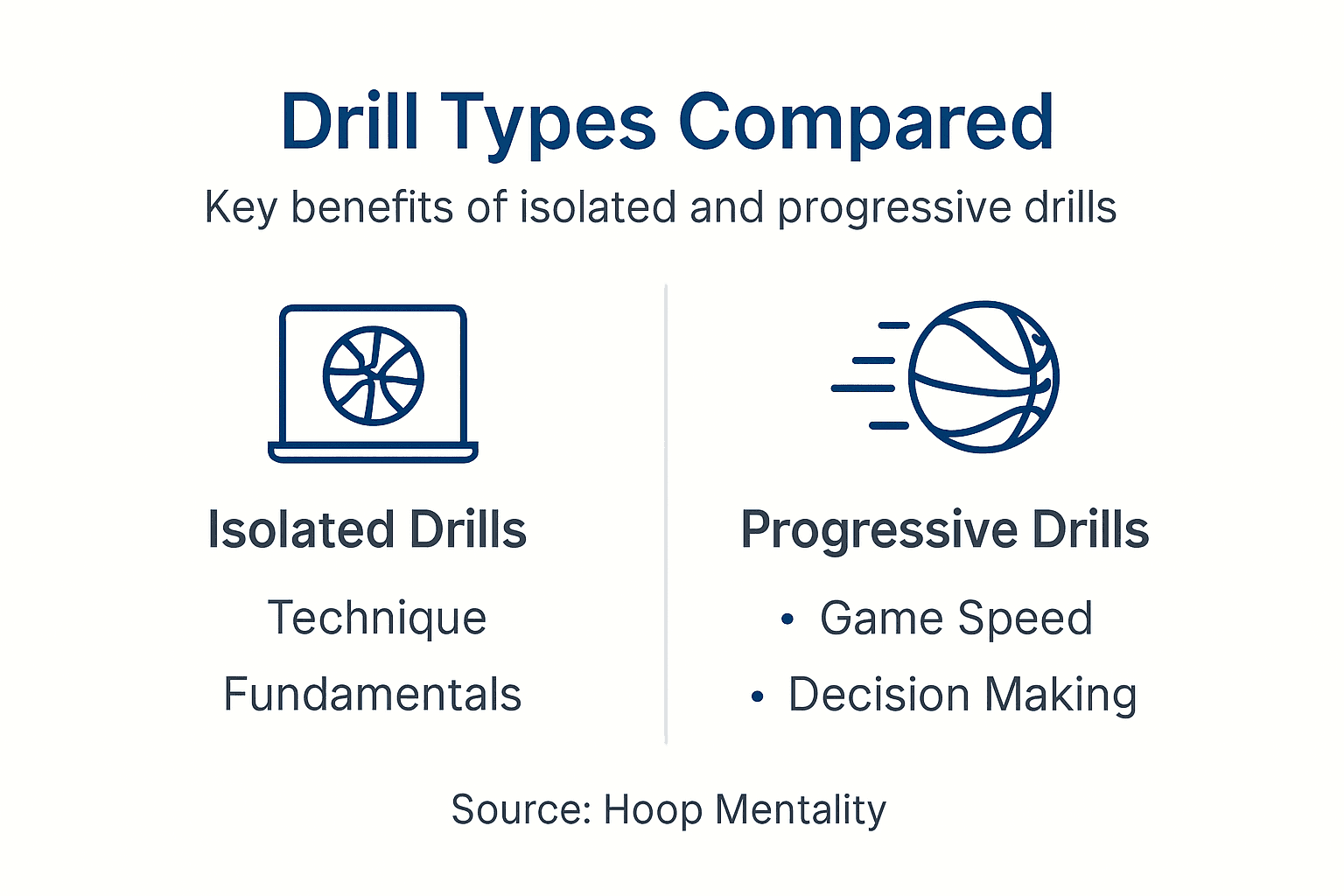
Understanding drill categories helps you select appropriate activities for specific developmental goals. Isolated drills focus on single fundamental skills with minimal cognitive demand. Progressive drills integrate multiple skills and require game-like decision-making. Research shows progressive drills improve offensive and defensive skills by over 20%, while isolated drills have limited game transfer.
| Drill Type | Best For | Key Characteristics | Game Transfer |
|---|---|---|---|
| Isolated | Beginners learning fundamentals | Single skill focus, low cognitive load | Limited without progression |
| Progressive | Intermediate to advanced players | Multiple skills, decision-making required | High transfer to competition |
| Game-based | All levels (scaled appropriately) | Full context, pressure situations | Highest competitive preparation |
Isolated drills serve specific purposes in your practice plan. They allow players to master fundamental movements before adding complexity. A basic form shooting drill helps players develop consistent release mechanics. Once those mechanics become automatic, you must progress to more challenging scenarios.
Progressive drills bridge the gap between isolated practice and actual games. These drills maintain focus on specific skills while adding variables that force decision-making. A shooting drill that includes passing, cuts, and defensive closeouts develops both shooting technique and the ability to create and recognize shooting opportunities.
Your drill selection should reflect your players’ current abilities:
- New players need isolated drills to build basic technique foundations
- Developing players benefit from progressive drills that add controlled complexity
- Advanced players require game-based drills with full competitive pressure
- All levels need appropriate balance based on individual development needs
Understanding basketball drill types allows you to build comprehensive practice plans. The key is recognizing when to progress from isolated to integrated work. Players ready for progression show consistent execution under basic conditions.
Neither drill type is inherently superior. The question is which serves your specific developmental goal at this moment. Beginners forced into complex progressive drills become overwhelmed and develop poor habits. Advanced players stuck in isolated drills plateau because they lack sufficient challenge.
Organizing Practices Around Drills for Maximum Development
Effective practice organization multiplies the impact of individual drills. When you sequence activities strategically, each drill builds on previous work and prepares players for subsequent challenges. Studies confirm that drill-based practice organization increases efficiency by 25% and shooting accuracy by 18%.
| Practice Phase | Duration | Drill Type | Primary Goal |
|---|---|---|---|
| Warm-up | 10 minutes | Dynamic movement | Prepare body, review fundamentals |
| Skill Development | 20-25 minutes | Isolated to progressive | Build specific techniques |
| Team Concepts | 15-20 minutes | Progressive to game-based | Apply skills in team context |
| Competitive Play | 15-20 minutes | Controlled scrimmage | Transfer to game situations |
You maximize practice efficiency through clear objectives for each segment. Players perform better when they understand the purpose behind each drill. This clarity also helps you evaluate whether activities are producing desired results.
- Begin with dynamic warm-ups that incorporate basic basketball movements
- Progress to isolated drills that develop or refine specific fundamental skills
- Advance to progressive drills that combine skills with decision-making elements
- Finish with game-based activities that require full skill integration
- Include brief rest periods that allow mental processing and physical recovery
Pro Tip: Transition between drills using specific player movements rather than standing around. This maintains practice intensity while providing active recovery between high-intensity segments.
The practice structure guide principles apply across all age groups and skill levels. Younger players need shorter drill segments with more frequent activity changes. Older players can sustain focus through longer drill sequences.
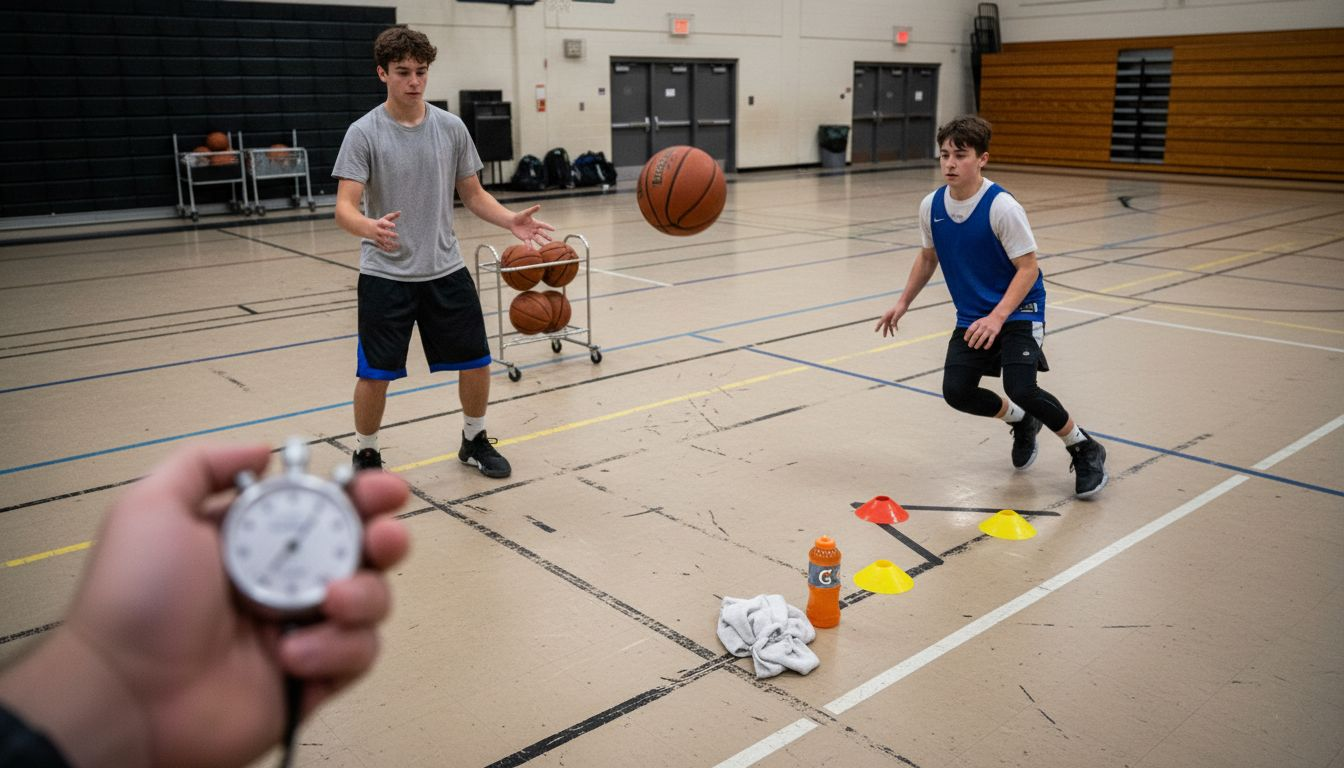
Organization extends beyond drill selection to include court setup and player grouping. Prepare equipment before practice starts. Use station-based rotations to keep everyone active. Group players by ability when necessary to provide appropriate challenge levels.
Your skills development workflow should follow a logical progression throughout the season. Early practices emphasize fundamental skill development through isolated drills. As players improve, shift toward progressive and game-based drills that prepare for competition.
Beyond Physical Skills: Psychological and Confidence Benefits of Drills
Drills shape player psychology as much as physical ability. Structured practice provides repeated success experiences that build confidence and motivation. When players see measurable improvement through drill progressions, they develop growth mindsets and increased engagement.
Confidence emerges from competence. As players master skills through deliberate practice, they trust their abilities under pressure. This psychological foundation proves as important as technical skill for game performance. Drills that gradually increase difficulty allow players to stretch their capabilities while maintaining success rates that sustain motivation.
Successfully executing challenging drills also builds mental toughness. When players push through difficult scenarios in practice, they develop resilience that transfers to game situations. This psychological preparation helps players maintain composure during competitive pressure.
Key psychological benefits from structured drill work:
- Increased self-efficacy through visible skill improvement
- Enhanced motivation from clear progress markers and achievable goals
- Greater resilience developed by overcoming challenging practice scenarios
- Improved focus and attention control through structured repetition
- Stronger team cohesion built through shared practice experiences
Understanding basketball IQ basics includes recognizing the confidence component. Players with high basketball IQ trust their decision-making because they have practiced similar situations repeatedly. This confidence allows faster processing and more aggressive play.
Competitive drills specifically target psychological development by adding pressure and consequences. These drills simulate game stress in controlled environments where players can safely experience and adapt to pressure situations.
You can leverage drills to build team culture as well. Drills that require communication and cooperation develop social cohesion. Players who work together through challenging practice activities build trust that translates to better team chemistry during games.
Practical Framework and Recommendations for Coaches
Implementing effective drill-based practices requires a systematic approach. This framework guides your planning and execution to maximize player development across all skill areas.
- Assess current player abilities through observation and skill testing to establish baselines
- Identify specific skill gaps and developmental priorities for individual players and the team
- Select drills that target priority skills while matching player readiness levels
- Design practice sequences that progress from isolated to progressive to game-based drills
- Balance drill difficulty to challenge players without overwhelming fundamental execution
- Monitor player progress through practice observation and performance metrics
- Adjust drill selection and sequencing based on demonstrated improvement or persistent struggles
- Maintain detailed records of which drills produce results for your specific players
Your drill selection must align with your overall program philosophy and season goals. Early season practices emphasize fundamental skill development. Mid-season shifts toward team concepts and system execution. Late season focuses on game preparation and competitive readiness.
Balance individual skill development with team concept work. Players need both personal skill mastery and understanding of how their skills fit within team strategies. The skills development workflow helps you maintain this balance throughout the season.
Regularly evaluate drill effectiveness by measuring player improvement. If a drill consumes practice time without producing results, replace it. Stay flexible and willing to adjust based on what works for your specific players rather than blindly following preset plans.
Remember that drill effectiveness depends on proper execution and coaching. The best drills fail if you do not provide clear instruction, maintain high standards, and offer specific feedback. Your active coaching during drills multiplies their developmental impact.
Elevate Your Coaching with Hoop Mentality Resources
Transforming your understanding of drills into consistent practice success requires proven systems and expert guidance. Access comprehensive resources specifically designed for youth and high school coaches who want to maximize player development and team performance.

Hoop Mentality provides detailed practice plans, progressive drill libraries, and organizational frameworks that streamline your coaching process. Our Basketball Fundamentals Guide delivers structured approaches to teaching core skills efficiently. Discover Essential Tips for Coaches that help you organize more effective practices immediately. Explore our Top Coaching Resources to build systems that develop players faster while saving you valuable preparation time.
Frequently Asked Questions
What is the best way to balance isolated and progressive drills in practice?
Start with isolated drills to establish proper fundamental technique, then progress to drills that combine skills with decision-making as players demonstrate competency. Beginners need more isolated work while advanced players benefit from predominantly progressive and game-based drills.
How often should drills be changed or updated during a season?
Reassess your drill selection every four to six weeks based on player progress and upcoming competition needs. Maintain effective drills that produce results while replacing activities that no longer challenge players or align with current developmental priorities.
Can drills improve mental toughness as well as physical skills?
Yes, drills that simulate game pressure and require sustained focus build psychological resilience alongside physical abilities. Competitive drills with consequences help players develop composure and confidence that transfers directly to game situations.
What common mistakes do coaches make when selecting drills?
Overusing isolated drills without progression to game-context scenarios is the most frequent error. Coaches also commonly neglect practice organization, fail to match drill difficulty to player ability, and continue ineffective drills without evaluating actual results.