

Most american youth and high school basketball coaches are discovering that rigid positions no longer guarantee success on the court. As global basketball trends evolve, traditional roles like point guard and center are giving way to approaches where every player can do it all. Teams practicing positionless basketball have seen dramatic improvements in adaptability and skill development, making this strategy vital for coaches seeking a competitive edge and all-around player growth.
Table of Contents
- Defining Positionless Basketball And Key Concepts
- Essential Skills For Player Versatility
- Implementing Positionless Offenses In Practice
- Benefits For Player Growth And Team Success
- Challenges, Misconceptions, And Coaching Solutions
Key Takeaways
| Point | Details |
|---|---|
| Positionless Basketball Redefines Roles | Emphasizes player versatility, allowing athletes to excel in multiple positions, fostering adaptability on the court. |
| Comprehensive Skill Development is Essential | Coaches should focus on fostering multi-dimensional skills in players, enhancing their overall basketball intelligence. |
| Adaptability Leads to Success | Teams benefit from fluid offensive and defensive strategies that arise from breaking traditional positional boundaries. |
| Addressing Misconceptions is Crucial | Coaches need to challenge common misconceptions about positionless basketball to ensure effective implementation and player growth. |
Defining Positionless Basketball and Key Concepts
Positionless basketball represents a transformative approach to team strategy that challenges traditional player role limitations. At its core, this concept eliminates rigid positional boundaries, enabling players to perform multiple roles simultaneously. Basketball systems are fundamentally changing to accommodate this dynamic playing style that prioritizes versatility and adaptability.
The philosophy behind positionless basketball centers on developing players with comprehensive skill sets that transcend conventional position-specific expectations. Players are no longer confined to narrow roles like point guard or center but instead cultivate abilities across multiple dimensions. Research indicates this approach requires significant psychological and physical development, demanding heightened concentration, emotional regulation, and rapid decision-making capabilities.
Key characteristics of positionless basketball include:
- Multi-dimensional skill development
- Adaptable defensive capabilities
- Superior ball-handling across all player types
- Enhanced court vision and strategic understanding
- Fluid offensive and defensive transitions
Coaches implementing this strategy must focus on player development that emphasizes flexibility, technical proficiency, and mental agility. The goal is creating athletes who can seamlessly interchange roles based on game dynamics rather than predefined positional constraints.
Pro Tip for Coaches: Cross-train players in multiple skill sets by designing practice drills that rotate position responsibilities, helping athletes develop comprehensive basketball intelligence and adaptability.
Here is a comparison of traditional basketball and positionless basketball approaches:
| Aspect | Traditional Basketball | Positionless Basketball |
|---|---|---|
| Player Roles | Fixed, position-specific | Flexible, role interchangeable |
| Coaching Focus | Specializing individual skills | Developing multi-dimensional skills |
| Adaptability | Limited by positions | High, players adapt instantly |
| Team Offense | Predetermined structure | Fluid, dynamic movement |
| Defensive Assignments | Assigned by position | Matched by skill and situation |
Essential Skills for Player Versatility
Developing a comprehensive skill set is fundamental to becoming a successful positionless basketball player. Mastering core basketball fundamentals requires players to expand their capabilities beyond traditional positional limitations, focusing on versatility and adaptability across multiple court dimensions.
The essential skills for player versatility encompass a range of technical and strategic competencies. Players must develop exceptional shooting abilities from various angles and distances, ensuring they can score effectively in multiple scenarios. Defensive skills are equally critical, with players needing superior footwork, positioning, and the ability to guard multiple positions effectively. Court vision becomes a paramount skill, enabling athletes to anticipate plays, create strategic passing lanes, and make split-second decisions that can change game dynamics.
Key skills for positionless basketball development include:
- Dynamic shooting techniques
- Advanced ball-handling capabilities
- Adaptive defensive positioning
- Strategic off-ball movement
- Comprehensive court awareness
- Rapid decision-making skills
- Consistent rebounding from multiple positions
Successful player development in positionless basketball demands a holistic approach that integrates physical training, mental preparation, and tactical understanding. Coaches must design training programs that challenge players to break traditional positional boundaries, encouraging them to develop a diverse and flexible skill set that transcends conventional role limitations.
Pro Tip for Coaches: Implement cross-training drills that rotate players through different positions during practice, forcing them to develop skills outside their comfort zones and enhancing overall court versatility.
Implementing Positionless Offenses in Practice
Implementing positionless basketball strategies requires coaches to fundamentally rethink traditional team structures and player development approaches. This transformative methodology demands a strategic reimagining of offensive schemes that prioritize player versatility over rigid positional constraints.
Successful implementation begins with designing practice drills that challenge players to develop comprehensive skill sets. These drills should encourage players to practice ball handling, perimeter shooting, interior scoring, and defensive positioning across multiple court locations. Coaches must create scenarios that force athletes to adapt quickly, making split-second decisions that demonstrate their ability to perform various roles dynamically.
Key practice strategies for developing positionless offenses include:
- Rotating player positions during scrimmages
- Implementing complex passing and movement sequences
- Designing multi-option scoring drills
- Creating defensive scenarios that require positional flexibility
- Encouraging spontaneous decision-making
- Developing comprehensive court awareness
- Emphasizing skill transferability across different court positions
Ultimately, positionless offense requires a philosophical shift from traditional basketball training. Coaches must cultivate an environment that values adaptability, basketball intelligence, and multidimensional skill development over conventional positional specialization. This approach demands patience, creativity, and a willingness to challenge established basketball paradigms.
Pro Tip for Coaches: Create hybrid drills that combine offensive and defensive skills, requiring players to seamlessly transition between roles and develop a more holistic understanding of court dynamics.
Benefits for Player Growth and Team Success
Psychological and physical development in positionless basketball represents a transformative approach to player growth that extends far beyond traditional skill acquisition. This holistic methodology fundamentally reshapes how athletes understand and interact with the game, creating more intelligent, adaptable, and resilient players who can excel in complex competitive environments.
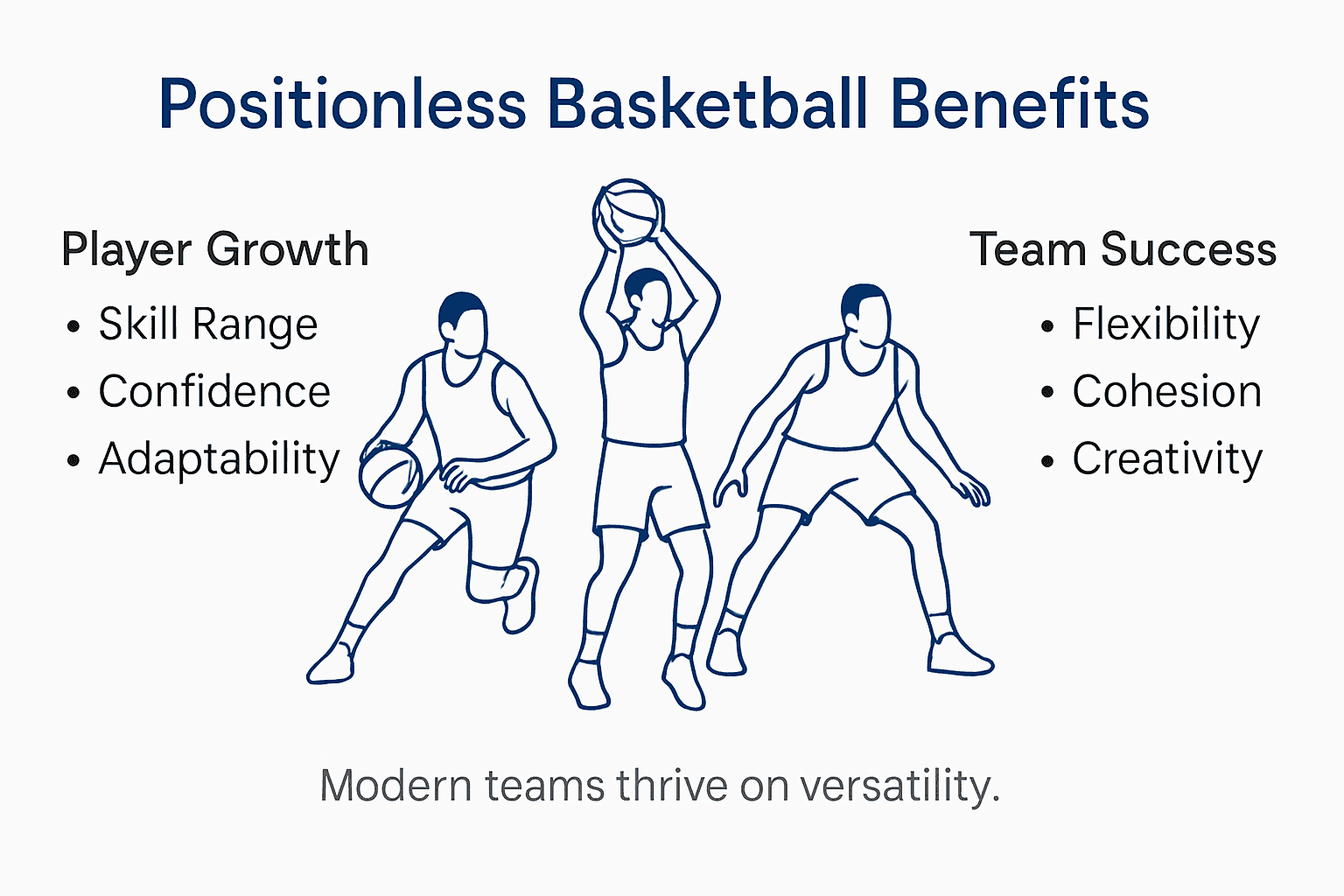
The comprehensive development process cultivates critical psychological competencies that are essential for modern basketball success. Players learn to regulate emotions under pressure, make rapid decisions, and maintain high levels of confidence across multiple game scenarios. These mental skills translate directly into improved on-court performance, enabling athletes to respond dynamically to changing game situations with greater precision and strategic insight.
Key benefits of positionless basketball development include:
- Enhanced cognitive flexibility
- Improved situational awareness
- Increased mental resilience
- Superior adaptive decision-making
- More comprehensive skill integration
- Reduced positional limitations
- Greater individual and team creativity
Team success emerges naturally from this approach as players develop a more nuanced understanding of collective gameplay. By breaking down traditional positional barriers, teams create more fluid, unpredictable offensive and defensive strategies that challenge opponents’ conventional tactical preparations. This approach transforms basketball from a structured, predetermined system into a dynamic, responsive form of athletic expression.
Pro Tip for Coaches: Implement progressive skill-building exercises that deliberately mix traditional positional responsibilities, forcing players to develop a more comprehensive understanding of team dynamics and individual potential.
Challenges, Misconceptions, and Coaching Solutions
Understanding the nuanced implementation of positionless basketball requires coaches to confront several critical misconceptions that can derail effective strategy development. Many coaches mistakenly believe positionless basketball means completely eliminating player roles, when in reality it represents a more sophisticated approach to maximizing individual player strengths and team dynamics.
The primary challenges coaches encounter stem from deeply ingrained traditional basketball paradigms that resist fundamental strategic shifts. Resistance often comes from players accustomed to specialized roles, coaching staff committed to conventional systems, and administrative structures that reward traditional positional performance metrics. Overcoming these institutional barriers demands a comprehensive educational approach that demonstrates the tangible benefits of a more fluid, adaptive basketball philosophy.
Key misconceptions about positionless basketball include:
- Believing it eliminates all positional specialization
- Assuming players can instantly adapt without targeted training
- Thinking versatility means sacrificing individual skill mastery
- Underestimating the psychological complexity of role flexibility
- Overlooking the need for systematic skill development
- Expecting immediate performance improvements
- Misunderstanding the difference between versatility and generalization
Successful implementation requires coaches to develop strategic coaching solutions that gradually introduce positionless concepts. This involves creating progressive training modules, developing individualized skill enhancement plans, and cultivating a team culture that values adaptability and continuous learning. Coaches must become architects of player potential, designing environments that encourage experimentation, strategic thinking, and holistic athletic development.
Pro Tip for Coaches: Implement incremental positionless training by starting with small-sided games that force players to perform multiple roles, gradually increasing complexity to build confidence and skill transferability.
This overview highlights challenges and coaching solutions for implementing positionless basketball:
| Challenge | Why It Happens | Coaching Solution |
|---|---|---|
| Player resistance | Accustomed to set roles | Incremental skill rotation |
| Staff bias to tradition | Comfort with legacy systems | Continual education and demos |
| Skill imbalance | Weaknesses in less familiar roles | Individualized skill development |
| Measuring progress | Lack of clear benchmarks | Track growth with versatility metrics |
Unlock the Full Potential of Positionless Basketball in Your Team Development
Positionless basketball demands coaches overcome the challenge of building versatile players who can seamlessly adapt across multiple roles. This approach requires deliberate training that cultivates dynamic skills, mental agility, and tactical intelligence—all essential for creating flexible, high-performing teams. If you are looking to transform your practice sessions and prepare your athletes for this modern style of play you need resources that help you systematically develop comprehensive skill sets and game strategies.
Explore our Basketball Drills collection designed specifically to enhance player versatility and adaptability.
Take control of your team’s development by implementing drills, workouts, and playbooks that emphasize role interchangeability and fluid offense. Visit Hoop Mentality now to access professional coaching resources that streamline your practice planning and bring confident structure to your positionless basketball journey. Don’t wait to elevate your squad’s basketball IQ and unlock their true potential.
Frequently Asked Questions
What is positionless basketball?
Positionless basketball is a modern approach to team strategy that eliminates rigid player roles, allowing athletes to perform multiple functions based on game dynamics and adaptability.
What are the key characteristics of positionless basketball?
Key characteristics include multi-dimensional skill development, adaptable defensive capabilities, superior ball-handling, enhanced court vision, and fluid transitions between offense and defense.
How can coaches implement positionless basketball strategies in practice?
Coaches can implement these strategies by designing practice drills that rotate player positions, encourage complex passing and movement sequences, and create situations requiring positional flexibility.
What benefits does positionless basketball provide for player growth?
Benefits include enhanced cognitive flexibility, improved situational awareness, increased mental resilience, and the development of a comprehensive skill set that fosters individual and team creativity.
Recommended
- Is Positionless Basketball in the NBA Just a Current Coaching Trend? – Hoop Mentality
- Basketball Player Positions: Roles and Responsibilities Guide – Hoop Mentality
- 7 Key Player Development Tips for Coaches – Hoop Mentality
- Build a Basketball Team: Step-by-Step Guide for Coaches – Hoop Mentality
- 7 Real-World Examples of Brand Positioning for Growth