

Coaching team leaders means building the systems, practice structures, and player-leadership habits that let a basketball team run itself when you’re not talking. It comes down to playbooks, practice plans, and scouting templates that give players clarity and give coaches back their prep time. The single action to take this week: adopt one modular practice-plan template and run it as a focused 60 or 90-minute session before you build anything else.
- Pick one template, not five
- Run it exactly once before adjusting
- Track what broke down, then fix only that
Key Takeaways
Coaching team leaders works when coaches pair competence-supportive structure with modular, editable templates that staff can run consistently across every practice.
| Point | Details |
|---|---|
| Structure drives competence | Clear pre-practice expectations, live coaching cues, and task-focused feedback build player confidence and coordination. |
| Use modular templates | Adopt one 60 or 90-minute practice-plan template first, then adjust based on what breaks down. |
| Cap drills at four to six | Follow the 80/20 rule so reps concentrate on the skills that actually show up in games. |
| Build player leadership deliberately | Assign specific voice roles and scripted phrases rather than relying on a captain’s patch alone. |
| Get ready-made templates | Hoop Mentality’s Basketball Template Bundle For Coaches provides editable practice plans, drills, and scouting sheets matched to this structure. |
Table of Contents
- Core Coaching Principles That Actually Move the Needle
- A Reusable Practice Plan Template for Any Level
- Copy-and-Run Blueprints: 60 and 90-Minute Sessions
- Growing Player Leaders and Organizing Your Staff
- Motivational Techniques That Work for Youth Teams
- Handling Conflict and Team Dynamics on the Floor
- Coaching Adjustments That Actually Win Games
- Tracking Player and Team Progress Over a Season
- Where to Find Ready-Made Coaching Templates
- What Coaches Get Wrong About Leadership Development
- Get the Full Template System From Hoop Mentality
- Sources
- FAQ
Core Coaching Principles That Actually Move the Needle
Structure beats charisma. A qualitative study of professional soccer coaches and players found that competence-supportive coaching, meaning clear expectations before activity, instructional guidance during it, and task-focused feedback after it, builds players’ sense of competence and improves how the team coordinates on the floor. That’s not motivational-poster language. It’s a specific sequence: tell them what you expect, guide them while they do it, then tell them exactly what worked and what didn’t once it’s over.
The second principle is freedom within structure. Rigid systems break down the moment a game plan meets a live opponent, so the best coaches build a skeleton (blocks, timing, core actions) and let players and assistants adapt the details to context. A mixed-methods evaluation of a nationwide coach education program found that module-based, blended delivery, meaning short standalone units coaches can mix and tailor, improved uptake and helped coaches actually transfer what they learned onto the practice floor rather than letting it sit in a binder.
Three behaviors translate this into daily coaching:
- Pre-practice clarity: State the session’s single objective in one sentence before the first whistle.
- Concise on-court cues: Give one correction at a time, tied to what the player can see or feel.
- Task-focused post-practice feedback: Note what happened against the standard, not how it made anyone feel.
Pro Tip: Write your practice objective on the whiteboard before players arrive. If you can’t compress it to one sentence, the practice doesn’t have a clear enough goal yet.
A Reusable Practice Plan Template for Any Level
A practice plan is only useful if the blocks are the same every time and the percentages shift with the level you coach. That consistency is what lets an assistant run your practice from a printed sheet without you standing over their shoulder.
A standard basketball practice structure breaks court time into five blocks:
- Warm-up (dynamic movement, ballhandling, light shooting)
- Individual skill work (ballhandling, shooting form, footwork)
- Team concepts (spacing, cuts, pick-and-roll reads, defensive rotations)
- Competitive play (small-sided games, scrimmage, situational reps)
- Cooldown (stretching, free throws, brief team talk)
Time allocation shifts by level:
| Coaching level | Skill work | Team concepts | Competitive play |
|---|---|---|---|
| Youth (ages 8-10) | 35% | 10% | 15% |
| Middle school | 30-35% | 15% | 15% |
| High school | 25% | 20% | 20% |
| College/pro | 20% | 25% | 25% |
Younger teams need more individual repetition because their skills aren’t automatic yet. Older, more experienced teams can spend more time on reads and live execution because the mechanics are already there.
The 80/20 rule keeps sessions focused: roughly 80% of your practice time should reinforce the 20% of skills and concepts that show up most in games (spacing, ball security, closeouts, transition). Pick four to six drills per session, no more. Every extra drill past that number dilutes reps on the ones that actually matter, and players start coasting instead of competing.
Copy-and-Run Blueprints: 60 and 90-Minute Sessions
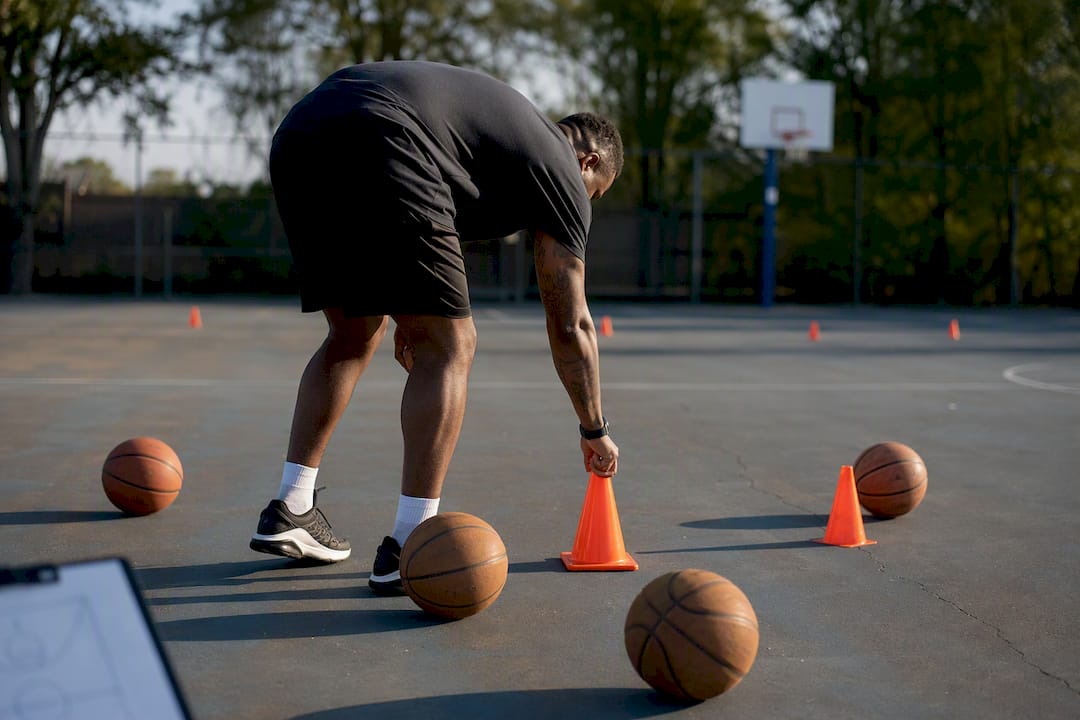
Here’s a 60-minute plan you can run tomorrow:
- 0:00 to 8:00, dynamic warm-up and ballhandling
- 8:00 to 20:00, individual skill stations (shooting form, finishing, footwork, pick-and-roll ballhandling), rotating every four minutes
- 20:00 to 35:00, team concepts (spacing rules, closeout drills, one defensive rotation)
- 35:00 to 55:00, 4v4 or 5v5 controlled scrimmage with a coaching point live
- 55:00 to 60:00, free throws and a two-sentence team talk
A 90-minute first-practice blueprint for high school teams extends this with more station time and a longer live-play block, using controlled 3v3 and 5v5 segments as teaching checkpoints rather than pure scrimmage. Station-based blocks work best with strict rotation timing and a coach or captain acting as a “traffic cop” to keep lines from forming, since demo time has to be built into the station clock, not stolen from reps.
Three quick fixes for common breakdowns:
- Lines forming at a station: Add a second ball or a second station doing the same drill.
- Spacing collapsing in scrimmage: Stop play, reset floor positions, restart from that exact spot.
- Energy dropping mid-practice: Insert a 90-second competitive shooting game between blocks.
Pro Tip: Set a visible clock for every block. Players police their own pace once they can see time running out.
Growing Player Leaders and Organizing Your Staff
Leadership on the court doesn’t come from naming a captain in September and hoping it sticks. It comes from a repeatable process, and it starts with identifying who actually influences teammates during a live possession, not just who talks the most in the huddle.
Steps to build player leadership:
- Watch scrimmages for who teammates look to after a mistake.
- Assign that player a specific voice role (calling out screens, communicating switches).
- Give them a script: two phrases they use every time a situation repeats.
- Debrief weekly on what they said and what changed because of it.
Short leadership drills work better than lectures. A 3v3 shell drill where one player must verbally call every defensive rotation builds the exact communication habit you want live in games, because it forces the “why” behind the action into words the player has to say out loud.
For your staff, delegation follows the same logic as player leadership: shared templates, not verbal instructions repeated every practice. A standardized approach to player pathways argues that shared session plans and assessment templates keep delivery consistent even when different assistants run different stations.
Staff delegation checklist:
- Share the written practice plan 24 hours ahead, not at the gym door.
- Assign one assistant per station block, not a rotating free-for-all.
- Use the same feedback template across the whole staff so players hear consistent language.
Motivational Techniques That Work for Youth Teams
Youth players respond to specific, immediate acknowledgment, not generic praise. “Nice job” teaches nothing. “You beat your defender to the spot before the catch” tells a ten-year-old exactly what to repeat.
Short-term competitive games inside practice, like a two-minute shooting contest between blocks, work better than long pep talks for holding attention. Youth attention spans are shorter, and a practical guide to coaching youth mini-games shows how small-sided competition keeps energy up while still teaching real skills.
Recognition systems matter more at this age than at any other level. A simple “hustle chart” tracked on a whiteboard, updated after every practice, gives kids a visible reason to compete for effort rather than just outcome. Pair that with peer recognition, letting teammates nominate one player each session for a specific good habit, and you build intrinsic motivation instead of dependence on the coach’s approval.
Avoid tying youth motivation exclusively to winning. Teams that only celebrate scoreboard results burn out fast once the losses start piling up, and youth seasons have plenty of those. Tie recognition to controllable behaviors: effort, communication, following the game plan. Those are things a nine-year-old can actually control possession to possession, and celebrating them keeps buy-in high even during a rough stretch. For deeper technique on this, proven team motivation strategies break down age-specific approaches in more detail.
Handling Conflict and Team Dynamics on the Floor
Conflict during practice usually isn’t about basketball. It’s about a player feeling embarrassed, overlooked, or unfairly benched, and it surfaces as a shouting match over a foul call. Address the surface issue fast, then deal with the real one privately.
The fastest de-escalation tool is a fixed protocol every player knows in advance: stop play, both players state their view in one sentence each, coach makes a ruling, practice resumes. No debate round two. Players accept decisions faster when the process is predictable, even when they disagree with the outcome.
Team dynamics problems, cliques, a star player dominating touches, a bench player checking out, rarely resolve themselves. They need direct intervention through practice design. Rotating lineups during scrimmage sections forces different combinations of players to rely on each other, which breaks up cliques without a single conversation about it.
For in-game conflict, the rules change because you have less time and higher stakes. A quick timeout conversation should isolate one behavior, not relitigate the whole game. “Talk on defense, right now” beats a three-point lecture about effort. Save the full conversation for the next practice, when there’s actual time to unpack it.
Bench management deserves its own attention here. Players who don’t play often disengage first and disrupt second. Give bench players a specific in-game job, charting opponent tendencies, tracking fouls, calling out substitution patterns, and disengagement drops sharply because they have something to actually do.
Coaching Adjustments That Actually Win Games
In-game coaching is different from practice coaching because you’re reading a live problem with incomplete information and a shot clock running. The best adjustments are specific and singular: one change per timeout, not three.
Start every halftime or timeout adjustment with what’s working before addressing what’s broken. Players tune out a coach who only lists problems, and you lose the next five minutes to defensiveness instead of execution. State one thing to keep doing, then one thing to change.
Watch for these signals that demand an in-game adjustment rather than a wait-and-see approach:
- Same player scoring three straight times: Switch coverage immediately, don’t wait for a stoppage.
- Turnovers coming from the same action: Call a different inbound or press-break set next time down.
- Bench energy dropping visibly: Substitute for energy, not just matchup, even if stats look fine.
Game-time adjustments work best when they’re pre-planned rather than invented live. Build two or three “if this happens, we do that” contingencies into your scouting prep before tip-off, so the in-game decision is recognition, not improvisation. A team facing full-court pressure, for instance, should already have a rehearsed press-break rather than discovering one at the scorer’s table.
Trust your bench’s read of the game too. Players on the floor sometimes see a mismatch or a tendency before you do from the sideline. A quick question during a stoppage, “what are you seeing out there,” often surfaces the adjustment faster than film review after the fact.
Tracking Player and Team Progress Over a Season
Development without measurement is guesswork dressed up as coaching. You need a simple, repeatable way to see whether a player’s actually improving or just getting older.
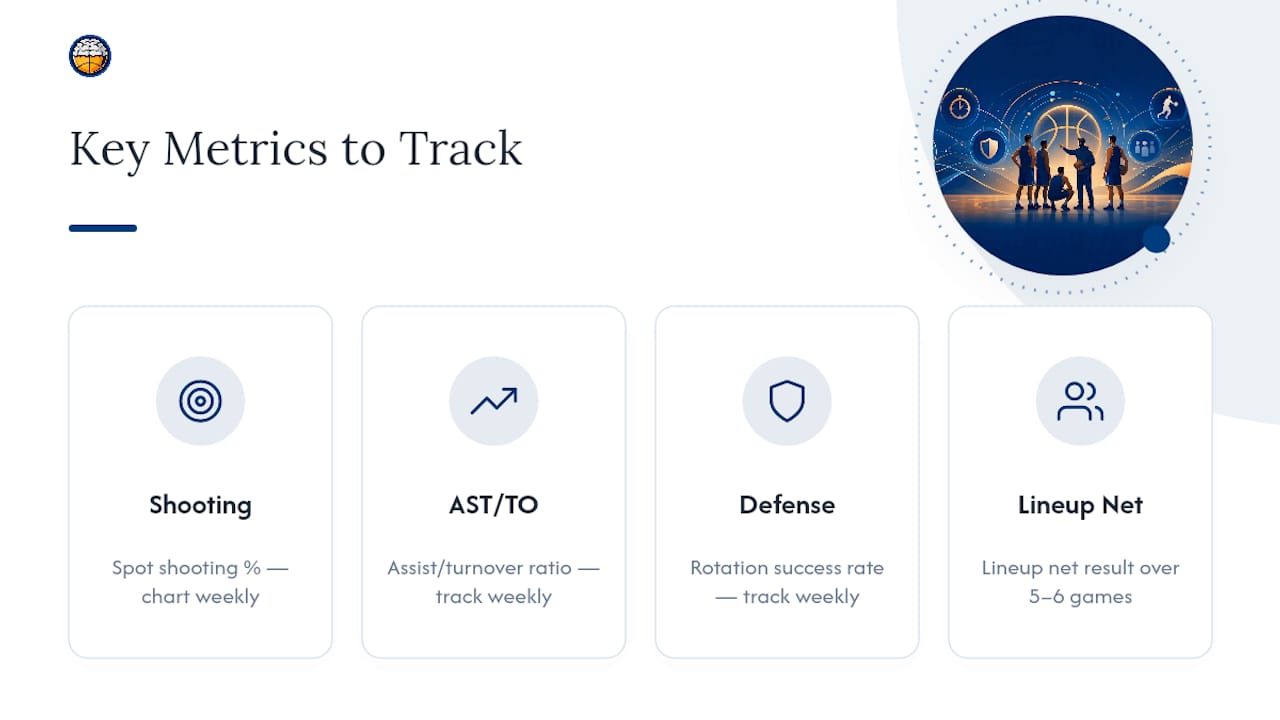
Track a small number of metrics consistently rather than a large number sporadically. Shooting percentage from specific spots, assist-to-turnover ratio, defensive rotations executed correctly, these numbers mean more when charted weekly than when calculated once a month from memory. A basic spreadsheet updated after every game beats an elaborate system nobody maintains past October.
Individual development conversations work better with a template than a memory-based recap. Note three things every two weeks: one skill that improved, one skill that needs more reps, one leadership or communication observation. Players remember specific feedback far longer than a vague “keep working hard.”
Team-level tracking matters just as much as individual tracking. Chart which offensive sets score at the highest rate, which defensive coverages get beaten most often, and which lineup combinations produce the best net result over a stretch of games. Patterns that feel obvious in the moment often look different once you actually chart them across five or six games.
Standardized templates for tracking player pathways show that consistent assessment formats, used the same way every time, give coaches a clearer long-term picture than ad hoc notes. That consistency is exactly what separates a coach who can point to real growth in March from one who’s guessing based on gut feel.
Where to Find Ready-Made Coaching Templates
You don’t need to build a practice-plan template from scratch every season. A library of pre-built drill videos, editable playbooks, and session templates saves the hours most coaches spend recreating the same document every August.
Look for three things in any downloadable resource: editability (a static PDF you can’t adjust for your roster is close to useless by week three), drill-to-outcome clarity (every drill should state what game situation it trains), and modularity, meaning you can pull one piece into your existing system without adopting an entire foreign framework.
Drill video libraries solve a specific problem: describing a footwork pattern in words takes five minutes and still leaves room for misinterpretation, while a 30-second clip settles it instantly. Scouting templates solve a different problem, standardizing how your staff records opponent tendencies so the report reads the same way whether an assistant or a volunteer parent fills it out.
The Basketball Template Bundle For Coaches from Hoop Mentality packages exactly this combination: editable practice plans, a drill library, and scouting templates built around the same block structure covered here. Coaches running programs with limited staff time see the biggest gain, since the prep work that used to eat a Sunday afternoon compresses into an hour of customization.
What Coaches Get Wrong About Leadership Development
Most coaching advice treats leadership development as a personality trait you either have or don’t. Give someone a captain’s patch, hope charisma does the rest. The research on competence-supportive structure says something different: leadership is a behavior sequence you can teach, script, and repeat, the same way you teach a closeout or a box-out.
The bigger error is treating templates as a shortcut around actual coaching judgment. A practice plan template doesn’t replace your read of the room, it protects your prep time so you have more attention left for the read. Coaches who skip structure entirely burn energy reinventing the wheel every week. Coaches who follow a rigid template with zero adaptation lose their players just as fast, because kids notice when a coach is running a script instead of coaching the team in front of them.
Prioritize this first: build one modular practice template, run it, then adjust based on what actually broke down. Not the other way around. Most coaches try to perfect the plan before running it once, and that’s backward. The plan gets better after contact with real players, not before.
— Dejan
Get the Full Template System From Hoop Mentality
You’ve seen the blocks, the percentages, and the feedback structure that make a practice actually work. The Basketball Template Bundle For Coaches turns all of it into files you edit and use the same day, instead of documents you have to build from a blank page every season.
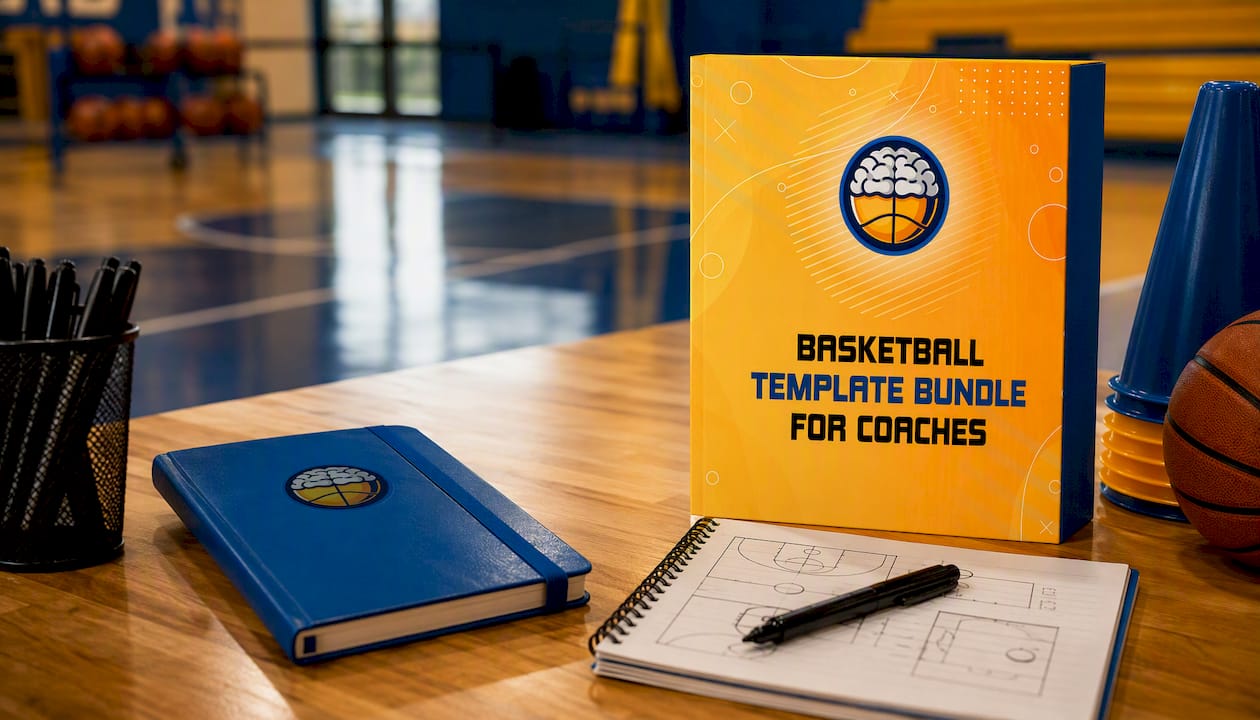
The bundle includes editable practice-plan templates matched to the 60 and 90-minute blueprints above, a drill library organized by the same skill-work and team-concepts categories, scouting templates your staff can fill out consistently, and week-planning tools that map your whole season instead of just tomorrow’s practice. Every file maps directly to the block structure and percentage splits covered here, so there’s no translation step between what you just read and what you run on the floor Monday. Coaches juggling a full-time job and a volunteer staff save the most, since customization takes minutes instead of hours.
Get the Basketball Template Bundle For Coaches and start next week’s practice with a finished plan instead of a blank document.
Sources
- Coaches’ Provision of Structure for Players’ Competence Development: Perspectives of Professional Soccer Coaches and Players in Norway
- Fostering learning-supportive coaching in a nationwide talent development program: mixed-methods evaluation
- Basketball Practice Plan (Free Templates & Drills)
FAQ
What Does Coaching Team Leaders Mean in Basketball?
It refers to the practice plans, playbooks, and leadership habits coaches use to build a team that runs itself with clarity, not to executive or corporate leadership coaching.
How Many Drills Should One Practice Include?
Four to six drills per session, following the 80/20 rule so most practice time reinforces the game situations that show up most often.
What Makes a Practice Plan Template Actually Useful?
An editable, modular structure that a coach can adapt to their roster and level, like the templates in the Basketball Template Bundle For Coaches, matters more than a fixed script.
How Do You Develop Player Leaders on a Basketball Team?
Assign specific communication roles during live scrimmage reps, give players a scripted phrase for repeating situations, and debrief weekly on what changed as a result.
Recommended
- Build a Basketball Team: Step-by-Step Guide for Coaches – Hoop Mentality
- Team Building for Basketball Coaches: A Ready-Run Playbook – Hoop Mentality
- Team Leadership Roles for Basketball Coaches: Practical Guide – Hoop Mentality
- Leadership Team Building Activities for Basketball Coaches – Hoop Mentality