

TL;DR:
- Coaching youth mini-games involves using short, structured activities that keep all players active, engaged, and making decisions during practice. These small-sided games increase individual touches, decision-making, and fun, making them more effective than traditional drills for skill development and teamwork. Properly designed mini-games aligned with age groups help coaches diagnose team needs and create dynamic, focused practices within time limits.
Coaching youth mini-games means using short, structured activities that keep every player moving, touching the ball, and making decisions throughout practice. These are not just warm-up fillers. Mini-games increase individual ball touches and high-intensity decision-making by reducing player numbers, which makes them far more effective than traditional line drills. For youth basketball coaches, they are the fastest way to build skills, improve teamwork, and keep players genuinely excited to show up.
What makes coaching youth mini-games actually work?
The term “mini-games” is the common coaching shorthand. The formal concept behind them is small-sided games, a well-researched training method used across youth sports from soccer to basketball. Both terms describe the same thing: reduced player numbers, smaller spaces, and game-like conditions that force constant engagement.
The core advantage is simple. Traditional drills put most players in line waiting. Mini-games put every player in the action. Mini-games serve as controlled practice reps that develop skills and expose gaps in team communication at the same time. That dual function is what separates them from standard repetition drills.
Three benefits stand out for youth basketball coaches:
- More touches per player. Smaller groups mean more dribbling, passing, and shooting decisions per minute.
- Real decision-making. Players must read defenders, choose passes, and react, not just follow a script.
- Built-in fun. Competitive stakes and movement keep attention high without you having to manufacture energy.
You can learn more about building youth team success by pairing mini-games with a clear practice structure from the start of the season.
How do you choose mini-games for different age groups?
Age determines everything about which mini-game format works. A game that engages a 10-year-old will lose a 6-year-old in under two minutes.
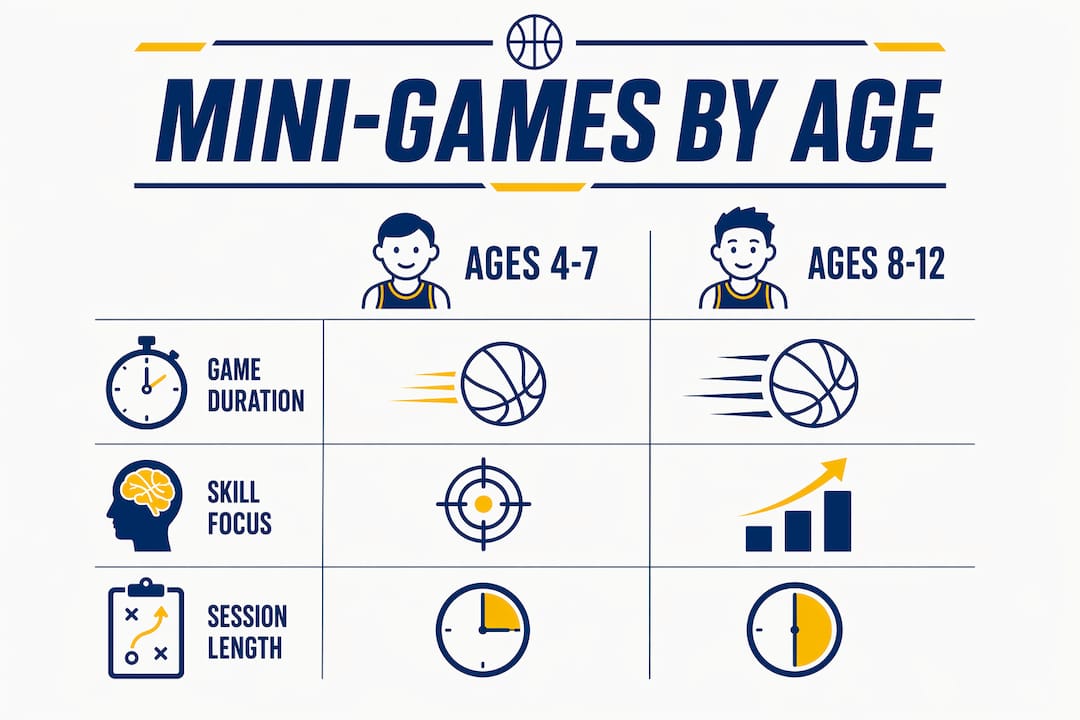
Ages 4–7: short, imaginative, and constant movement
Practice sessions for children aged 4–7 should total 45–60 minutes, with no single activity lasting longer than 6 minutes. That is not a suggestion. It matches the actual attention span of this age group. Beyond 6 minutes, engagement drops and behavior problems increase.
For this age group, story-based metaphors are the most effective engagement tool. Use imaginative themes like pirates or monsters to frame the game. Instead of “dribble to the cone,” say “carry your treasure past the sharks.” The movement is identical. The buy-in is completely different.
- Keep every player with a ball at all times
- Avoid any format with lines or laps
- Change activities every 4–6 minutes
- Use simple rules with one or two decisions maximum
Pro Tip: For ages 4–7, never explain a game for more than 30 seconds. Start playing immediately and adjust rules on the fly. Kids this age learn by doing, not listening.
Ages 8–12: small-sided formats with progression
Youth sports use a small-sided game progression starting with 4v4 for ages 8 and under, moving to 7v7 for ages 9–10, and 9v9 for ages 11–12. In basketball, you adapt this by adjusting team sizes, court zones, and rule complexity as players get older.
An 8-year-old thrives in a 2v2 or 3v3 half-court game with one rule: score by dribbling through a gate. An 11-year-old can handle a 4v4 game with multiple scoring options, defensive assignments, and a shot clock. Match the complexity to the developmental stage, not just the age on paper.
How do you set up and run popular youth basketball mini-games?
These three mini-game formats work across age groups and build specific skills. Each one is easy to set up with standard gym equipment.
Gate dribbling
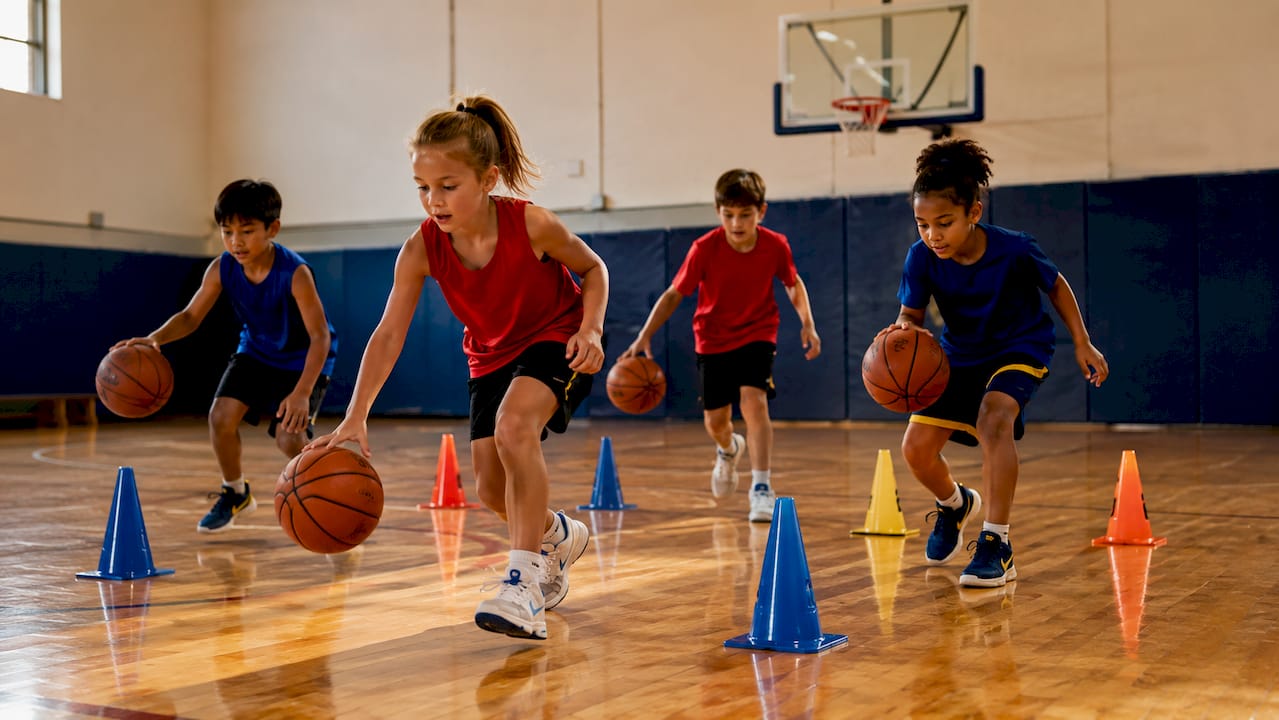
Setup: Place 8–10 pairs of cones across the half court, each pair about 3 feet apart. These are the “gates.”
- Every player gets a ball.
- Players dribble freely and must pass through as many gates as possible in 90 seconds.
- Count gates. Reset and beat the score.
What it builds: Ball control, court vision, and spatial awareness. Players must look up to find open gates, which directly trains the habit of keeping their head up while dribbling. This is one of the best youth basketball drills for developing handle and awareness simultaneously.
1v1 gate battles
Setup: Use the same cone gates. Pair players up at each gate.
- One player attacks, one defends.
- The attacker scores a point by dribbling through the gate. The defender scores by stealing or deflecting the ball.
- Rotate defenders every 2 minutes.
What it builds: 1v1 offense, defensive footwork, and competitive intensity. The rotation keeps every player active and prevents any one matchup from going stale.
Freeze tag with ball
Setup: Use the full half court. Designate 2 players as “taggers” without balls.
- All other players dribble freely.
- If a tagger touches you, you freeze in place with the ball held overhead.
- A teammate can unfreeze you by dribbling through your legs.
- Rotate taggers every 3 minutes.
What it builds: Communication, court awareness, and dribbling under pressure. The unfreeze mechanic forces players to look for teammates who need help, which directly mirrors team building exercises used in professional development settings.
Pro Tip: Add a rule that players can only unfreeze a teammate by calling their name first. This one change turns a dribbling game into a communication drill.
How long should mini-game sessions run during practice?
Practice structure determines whether mini-games deliver results or just burn time. The total session length for young players should stay in the 45–60 minute range. Beyond that, fatigue and distraction reduce the quality of every rep.
Within that window, individual mini-games should not exceed 6 minutes. Short bursts with clear competitive stakes keep intensity high. When a game runs too long, players disengage and the activity loses its diagnostic value.
Here is a sample practice structure for a 50-minute youth session:
| Segment | Activity | Duration |
|---|---|---|
| Warm-Up | Fun dribbling activity or tag game | 8 minutes |
| Skill Mini-Game 1 | Gate Dribbling | 6 minutes |
| Skill Mini-Game 2 | 1v1 Gate Battles | 6 minutes |
| Team Mini-Game | Freeze Tag with Ball | 6 minutes |
| Small-Sided Game | 3v3 or 4v4 with scoring rules | 12 minutes |
| Debrief and Water | Structured questions and cool-down | 8 minutes |
| Free Shoot | Player choice shooting | 4 minutes |
The biggest mistake coaches make is relying on verbal commands to fix spacing problems. Coaches should avoid yelling “spread out” and instead use game constraints to teach spacing organically. Shrink the playing area to force congestion, then expand it and watch players naturally find open space. The constraint teaches the concept. The command does not.
Pro Tip: Use a visible countdown timer on a phone or tablet during each mini-game. Players self-regulate better when they can see the clock. It also eliminates arguments about when time is up.
Can mini-games diagnose what your team actually needs?
Mini-games are the most honest feedback tool a youth coach has. Full-team scrimmages hide individual weaknesses behind team flow. Mini-games expose them immediately.
Effective mini-games act as controlled practice reps that reveal gaps in communication, decision-making, and trust that are invisible in full-court play. Watch a 3v3 game for two minutes and you will see exactly which players avoid contact, which ones never call for the ball, and which ones make the same dribbling mistake on every possession.
Use these observation checkpoints during mini-game play:
- Communication: Are players calling for the ball or playing silently?
- Decision speed: Do players hesitate at the moment of choice, or do they act quickly?
- Spacing: Do players crowd the ball or find open areas?
- Reaction to mistakes: Do players reset and compete, or do they shut down?
The debrief after the game is where development actually happens. Structured debriefs connect game mechanics to real match improvement and reveal communication gaps that full matches hide. Keep debriefs under 3 minutes and ask open-ended questions rather than delivering lectures.
Use open-ended questions during mini-games to facilitate game-based discovery instead of direct tactical commands. The difference in player ownership is significant.
Strong debrief questions include:
- “What did you notice about the open space in that game?”
- “When did your team communicate best? What changed?”
- “If you played that game again right now, what would you do differently?”
“The best coaching happens in the debrief, not the drill. When players answer their own questions, they own the answer.”
Check out Hoopmentality’s coaching feedback strategies for more structured approaches to post-game player development conversations.
Key takeaways
Mini-games are the most effective tool youth basketball coaches have for building skills, diagnosing team weaknesses, and keeping players engaged throughout every practice.
| Point | Details |
|---|---|
| Match games to age | Use 4v4 formats for U8, progress to larger groups as players develop. |
| Keep activities short | Limit each mini-game to 6 minutes to match youth attention spans. |
| Use constraints, not commands | Adjust court size and rules to teach spacing instead of yelling at players. |
| Debrief every session | Ask open-ended questions after games to turn play into learning. |
| Observe during play | Use mini-games to spot communication gaps and decision-making habits. |
What i’ve learned from years of running mini-games
The coaches who get the most from mini-games are the ones who stop trying to control every rep. Early in my coaching career, I over-coached every game. I stopped play constantly to correct technique. Players learned to wait for my feedback instead of solving problems themselves.
The shift happened when I started treating mini-games as information, not instruction time. I watched more. I talked less during play. The debrief became the teaching moment, not the interruption. Players started making better decisions faster because they had to figure things out in real time.
The other thing I learned: fun is not the opposite of development. The most skill-building sessions I have run were also the most enjoyable. When players are laughing and competing hard, they are also learning. The two are not in conflict. They are the same thing when the game is designed well.
If your players are dragging through practice, the problem is usually not motivation. It is game design. Shorten the activity, add a competitive stake, and give every player a ball. The energy returns immediately.
— Dejan
Ready to build better practices?
Hoopmentality has the tools to put these mini-game formats into a complete practice structure. Stop building sessions from scratch every week.

The Basketball Practice Plan Template from Hoopmentality gives you a ready-to-use framework that organizes mini-games, skill work, and team play into one clear session. For coaches who want a full weekly system, the weekly practice planning guide maps out every session from warm-up through debrief. Both resources are built from real coaching experience and designed to save you time while improving what happens on the court.
FAQ
What are coaching youth mini-games in basketball?
Coaching youth mini-games are short, structured small-sided activities that keep all players active and making decisions throughout practice. They replace traditional line drills with game-like formats that build skills faster and hold attention longer.
How long should a youth basketball mini-game last?
Each mini-game should last no longer than 6 minutes for players aged 4–12. Total practice sessions should stay within 45–60 minutes to match the attention span of young athletes.
What mini-games work best for players under 8?
Games like Gate Dribbling and Freeze Tag with Ball work well for players under 8 because every player has a ball and the rules are simple. Story-based themes like pirates or treasure hunts increase engagement for the youngest age groups.
How do mini-games help with team building?
Mini-games expose communication gaps and trust issues that full-court scrimmages hide. A structured debrief after each game connects what players experienced to real match situations and builds team awareness faster than traditional drills.
Should i use open-ended questions during mini-games?
Yes. Asking players “What did you notice?” instead of telling them what to do builds decision-making ownership. Game-based discovery through open-ended questions produces better long-term skill retention than direct tactical commands.