

TL;DR:
- Most youth basketball coaches are parents who care deeply but feel unsure about how to begin coaching effectively.
- A structured practice plan, safety certifications, and age-appropriate expectations are essential for successful youth coaching.
- Focusing on clear feedback, simple strategies, and individual progress helps build players’ skills and confidence over time.
Most parents who step up to coach youth basketball share the same first feeling: they care deeply about their kid but have no idea where to start. You know the game, but knowing how to coach it is different. Youth coaching step by step is not just about drills and plays. It is about building a structure that works for young athletes, keeping them engaged, and helping them grow both as players and as people. This guide gives you a clear, organized path from your first day on the court to running practices your kids will actually look forward to.
Table of Contents
- Key takeaways
- Before you coach: what you need in place
- How to structure a youth basketball practice
- Coaching techniques that build skills and confidence
- Common mistakes to avoid
- Measuring progress and keeping players growing
- My take on coaching your own kid
- Build better practices with Hoopmentality
- FAQ
Key takeaways
| Point | Details |
|---|---|
| Complete requirements first | Get background checks, abuse prevention training, and concussion certification before your first practice. |
| Structure every practice | A timed practice plan with defined blocks keeps sessions focused and players developing. |
| Balance skill and confidence | Use demonstrations for competence and specific feedback to build each player’s belief in themselves. |
| Keep plays simple | Simple systems reduce confusion and let young players play with aggression and confidence. |
| Track progress with feedback | Set measurable goals each session and celebrate effort, not just results. |
Before you coach: what you need in place
Before you set foot on the court as a coach, you need to handle the administrative and safety side. This part is non-negotiable and often surprises first-time parent coaches.
Most youth leagues require annual registration and background checks before any coach can work with players. These include CORI checks, National Background Check (NBGC) screening, abuse prevention training, and concussion awareness courses. Some organizations also require first aid certification. Check with your league coordinator early, because processing these can take a few weeks.
Beyond paperwork, you need the right equipment and space. Here is a basic checklist to get started:
- Basketballs sized appropriately for your age group (size 5 for under-11, size 6 for ages 11-14)
- Cones, agility ladders, and colored pinnies for drill organization
- A whiteboard or clipboard with a marker for drawing plays
- A printed or digital practice plan for every session
- A first aid kit courtside at all times
Pro Tip: Contact your league coordinator in the first week of the season to confirm exactly which safety certifications are required in your area. Getting this done early means you can focus entirely on coaching once the season starts.
Age-appropriate expectations matter just as much as equipment. A 10-year-old and a 14-year-old require completely different approaches to instruction, pace, and complexity. Young athletes learn better through repetition and short instruction windows. Keep explanations under 30 seconds, demonstrate every skill physically, and repeat it often.
How to structure a youth basketball practice
A timed practice plan is the single biggest difference between chaotic sessions and productive ones. Disorganized practices result in chaos and less player development. You need a defined cadence every time your team steps on the court.
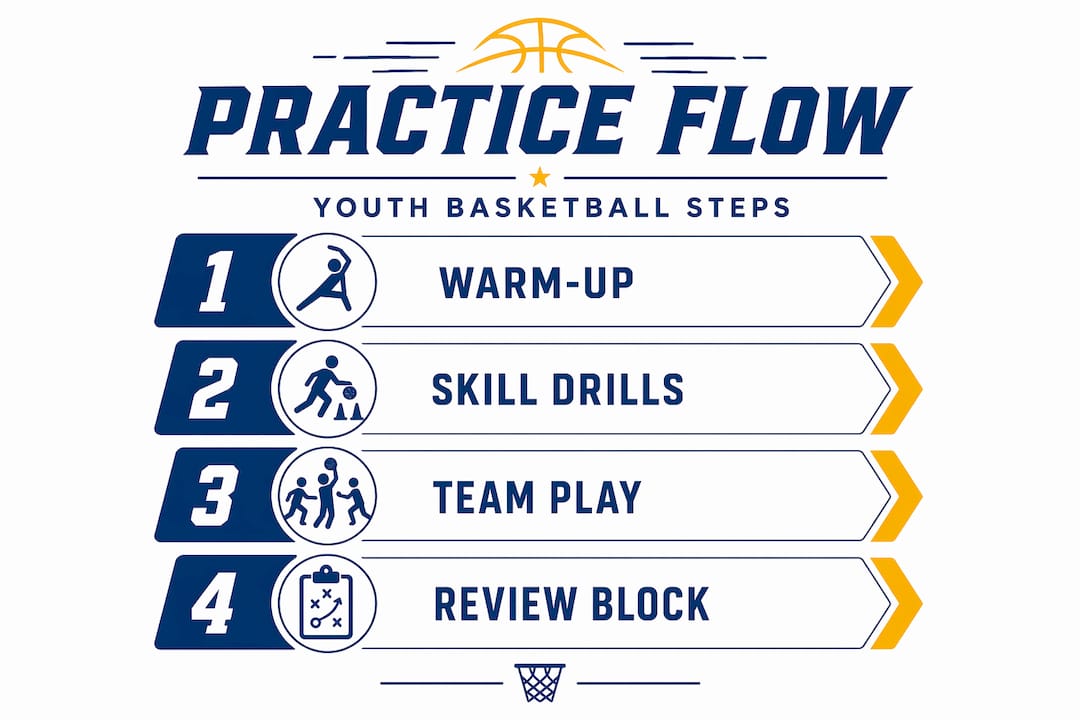
A well-structured 90-minute practice uses specific time blocks for each component. Here is a proven breakdown to follow:
| Practice Block | Duration | Purpose |
|---|---|---|
| Warm-up | 10 minutes | Prepare bodies and focus minds |
| Fundamental skill drills | 15 minutes | Build core individual skills |
| Team offense | 20 minutes | Simplified plays and ball movement |
| Defensive fundamentals | 15 minutes | Stance, positioning, and footwork |
| Team defense | 20 minutes | Group defensive concepts and schemes |
| Competitive or fun drills | 10 minutes | Maintain energy and enjoyment |
| Breakdown and review | 5 minutes | Reinforce the day’s learning |
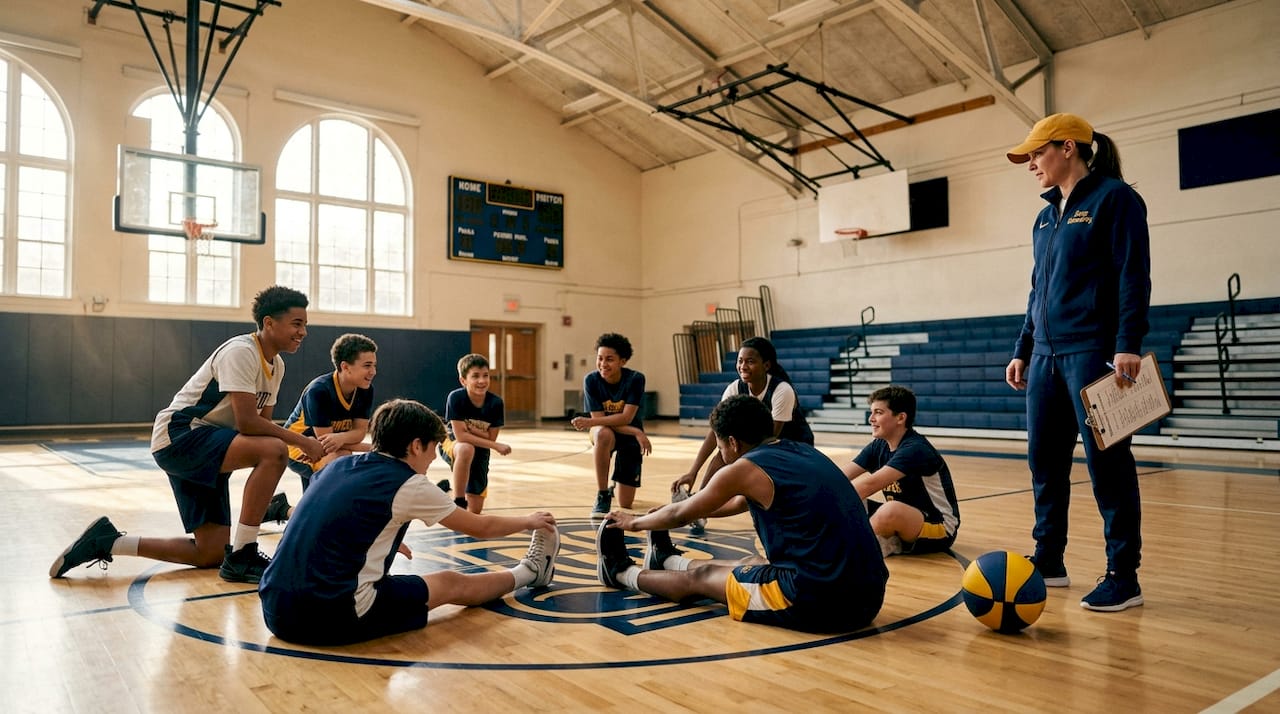
The warm-up is not optional filler. Use it to set the tone. Dynamic stretching, light layup lines, and a brief team huddle get players mentally present and physically ready. The competitive drill block near the end is where you turn work into play. Games like “king of the court” for ball handling or 3-on-3 half-court scrimmages reward the skills practiced earlier in the session.
Pro Tip: Print your practice plan template before every session and give a copy to any assistant coaches. When everyone knows the schedule, transitions between blocks take 30 seconds instead of 3 minutes.
One detail coaches miss: the review block at the end is where real learning is reinforced. Ask players two questions before they leave. What did we work on today? What is one thing you want to get better at next practice? This habit builds self-awareness faster than any drill.
Coaching techniques that build skills and confidence
Research shows that youth coaches support competence through verbal instruction but often underuse the tools that build confidence and character. Effective youth coaching requires all four dimensions: competence, confidence, character, and contribution.
Here is how each one looks in practice:
- Competence: Show, don’t just tell. Demonstrate every skill before asking players to try it. Use slow-motion breakdown for complex moves like a crossover dribble or drop step in the post.
- Confidence: Give specific feedback, not just general praise. “Great job” means less than “You kept your eyes up the whole time on that drive.” Specific feedback tells a player exactly what they did right.
- Character: Model the behavior you expect. If you want players to respect officials and opponents, they need to see you do it first. No exceptions.
- Contribution: Give every player a meaningful role in practice. Rotate who demonstrates a drill, who leads the warm-up, and who calls the team together. Inclusion is not just nice. It is a development tool.
“Coaching is a dynamic, co-created process requiring customization to context and goals.” (Boldly.app)
High-performance coaches use open-ended questioning to help athletes reach their own conclusions. Instead of telling a player they need to use their off-hand, ask: “What do you notice about how defenders are guarding you?” That kind of question builds thinking habits that last beyond basketball.
Pro Tip: Try the coaching feedback strategies Hoopmentality recommends: use a “compliment, correct, compliment” structure during drills to keep players receptive to instruction without shutting down their confidence.
Smaller coaching groups also significantly improve player development. If you can recruit one or two parent volunteers to help run station drills, each player gets more repetitions and more direct feedback per session.
Common mistakes to avoid
Even experienced parent coaches fall into predictable traps. Knowing what they are lets you sidestep them before they cost your team development time.
-
Overcomplicating plays. Young players do not need five-man motion offense. Simple defensive and offensive systems reduce confusion and help players play with confidence instead of hesitation. Stick to one or two foundational concepts per season and run them until they are automatic.
-
Skipping the practice plan. Showing up without a written plan is the fastest way to lose control of a session. Use a structured practice checklist every time, and stick to your time blocks even when a drill is going well.
-
Ignoring parent dynamics. The sideline culture your players grow up with shapes how they play and how they respond to coaching. Build clear expectations with parents early. A short pre-season meeting to align on communication norms and team goals prevents most mid-season conflicts. Hoopmentality has practical guidance on parent communication methods worth reviewing before your first game.
-
Coaching without reading readiness. Effective coaching is adaptive, not formulaic. If your team looks flat on a particular day, a 20-minute defense block might need to become 10 minutes of defense and 10 minutes of a competition game. Read the room and adjust.
-
Treating all players the same. Some kids are motivated by competition. Others shut down under pressure and respond better to process praise. Pay attention to individual responses and adjust your tone and expectations accordingly.
Pro Tip: If a drill falls apart in the first two minutes, stop it. Reset the players, simplify the instructions, and try again. Pushing through a drill that nobody understands teaches nothing and burns session time.
Measuring progress and keeping players growing
Tracking development does not require a spreadsheet or video analysis. It requires intentional observation and consistent feedback.
Set one or two specific, measurable goals for each practice block. For example: “Every player will make 7 out of 10 free throws before we move on” or “Complete 3 full team offense reps without a turnover.” These micro-goals give players something concrete to aim for within each session.
- Give specific feedback rather than general praise. Name the exact skill and the exact moment it worked.
- Ask players to self-assess after competitive drills. “What would you do differently on that possession?” builds metacognitive habits.
- Use the breakdown session to highlight two or three moments from practice where a player showed real improvement, even small ones.
- Track skill progress informally over the season by noting which skills each player struggled with in week two and revisiting them in week six.
- Celebrate developmental milestones out loud. When a quiet player finally boxes out consistently or a hesitant shooter starts attacking the rim, name it in front of the team.
The skill progressions approach that Hoopmentality recommends is worth studying for this reason. When you map skills in sequence from basic to complex, players can see their own progress over time. That visibility is one of the most powerful motivators in youth sports.
My take on coaching your own kid
I’ve worked with parent coaches at every level of youth basketball, and the ones who struggle most are not the ones who don’t know the game. They are the ones who cannot separate the coach role from the parent role once they get on the court.
In my experience, the most effective parent coaches are the ones who decide early that during practice and games they are the coach first. That means no extra attention to your own child, no softer correction, and no harder criticism either. Kids are shockingly perceptive. When a parent coach plays favorites even slightly, the whole team feels it.
What I’ve found is that a structured practice plan is not just a coaching tool. It is a confidence tool for you. When you walk in with a printed plan that covers every 10-minute block of the session, you stop winging it. And when you stop winging it, you stop panicking. You coach.
I also believe the wins-versus-development conversation is one that every parent coach needs to have with themselves in week one. Chasing wins at the youth level often means playing your best three players and developing nobody. Chasing development means every player gets meaningful reps, learns from mistakes in a safe environment, and shows up next season better. That is how you build something real.
— Dejan
Build better practices with Hoopmentality
Ready to put your youth coaching step by step plan into action?

Hoopmentality’s Basketball Practice Plan Template gives you a ready-to-use structure that matches the time blocks covered in this guide. It is built for coaches who want to run organized, development-focused sessions without spending hours planning from scratch. Pair it with the Big Man Dual Action Drill to target interior player development with a focused, progressive skill resource. Both tools are designed to work together inside the structured practice cadence you have just learned. Visit Hoopmentality to explore the full catalog of practice plans, drills, and coaching guides built from real court experience.
FAQ
What does youth coaching step by step actually mean?
Youth coaching step by step means breaking the coaching process into defined, sequential phases including preparation, practice structure, skill instruction, and feedback, so parents can apply each element with clarity and confidence.
How long should a youth basketball practice be?
A well-organized 90-minute practice session works well for most youth age groups, divided into timed blocks for warm-up, skill work, offense, defense, competition drills, and review.
What certifications do youth coaches need?
Most leagues require annual background checks, abuse prevention training, and concussion awareness courses before a coach can work with players. Requirements vary by organization, so check with your league coordinator.
How do I keep young players engaged during practice?
Include a competitive or fun drill block in every session and use open-ended questions to involve players in their own development. Engagement comes from variety, movement, and feeling like progress is happening.
How do I know if my players are improving?
Set specific, measurable goals for each practice block and track them informally over the season. Specific verbal feedback tied to exact moments in practice gives players and coaches a clear picture of real development progress.