

Over half of new American basketball coaches report feeling unprepared for their first season. The challenge of organizing practices, assigning roles, and setting clear goals can be daunting, especially when every decision impacts both team morale and performance. This practical guide uncovers research-backed methods that help American coaches build strong teams from day one, ensuring your approach is as strategic as it is supportive.
Table of Contents
- Step 1: Assess Team Strengths And Roles
- Step 2: Develop Structured Practice Plans
- Step 3: Implement Essential Drills And Plays
- Step 4: Communicate Goals And Expectations
- Step 5: Evaluate Progress And Adjust Strategies
Quick Summary
| Key Point | Explanation |
|---|---|
| 1. Assess Player Strengths Thoroughly | Evaluate individual player capabilities to maximize their unique talents in team roles and strategy development. |
| 2. Structure Effective Practice Plans | Organize practice sessions into segments that target skills, strategies, and recovery for comprehensive player development. |
| 3. Implement Targeted Drills and Plays | Choose drills that enhance essential skills and simulate game situations for better player preparedness and coordination. |
| 4. Communicate Clear Goals and Expectations | Establish a team vision and set specific performance and skill development targets to align player motivation with objectives. |
| 5. Regularly Evaluate Progress and Adjust | Use performance metrics to assess growth, provide feedback, and refine training strategies to ensure continuous improvement. |
Step 1: Assess Team Strengths and Roles
As a first time basketball coach, understanding your team’s individual strengths and potential role assignments is crucial to developing an effective strategy. By systematically evaluating player capabilities, you will create a foundation for team success that maximizes each athlete’s unique talents.
Start by conducting a comprehensive skills assessment through individual player evaluations. Sports analytics research demonstrates that data-driven approaches can significantly improve team performance by identifying precise player compatibility and effectiveness metrics. Watch players during initial practices and design simple drills that reveal their core competencies such as shooting accuracy, defensive positioning, court vision, and physical stamina. Take detailed notes on each player’s natural abilities and potential strategic contributions.
Consider creating a matrix that categorizes players into potential roles like primary scorer, defensive specialist, playmaker, or utility player. Performance data analysis can help coaches optimize team compositions by understanding how individual strengths interconnect. Look for complementary skill sets that can create dynamic on court interactions.
Pro tip: Create individual player profile sheets that document not just physical skills but also mental attributes like leadership potential, communication style, and adaptability to help you make nuanced role assignments throughout the season.
Here is a comparison of key basketball player roles and the skills that best suit each role:
| Role | Essential Skills | Typical Strategic Contribution |
|---|---|---|
| Primary Scorer | Shooting accuracy, aggressiveness | Leading team offense, scoring points |
| Defensive Specialist | Lateral quickness, anticipation | Disrupting opponents, protecting the rim |
| Playmaker | Court vision, ball handling | Creating plays, distributing the ball |
| Utility Player | Versatility, adaptability | Filling gaps, supporting multiple roles |
Step 2: Develop Structured Practice Plans
Creating a strategic and organized practice plan is fundamental to your success as a basketball coach. Your practice sessions will serve as the critical foundation for team development, skill improvement, and overall performance enhancement.
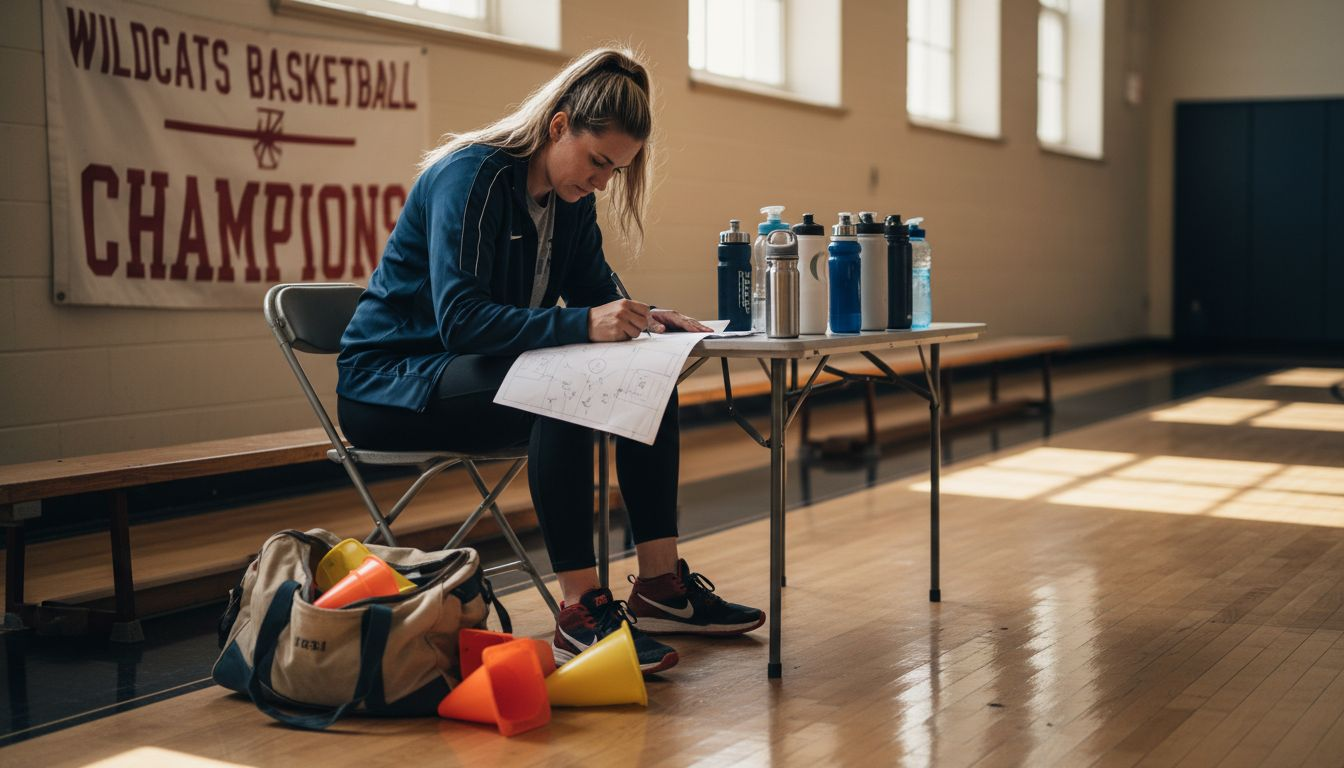
Systematic research on coaching education programs highlights the importance of methodical technical and tactical training in basketball preparation. When designing your practice plan, focus on creating a balanced framework that addresses multiple aspects of player and team development. Start by breaking down your session into distinct segments like warm up, skill drills, tactical training, scrimmage time, and cool down. Allocate specific time blocks for each segment and ensure that every minute contributes purposefully to overall team improvement.
Structure your practice with progressive complexity, beginning with fundamental skill work and gradually increasing difficulty. Incorporate drills that target specific areas such as shooting technique, defensive positioning, ball handling, and team coordination. Alternate between individual skill development and group exercises that promote teamwork and strategic understanding. Maintain flexibility in your plan to adapt to the team’s immediate needs and response to different training approaches.
Pro tip: Create a practice plan template with time allocations and key objectives that you can quickly adjust and reuse, allowing you to maintain consistency while remaining responsive to your team’s evolving needs.
The table below summarizes practice plan segments and their main objectives:
| Practice Segment | Primary Objective | Example Activity |
|---|---|---|
| Warm Up | Prepare body, prevent injuries | Dynamic stretching |
| Skill Drills | Improve core techniques | Shooting or dribbling drills |
| Tactical Training | Build game strategy | Offensive and defensive sets |
| Scrimmage | Apply skills in live context | Full-court practice game |
| Cool Down | Aid recovery, reduce soreness | Light jogging and stretching |
Step 3: Implement Essential Drills and Plays
Successful basketball coaching requires a strategic approach to skill development and team coordination through carefully selected drills and plays. Your ability to choose and implement the right exercises will directly impact your team’s performance and player growth.
Sport psychology research demonstrates how integrated psychological training can enhance athletes’ tactical thinking and overall performance through purposeful practice techniques. Begin by selecting drills that target fundamental skills such as ball handling, shooting accuracy, defensive positioning, and team communication. Prioritize exercises that challenge players mentally and physically while maintaining an appropriate difficulty level that promotes learning and builds confidence.
Performance assessment tools emphasize the importance of developing drills that engage players’ perceptual cognitive systems during skill practice. Design drills that simulate game scenarios, allowing players to develop muscle memory and decision making skills simultaneously. Incorporate progressive complexity by starting with basic techniques and gradually introducing more advanced movements and strategic elements. Rotate between individual skill work and team coordination exercises to ensure comprehensive player and team development.
Pro tip: Create a drill progression notebook that tracks each player’s improvement and adapts exercises based on individual and team performance levels to maintain engagement and continuous skill development.
Step 4: Communicate Goals and Expectations
Effective communication forms the cornerstone of successful basketball coaching, establishing a clear framework that aligns player understanding with team objectives. Your ability to articulate goals and set transparent expectations will directly influence team motivation and performance.
Research comparing coaching approaches across experience levels reveals significant differences in communication strategies that impact player development. Begin by creating a comprehensive team vision that outlines both individual and collective goals. Be specific about performance expectations, skill development milestones, and the team’s overall competitive objectives. Communicate these goals during an initial team meeting, ensuring every player understands their potential role and the broader team mission.
Sport psychology principles emphasize the critical role of psychological training in enhancing athlete performance through clear and consistent communication. Develop a communication strategy that includes regular team meetings, individual player check ins, and transparent feedback mechanisms. Use a mix of verbal and written communication to reinforce expectations, highlighting not just technical skills but also team values like respect, commitment, and collective growth. Adjust your communication style to match different player personalities while maintaining a consistent message about team goals and individual responsibilities.
Pro tip: Create a written team handbook that outlines goals, expectations, and communication protocols to provide players with a permanent reference point and demonstrate your commitment to clear organizational communication.
Step 5: Evaluate Progress and Adjust Strategies
Successful basketball coaching requires consistent performance evaluation and strategic adaptation. Your ability to objectively assess team and individual progress will determine your effectiveness in driving continuous improvement and achieving competitive success.
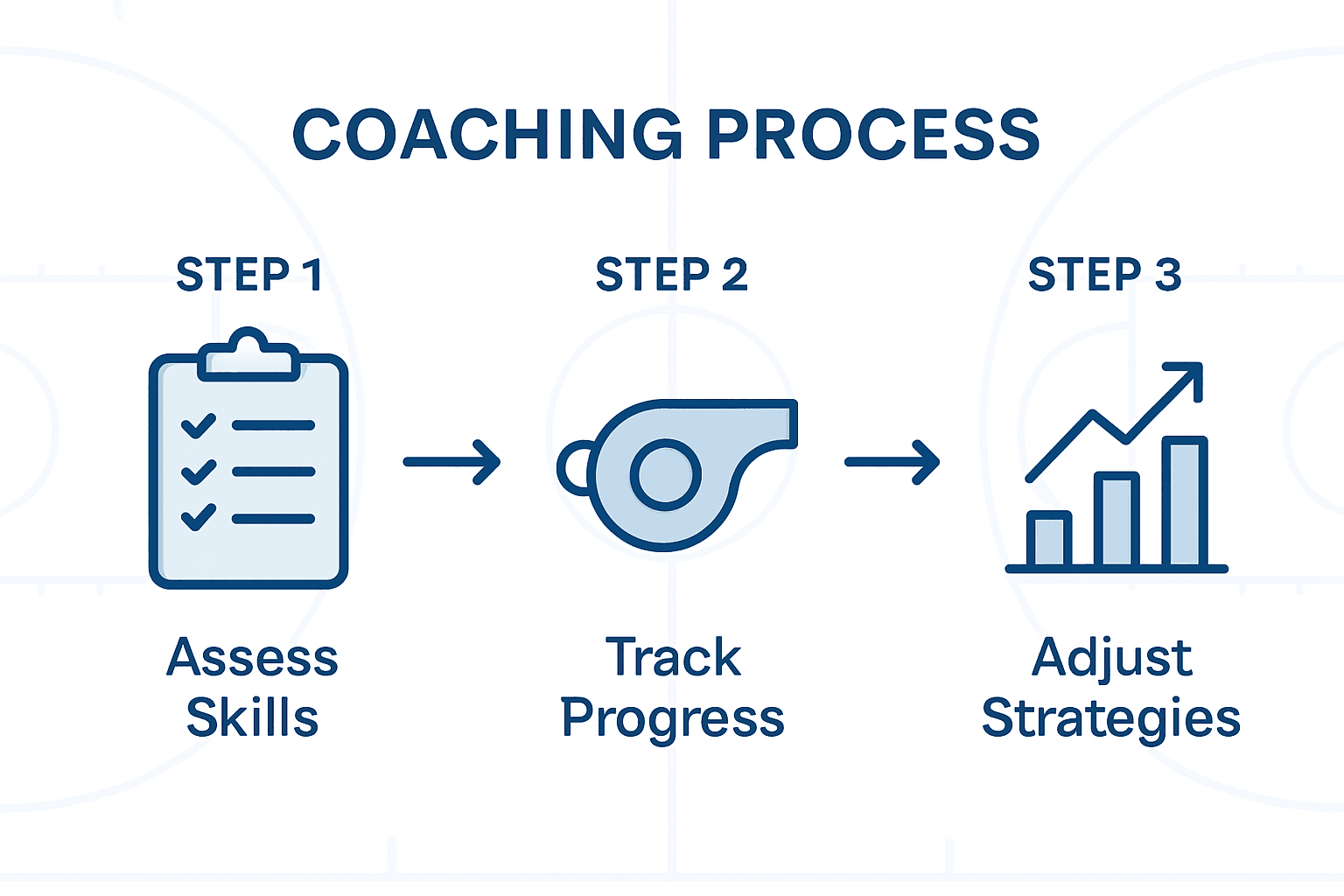
Advanced data mining techniques in sports analytics provide sophisticated methods for analyzing team performance that can transform how coaches approach strategy development. Begin by establishing clear performance metrics for both individual players and team dynamics. Track statistical measures like shooting percentages, defensive efficiency, assist ratios, and overall game outcomes. Create a structured evaluation framework that allows you to quantitatively and qualitatively assess player development across multiple dimensions.
Performance assessment tools emphasize the importance of comprehensive skill evaluation based on game scenarios, focusing on perceptual cognitive skills beyond traditional statistical measurements. Implement regular review sessions where you provide constructive feedback, highlighting areas of improvement and acknowledging player growth. Be prepared to adjust your training strategies based on these assessments. This might involve modifying practice drills, realigning player positions, or changing team tactics to address identified weaknesses and leverage emerging strengths.
Pro tip: Develop a dynamic performance tracking spreadsheet that allows you to log individual and team progress, enabling quick visual comparisons and trend analysis throughout the season.
Elevate Your Coaching with Proven Tools from Hoop Mentality
Taking on the role of a first-time basketball coach brings real challenges like assessing player strengths, structuring effective practices, implementing impactful drills, and communicating clear goals. You want to save time while building a confident, disciplined team that progresses every game. The key is having access to organized resources that guide you step-by-step through these essential coaching tasks.
Discover how our Basketball Templates can simplify your player evaluations and practice plans. Use our expert-designed Basketball Drills to build skills with purpose and precision. 
Don’t let uncertainty slow your team’s growth. Visit Hoop Mentality today to access everything you need to develop confident players and winning strategies. Start coaching smarter right now and watch your team’s potential turn into real success.
Frequently Asked Questions
How do I assess my players’ strengths for basketball?
Start by conducting individual evaluations during practice to observe skills like shooting accuracy and defensive positioning. Create a comprehensive skills assessment matrix to categorize each player into potential roles, helping to maximize their unique talents.
What should be included in a practice plan for my basketball team?
A practice plan should consist of distinct segments such as warm-up, skill drills, tactical training, scrimmage, and cool down. Allocate specific time blocks for each segment to ensure a balanced focus on both individual skills and team development.
How can I implement effective drills for my basketball team?
Choose drills that target fundamental skills like ball handling and shooting accuracy while gradually increasing complexity. Incorporate scenarios that simulate real game situations to enhance both physical skills and mental decision-making.
What are effective ways to communicate goals to my basketball players?
Clearly articulate both individual and team goals during an initial team meeting. Develop a communication strategy that includes regular check-ins and feedback, ensuring every player understands their role and expectations throughout the season.
How do I evaluate my team’s progress as a first-time basketball coach?
Establish clear performance metrics to track individual and team development, such as shooting percentages and overall game outcomes. Conduct regular review sessions to provide constructive feedback, making adjustments to training strategies as needed.
What strategies can I use to adapt my coaching based on player performance?
Regularly assess player progress using both quantitative data and qualitative observations. Be prepared to modify practice drills or adjust player roles based on identified strengths and weaknesses, aiming for continuous improvement throughout the season.