

Run three short, high-pressure drills every practice and close with a five-minute team debrief. That single combination builds cohesion faster than any preseason retreat or trust fall.
- Drill 1: Scramble Drill (5 minutes) — hustle and passing accuracy under pressure
- Drill 2: Five-Pass Shell with vocal callouts (10 minutes) — forces communication
- Drill 3: Small-sided 3v3 with assist scoring (8 minutes) — rewards unselfish play
Total block: about twenty minutes, several times per week. Structured shared reps under pressure build cohesion far more reliably than unplanned bonding time.
Key Takeaways
Team cohesion in basketball comes from short, constraint-driven drills run consistently, not from occasional bonding events disconnected from practice.
| Point | Details |
|---|---|
| Run drills, not events | Three short, high-pressure drills per practice build cohesion faster than occasional team outings. |
| Force communication with constraints | Rules like the five-pass requirement or mandatory callouts make talking necessary, not optional. |
| Debrief every session | A five-minute reflection after each drill builds trust and surfaces fixes before the next practice. |
| Progress over four weeks | Add competitive scoring in week 2, shrink space in week 3, and test under fatigue in week 4. |
| Use ready-made templates | Hoop Mentality’s Starter Pack and Weekly Practice Plan guide give coaches a plug-and-play structure for this exact progression. |
Table of Contents
- What Team Building Actually Means for a Basketball Team
- High-Impact Drills That Build Cohesion Fast
- A Copy-Ready Weekly Practice Plan
- How to Run These Sessions So They Actually Work
- Adjusting Drills by Age, Skill, and Ability
- Ready-Made Coaching Assets You Can Use Right Away
- A Coach’s Perspective on What Actually Changes Behavior
- Get the Templates That Match This Plan
- Sources
- FAQ
What Team Building Actually Means for a Basketball Team
Team building on a basketball team is not a ropes course or a pizza party. It is the deliberate use of drills, constraints, and practice structure to build trust, communication, and role clarity among players who have to rely on each other in live-game chaos.
The standard term coaches and sports scientists use is “practice design for cohesion,” and it works because it treats chemistry as a skill, not a personality trait. You build it the same way you build a jump shot: with reps, feedback, and repetition under mild pressure.
High-Impact Drills That Build Cohesion Fast
Team bonding activities that actually transfer to games share one trait: they force players to communicate or fail. Pick drills where talking is the only way to succeed, not an optional extra.
1. The Scramble Drill. Set up three or four stations with cones and a rim. Players sprint station to station, passing crisply and finishing at the basket under time pressure. The Scramble Drill builds hustle, accurate passing, and urgency because players have to move and call for the ball simultaneously. Time: 5 to 7 minutes. Equipment: four cones, two balls. Variation for younger groups: shorten the sprint distance and remove the finishing contest.
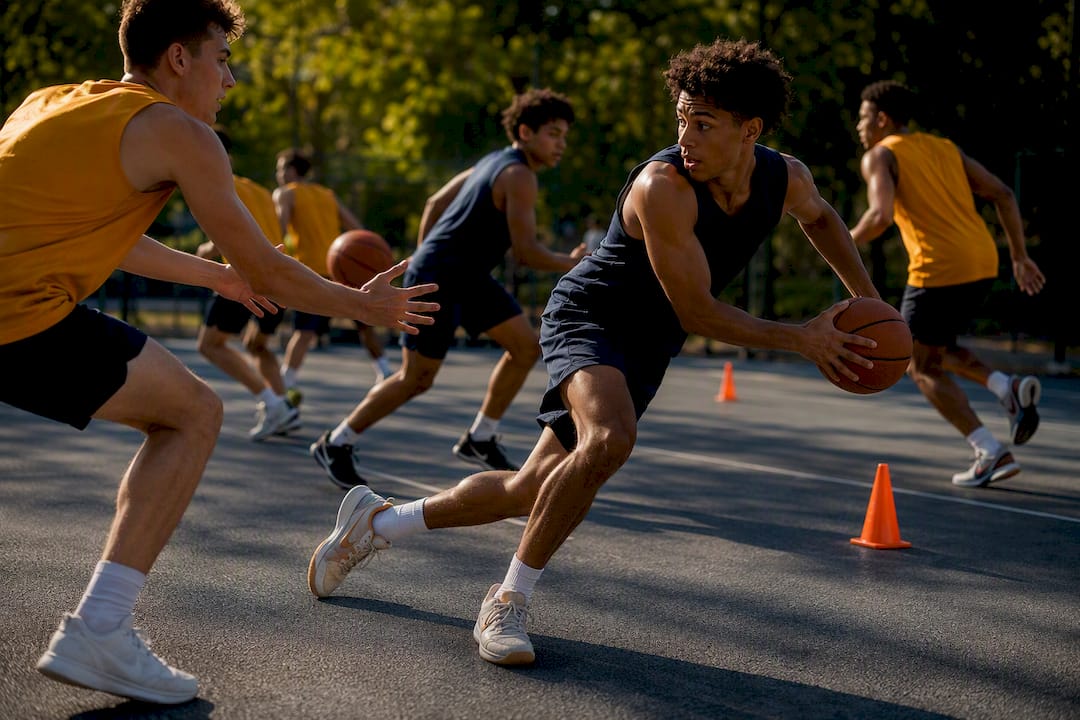
2. Shell Drill with mandatory callouts. Standard 4v4 or 5v5 shell defense, but every rotation, screen, and help call must be shouted aloud. Silence means a defensive stop doesn’t count. Callout-based drills like shell defense create habit-based talking that carries straight into games. Time: 8 to 10 minutes.
3. Five-pass rule scrimmage. No shot counts unless the team completes five passes first. This single constraint kills hero ball and forces ball movement. Time: 10 minutes.
4. Assist-only scoring game. Baskets count double when assisted, zero when unassisted. Rewarding assists and callouts in practice scoring reinforces the exact behaviors you want on Friday night.
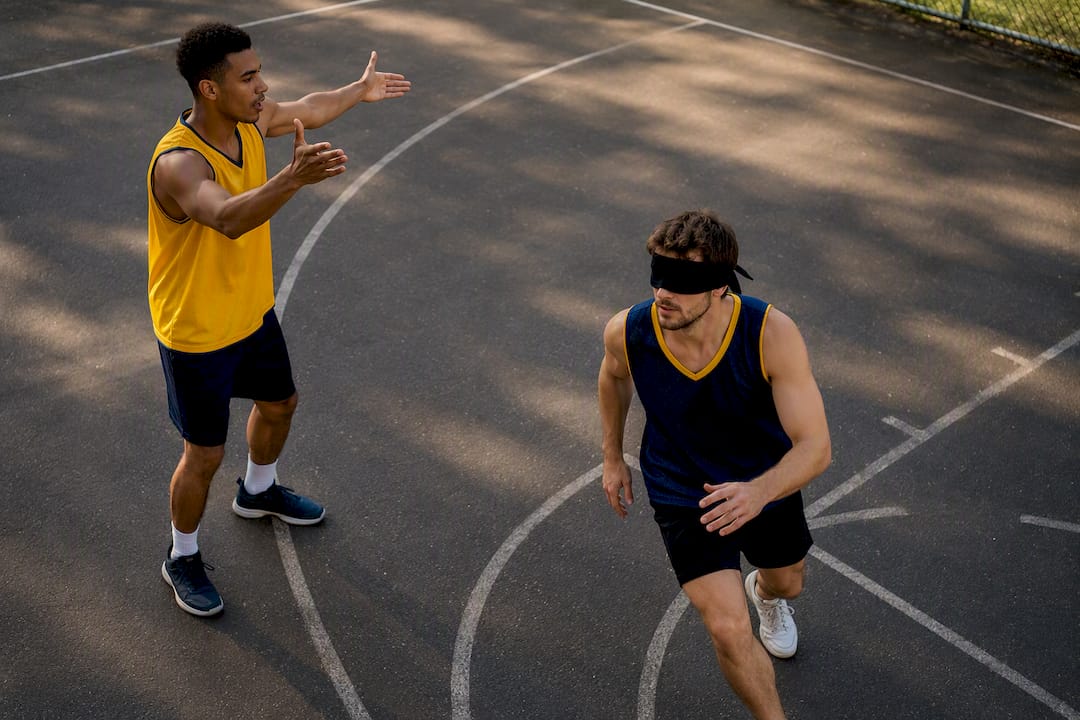
5. Blind screen drill. One offensive player closes their eyes; a teammate verbally guides them through a screen and cut. Builds trust and precise communication fast.
6. Read-and-react passing lines. Two lines, no set pattern. Passer reads cutter’s body language instead of calling a set play.
7. Two-ball story dribbling. Partners dribble two balls each while one narrates a short story aloud. This combines listening under pressure with dribble control, and it doubles as comic relief on a heavy practice day.
8. 3v3 half-court with rotating captains. A different player calls every offensive set for one possession, then rotates.
Off-court additions: a two-minute circle where each player names one teammate’s strength before practice, a blindfolded free-throw drill where teammates give verbal-only guidance, and a five-minute “captain’s meeting” where two rotating players set the practice tone.
Constraints do the real work here. Limiting touches, shrinking space, or requiring a minimum pass count all force players to solve problems together in real time instead of relying on one ball-dominant scorer.
Pro Tip: Rotate practice partners weekly. Chemistry built only between the same five players caps your bench depth when foul trouble or injury hits.
A Copy-Ready Weekly Practice Plan
Here’s a single practice you can run tomorrow:
- Warm-up and stretch (10 minutes)
- Team-building block: Scramble Drill + Shell with callouts (15 minutes)
- Individual skill work: shooting or ball handling stations (20 minutes)
- Small-sided scrimmage with five-pass rule (20 minutes)
- Full scrimmage or live reps (25 minutes)
- Debrief circle (5 minutes)
That’s a 95-minute practice with cohesion work built into the first quarter, not bolted on as an afterthought.
Four-week progression:
- Week 1: Introduce constraints (five-pass rule, callout requirements). Focus on compliance, not intensity.
- Week 2: Add competitive scoring (assist points, defensive stop bonuses). Rotate practice partners.
- Week 3: Shrink space and shorten shot clocks on small-sided games to raise pressure. Rotate captain roles.
- Week 4: Test under game-like fatigue by running team-building drills at the end of a hard conditioning block.
Swap the team-building block for extra scouting or walkthrough time during travel weeks or the 48 hours before a big game. Rotating short team themes weekly gives players a shared focus and keeps the drills from feeling repetitive across a long season. Pair this plan with a structured warm-up routine so the first ten minutes aren’t wasted.
How to Run These Sessions So They Actually Work
Setup matters less than what you say while the drill runs. Before the Shell Drill, tell players explicitly: “A stop without a callout doesn’t count.” That one sentence changes behavior instantly, because it makes communication a scored requirement instead of a suggestion.
Watch for the same two failures every time: players talking only when they’re already in trouble, and one player doing all the talking while four stay silent. Fix the first by stopping the drill and resetting the possession. Fix the second by assigning a mandatory callout to a specific player each rep.
Run a debrief after every team-building drill, not just at the end of practice. Ask:
- What worked in that possession?
- Who talked, and who didn’t?
- What would you do differently right now?
A short honest team reflection after each drill builds trust faster than a single end-of-practice speech.
Measure progress with simple indicators: assist counts in scrimmages, number of verbal callouts per defensive possession, and how quickly the team resets after a turnover. If a drill stops producing more talking after two weeks, change the constraint rather than repeating it.
Pro Tip: Have players self-report their callout count after scrimmages. Public accountability, even self-reported, transfers directly to game-night communication.
Adjusting Drills by Age, Skill, and Ability
Youth teams need fewer players per drill and simpler cues. Run 2v2 instead of 4v4 shell, drop the callout requirement to one word (“switch” or “help”), and shorten the Scramble Drill sprint distance.
High school and older teams can handle full 5v5 constraints, tighter shot clocks, and rotating leadership roles. Blindfolded shooting with verbal-only guidance works especially well for teenagers who respond to a bit of playful pressure.
Before any session: check the court for wet spots or loose equipment, confirm players are hydrated, and give quieter players a defined speaking role rather than hoping they volunteer. Rotate who calls out plays so leadership doesn’t concentrate in two or three players. For players with limited mobility, adjust distances and touch counts rather than cutting them from the drill entirely.
Ready-Made Coaching Assets You Can Use Right Away
You don’t have to build every drill sheet from scratch. Hoop Mentality’s resources map directly onto this plan:
- Basketball Starter Pack For Coaches — foundational drills and practice structure for teams just starting a cohesion focus.
- Basketball Template Bundle For Coaches — editable planning documents for season-long scheduling.
- Basketball Shooting Bundle For Coaches — shooting progressions that slot into the skill-work block above.
- Editable Scouting Report Template — customizable scouting sheets for opponent prep tied to player roles.
- Basketball Scouting Report Template — a ready-format version for coaches who want less editing.
Pro Tip: Print the scouting template the same week you introduce rotating captains. Letting a captain present part of the scouting report builds ownership fast.
A Coach’s Perspective on What Actually Changes Behavior
A youth coach I worked alongside cut his pregame talk from ten minutes to two and added a mandatory “one thing you’ll do for a teammate today” from each starter. Turnovers under pressure dropped within three games.
Consistency beats intensity. Players buy in when the routine repeats often enough to become identity, not a one-off gimmick. Start with one small, repeatable habit before adding five new drills at once.
Get the Templates That Match This Plan
Building this plan from scratch every week eats hours you don’t have during a season. Hoop Mentality built these resources from real practice plans, so the drill sheets, scouting templates, and progressions above already exist in a downloadable format instead of a blank page you have to fill yourself.
If your main pain point is practice planning, start with the Basketball Starter Pack For Coaches. If you’re deep into a season and need a structured weekly rhythm, the Game Preparation Guide With Weekly Practice Plan mirrors the four-week progression above almost exactly. Coaches leaning into shooting development can grab the Basketball Shooting Bundle For Coaches to slot straight into the skill-work block. And if you want your team looking as unified as it plays, custom team apparel is a simple off-court touch that reinforces identity. Browse the starter pack and pick the one resource that solves this week’s biggest headache.
Sources
- Sportstacticedge
- Basketball Communication Drills: Sharpen Team Talk on the Court - Balr
- 5 Team Building Activities For Youth Basketball | Imperial Point
FAQ
What Is Team Building in Basketball?
Team building in basketball means using structured drills, scoring constraints, and debriefs to build communication, trust, and role clarity among players, not off-court bonding exercises.
How Often Should I Run Team-Building Drills?
Three to four times a week for 20 to 25 minutes works well when integrated at the start of practice, right after warm-up.
What’s the Fastest Drill to Build Communication?
The Shell Drill with mandatory vocal callouts produces immediate results because silence directly costs the defense a stop, making talking a scored requirement.
Can These Drills Work for Youth Teams?
Yes. Reduce group size to 2v2, simplify callouts to single words, and shorten sprint distances in drills like the Scramble Drill.
Do I Need Special Equipment?
No. Most drills need only cones, basketballs, and standard court markings, and Hoop Mentality’s Basketball Starter Pack includes ready-made setups if you want a shortcut.