

Building a basketball playbook can feel overwhelming when every player learns differently and time is limited. Coaches across American and European programs know clarity is the key to performance. Organizing plays by type, using logical sections, and integrating visual aids transforms playbooks into resources that reinforce understanding and streamline team communication. This guide offers practical strategies for designing a playbook that reflects your team’s strengths and adapts to real game situations.
Table of Contents
- Step 1: Assess Team Needs And Goals
- Step 2: Gather And Organize Essential Plays
- Step 3: Structure Playbook For Clarity And Flow
- Step 4: Integrate Teaching Aids And Visuals
- Step 5: Review And Test Playbook Effectiveness
Quick Summary
| Key Insight | Explanation |
|---|---|
| 1. Assess Team Strengths | Identify players’ natural abilities and gaps early to tailor your playbook effectively. |
| 2. Set Clear Goals | Define both short-term and long-term goals to align offensive and defensive strategies. |
| 3. Limit Play Complexity | Prioritize core plays that fit your team’s skill level rather than overcomplicating your system. |
| 4. Utilize Visual Aids | Use diagrams and visual tools to enhance understanding and execution of plays by players. |
| 5. Regularly Review Effectiveness | Continuously assess play success during practice and games to refine strategies over time. |
Step 1: Assess Team Needs and Goals
Before you draw up a single play, understand what your team actually needs. This is your foundation. Every playbook decision flows from this assessment.
Start by watching your players in action. Not in a formal game, but during early practices. Notice who handles the ball effectively, who can shoot consistently, and who thrives near the basket. Identify your team’s natural strengths. Maybe you have a point guard who can orchestrate the offense or a post player who dominates inside.
Next, catalog the gaps and weaknesses. Does your team struggle creating space? Turn the ball over too much? Lack ball movement? Be honest here. Coaches often design playbooks around what they wish their team could do, not what they actually can do. That’s a recipe for frustration.
Clearly define your team’s short-term and long-term goals. Short-term could be “win conference games by executing consistent half-court offense.” Long-term might involve “develop decision-making skills so players can play unsupervised in pickup games.” When crafting playbooks using basketball goal-setting strategies, align your offensive and defensive designs with these objectives.
Your playbook should reflect your team’s actual capabilities, not a fantasy version of your team.
Consider your personnel limitations and assets:
- Youth teams may lack fundamental ball-handling skills
- High school teams might have one or two elite players and several developing ones
- You may have limited practice time to install complex schemes
- Physical size, athleticism, and IQ vary significantly
Have conversations with your assistant coaches about realistic expectations. What can your team execute at game speed under pressure? That’s your ceiling for playbook complexity. A youth team with shaky fundamentals doesn’t need a Princeton offense. They need clear, repeatable actions they can execute without overthinking.
Document everything you discover. Create a simple player inventory listing roles, strengths, and development areas. This becomes your reference as you build plays later.
Here’s a quick summary of team assessment categories and examples:
| Assessment Area | Description | Typical Example |
|---|---|---|
| Skill Strengths | Natural abilities of players | Accurate shooters, quick guards |
| Weaknesses | Core gaps needing attention | Poor spacing, frequent turnovers |
| Goals | Desired outcomes | Win conference, develop decision-making |
| Personnel Limitations | Constraints impacting execution | Small roster, limited practice time |
| Assets | Resources or advantages | Tall center, athletic forward |
Pro tip: Schedule a dedicated 30-minute film review session before designing your playbook. Watch clips of your best possessions and your worst ones, then identify the two or three core principles your plays must reinforce.
Step 2: Gather and Organize Essential Plays
Now that you understand your team’s strengths and limitations, it’s time to build your play library. You don’t need hundreds of plays. You need the right plays executed with precision.
Start by identifying the core offensive actions your team will run. These are your foundational plays that work within your team’s skill level. For a youth team, this might be three or four half-court sets plus a transition game. For high school, you might add pick-and-roll variations and specific reads.
On defense, select your base defensive schemes. Will you play man-to-man? Zone? A combination? Choose what aligns with your personnel and practice time. Defensive complexity should match your offensive complexity or be slightly simpler.
When organizing plays by type and category, group them logically so your team can find them quickly. Create sections for half-court sets, transition plays, pick-and-roll actions, and defensive packages. Clear organization saves time during games when communication matters most.
A cluttered playbook is worse than a small one. Twenty plays your team executes perfectly beats fifty plays executed poorly.
Use visual supports to enhance understanding:
- Diagrams or simple line drawings showing player movement
- Numbered steps showing the sequence of actions
- Player positions clearly labeled on each play diagram
- Key reads or decision points highlighted for ball handlers
Document each play on a single page or card. Include the play name, the formation it starts from, the objective, and visual representation. Players should understand what the play accomplishes, not just memorize positions.
Build flexibility into your plays. Every play should have one or two counters or adjustments if the defense reacts a certain way. This teaches decision-making and prevents your offense from becoming predictable.
Start small and add gradually. Install five offensive plays and two defensive schemes first. Once your team executes these consistently under pressure, add more. Expansion should feel natural, not overwhelming.
Pro tip: Create a master index at the front of your playbook listing every play alphabetically with the page number, making it instantly searchable during timeouts or film review.
Step 3: Structure Playbook for Clarity and Flow
Your playbook is only useful if players can find what they need quickly. Structure determines whether your playbook becomes a trusted resource or gathers dust on a shelf.
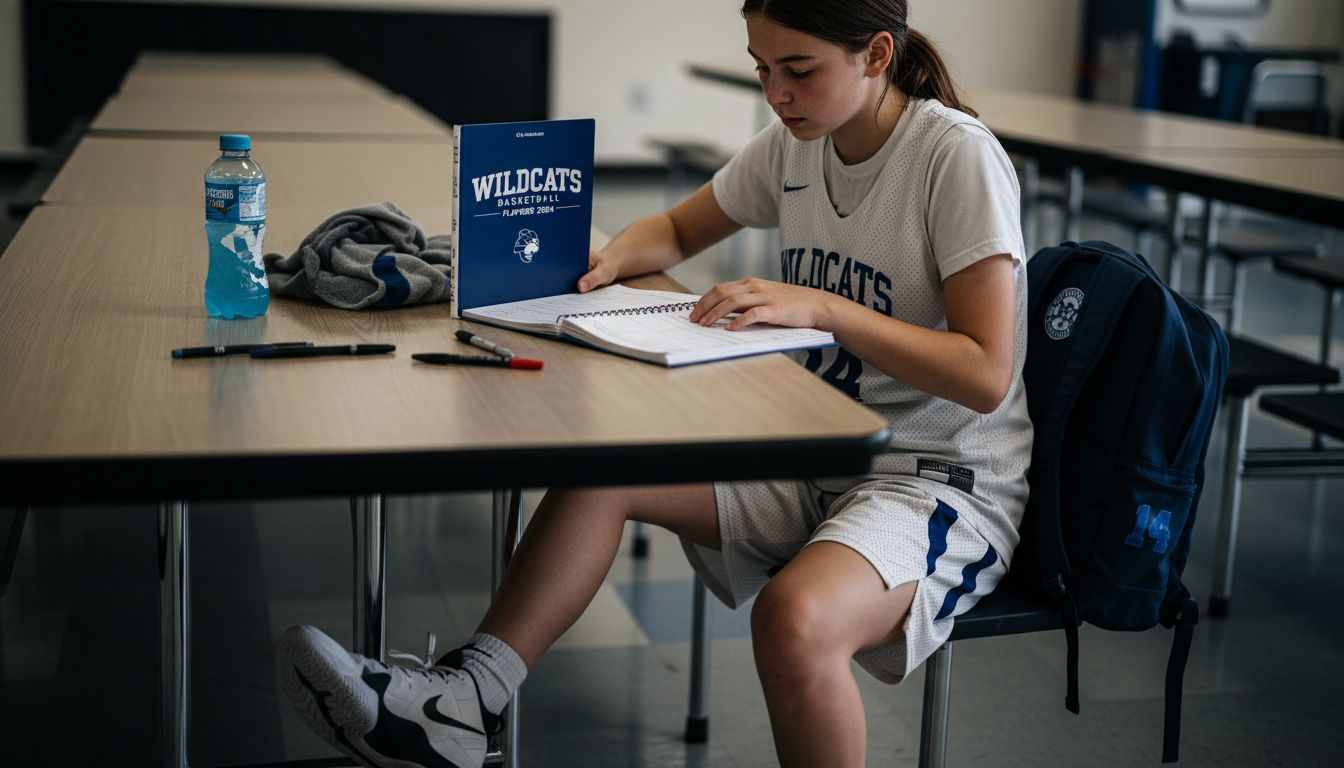
Start by building a table of contents at the front. List every section and the page numbers where they appear. Include offensive plays, defensive schemes, special situations, and any other major categories. Players should flip open your playbook and instantly know where to look.
Organize content into logical sections. Group all half-court offensive sets together. Keep transition plays separate. Create a defensive section with your base schemes and adjustments. Special situations like inbound plays or end-of-game scenarios deserve their own area. This structure makes the playbook intuitive to navigate.
When using clear headings and organization, make sure each section has a descriptive heading. Use consistent formatting so the playbook feels cohesive. A player should never wonder which section they’re in or what a section contains.
Simplicity beats sophistication. A playbook understood by everyone beats a complicated one only you understand.
Keep the language straightforward and direct. Avoid basketball jargon your players don’t already know. If you use specific terminology, define it the first time. Use simple, action-oriented language that describes what players do, not abstract concepts.
Number or name your plays clearly:
- Use memorable names that describe action (“High Pick and Roll Left” vs “Play 7”)
- Keep names short enough to call out during games
- Use consistent naming conventions so patterns emerge naturally
- Avoid overly cute or confusing play names
Each play page should follow a consistent format. Show the play diagram at the top, then list the objective, the starting formation, the sequence of actions, and any key reads. This uniformity helps players know exactly where to find information.
Leave white space in your playbook. Don’t cram content onto pages. Give diagrams breathing room. Use margins generously. A cluttered page discourages reading and creates confusion during preparation.
Pro tip: Color-code your sections using tabs or page markers, so players can physically flip to the right section in seconds without reading the table of contents.
Step 4: Integrate Teaching Aids and Visuals
Words alone don’t teach basketball plays. Players need to see movement, spacing, and timing clearly. Visuals transform a playbook from confusing text into an understandable guide.
Start with simple diagrams for every play. Use basic shapes to represent players: circles for guards, squares for forwards, triangles for centers. Draw arrows showing player movement and ball movement. Keep the diagram uncluttered so players can follow the action without confusion.
Your diagrams should show three key elements: starting positions, player movements, and the final result or read point. A player looking at your diagram should instantly understand where everyone starts and where they go.
When using visual aids to enhance player comprehension, number the sequences so players follow the action in order. Step 1 shows initial setup. Step 2 shows the first movement. Step 3 shows the ball handler’s read or the play’s conclusion. This sequential approach prevents confusion.
A single clear diagram beats ten paragraphs of explanation. Make it visual first, then add text to reinforce.
Include supporting annotations on your diagrams:
- Player numbers or positions clearly labeled
- Timing cues like “on catch” or “after two dribbles”
- Decision points where ball handlers must read the defense
- Target spots where players should be when receiving the ball
Consider using technology tools to enhance your visuals. Coaching software allows you to create professional diagrams faster than drawing by hand. Some platforms let you animate plays so players see movement in real time rather than imagining it.
Provide multiple formats when possible. A printed diagram in your playbook works for study time. A video or animated sequence helps during practice when players can pause and rewind. Different learning styles benefit from different presentation methods.
Use consistent visual language throughout your playbook. If you use dotted lines for one thing, use them consistently everywhere. If solid arrows mean ball movement, never use them for player movement. This consistency helps your brain process information faster.
Pro tip: Create laminated reference cards with your most important plays, so assistants and players can grab them instantly during timeouts or practice without flipping through pages.
Below is a comparison of visual teaching aids to boost playbook comprehension:
| Visual Aid Type | Purpose | Best Use Scenario |
|---|---|---|
| Diagrams | Show player movement | Explaining set plays |
| Animated Videos | Demonstrate timing | Communication during practice |
| Laminated Cards | Quick reference | Timeout or sideline access |
| Technology Software | Create dynamic visuals | Designing new plays |
Step 5: Review and Test Playbook Effectiveness
Your playbook isn’t finished when you print it. Testing reveals what actually works versus what looks good on paper. This step separates effective playbooks from theoretical ones.
Start by tracking execution metrics during practice. How many times did your team run a specific play? How many times did they execute it correctly? Track completion rates for each play. A play your team runs 20 times but only executes correctly 30% of the time needs adjustment or more practice.
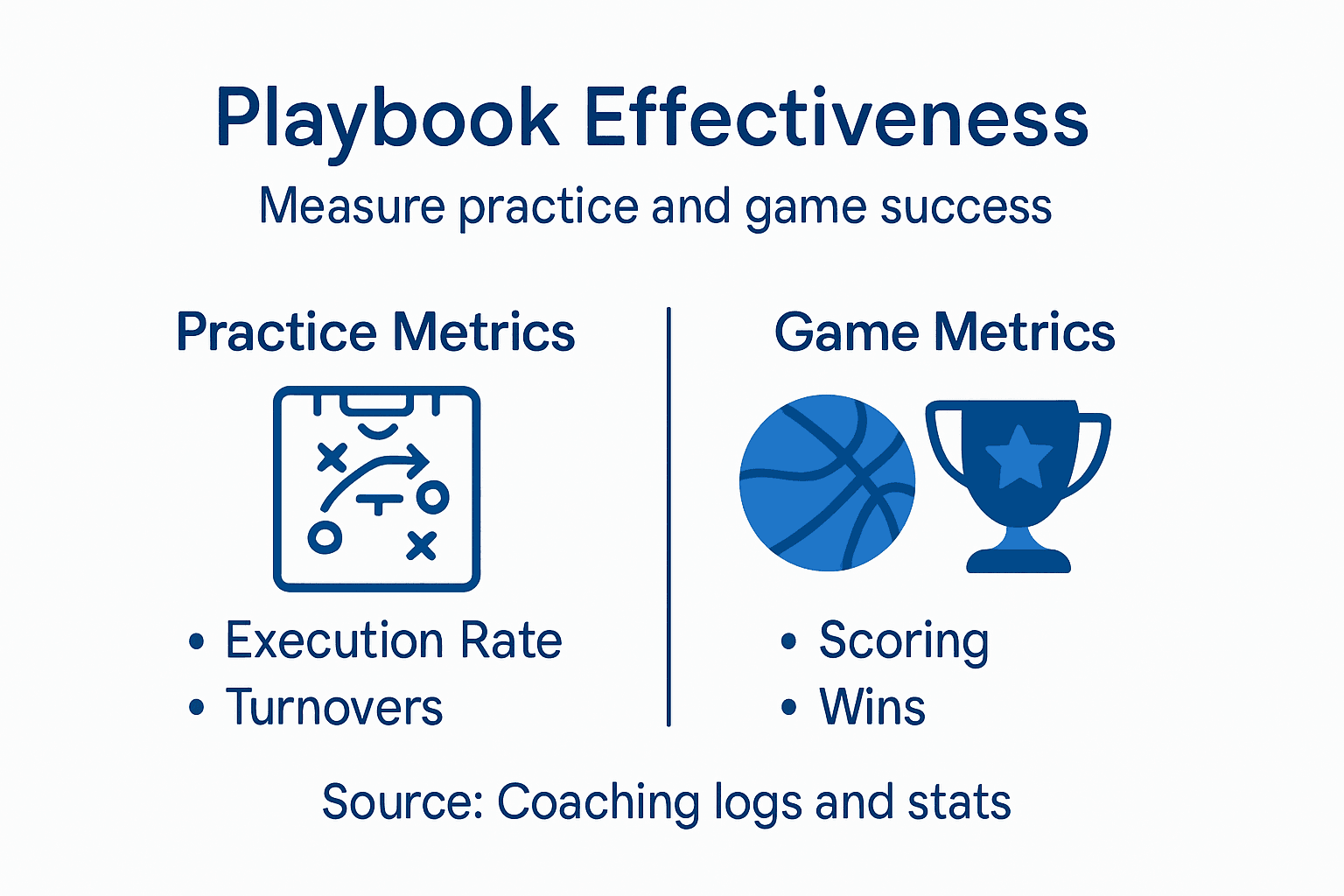
Watch game film and note which plays generated scoring opportunities. Did your “High Pick and Roll Left” consistently create open looks? Did your zone defense allow too many three-pointers? Real game pressure reveals weaknesses your practice drills might mask.
When gathering feedback from players and coaches, create open dialogue about playbook effectiveness. Ask your point guard if reads feel natural. Ask your big men if cuts make sense from their positioning. Players executing the plays offer insights coaches might miss.
Players will execute plays they understand and believe in. If they’re confused or skeptical, your playbook needs revision.
Conduct regular evaluation sessions with your coaching staff:
- Review film weekly to assess execution quality
- Discuss which plays are generating positive results
- Identify plays that consistently fail or confuse players
- Set specific improvement targets for each play
Measure tangible outcomes aligned with your goals. If your goal was “improve half-court offensive efficiency,” track your points per possession in half-court situations. If it was “reduce turnovers,” measure turnover rate before and after playbook implementation.
Be willing to eliminate plays that don’t work. A play that looked good in design but fails in execution wastes practice time. Replace it with something more effective. Your playbook should evolve based on what your team can actually execute.
Schedule periodic full reviews of your entire playbook. Every two or three weeks, step back and assess the big picture. Are players confident? Are plays generating points? Are there gaps in your offense or defense? Use this feedback to refine and improve.
Pro tip: Track success rates with a simple spreadsheet listing each play, how often it was run, execution success percentage, and points generated, making trends obvious at a glance.
Take Your Basketball Playbook to the Next Level with Hoop Mentality
Designing an effective basketball playbook requires understanding your team’s strengths and limitations while organizing clear, actionable plays that your players can confidently execute. If you want to transform your strategic ideas into winning results, the challenge is real but the solution is within reach. Hoop Mentality offers a curated selection of professional Basketball Playbooks designed to align perfectly with your team’s goals and skill level.
Don’t lose precious practice time creating complex or confusing systems that your team struggles to implement. Choose proven resources that simplify playbook structure, reinforce teaching aids with clear visuals, and support real game success. Explore our full range of Basketball Templates and All Products – Hoop Mentality to build your playbook with ease and confidence. Start now at https://hoopmentality.com and watch your team execute smarter, win more, and develop faster.
Frequently Asked Questions
How do I assess my basketball team’s needs before designing a playbook?
Start by observing players during practices to identify their strengths and weaknesses. Create a detailed inventory of skills and gaps, focusing on areas like ball handling and shooting consistency, to inform your playbook design.
What are the core components I should include in my playbook?
Your playbook should have sections for offensive plays, defensive schemes, and special situations. Organize the content with clear headings and include visual diagrams to help players quickly understand the necessary actions and objectives for each play.
How can I effectively teach my players the plays in the playbook?
Use simple diagrams and numbered sequences to visualize player movements and actions. Reinforce understanding by incorporating practice drills that emphasize each play, ensuring players can execute them under game conditions.
How often should I review and update my playbook?
Conduct regular evaluations, ideally every few weeks, to assess the effectiveness of your plays and the team’s execution. Eliminate any plays that are not working and revise the playbook based on feedback from players and coaches.
What metrics should I track to measure the effectiveness of my playbook?
Track execution metrics such as completion rates for each play and points generated from specific strategies. Aim for a quantitative goal, like improving half-court offensive efficiency by 15% within the next month to assess your playbook’s success.