

Mix short on-court leadership drills with off-court transfer activities and a rotating captain system. That combination builds communication, decision-making, and accountability faster than any single approach alone. This week: run one role-based drill at practice, assign a rotating captain, and debrief for five minutes after.
Before your next session, check these three things:
- A clear leadership role assigned to at least one player per drill
- A debrief question ready for after the activity
- A simple observation checklist to track what you see
Key Takeaways
The fastest path to player leadership is repetition in role-based drills, a rotating captain system, and a short debrief after every session.
| Point | Details |
|---|---|
| Run role-based drills first | Start with Voice-Up 3-on-3 or Shell Drill with a Leader to build communication habits quickly. |
| Rotate captains every 4 weeks | Give every player enough time in a role to develop the behavior, not just perform it once. |
| Debrief every session | Use the 3-step script: describe, connect, commit. Keep it under five minutes. |
| Measure three behaviors | Track communication, initiative, and accountability per practice using a simple observation checklist. |
| Use Hoop Mentality templates | The Basketball Starter Pack and Template Bundle give you plug-and-play drill cards and session plans for all age groups. |
Table of Contents
- What do you need before running leadership team-building activities?
- Ten on-court drills that teach real leadership behaviors
- Three off-court activities that transfer to the court
- Sample practice plans with leadership drills built in
- How do you select, rotate, and develop team captains?
- How do you measure leadership and team cohesion?
- Coaching language, debrief scripts, and handling setbacks
- Which Hoop Mentality resources map to these activities?
- Why drills beat lectures for leadership development
- Hoop Mentality gives you practice-ready tools, not more prep work
- Sources
- FAQ
What do you need before running leadership team-building activities?
Keep the setup minimal. Most leadership development drills run with gear you already have.
Equipment:
- 6–8 basketballs
- 8–12 cones
- Colored bibs or pinnie jerseys (2 sets)
- Stopwatch or phone timer
- Whiteboard or clipboard with a marker
Space and time: A full court works best, but a half-court handles most drills. Budget 10–25 minutes per drill block, including setup and debrief.
Age/level notes:
- Youth (ages 8–12): Reduce decision layers. One role per player, simple verbal cues, short durations (8–10 min).
- High school: Add positional responsibilities and peer feedback rounds.
- College: Layer in film review, self-assessments, and cross-role accountability tasks.
Ten on-court drills that teach real leadership behaviors
These drill cards are ready to copy into your practice plan. Each targets a specific leadership behavior you can observe and measure. For a full library of progressive practice drills, Hoop Mentality’s blog has session templates mapped by age group.
1. Voice-up 3-on-3
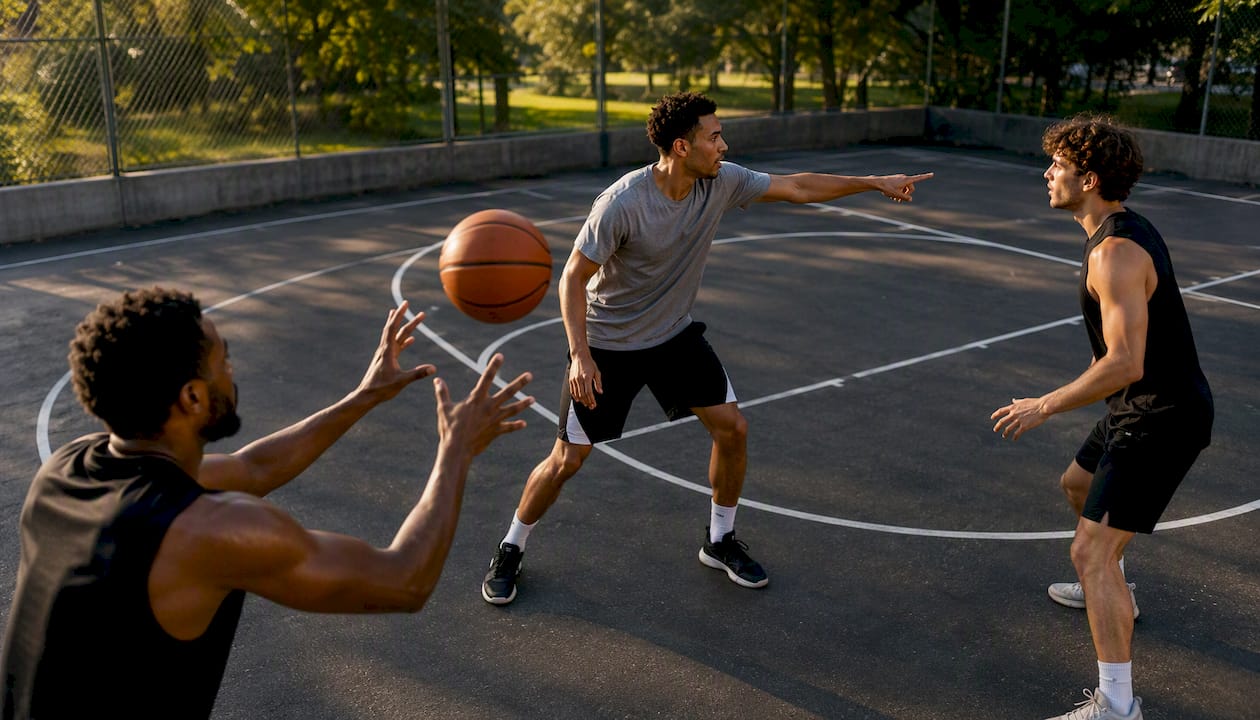
Objective: Communication. Setup: Half-court, 3v3. Every pass requires the passer to call the receiver’s name. Duration: 10 min. Cue: “No silent passes.” Measurable behavior: Count named passes per possession. Progression: Add a rule that the team loses possession on any silent pass.
2. Captain’s timeout
Objective: Decision-making. Setup: 5v5 scrimmage. One player holds “timeout” authority for 2 minutes. Duration: 12 min. Cue: “When do you stop the game?” Measurable behavior: Quality of the timeout call (score, momentum, fatigue). Progression: Rotate the role every two possessions.
3. Defensive director
Objective: Directing teammates. Setup: 5v5 half-court defense. One player calls every rotation out loud before it happens. Duration: 10 min. Cue: “Point before you move.” Measurable behavior: Correct rotations called vs. missed. Progression: Add a second director on offense.
4. Shell drill with a leader
Objective: Initiative. Setup: Standard 4-on-4 shell. The designated leader must correct one teammate per rep. Duration: 12 min. Cue: “Fix it before I do.” Measurable behavior: Number of peer corrections made. Progression: Leader rotates every 3 reps.
5. Blindfolded dribble relay
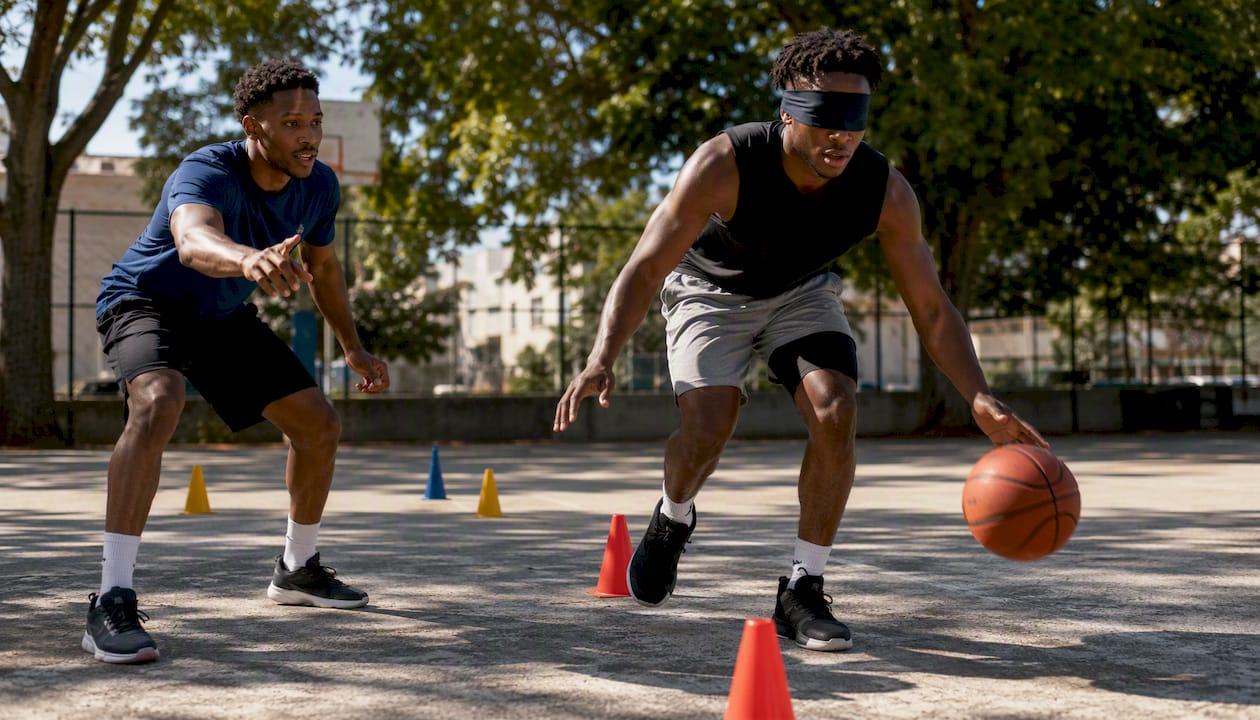
Objective: Trust and communication. Setup: Partners, one dribbles with eyes closed while the other guides verbally. Duration: 8 min. Cue: “Your words are their eyes.” Measurable behavior: Successful completions per pair. Progression: Add a second voice (conflicting instructions) to test filtering.
6. Practice lead warm-up
Objective: Taking initiative. Setup: One player runs the warm-up with no coach input. Duration: 8 min. Cue: “Own the first five minutes.” Measurable behavior: Engagement level of the group. Progression: Player plans the warm-up the night before.
7. Pressure free-throw accountability
Objective: Accountability. Setup: Player calls their own make/miss result to the team. Duration: 10 min. Cue: “Say it out loud.” Measurable behavior: Honest self-reporting rate. Progression: Team sets a collective make target; leader reports result.
8. Transition talk drill
Objective: Communication in transition. Setup: 4v4 full court. Leader must call “ball,” “help,” or “sprint” on every possession. Duration: 12 min. Cue: “One word, every time.” Measurable behavior: Calls made per possession. Progression: Add a second caller on the other end.
9. Film-room captain
Objective: Analysis and feedback. Setup: Watch 3 minutes of practice film. One player leads the debrief. Duration: 10 min. Cue: “What did you see?” Measurable behavior: Number of specific observations made. Progression: Player prepares two questions before the session.
10. Big Man Dual Action
Objective: Frontcourt leadership and communication. Setup: Post player receives, reads the defense, and calls the guard’s cut out loud. Uses the Big Man Dual Action Drill card. Duration: 10 min. Cue: “Read, then talk.” Measurable behavior: Correct calls per possession. Progression: Add a second read option.
Pro Tip: Pick one cue per drill and repeat it every rep. A single sharp phrase (“Point before you move”) changes behavior faster than a full correction after the fact.
Safety and inclusion: Pair players by size for contact drills. For the blindfolded relay, use a clear lane with no obstacles. Give players with communication challenges a visual signal option instead of verbal-only cues.
Three off-court activities that transfer to the court
Short, low-cost, and directly tied to on-court behaviors. These team bonding experiences work in a locker room, film room, or gym lobby.
Activity 1: One Word (5 min) Each player says one word that describes the team right now. No explanation. Go around the circle twice: once for how the team feels, once for how they want to feel. Debrief question: “What word showed up twice? Why?”
Activity 2: Two Truths, One Lie (10 min) Players share three statements about themselves; teammates identify the lie. Debrief question: “What did you learn about a teammate you didn’t know?” Tie-back: “How does knowing your teammate help you trust them on defense?” The McKinnon Basketball Association’s culture-building activity list includes both of these with ready-to-use scripts.
Activity 3: Stop / Start / Keep Doing (10 min) Each player writes one thing the team should stop, start, and keep doing. Share anonymously. Coach reads them aloud. Debrief question: “Which ‘start’ can we do at tomorrow’s practice?”
For youth players, shorten prompts to single words or drawings. For high school and college players, add a written reflection step before the group share.
Sample practice plans with leadership drills built in
These three templates drop directly into a normal session. For more practice plan templates by age group, Hoop Mentality’s resource library has printable versions.
Youth session (~60 min)
- Practice Lead Warm-Up — 8 min
- Voice-Up 3-on-3 — 10 min
- Skill block (shooting/ballhandling) — 20 min
- Blindfolded Dribble Relay — 8 min
- Scrimmage with Captain’s Timeout — 10 min
- Debrief (One Word activity) — 4 min
High school session (~75 min)
- Practice Lead Warm-Up — 8 min
- Shell Drill with a Leader — 12 min
- Skill block — 20 min
- Transition Talk Drill — 12 min
- Scrimmage with Defensive Director — 15 min
- Debrief (Stop / Start / Keep Doing) — 8 min
College session (~90 min)
- Practice Lead Warm-Up — 8 min
- Film-Room Captain — 10 min
- Shell Drill with a Leader — 12 min
- Skill block — 20 min
- Big Man Dual Action — 10 min
- 5v5 scrimmage with Captain’s Timeout + Defensive Director — 20 min
- Debrief (Two Truths, One Lie or written reflection) — 10 min
Substitution note: swap any 10-minute drill for a skill block if the team needs more repetitions that day. Keep the debrief in every session, even if you cut it to three minutes.
How do you select, rotate, and develop team captains?
Four role templates give every player a leadership entry point. Assign these at the start of each 4-week cycle.
- Captain: Sets tone in warm-ups, speaks for the team in huddles, leads the post-game debrief.
- On-court director: Calls sets, signals rotations, manages pace.
- Defensive leader: Owns communication on the defensive end, calls switches and help.
- Practice lead: Runs the warm-up, sets the energy standard for the session.
Selection options: Coach appointment works well early in a season when trust is still forming. Player vote builds buy-in mid-season. A hybrid rotation, where the coach nominates two candidates and the team votes, balances both. The player leadership development guide from Hoop Mentality includes a 4-week development checklist you can print and use directly.
Mid-cycle feedback script (week 2 check-in): “Here’s one thing I’ve seen you do well in this role. Here’s one specific moment where you could have stepped up. What do you need from me to make that happen next week?”
Pro Tip: Rotate roles every 4 weeks, not every game. Players need enough time in a role to actually develop the behavior, not just perform it once.
How do you measure leadership and team cohesion?
Track three behaviors per practice. Keep the observation sheet simple enough to use on a clipboard during a live session. The basketball leadership guide from Hoop Mentality outlines measurement frameworks coaches can apply across a full season.
Practice observation checklist (per session):
Player self-assessment (every 2–4 weeks):
- “What leadership role did I take this week?”
- “One moment I led well.”
- “One moment I held back.”
- “One thing I’ll do differently next week.”
Game observation sheet (3 behaviors, 1–3 scale): Score each behavior 1 (not present), 2 (present but inconsistent), or 3 (consistent and clear).
- Verbal communication on defense
- Initiative in transition
- Accountability after a turnover or mistake
Use the Editable Scouting Report Template to track leadership tendencies alongside opponent prep. The Basketball Scouting Report Template works for post-game observation notes.
Coaching language, debrief scripts, and handling setbacks
Exact phrases matter. These cues prompt leadership behavior without long explanations.
In-practice prompts:
- “Who’s talking right now?”
- “What did you see before you made that decision?”
- “Say it louder so everyone hears it.”
- “That’s your call. Make it.”
3-step debrief script (use after any drill or game moment):
- Describe: “What happened in that possession?”
- Connect: “What leadership behavior did we see, or miss?”
- Commit: “What’s one thing we do differently next rep?”
Handling setbacks: When trust breaks down or communication drops, run the Stop / Start / Keep Doing activity before the next practice. When a captain loses the group, have a private conversation using the mid-cycle feedback script above. For persistent poor communication, go back to Voice-Up 3-on-3 for two sessions before adding complexity. More interpersonal coaching strategies are available on the Hoop Mentality blog.
Pro Tip: After a tough loss, run the debrief script before any tactical review. Players process accountability better when they feel heard first.
Which Hoop Mentality resources map to these activities?
Each product below plugs directly into the drills and plans in this article.
- Basketball Starter Pack For Coaches: Drill cards, practice templates, and leadership exercises. Download, print, and run on day one.
- Basketball Template Bundle For Coaches: Editable session timelines and drill cards for all three age groups. Adapt the headers, drop in your roster, and go.
- Basketball Shooting Bundle For Coaches: Shooting drills you can layer leadership responsibilities onto, such as a shot-clock captain or a communication requirement on every catch.
- Editable Scouting Report Template: Track leadership tendencies and opponent matchups in one editable file.
- Basketball Scouting Report Template: Printable version for sideline use and post-game feedback notes.
- Big Man Dual Action Drill: A frontcourt-specific drill card that embeds read-and-communicate tasks for post players.
3-step usage for any resource: Download the file. Swap in your team’s names, positions, and session timing. Run it at the next practice.
All resources are available in the United States through the Hoop Mentality store.
Pro Tip: Start with the Basketball Starter Pack. It covers the most ground for a coach who wants to run leadership drills and structured practice plans without building everything from scratch.
For inclusive outdoor group challenge ideas that complement these on-court sessions, team-building event formats designed for school-age groups offer useful adaptations.
Why drills beat lectures for leadership development
Most coaches know that telling players to “communicate more” rarely changes anything. The behavior has to be practiced, not explained. A player who runs Voice-Up 3-on-3 for three sessions will call names on passes without thinking about it. A player who hears a five-minute talk about communication might nod and forget it by the next possession.
The drills in this article are built around one principle: leadership is a skill, and skills are trained through repetition with feedback. The rotating captain system adds accountability because the role rotates to everyone. No player can opt out of leading, and no player gets stuck in a role they’ve outgrown.
The measurement tools matter too. When players see their own scores on a self-assessment form, the conversation shifts from “you need to lead more” to “here’s what I saw, here’s what you saw, what’s the gap?” That specificity is what produces real change. Busy coaches can get there faster with ready-to-use templates rather than building observation sheets from scratch.
Hoop Mentality gives you practice-ready tools, not more prep work
Coaches who want to build player leadership without spending hours writing drill cards and session plans have a direct path: the Hoop Mentality resource library.
The Basketball Starter Pack For Coaches and the Basketball Template Bundle For Coaches cover every section of this article, from on-court drill cards and timed session plans to observation checklists and captain development guides. Every file is editable, built from real coaching experience, and ready to use at youth, high school, and college levels across the United States. Download a pack, swap in your team’s details, and run it this week.
Sources
- 7 Culture-Building Activities for Your Team — McKinnon Basketball Association
Download any Hoop Mentality template, adapt it to your roster and level, and run it at the next practice.
FAQ
What are the best on-court leadership drills for youth players?
Voice-Up 3-on-3 and Practice Lead Warm-Up work well for youth. Keep roles simple, durations short (8–10 minutes), and use one verbal cue per drill.
How often should you rotate captain roles?
Rotate every 4 weeks. Players need enough time in a role to develop consistent behavior, not just demonstrate it once.
How do you measure leadership development in basketball?
Track three observable behaviors per session: verbal communication, initiative, and accountability. A simple 1–3 scoring scale on a game observation sheet gives you data you can discuss with players.
Which Hoop Mentality product is best for a coach starting out?
The Basketball Starter Pack For Coaches covers the most ground. It includes drill cards, practice templates, and leadership exercises that work at any level.
How long should a leadership debrief take after practice?
Three to five minutes is enough. Use the 3-step script: describe what happened, connect it to a leadership behavior, and commit to one change for the next rep.