

TL;DR:
- Choosing the right team building activity depends on your team’s current needs, goals, and constraints.
- Structured debriefs immediately after activities are essential for turning fun into lasting teamwork improvements.
Picking the wrong team building activity wastes time and kills player buy-in fast. Coaches worldwide face the same problem: too many team building activities ideas, not enough clarity on which ones actually move the needle for basketball teams. Trust, communication, and cohesion don’t build themselves between games. The right activity, chosen for the right reason, at the right moment in your season, can shift how your players show up for each other on the court. This guide gives you the criteria, the specific activities, and a comparison framework to make that decision confidently.
Table of Contents
- How to choose the right team building activities for your basketball team
- Top quick team building activities under 30 minutes
- Engaging outdoor team building challenges for basketball teams
- Trust-building through 3-hour immersive outdoor team challenges
- The power of structured debriefs after team building activities
- Comparing team building activities: finding the best fit for your basketball team
- Why team building success depends on ongoing operational rhythm, not isolated events
- Discover Hoop Mentality drills and plans to boost your team’s cohesion
- Frequently asked questions
Key Takeaways
| Point | Details |
|---|---|
| Define clear goals | Selecting activities based on specific team needs ensures more meaningful outcomes. |
| Match activities to time | Choose exercises fitting your available time, from quick 30-minute sessions to multi-hour challenges. |
| Prioritize debriefs | Structured, immediate debriefs solidify learning and create lasting team improvements. |
| Build trust deliberately | Trust must be nurtured over time with consistent, purposeful actions during team building. |
| Use operational rhythm | Integrate team building as an ongoing process, not a one-off event, for compounding benefits. |
How to choose the right team building activities for your basketball team
Before you pick any activity, define what your team actually needs right now. That sounds obvious, but most coaches skip this step and choose whatever sounds fun or whatever they saw another team do. The result is a forgettable afternoon that changes nothing.
Start with one clear goal. Your options are trust, communication, problem-solving, or morale. Each goal calls for a different type of activity. A team struggling with locker room tension needs trust exercises, not a trivia night. A team that communicates poorly during games needs activities that force verbal coordination under pressure.
Next, factor in your constraints:
- Time: Do you have 30 minutes before practice or a full off-day?
- Location: Gym, outdoor field, or remote players requiring virtual options?
- Group size: A squad of 8 plays differently in group exercises than a roster of 18.
- Physical ability: Not every player can participate in every physical challenge. Plan for inclusivity from the start.
Choosing the right activity depends on constraints like time, setting, and goal category, so activities should fit the team’s current context rather than just being fun. That framing matters. Fun is a byproduct, not the objective.
Finally, plan your debrief before the activity starts. If you don’t know what questions you’ll ask afterward, you’re not ready to run the activity. Check out these best team building activities for more criteria-based guidance built specifically for basketball coaches.
Now that you understand the criteria, let’s explore specific activity ideas basketball coaches can implement.
Top quick team building activities under 30 minutes
Short team-building activities can enhance communication, trust, and collaboration in just 30 minutes, especially when planned carefully with a feedback loop. These are your go-to options when time is tight but you still want meaningful connection.
Here are four quick basketball team building activities worth running:
- Two Truths and a Lie: Players share two true facts and one false one. Teammates guess the lie. Takes 15 minutes, costs nothing, and works for any group size. Great icebreaker activity for teams at the start of a season or after adding new players.
- Marshmallow Challenge: Small groups build the tallest freestanding structure using spaghetti, tape, string, and a marshmallow on top. 20 minutes. Low cost. Builds problem-solving and reveals natural leadership patterns quickly.
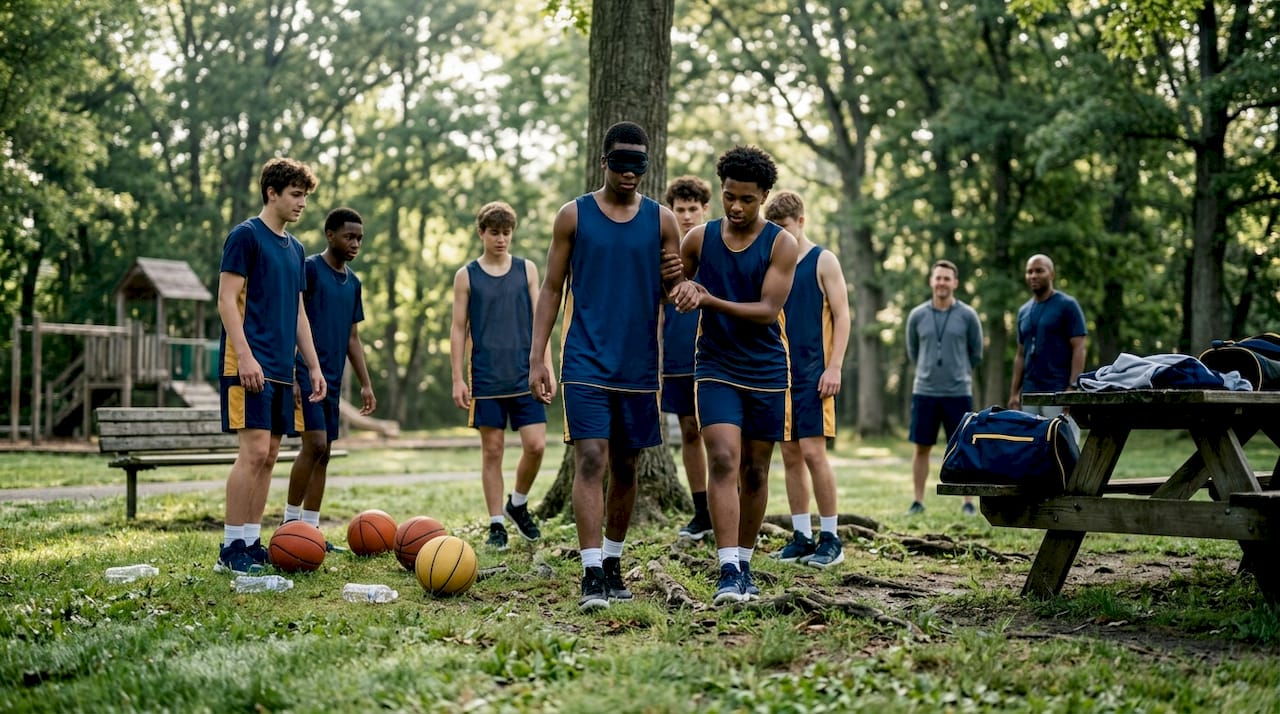
- Blindfolded Trust Walk: One player is blindfolded. A partner guides them through an obstacle course using only verbal cues. 20 minutes. Directly mirrors on-court communication needs. Skip this if any player has mobility concerns.
- Puzzle Race: Split the team into groups. Each group gets a puzzle to complete against the clock. 15 minutes. Builds focus and group coordination. Works well indoors before practice.
| Activity | Time | Group size | Cost | Energy level |
|---|---|---|---|---|
| Two Truths and a Lie | 15 min | Any | Free | Low |
| Marshmallow Challenge | 20 min | 3 to 6 per group | Under $10 | Medium |
| Blindfolded Trust Walk | 20 min | Pairs | Free | Medium |
| Puzzle Race | 15 min | 3 to 5 per group | Under $15 | Low |
Pro Tip: Run a 5-minute feedback round immediately after any quick activity. Ask two questions: “What did you notice about how your group communicated?” and “What would you do differently?” This turns a fun team challenge into a real learning moment.
Having covered quick activities, let’s explore longer, more immersive team challenges suitable for basketball teams with more time.
Engaging outdoor team building challenges for basketball teams
When you have two hours and access to outdoor space, you can run activities that build deeper collaboration and get players out of their usual comfort zones. These outdoor team activities like scavenger hunts and relay races can be scheduled as 2-hour team events with clear time, cost, and group size guidance.
Here are five solid options for outdoor basketball team bonding ideas:
- Scavenger hunt: Split players into teams of 4 to 5. Give each group a list of tasks or items to find across a defined area. Builds communication, strategy, and friendly competition. Cost: under $20 for printed materials. Skip if venue access is limited.
- Relay races: Classic but effective. Design relay legs around basketball-specific movements like dribbling, defensive slides, or passing. Keeps the activity relevant to the sport. Cost: free. Works for any group size.
- Trust falls: One player falls backward and teammates catch them. Simple, physical, and direct. Builds trust fast. Skip if any player has back or shoulder issues.
- Tug of war: Divide the roster into balanced teams. Two rounds, swap teams after the first. Builds group energy and camaraderie. Cost: one rope. Works for 10 to 20 players.
- Team puzzle challenge: Large-format puzzles spread across outdoor tables. Groups race to finish. Builds patience and coordination in a low-pressure setting. Cost: under $30.
Logistics to plan ahead: Book your venue at least one week out. Bring water, sunscreen, and a first-aid kit. Have a backup indoor plan if weather turns. Always brief players on safety rules before physical activities start.
For accessibility, make sure every activity has a role for players who can’t participate physically. Assign them as timekeepers, scorekeepers, or team strategists. No one sits out entirely.
For coaches aiming to build deeper trust and cohesion, let’s review longer, focused outdoor challenges next.
Trust-building through 3-hour immersive outdoor team challenges
Three hours gives you enough time to run a full trust-focused experience with proper setup, execution, and debrief. These are the activities that players remember at the end of a season. Trust-building outdoor challenges include trust falls, blindfolded obstacle courses, and trust-focused scavenger hunts, all scheduled over about 3 hours with clear planning milestones.
Use this planning timeline for building basketball team cohesion through a 3-hour outdoor session:
- Two weeks out: Define your goal. Is this about rebuilding trust after a rough stretch? Welcoming new players? Preparing for playoffs? Your goal shapes every activity choice.
- One week out: Book the venue. Confirm materials. Assign a co-facilitator if your roster is larger than 12 players.
- Day before: Walk the course yourself. Check for hazards. Confirm your backup indoor plan is ready.
- First 30 minutes: Warm-up and intro. Explain the purpose. Set ground rules for physical and emotional safety.
- Next 90 minutes: Run the main activities. Rotate through trust falls, a blindfolded obstacle course, and a trust-themed scavenger hunt.
- Final 60 minutes: Structured debrief. This is not optional. See the next section for exactly how to run it.
One important caution: trust does not build automatically from a single event. Think of it as deliberate trust building that requires repeated deposits over time. One great afternoon is a start, not a finish.
After exploring longer trust exercises, it’s vital to discuss how to maximize learning with effective debriefs after team building.
The power of structured debriefs after team building activities
Running an activity without a debrief is like running a practice without reviewing film. You did the work, but you left the learning on the table. The ORCA framework (Objective, Result, Cause, Action) is non-negotiable to turn activities into lasting behavioral change by connecting experiences to future actions.
Here is what each letter means:
- O (Objective): What was the goal of the activity?
- R (Result): What actually happened?
- C (Cause): Why did it happen that way?
- A (Action): What will we do differently next time, in practice or in a game?
Timing matters. Debriefs must be conducted immediately after an activity, as effectiveness drops sharply after 48 hours due to context fading. Run your debrief while the experience is still fresh. Ten minutes is enough if you stay focused.
A simple 10-minute ORCA debrief template:
- Minutes 1 to 2: Restate the objective together as a group.
- Minutes 3 to 4: Ask players to name one thing that went well and one thing that did not.
- Minutes 5 to 7: Dig into causes. Why did communication break down? Who stepped up and why?
- Minutes 8 to 10: Identify one concrete action each player will carry into the next practice.
“The debrief is half the battle. Without it, you’ve just had a fun day. With it, you’ve built a better team.” — Christian “Boo” Boucousis, former fighter pilot and performance coach.
Pro Tip: Write the ORCA actions on a whiteboard in the locker room after every team building session. Reference them at the start of your next three practices. That repetition is what turns a one-day activity into a lasting behavior shift.
With debriefs reinforcing team building, next is the practical side: comparing activities to pick the right fit for your basketball team.
Comparing team building activities: finding the best fit for your basketball team
Use this table to match activities to your team’s current situation. Comparison tables help coaches weigh trade-offs like activity duration, cost, and energy level to select the best match for their team.
| Activity | Duration | Group size | Cost | Energy level | Best for |
|---|---|---|---|---|---|
| Two Truths and a Lie | 15 min | Any | Free | Low | New rosters, icebreakers |
| Marshmallow Challenge | 20 min | 3 to 6 | Under $10 | Medium | Problem-solving |
| Blindfolded Trust Walk | 20 min | Pairs | Free | Medium | Communication |
| Scavenger Hunt | 2 hours | 4 to 5 per team | Under $20 | Medium | Collaboration |
| Relay Races | 2 hours | Any | Free | High | Energy and morale |
| Trust Fall | 2 to 3 hours | Any | Free | Medium | Trust building |
| Blindfolded Obstacle Course | 3 hours | 4 to 6 | Under $50 | High | Deep trust and communication |
Pros and cons to keep in mind:
- Quick activities (under 30 minutes) are easy to run but produce surface-level results without a strong debrief.
- Two-hour outdoor activities build real energy and buy-in but require venue planning and weather backup.
- Three-hour trust challenges produce the deepest results but demand more coach preparation and player commitment.
- Free activities remove budget barriers but sometimes feel less structured, so your facilitation quality matters more.
- High-energy activities work well mid-season when morale needs a lift. Lower-energy creative team exercises work better at the start of a season when players are still getting comfortable.
Match the activity to the moment. A team in conflict needs trust work, not relay races. A team that’s flat needs energy, not puzzles. Use these team building activities comparison options as a menu, not a checklist.
Why team building success depends on ongoing operational rhythm, not isolated events
Here is the uncomfortable truth most coaching articles won’t say directly: a single team building day does almost nothing on its own. Players enjoy it, laugh, maybe feel closer for a week. Then the season grinds on, old habits return, and the trust you thought you built quietly disappears.
The coaches who see lasting results treat team building like an operational improvement loop, not a calendar event. Run the activity. Debrief immediately with ORCA. Assign owned actions. Reference those actions in the next three practices. Then run another activity next month and repeat. That cycle is what builds real team cohesion.
The common mistake is assuming trust appears automatically after a good experience. It doesn’t. Trust is built through repeated, small deposits over time. One afternoon of trust falls doesn’t override months of poor communication or unresolved conflict. What it does is give you a shared reference point to build from, but only if you follow through.
Integrate ORCA actions directly into your weekly practice plans. If a player committed to communicating louder on defense, call it out when they do it in the next drill. That connection between the off-court activity and the on-court behavior is where the real value lives.
Pro Tip: Schedule team building as a recurring item in your season calendar, not a one-off event. Even one 30-minute teamwork activity for adults per month, followed by a tight ORCA debrief, compounds into measurable improvement by playoff time.
The mindset shift is simple. Stop thinking “we did our team building.” Start thinking “we are running our team building system.” That difference in framing changes everything about how you plan, execute, and follow up.
Discover Hoop Mentality drills and plans to boost your team’s cohesion
Team building activities work best when they connect directly to what happens in practice. That’s where Hoop Mentality comes in.

Hoop Mentality offers basketball coaching resources built from real coaching experience. The Big Man Dual Action Drill is a targeted resource that improves individual skill and team communication at the same time. Pair it with the Game Preparation Guide With Weekly Practice Plan, which gives you a full structure to integrate team building concepts directly into your practice schedule. Both tools help you carry the lessons from your off-court activities onto the court where they count. Explore the full catalog at Hoop Mentality and find the resources that fit your team right now.
Frequently asked questions
What are some quick team building activities I can do with my basketball team?
Quick activities like Two Truths and a Lie, Marshmallow Challenge, and Blindfolded Trust Walk can be done in 30 minutes to build communication and trust. These 30-minute activities work best when followed immediately by a short debrief.
How important is a debrief after a team building activity?
A structured debrief is critical to connect the activity to real-world improvements and should happen immediately to maximize learning. The ORCA framework is the most direct tool for turning a fun experience into lasting behavioral change.
Can outdoor team challenges improve trust among basketball players?
Yes. Well-planned 3-hour trust challenges like blindfolded obstacle courses and trust falls can significantly improve team dynamics and player communication.
How do I choose the best activity for my team’s current needs?
Evaluate your team’s goals, time availability, setting, and group dynamics first. Choosing the right activity means fitting the team’s current context, not just picking what sounds fun.
What mistakes do coaches make with team building activities?
The most common mistakes are skipping the debrief, choosing activities based only on fun, and assuming trust builds automatically. Deliberate trust building requires repeated, intentional effort over the full course of a season.