

Run a 5-on-5 constrained scrimmage with mandatory verbal cues at your next practice. That single drill, paired with a quick debrief, is the fastest entry point for interpersonal skills coaching on a basketball court. HSB Academy’s research confirms that leadership is “caught, not taught” — meaning players reveal and build communication habits when you put them under pressure, not when you lecture them. Hoop Mentality’s drill library and practice templates are built around exactly that principle. Start with the plan below, then pull from the drill bank to extend the work across your season.
Table of Contents
- What does a 30-minute interpersonal skills practice look like?
- A drill bank that trains communication and leadership
- How do you progress drills and measure improvement over 8 weeks?
- How to run pressure reps and use the right coaching language
- How do you connect drills to your playbook?
- What mistakes do coaches make when training interpersonal skills?
- Key Takeaways
- The gap most coaches never close
- Hoop Mentality resources that support this plan
- Useful sources
- FAQ
What does a 30-minute interpersonal skills practice look like?
Drop this plan into any practice. No extra setup. No extra equipment.
- Minutes 0–5 — Warm-up with role assignment. Assistant coach assigns a captain for the session. That player leads the dynamic warm-up and calls each transition. Head coach observes silently.
- Minutes 5–15 — Shell Drill with mandatory callouts. Four defenders, four offensive players. Every screen must be called verbally (“screen left,” “switch,” “stay”). Pause immediately if a player goes silent. Praise the first player who calls loudly and correctly.
- Minutes 15–22 — Transition Communication Drill. 4-on-4 half-court to full-court. Offense must call the play name before crossing half. Defense must call the rotation. In-game communication drills like this one transfer directly to game decision-making.
- Minutes 22–28 — Constrained scrimmage. 5-on-5. Rule: no basket counts unless the scoring player called the play or action before the catch. Assistant coach tracks call rate on a tally sheet.
- Minutes 28–30 — Quick debrief. Captain speaks first. Two questions only: “What did we call well?” and “What went silent?” Head coach reinforces one behavior, not five.
Staff roles: Head coach observes and reinforces. Assistant coach tracks call rate and rotation accuracy. Designated captain leads transitions and the debrief.
A drill bank that trains communication and leadership
Each drill below includes purpose, setup, cues, and a progression. Run them in any order. The 8-week calendar in the next section shows the recommended sequence.
| Drill Name | Purpose | Setup | Key Cues | Progression |
|---|---|---|---|---|
| Shell Drill Callouts | Verbal screen communication | 4v4 half-court, no dribble limit | “Call the screen before it sets” | Add a second screener; require both to be called |
| Blind Screen Guidance | Nonverbal + verbal cue pairing | 2v2, screener faces away from ball | “Use a hand signal AND a word” | Remove the word; signal only |
| Transition Talk | Rotation communication under speed | 4v4 full-court, 8-second limit | “Call the number before you cross half” | Reduce to — |
| Captain Huddle Rep | Leadership initiation | 5 players, timeout simulation | “Captain speaks first, always” | Rotate captain each rep |
| Beat The Coach | Leadership ownership | Full team; coach poses a problem | “Who solves it first?” | Increase problem complexity each week |
| Passing Circle | Active listening + timing | Multiple players in a circle, no verbal | “Eyes up, read the passer” | Add a second ball |
| Decision Speed 3v2 | Fast communication under pressure | 3 offensive, 2 defensive, 5-second clock | “Call the advantage before you catch” | Add a defender mid-rep |
| Silent 5-on-5 | Nonverbal coordination | Full 5v5, no talking allowed | “Find another way to signal” | Allow one word per possession |
| Role Rotation Warm-Up | Distributed leadership practice | Full team; new leader each day | “Your job is to set the tone” | Leader also runs the debrief |
| Film Cue Replay | Reflection and peer feedback | 3–5 players, short clip, pause-and-discuss | “What should have been called here?” | Players write their own cue cards |
Communication drills structured this way build habits faster than isolated skill work because they force real-time decisions.
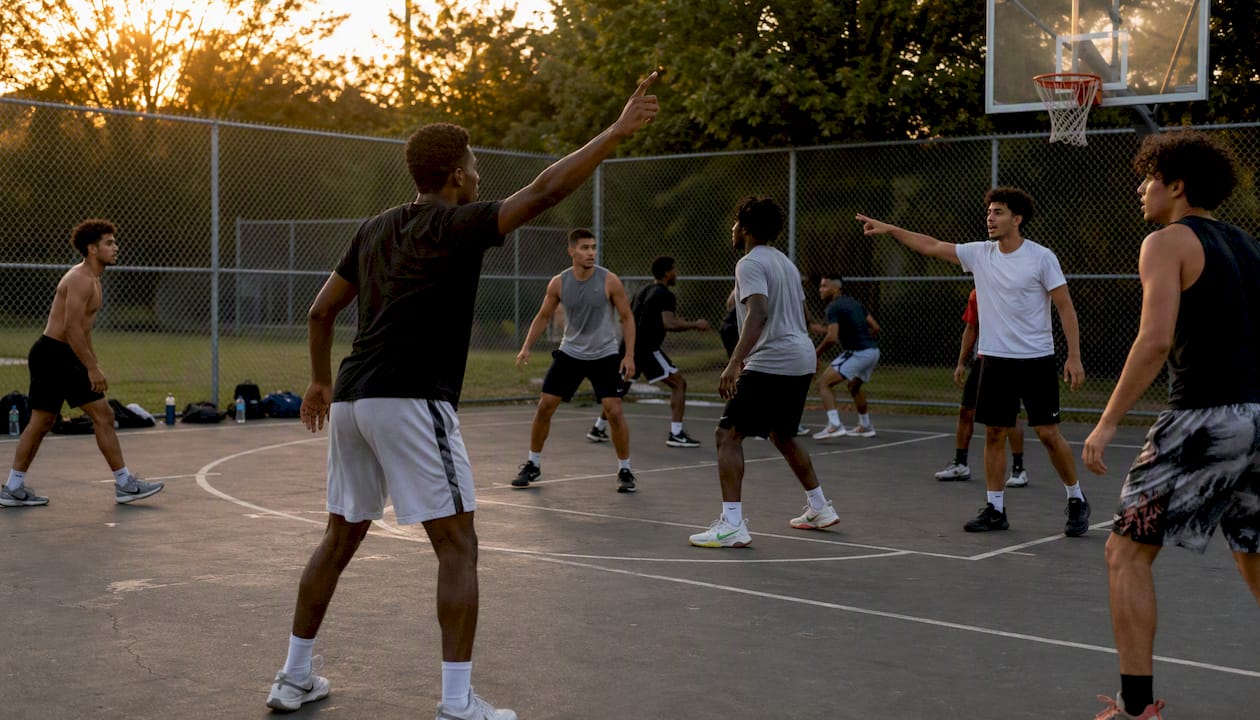
Pro Tip: Run the Silent 5-on-5 drill once every two weeks. Players who communicate well verbally often fall apart without words — and that gap shows up in noisy game environments where verbal cues get lost.
Balr’s drill research supports mixing verbal and nonverbal drills so teams develop both explicit and implicit coordination. The Blind Screen Guidance and Silent 5-on-5 drills above address exactly that gap.
How do you progress drills and measure improvement over 8 weeks?
8-week sample calendar
| Week | Primary Drill(s) | Focus | Frequency |
|---|---|---|---|
| 1–2 | Shell Drill Callouts, Role Rotation Warm-Up | Baseline verbal habits | 3x per week |
| 3–4 | Transition Talk, Captain Huddle Rep | Speed + leadership initiation | 3x per week |
| 5 | Beat The Coach, Decision Speed 3v2 | Pressure leadership | 2x per week |
| 7–8 | Silent 5-on-5, Film Cue Replay | Nonverbal + reflection | 2x per week |
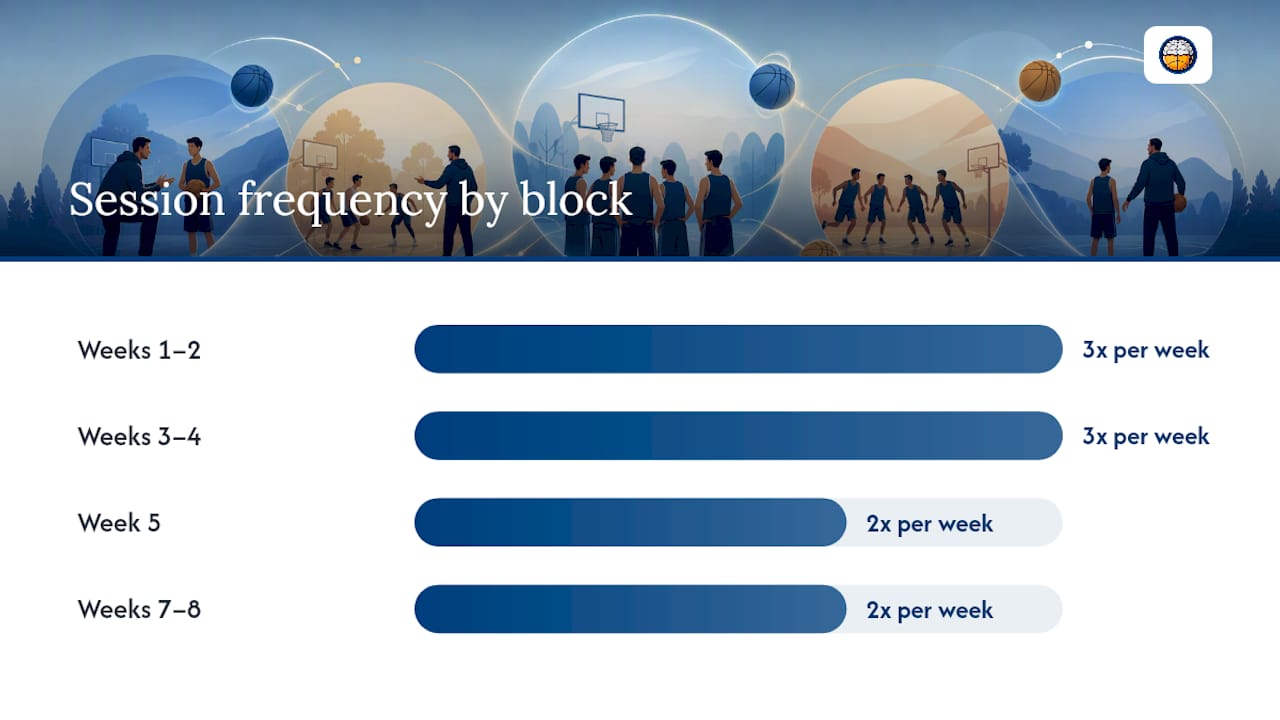
Run interpersonal skills work at least twice per week. Multiple sessions per week during early-season builds habits faster; fewer sessions per week is enough to maintain them mid-season.
What to measure
- Call rate: tally verbal cues per possession during constrained scrimmage. Target: at least one call per possession by week 4.
- Correct rotation rate: assistant coach marks each defensive rotation as correct or incorrect. Track the percentage each session.
- Captain initiation count: how many times the designated captain speaks first in a huddle or timeout without being prompted.
- Decision speed: time from catch to action call during Decision Speed 3v2. Record in seconds.
Observer checklist fields
- [ ] Player called screen before contact
- [ ] Defensive rotation verbalized
- [ ] Captain initiated huddle unprompted
- [ ] Silent drill completed without verbal breakdown
- [ ] Debrief led by player, not coach
Simple checklists like this let staff track progress without slowing down practice. Run a full observation session every two weeks and escalate to individual coaching when a player’s call rate stays flat across three consecutive sessions.
How to run pressure reps and use the right coaching language
Staff assignment checklist
- Head coach: observes, delays intervention, reinforces immediately after the rep
- Assistant coach: times the rep, records call rate and rotation accuracy
- Designated captain: manages player positioning and initiates the debrief
Sample coach scripts
Use these verbatim during reps:
- “I’m not stopping this until someone leads it.”
- “Who’s got the next call? Make it loud.”
- “Good call. Say it again so the whole gym hears it.”
- “Silence costs us a basket. Fix it.”
Fully detailed pressure rep: “Last 30 Seconds”
Setup: 5v5, score tied, 30 seconds on the clock. Coach calls a live timeout before the rep starts.
Trigger: Coach says nothing during the timeout. Waits up to 20 seconds for a player to lead.
Observation fields: Who speaks first? What do they say? Do teammates respond or wait for the coach?
Immediate feedback loop: The first player to lead the huddle gets a public acknowledgment before the next rep. No correction in the moment. Correction comes after, one-on-one.
HSB Academy’s “caught-not-taught” framework is the direct basis for this rep design. Lead 'Em Up’s Beat The Coach method adds the competitive layer: players compete to step up first, which turns leadership into a habit rather than a one-time event.
Pro Tip: Delay your intervention by at least 15 seconds during every pressure rep. Coaches who jump in immediately train players to wait for direction. The pause is the drill.
How do you connect drills to your playbook?
| Drill | Playbook Moment | Transfer Cue |
|---|---|---|
| Shell Drill Callouts | Any ball-screen action (pick-and-roll, DHO) | “Call it the same way you call it in the drill” |
| Transition Talk | Push-pace offense after a made basket | “Number call triggers the play” |
| Captain Huddle Rep | Live timeout or dead-ball situation | “Captain owns the initial seconds” |
| Decision Speed 3v2 | Fast-break reads | “Call the advantage out loud” |
| Silent 5-on-5 | Late-game noise situations | “Read the signal, not the word” |
Constrained scrimmage rules that force playbook communication:
- No basket counts unless the play was called before the catch.
- Any defensive breakdown without a verbal rotation call results in the offense keeping possession.
- Timeout huddles must be led by the captain, not the coach.
Film review prompts: Pause the clip and ask, “What should have been called here?” Then ask the captain to answer first. Jeb Kratzig’s drill research shows that reflection prompts like this accelerate communication habit formation when paired with live reps.
Rotating captain roles across your roster means every player practices leading a playbook moment, not just your most vocal players.
What mistakes do coaches make when training interpersonal skills?
- Coach over-directs: Players wait for you instead of leading. Fix: stay silent for at least 15 seconds at the start of every pressure rep.
- Drills become rote: Players go through the motions without real communication. Fix: change the constraint each week (add a defender, reduce time, remove verbal cues).
- Quieter players hide: Louder players dominate every call. Fix: assign specific call responsibilities by position so every player has a required verbal role.
- No measurement: Coaches feel improvement but can’t show it. Fix: use the call rate tally and rotation checklist from the progressions section every session.
- Feedback is too general: “Talk more” changes nothing. Fix: name the exact call that was missing (“You needed to say ‘switch’ before the screen set”).
- Mixed-age teams get one approach: Younger players need more explicit cues; older players need more autonomy. Fix: run the same drill with different constraint levels by age group within the same practice.
- Cultural diversity is ignored: Some players come from backgrounds where speaking up to peers feels uncomfortable. Fix: start with written cue cards before moving to verbal calls, and normalize all forms of communication equally.
- Skipping the debrief: The debrief is where habits form. Fix: protect the last two minutes of every session for a player-led debrief, no exceptions.
Pausing drills when players go silent and praising the first vocal player are the two highest-leverage corrections a coach can make in a single session.
Key Takeaways
Interpersonal skills coaching in basketball develops fastest when drills create pressure, measurement is simple, and players lead the debrief.
| Point | Details |
|---|---|
| Start with pressure reps | Run “Last 30 Seconds” at your next practice to reveal who leads without prompting. |
| Measure call rate weekly | Track verbal cues per possession; aim to increase calls over the weeks. |
| Rotate the captain role | Assign a new captain daily so every player practices leading, not just the most vocal. |
| Mix verbal and silent drills | Pair Shell Drill Callouts with Silent 5-on-5 to build both explicit and implicit coordination. |
| Hoop Mentality resources | Use the Basketball Starter Pack For Coaches for ready-made drill sheets and observation checklists. |
The gap most coaches never close
Most coaches know their players need to talk more. What they miss is that telling players to talk more does nothing. The real work is designing situations where silence costs the team something real, and then getting out of the way long enough for a player to fix it.
The “caught-not-taught” idea from HSB Academy sounds simple, but it requires coaches to resist their most natural instinct: correcting immediately. Every time you jump in before a player has a chance to lead, you take a leadership rep away from them. Over a season, that adds up to a roster that waits for direction instead of creating it.
The coaches who build the most communicative teams are not the loudest voices in the gym. They are the ones who build the right constraints, track the right numbers, and stay quiet long enough for their players to find their own voices.
Hoop Mentality resources that support this plan
Coaches who want to implement this plan without building everything from scratch have a direct path. The Basketball Starter Pack For Coaches includes drill sheets, observation checklists, and quick practice templates that map directly to the drills and measurement system in this guide. No reformatting required.
The Basketball Template Bundle For Coaches adds editable season calendars and playbook-integration templates, so you can map the 8-week progression directly into your existing practice schedule. The Editable Scouting Report Template and Basketball Scouting Report Template include fields for communication, decision-making, and leadership indicators, making them practical tools for tracking player development across games and evaluations. Browse all resources at Hoop Mentality and add what fits your program.
Useful sources
- The Role of Communication Drills in Basketball Coaching — Hoop Mentality: Source for observation checklist fields and call rate tracking methods.
- How To Develop Leadership Skills In Basketball Players — Hoop Mentality: Source for captain rotation and distributed leadership practice methods.
- 7 Effective Communication Strategies Basketball Coaches Use — Hoop Mentality: Source for pausing-and-praising methods and normalizing vocal leadership.
FAQ
What is interpersonal skills coaching in basketball?
It is the practice of using drills, pressure reps, and structured debriefs to develop players’ communication, leadership, and teamwork habits on the court. It differs from general soft-skills training because every method connects directly to game situations.
How long does it take to see measurable improvement?
Most teams show a measurable increase in call rate and correct rotation rate within a few weeks of consistent twice-weekly sessions. Visible leadership behavior in games typically appears after some time of regular practice.
Which drill should I run first?
Start with Shell Drill Callouts. It requires no extra equipment, fits any roster size, and immediately reveals which players communicate and which go silent under mild pressure.
How do I adapt these drills for younger or mixed-age players?
Use written cue cards before moving to verbal calls for younger players, and assign specific call responsibilities by position so no player can stay silent. Older players can handle reduced time constraints and silent variations sooner.
How does Hoop Mentality support this type of coaching?
The Basketball Starter Pack For Coaches provides ready-made drill sheets, observation checklists, and practice templates that coaches can use immediately without building materials from scratch.