

TL;DR:
- Communication drills cultivate measurable verbal habits, reveal coverage gaps, and foster psychological safety in basketball teams.
- Implementing a sequence of tabletop, on-court, and roleplay drills systematically improves communication, relationships, and decision-making under pressure.
Communication drills are structured practice exercises that train basketball players and coaches to exchange clear, timely information under game-like pressure. The role of communication drills goes beyond calling out screens or switching on defense. These exercises build the habits, trust, and decision-making clarity that separate coordinated teams from reactive ones. Coaches who treat communication as a trainable skill, not a personality trait, consistently develop stronger team cohesion and healthier coach-athlete relationships. This guide covers the key benefits, drill formats, measurement methods, and design principles you need to make communication a real competitive advantage.
What are the key benefits of communication drills for basketball teams?
Communication drills deliver three distinct advantages that standard skill work cannot replicate: improved coordination, psychological safety, and gap detection.
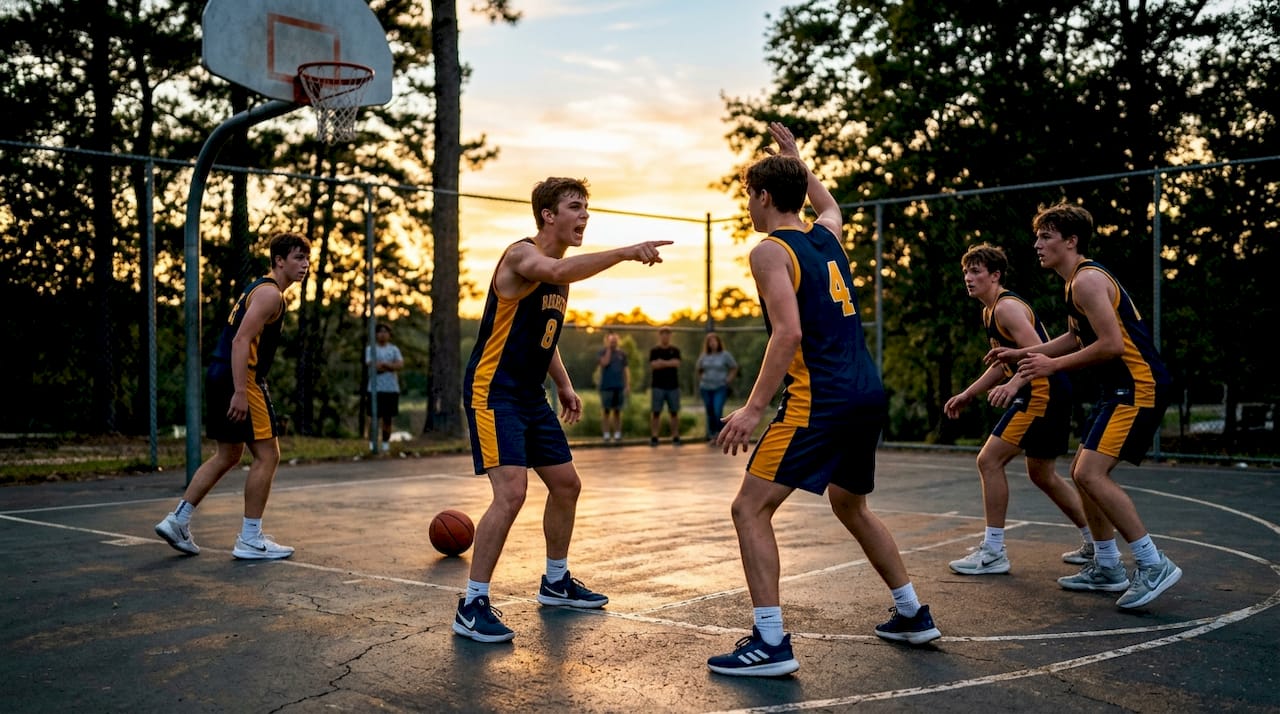
On-court coordination and decision speed improve because drills force players to verbalize reads in real time. When a point guard calls “ball screen left” before the screen arrives, the entire defense reacts faster. Repetition in practice builds the verbal habits that carry into games without conscious effort. Teams that practice communication under pressure develop faster recognition times and fewer coverage breakdowns.
Psychological safety is the second major benefit. When players know they can call out a mistake or ask for help without being criticized, they communicate more freely. A 2026 Frontiers in Psychology study found that coach-athlete relationship quality reduces burnout through psychological safety enabled by effective communication practices. That means your communication drills are not just tactical tools. They are relationship-building sessions that protect your players and yourself from long-term burnout.
Gap detection is the third benefit most coaches overlook. Drills reveal where your communication system actually breaks down, not where you think it breaks down. Drills reveal unclear roles and competing communication channels that only surface under time pressure. You cannot fix a gap you have not seen.
Here is what well-designed communication drills consistently improve:
- Verbal callout speed and accuracy during defensive rotations
- Player confidence in flagging confusion without fear of criticism
- Coach clarity on which communication systems are working and which are not
- Team-wide consistency in terminology and signal use
- Coach-player trust built through repeated, structured interaction
Pro Tip: Run your first communication drill with no scoring pressure. The goal is to hear every player verbalize their read, not to execute perfectly. Once the verbal habit forms, add competitive stakes.
How do different types of communication drills work?
Three drill formats target different communication skills. Each has a specific purpose, and the most effective programs use all three in sequence.
| Drill Type | Format | Primary Skill Targeted | Best Used When |
|---|---|---|---|
| Tabletop exercise | Verbal walkthrough, no movement | Role clarity and communication flow | Before introducing live drills |
| On-court drill | Live reps under game-like pressure | Real-time callouts and decision speed | Mid-practice, after roles are clear |
| Roleplay drill | Scripted scenario with emotional stakes | Difficult conversations and feedback | Off-court, team meeting settings |
Tabletop exercises are discussion-based sessions where coaches and players talk through who communicates what, when, and to whom. Tabletop exercises clarify roles before live drills, preventing the inefficient communication patterns that form when players are confused and moving fast at the same time. A simple tabletop rep looks like this: the coach describes a ball screen situation, and each player verbally states their assignment and their callout. No movement, no defense. Just language.
On-court drills simulate real game communication under defensive and offensive pressure. A 3-on-3 shell drill where every rotation requires a verbal callout is a communication drill, not just a defensive drill. The communication is the drill. Measuring metrics like time-to-callout during these reps gives you observable data on whether communication is actually improving.
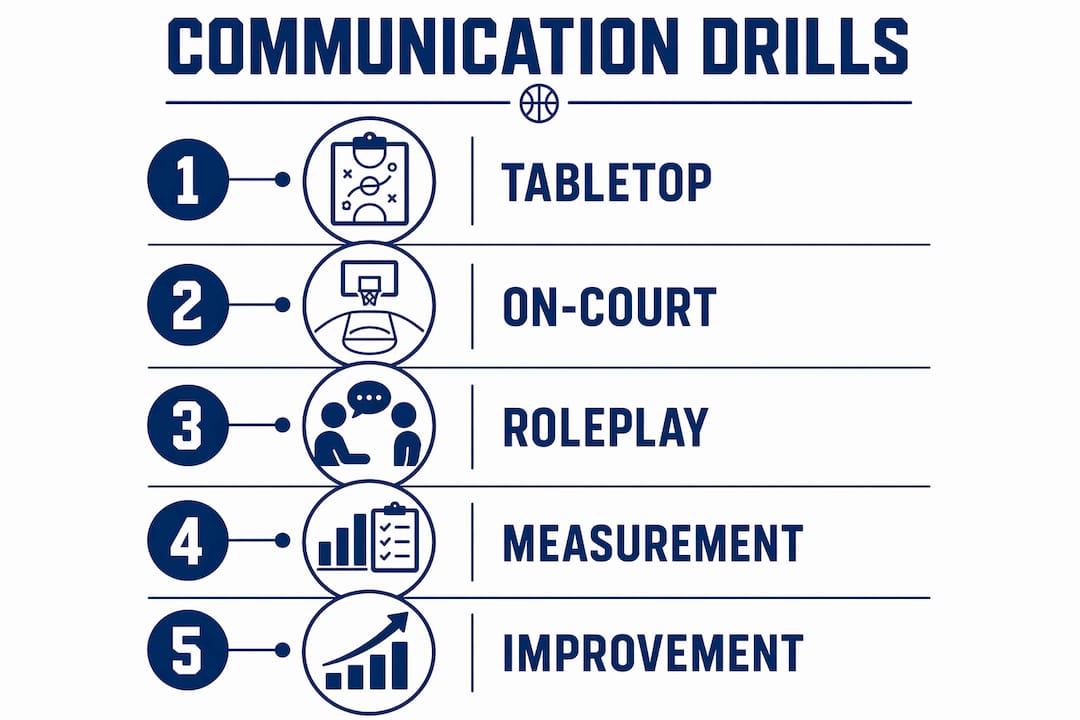
Roleplay drills address the conversations that happen off the court. Giving a player critical feedback, handling a conflict between teammates, or discussing a role reduction all require communication skills that standard practice never develops. Realistic roleplay scenarios close the gap between knowing what to say and actually saying it under emotional pressure. Exec Learn’s research on communication roleplay confirms that emotional intensity in practice is what drives skill transfer to real situations.
Pro Tip: Sequence your drills in this order every week: tabletop on Monday, on-court reps Tuesday through Thursday, and a short roleplay session Friday. This progression builds clarity before adding pressure.
What metrics can coaches use to measure drill effectiveness?
Treating communication as a measurable skill is what separates coaches who improve it from coaches who just hope it improves. Observable metrics like recognition time and communication acknowledgements give you concrete data instead of gut feelings.
The most useful metrics fall into two categories: speed metrics and accuracy metrics.
Speed metrics track how quickly communication happens:
- Time from screen set to verbal callout
- Time from defensive breakdown to coverage correction
- Time from coach instruction to player acknowledgement
Accuracy metrics track whether communication is correct and complete:
- Percentage of rotations with a verbal callout
- Percentage of plays where every player can state their assignment before execution
- Frequency of coverage checks completed without coach prompting
Beyond numbers, watch for qualitative indicators. Are players initiating communication, or only responding to it? Do players correct each other without hesitation? Does the team communicate the same way in scrimmages as in drills? These behavioral signals tell you whether communication has become a genuine habit or just a drill-time performance.
A simple tracking sheet with five to ten observable behaviors per practice session gives you a baseline within two weeks. From there, you can identify which drill formats are producing the most improvement and where to focus next.
How do communication drills support coach-athlete relationships?
Communication drills build trust by creating repeated, structured moments where coaches and players practice honest interaction. That consistency is what strengthens coach-athlete relationships over a full season.
The 2026 Frontiers in Psychology research on coach burnout found that psychological safety and relationships mediate the connection between coach knowledge and burnout outcomes. In plain terms: a coach who communicates well with players is less likely to burn out, and so are the players. The quality of the relationship is the buffer.
Motivational climate research adds another layer. A 12-week swimming coach intervention found that empowering communication behaviors increased after structured communication training and were perceived positively by athletes. That study applies directly to basketball. When you train yourself to communicate with clarity and respect, players respond with more openness and effort.
“High-quality coach-athlete relationships foster psychological safety and sustain coach wellbeing in high-pressure environments.” — Frontiers in Psychology, 2026
The practical implication is clear. Communication drills are not just player development tools. They are coaching development tools. Every drill you run is an opportunity to model the communication standard you want your team to adopt. Players learn how to communicate by watching how you communicate, especially under pressure. Explore coach communication methods to see how this plays out across different coaching styles and team contexts.
What are practical tips for designing effective communication drills?
Effective drill design follows a clear sequence. Start simple, add pressure gradually, and keep the focus on communication and decisions rather than outcomes.
-
Define one communication objective per drill. Do not try to fix defensive rotations and verbal callouts in the same rep. Pick one. “Every player states their assignment before the ball is inbounded” is a clear, measurable objective. “Communicate better” is not.
-
Use a single-source communication flow. Assign one player per situation as the primary communicator. In a ball screen, the on-ball defender calls the coverage. Everyone else responds. Competing callouts create confusion faster than silence does.
-
Progress from tabletop to live. Starting with tabletop reps before adding movement prevents players from forming bad communication habits under pressure. Walk before you run, and talk before you walk.
-
Use plain language. Every callout in your system should be one or two words maximum. “Switch,” “drop,” “hedge,” “help.” If a player needs three seconds to remember the term, the drill has already failed its purpose.
-
Add structured roleplay for off-court communication. Combining on-court drills with roleplay builds the full communication skill set your team needs. On-court drills handle tactical communication. Roleplay handles the relational communication that determines team culture.
Pro Tip: Record one practice per week and review communication moments specifically, not just execution. You will catch patterns in your own communication that you cannot see in real time.
Key takeaways
Communication drills work because they make communication a trainable, measurable skill rather than an assumed personality trait, and that shift produces faster teams, stronger relationships, and more sustainable coaching.
| Point | Details |
|---|---|
| Communication is a skill, not a trait | Treat callouts and acknowledgements as measurable behaviors, not personality characteristics. |
| Sequence drill types deliberately | Run tabletop exercises before on-court reps to prevent confusion under pressure. |
| Measure speed and accuracy | Track time-to-callout and coverage check rates to confirm real improvement. |
| Drills protect against burnout | Psychological safety built through communication reduces burnout for coaches and players alike. |
| Roleplay covers the full picture | Structured roleplay develops the relational communication skills that on-court drills cannot reach. |
Why communication drills changed how I coach
Most coaches I know treat communication as a byproduct of good culture. If the culture is right, players will talk. I believed that for years, and it cost me. The teams I coached early in my career had good culture and poor communication. Players liked each other but could not execute under pressure because they had never practiced the actual language of the game.
The shift happened when I started treating communication the same way I treat shooting mechanics. You do not assume a player will develop a good shot because they love the game. You build it rep by rep. Communication is identical. The effective communication strategies that actually stick are the ones practiced with the same structure and repetition as any other skill.
What surprised me most was the relational payoff. When players practice communicating honestly in drills, they start doing it in film sessions, in timeouts, and in difficult conversations with me. The drill creates the habit, and the habit builds the relationship. That connection between structured practice and genuine trust is what I think most coaching resources miss entirely. They focus on the tactical output and skip the relational foundation that makes the output sustainable.
If you are only running communication drills to fix defensive breakdowns, you are leaving the most valuable benefit on the table.
— Dejan
Build your practice plan around communication
Hoopmentality’s Game Preparation Guide with Weekly Practice Plan gives you a structured framework to integrate communication drills into every week of your season. The guide includes progressive drill sequences, practice plan templates, and preparation tools built from real coaching experience. You get a clear system for organizing tabletop sessions, on-court communication reps, and team-building work without starting from scratch each week. Coaches at every level use it to save time, communicate more clearly with players, and prepare teams with confidence. Get your copy at Hoopmentality and put communication at the center of your practice plan.
FAQ
What is the role of communication drills in basketball?
Communication drills train players and coaches to exchange clear, accurate information under game-like pressure. They build verbal habits, reveal coverage gaps, and develop the psychological safety that supports stronger team performance.
How often should basketball teams run communication drills?
Communication drills should appear in every practice session, even briefly. A five-minute tabletop walkthrough before on-court work is enough to reinforce roles and terminology consistently across a full season.
Can communication drills reduce coach burnout?
Yes. A 2026 Frontiers in Psychology study found that coach-athlete relationship quality reduces burnout through psychological safety. Communication drills build that relational quality directly.
What is the difference between on-court drills and roleplay drills?
On-court drills develop tactical communication like callouts and coverage checks during live reps. Roleplay drills develop relational communication skills for difficult conversations, feedback, and conflict, which standard practice never addresses.
How do you measure whether communication drills are working?
Track observable metrics like time-to-callout, percentage of rotations with verbal acknowledgement, and frequency of player-initiated communication. Improvement in these numbers confirms the drills are producing real skill transfer.