

A coaching philosophy is a one-page statement of your core values plus the decision rules you follow when those values get tested. The examples below are copyable starting points, not scripts. Pick one that matches your level and adjust the wording until it sounds like you, then move to the template section to turn it into something enforceable.
TL;DR:
- Coaches should develop a one-page philosophy with two or three enforceable core values and specific decision rules tied to each, tailored to their coaching level.
- Regularly revisiting and adjusting the philosophy based on team feedback and roster changes ensures it remains relevant and effective throughout the season.
- Clear, written communication of rules and expectations at the start of the season helps prevent conflicts and disputes over playing time and accountability.
- Applying coaching frameworks from top coaches, like documenting values and posting decision rules, improves consistency and team trust.
- Tailoring decision rules to age, skill level, and team diversity enhances fairness and effectiveness, especially between recreational youth and competitive programs.
Table of Contents
- Sports Coaching Philosophy Examples by Level and Style
- How to Write a Coaching Philosophy in Four Steps
- A One-Page Coaching Philosophy Template You Can Copy
- Putting Your Philosophy Into Practice
- What Legendary Coaches Can Teach You About Building a Philosophy
- How Hoop Mentality Turns Your Philosophy Into Action
- Common Mistakes Coaches Make Writing a Philosophy
- Adjusting Your Coaching Philosophy for Different Ages and Skill Levels
- Why Team Diversity Should Shape Your Coaching Philosophy
- How to Assess and Update Your Philosophy Over Time
- A Coach’s Case for Writing It Down
- Get Your Philosophy Off the Page and Into the Season
- Sources
- FAQ
Sports Coaching Philosophy Examples by Level and Style
Coaching philosophy examples work best when they’re grouped by context. A statement built for a rec league doesn’t translate to a college locker room, and a process-first philosophy reads differently than one built around discipline. Below are close to 20 examples, sorted by where you coach and what you emphasize. Copy one directly or blend two together.
Recreational and youth coaching philosophy examples
Coaches at this level are managing first exposure to the game. Fun, safety, and equal opportunity usually come before winning.
- “Every kid plays every game, every position gets a turn, and effort gets more praise than the scoreboard.” Best for rec leagues where retention matters more than the standings.
- “I coach to build confidence first and skill second, because kids who feel safe making mistakes improve faster.” Best for first or second-year players still learning the rules.
- “Practice is where we compete hard. Games are where we have fun with what we built.” Best for coaches who want structure without pressure.
- “I measure a good season by whether kids ask to play again next year.” Best for a program focused on long-term participation over short-term wins.
Youth development coaching philosophy examples
This is the bridge between recreational ball and real competition. The philosophy needs to protect development while introducing accountability.
- “Skill development comes before winning. I’d rather lose a game teaching the right habit than win one reinforcing a bad one.” Best for U10 to U14 programs building fundamentals.
- “Every player gets individual feedback at least once per practice, win or lose.” Best for coaches trying to keep parents informed without formal meetings.
- “We rotate positions through age 12 so athletes understand the whole game before they specialize.” Best for programs resisting early position-locking.
- “Effort and attendance drive playing time here, not talent alone.” Best for coaches trying to reward the right behaviors early.
Competitive club and high school coaching philosophy examples
Once tryouts and cuts enter the picture, the philosophy has to explain how decisions get made under pressure.
- “I coach the person before the player. Character issues get addressed before skill issues, every time.” Best for programs where locker room culture has been a problem.
- “Playing time reflects practice performance, not reputation. What you did last season doesn’t buy you minutes this season.” Best for programs with returning players who expect automatic roles.
- “We define success by improvement from October to March, not by our record in November.” Best for rebuilding programs managing expectations.
- “Discipline is the foundation. If you’re late, you sit. If you argue a call, you sit. No exceptions.” Best for coaches who’ve struggled with enforcement in the past.
- “I coach with the parents in the loop, not in the huddle. Concerns get a meeting within 48 hours, not a sideline conversation.” Best for programs managing high parent involvement.
College and pro-level coaching philosophy examples
At this level, the philosophy tends to center on preparation, roles, and competitive standards rather than development basics.
- “Preparation is the only variable I fully control, so it gets the most attention.” Borrows directly from Mike Krzyzewski’s emphasis on the will to prepare as a defining value.
- “Roles are earned weekly through film grades and practice reps, and they’re communicated before they’re enforced.” Best for programs with deep rosters and real competition for minutes.
- “I build systems around what my personnel does well rather than forcing personnel into a system.” Best for coaches inheriting a roster rather than recruiting one from scratch.
Cross-cutting styles worth borrowing from
These aren’t tied to a level. They describe a coaching identity you can layer onto any of the examples above.
- Player-centered: “My job is to make each athlete better than they thought they could be, and better people than they were when they arrived.”
- Process-first: “I don’t coach outcomes. I coach habits, and I trust that good habits produce good outcomes.”
- Accountability-driven: “Standards apply to everyone equally. Your best player and your last player off the bench follow the same rules.”
- Relationship-first: “Trust comes before tactics. I can’t coach someone who doesn’t believe I have their best interest in mind.”
A coaching philosophy in sports works because it’s specific enough to guide a real decision, not just sound good in a meeting.
How to Write a Coaching Philosophy in Four Steps
A workable philosophy statement takes about an hour of honest thinking, not a weekend retreat. Structured coaching methods like goal setting and competency-based assessment consistently improve outcomes precisely because they force vague intentions into concrete language. The same logic applies to writing your own philosophy.
- State why you coach. Write one honest sentence. Not the answer that sounds good in an interview, the real one. “I coach because I want kids to learn they can handle hard things” is different from “I coach because I want to build a winning program,” and each leads to different decision rules later.
- Pick two or three core values, not eight. A philosophy with ten values is a wish list. Pick the two or three that you’ll actually enforce when it’s uncomfortable, like benching a starter for missing curfew.
- Translate each value into an if/then decision rule. “Effort matters” is a slogan until you attach a rule to it. Rizzler Sports’ guide to writing a coaching philosophy statement offers a clean example: “Effort over outcome” becomes “playing time is allocated primarily by attendance and effort scores collected weekly; players who miss more than two practices without notice are ineligible for the next game.” That’s a rule you can actually apply on a Tuesday when someone tests it.
- Write your definition of success. Decide now, not in March, whether success means a record, a development benchmark, or something else. Write it down so nobody has to guess later.
For one-on-one conversations about roles or goals, Google’s coaching guide recommends the GROW model: Goal, Reality, Options, Will. It’s a simple four-question structure (What do you want? Where are you now? What could you do? What will you do?) that turns a philosophy into an actual development conversation instead of a lecture.
Pro Tip: Draft your philosophy before the season starts, then revisit it at the midpoint. A philosophy written in August and never reopened until May usually needs more revision than one checked in October.
A One-Page Coaching Philosophy Template You Can Copy
A one-page document beats a mission statement buried in a parent handbook nobody reads. The most useful version includes five parts: two or three non-negotiable values, two example decision rules per value, a definition of success, communication commitments, and scheduled written assessments.
Here’s the layout:
- Why I coach: One sentence, personal and specific.
- Core values: Two or three, no more.
- Decision rules: If/then statements tied to each value.
- Definition of success: What you’re actually measuring this season.
- Coach commitments: What players and parents can expect from you.
- Player and parent expectations: What you expect back from them.
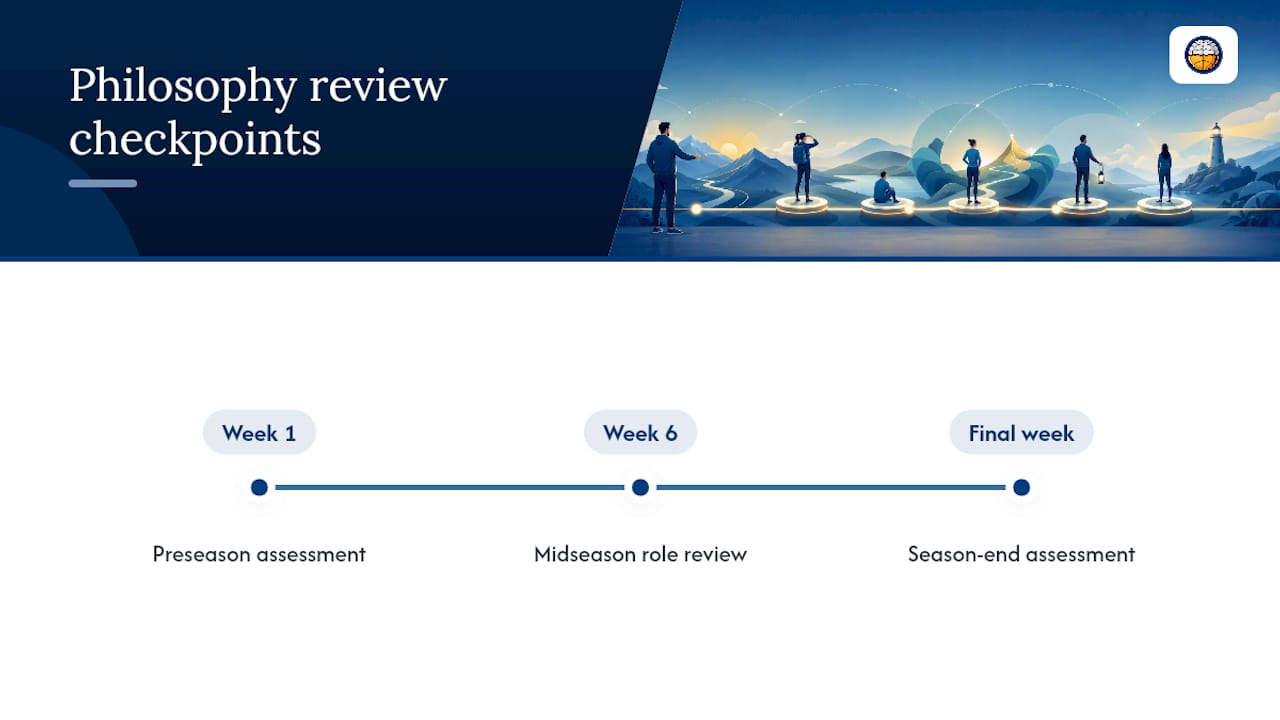
- Season checkpoints: Dates for written assessments or role reviews.
Worked example: youth development team
Why I coach: I want players to leave this program better at basketball and better at handling failure than when they arrived.
Core values: Effort, coachability, teamwork.
Decision rules: Playing time is allocated by practice attendance and effort scores, not scrimmage stats alone. Players who ignore feedback twice in a practice sit the next quarter of the following game.
Definition of success: Every player improves at least one skill area from our preseason assessment to our season-end assessment, regardless of team record.
Coach commitments: Written feedback three times per season. A role conversation before every player’s third game.
Player and parent expectations: Attend practice or notify the coach in advance. Address concerns through a scheduled conversation, not a postgame sideline comment.
Season checkpoints: Preseason assessment (week 1), midseason role review (week 6), season-end assessment (final week).
Once it’s written, turn it into a handout: one page, printed or PDF, handed out at the first parent meeting and posted wherever your team checks announcements. Keep the language identical to what’s in your practice plans so players hear the same words in both places.
Putting Your Philosophy Into Practice
A philosophy that lives only in your head doesn’t survive the first parent complaint about playing time; building respect and clear expectations is key, as shown by formation coach vocal certifié insights. It has to show up in three places: the first meeting, the practice plan, and a measurement schedule you actually follow.
Present it at your first parent and player meeting as a one-page handout, not a verbal summary. Read the decision rules out loud so nobody can claim they didn’t know the standard. This single step prevents most of the playing-time arguments that surface in November, because a written rule that says “playing time reflects weekly effort scores” is much harder to dispute than an unwritten sense that a coach “just likes” certain players.
Decision rules only matter if they show up consistently:
- Playing-time rules: State the formula (attendance, effort scores, practice performance) and apply it the same way for your best player and your twelfth man.
- Written progress reports: Three per season is enough for most youth and high school programs, tied to your preseason, midseason, and season-end checkpoints.
- Role talks: Use a short structure like GROW to walk a player through where they stand and what changes their role, rather than a vague “keep working hard.”
Programs that formalize goal-setting and personal development plans see measurably better tracking of athlete growth than programs relying on informal feedback, according to a review of positive coaching psychology.
For practice design itself, resist the temptation to run the same plan every week. Elite coaches adapt their practice plans to the team’s emotional and developmental state on a given day rather than defaulting to what worked last season. If your team looks flat, that’s a signal to change the plan, not push through it. For more on aligning daily practice structure with your stated values, see these team communication tips for coaches.
What Legendary Coaches Can Teach You About Building a Philosophy
You don’t need forty years on a sideline to borrow good structure. A handful of well-documented coaching frameworks show what a codified philosophy actually looks like at the highest level.
- John Wooden’s Pyramid of Success codified character traits, like industriousness and loyalty, into a visual hierarchy players could reference. The takeaway for youth and club coaches: pick your two or three values and give them a name players can repeat back to you.
- Pat Summitt’s Definite Dozen was a list of non-negotiables, things like respect and discipline, posted where players saw them daily. The lesson: write your decision rules down and post them, don’t just say them once in August.
- Mike Krzyzewski’s “will to prepare” treated preparation itself as a value, not just a means to winning. Practice was adapted constantly rather than run on autopilot, a habit worth copying regardless of level.
- Anson Dorrance’s competition-based culture at North Carolina built measurable internal competition into daily training. The adaptation for youth programs: keep the competitive structure but scale down the stakes so it builds confidence instead of anxiety.
What transfers to a rec or club program is the codification, writing values down as specific, repeatable language. What doesn’t transfer is the intensity calibration; a Definite Dozen posted in a middle school gym needs gentler enforcement than one posted in a Division I locker room.
How Hoop Mentality Turns Your Philosophy Into Action
Writing the philosophy is step one. Making players and parents live by it is the harder part, and it’s the part most coaches skip because building enforcement documents from scratch eats into practice-planning time. Hoop Mentality builds its basketball coaching resources from real coaching experience, focused specifically on turning stated values into documents coaches actually use.
Each product maps to a specific gap in the process:
- Rules need a document, not a speech. A code-of-conduct template gives your decision rules a physical form players and parents sign off on, instead of a rule they half remember from the first meeting.
- The one-pager and season checkpoints need a system. A bundled set of practice-plan and assessment templates lets you build your one-pager, your written progress reports, and your practice plans in the same format, so the language stays consistent everywhere your team sees it.
- Your philosophy needs to travel with you. If you’re applying for a new coaching role, a resume template lets you present your philosophy and results clearly to an athletic director who’s reading twenty other applications that afternoon.
For the deeper version of this process, including identity-building examples specific to basketball programs, see this basketball coaching philosophy guide.
Common Mistakes Coaches Make Writing a Philosophy
The most common mistake is writing values with no enforcement mechanism attached. “I value hard work” means nothing until it’s tied to a decision rule about playing time or roles. Without that translation, the philosophy is a poster, not a working document.
The second mistake is writing too many values. A list of eight or nine sounds thorough but becomes impossible to reference under pressure. When a parent challenges a decision mid-season, you need to point to two or three rules you can recite from memory, not scroll through a long document looking for the relevant clause.
A third mistake: copying a philosophy verbatim from a famous coach without adapting it to your actual roster and level. Anson Dorrance’s competitive drills work at an elite college program with players who’ve opted into that intensity. The same structure dropped into a U12 rec team without adjustment creates anxiety instead of growth.
The fourth mistake is writing the philosophy once and never revisiting it. A statement drafted in August, before you knew this year’s roster, often stops matching reality by January. Coaches who treat the philosophy as a living document, not a plaque, get more use out of it.
Finally, plenty of coaches write a philosophy nobody but them ever reads. If it’s not handed out, posted, or referenced in a parent meeting, it isn’t actually guiding decisions, it’s just a private journal entry.
Adjusting Your Coaching Philosophy for Different Ages and Skill Levels
The same core value can require an entirely different decision rule depending on who’s on your roster. “Effort determines playing time” works cleanly in a competitive high school program where players understand tryouts and cuts. Applied literally to a first-grade rec team, it can undercut the entire point of introducing kids to the game.
For recreational and early youth levels, lean the philosophy toward participation and skill exposure. Decision rules should protect equal playing time and position rotation rather than ranking players against each other. Save competitive rules like performance-based minutes for the point where players and parents have opted into a competitive environment, typically club tryouts or high school.
For competitive club, high school, and college levels, the philosophy can carry sharper edges. Decision rules tied to attendance, film study, and practice performance make sense once athletes understand the trade-off: more accountability in exchange for more competitive opportunity.
Skill level matters as much as age. A talented 10-year-old on a competitive travel team needs a different philosophy than an average 10-year-old in a house league, even though they’re the same age. Write your decision rules around the actual stakes of your program, not a generic age bracket.
Why Team Diversity Should Shape Your Coaching Philosophy
Rosters rarely arrive with a single shared background, and a philosophy written for one type of player often fails a chunk of the team silently. Players raised in cultures that emphasize deference to authority may hesitate to raise a concern about playing time directly, even when your open-door policy invites it. Others expect direct, immediate feedback and read a coach’s silence as disapproval.
Build flexibility into your communication commitments rather than assuming one meeting format works for everyone. Some players respond better to a private conversation before or after practice; others prefer written feedback they can process before responding. Offering both isn’t a compromise of your standards, it’s a recognition that the same decision rule can be communicated multiple ways without changing what it requires.
Team diversity also shows up in what motivates effort. A rule tied purely to competitive ranking may resonate with players raised in highly individualistic sports cultures, while players from more collectivist backgrounds may respond better to team-based accountability, like group attendance targets tied to a team reward. A philosophy that only recognizes one motivational style will connect with part of your roster and lose the rest.
How to Assess and Update Your Philosophy Over Time
A philosophy written in August and never touched again usually drifts out of sync with the team you actually have by midseason. Build a review into your calendar the same way you’d schedule a scouting session.
Three checkpoints work well for most programs: preseason drafting, a midseason review around the halfway point of your schedule, and a season-end assessment once the year wraps. At each checkpoint, ask a direct question: did my decision rules actually get applied consistently, or did I make exceptions? Exceptions aren’t automatically wrong, but repeated ones signal a rule that doesn’t fit your roster.
Player and parent feedback matters here too. If the same concern comes up in multiple conversations, whether it’s confusion about playing time criteria or a sense that communication commitments aren’t being met, that’s a signal the language needs revision, not just better enforcement. Structured, competency-based assessment tools consistently improve outcomes precisely because they create a regular checkpoint instead of relying on memory.
Treat your one-pager as a working draft across seasons, not a permanent document. The values might stay stable for years. The decision rules attached to them should evolve as your roster, level, and program’s goals shift.
A Coach’s Case for Writing It Down
The gap between a philosophy that works and one that gathers dust is enforceability. Plenty of coaches can articulate values in a hallway conversation. Far fewer write those values down as decision rules they’ll actually apply when a parent is upset or a starter is unhappy. That gap is where trust either builds or breaks.
Draft your one-page philosophy this week, before the next roster decision forces you to improvise one. Share it with your assistant coaches and, if you’re comfortable, with parents at your next meeting. A philosophy tested in a real conflict is worth more than one that only ever sounded good in a preseason speech.
— Dejan
Get Your Philosophy Off the Page and Into the Season
Writing the philosophy is the easy half. Hoop Mentality exists for the harder half, turning those values into documents your team actually sees and follows, without you building forms from scratch during your one free hour between practice and film review.

Start with the Basketball Player Code Of Conduct Template if your priority is enforcing behavior rules, attendance, curfew, respect for officials, with something players and parents sign rather than just hear about once. If you’re building your full one-pager, practice plans, and assessment schedule from scratch, the Basketball Template Bundle For Coaches gives you all three in a consistent format, so the language in your philosophy matches the language in your practice plans and progress reports. And if you’re presenting that same philosophy to an athletic director in a job application, the Editable Basketball Coaching Resume Templates help you show it clearly on paper.
Pro Tip: Hand out your code-of-conduct template at the same meeting where you present your one-pager. Introducing both documents together, values and rules side by side, prevents the “wait, when did this rule start?” conversation later in the season.
For a deeper dive into building team identity around your philosophy, read this basketball coaching philosophy guide next.
Sources
- Bringing context to workplace coaching and meta-analytic findings (PMC article)
- NYTimes Athletic: Coach K on leadership and practice planning
- Rizzler Sports: Coaching philosophy guide with sample one-pager
FAQ
What is a good coaching philosophy in sports?
A good coaching philosophy names two or three core values and attaches a specific, enforceable decision rule to each one, rather than listing vague qualities like “hard work” with no rule behind them. It also states a clear definition of success so the coach and team are measuring the same thing all season.
How do I write my coaching philosophy?
Start by writing one honest sentence about why you coach, then pick two or three values you’ll actually enforce, translate each into an if/then decision rule, and finish with your definition of success. Google’s GROW model is a useful framework for turning that philosophy into individual conversations with players.
What are the three coaching philosophies?
There’s no single official list, but three commonly discussed approaches are player-centered (development and confidence first), process-first (habits over outcomes), and discipline or accountability-driven (equal standards enforced consistently). Many effective coaches blend two of these rather than picking just one.
How do I get parents to accept my coaching decisions?
Present your philosophy as a written one-pager at the first parent meeting, including the specific decision rules for playing time and communication, so expectations are set before conflict arises rather than during it. A written rule about how minutes are allocated is far harder to dispute than an unstated impression that a coach favors certain players.
Should my coaching philosophy change between age groups?
Yes. The core values can stay consistent, but the decision rules attached to them should shift, favoring equal participation and skill exposure at younger recreational levels and performance-based accountability once players opt into competitive club, high school, or college programs.