

This page collects ready-to-download coaching philosophy PDFs and editable templates you can copy, adapt, and print in 15 to 30 minutes. It highlights the exact lines worth stealing from real samples, breaks down fill-in-the-blank templates for three different approaches, and shows how to turn a printed page into daily practice language. Scroll to the annotated list below for specific PDFs organized by sport and audience.
TL;DR:
- A coaching philosophy PDF must clearly connect core values to observable actions to be truly effective in guiding behavior during practice and games.
- Using three to four specific values paired with concrete, measurable actions helps ensure players understand and embody the philosophy daily.
- Short, memorable catchphrases or slogans significantly improve team adoption and recall, especially when supported by simple practice or game heuristics.
- Templates that pair values with drills or decision rules streamline the process of integrating philosophy into actual coaching routines.
- Customizable resources like editable PDFs and practice sequence guides enable coaches to create practical, sport-specific philosophy documents quickly.
Table of Contents
- What Makes a Coaching Philosophy PDF Worth Downloading
- Annotated Coaching Philosophy PDF Examples by Sport and Level
- Three Fill-In-The-Blank Coaching Philosophy Templates
- Turning the PDF Into Daily Practice and Game Decisions
- Why Hoop Mentality Builds Ready-to-Use Philosophy PDFs
- Get Your Coaching Philosophy Into a Printable PDF Tonight
- Sources
- FAQ
What Makes a Coaching Philosophy PDF Worth Downloading
A coaching philosophy PDF is only useful if it does three things: state your core values, explain your purpose, and spell out the actions that prove both are real. Skip any one of those and you get a poster, not a philosophy. According to Positive Psychology’s coaching framework, a standard coaching philosophy rests on explicit core values, a clear mission statement, and documented action steps that connect those values to daily practice and game-day calls.
Most PDFs fail on the third piece. They list values like “discipline” or “respect” and stop there, leaving players to guess what those words mean in a huddle. A stronger document maps each value to a specific behavior:
- Value: Accountability → Action: Players call their own traveling violations in practice scrimmages.
- Value: Effort → Action: Every drill ends with a sprint, no exceptions for starters.
- Value: Composure → Action: Coaches use a scripted 10-second timeout routine instead of yelling.
That mapping is what separates a wall decoration from a working document; for a sports-specific example of how values shape athlete development, see sportsmanship in junior golf. When you scan a downloadable sample, check for at least three named values, each paired with something a player or assistant coach could actually observe during a practice or a game.
Recent guidance from the Positive Coaching Alliance frames this as answering four questions: Why are you coaching? How will the philosophy show up in your actions? Who holds you accountable to it? And what’s your catchphrase? That last question sounds like an afterthought. It isn’t.
Pro Tip: Before you copy any sample, run it through a 10-second test. Read it out loud to yourself. If you can’t imagine saying any line of it in a real huddle, cut the line and replace it with something you’d actually shout from the sideline.
Use this quick checklist when scanning a PDF sample: does it name three or more specific values, does it pair each value with an observable action, and could a 14-year-old player repeat the mission statement from memory after hearing it twice? If a sample fails on the third point, it’s built for the coach’s binder, not the team huddle.
Annotated Coaching Philosophy PDF Examples by Sport and Level
Below are the sample types coaches search for most, organized by audience and tone, along with the specific lines worth lifting from each and where they need trimming for your context.
1. Youth Basketball One-Pager
Youth-level philosophy PDFs work best under 150 words, printed in large type, taped inside a locker or handed to parents at the first practice. The copy-ready line here is usually the mission sentence: “We are here to build better kids through basketball, not just better basketball players.” Steal that sentence structure and swap in your sport. It reads clearly, it disarms overly competitive parents, and it sets expectations before the first whistle. Cut anything about advanced strategy; youth audiences need tone, not tactics.
2. High School Varsity Program Statement
High school programs tend to run two to three pages, because they double as a recruiting and staff document. The line worth copying is the accountability clause: “Playing time is earned through practice habits, not game-day emotion.” That single sentence heads off more parent conflict than an entire meeting could. Adapt it by naming your specific criteria (attendance, effort grade, conditioning benchmark) so it isn’t just a slogan. This version works better as a longer staff document than a locker handout.
3. Multi-Sport Athletic Department Framework
Athletic directors managing several teams need a philosophy that flexes across sports without sounding generic. The reusable piece here is the values list format itself: three to four values stated once at the department level, then a blank line under each for individual coaches to add sport-specific actions. This is a template disguised as an example, and it’s genuinely useful for departments trying to keep messaging consistent from volleyball to basketball to track.
4. Volleyball Team Culture Document
Volleyball programs frequently lean on acronym-based catchphrases, and the copy-ready element is exactly that structure. A memorable acronym summarizing values, similar to a “HI-FIVE” style device covering hustle, integrity, and other core traits, gives players a five-second recall tool during a timeout. You don’t need volleyball’s specific letters. Build your own acronym from your own values, then test whether a 12-year-old could recite it after one practice.
5. Winner’s Mindset Approach Sample
Some programs organize their entire philosophy around competitive identity. The Co-Active Training Institute’s coaching framework groups this as one of several common approach types, alongside strength-based and collaborative models, each with distinct sample phrasing. The line to copy: “We compete like the score is always close, because it usually is at the end.” Adapt the metaphor to your sport’s actual endgame scenarios. This fits better as a short, punchy player-facing card than a long staff manual.
6. Strength-Based Development Sample
This approach flips the usual deficit-focused coaching language (“fix your weaknesses”) toward naming what a player already does well and building from there. The copy-ready phrase: “Every player starts practice knowing one thing they’re already good at.” Trim this for player handouts, but keep the full explanation in the staff version, because assistant coaches need the reasoning behind the language shift, not just the slogan.
7. Autonomous and Player-Led Sample
Programs built around player leadership use philosophy language that hands decision-making back to athletes. The line worth lifting: “Captains call the last play in practice scrimmages, win or lose.” That single practice rule communicates more about the philosophy than three paragraphs of description would. It works as a short addendum to a longer document rather than a standalone page.
8. Staff Onboarding Extended Version
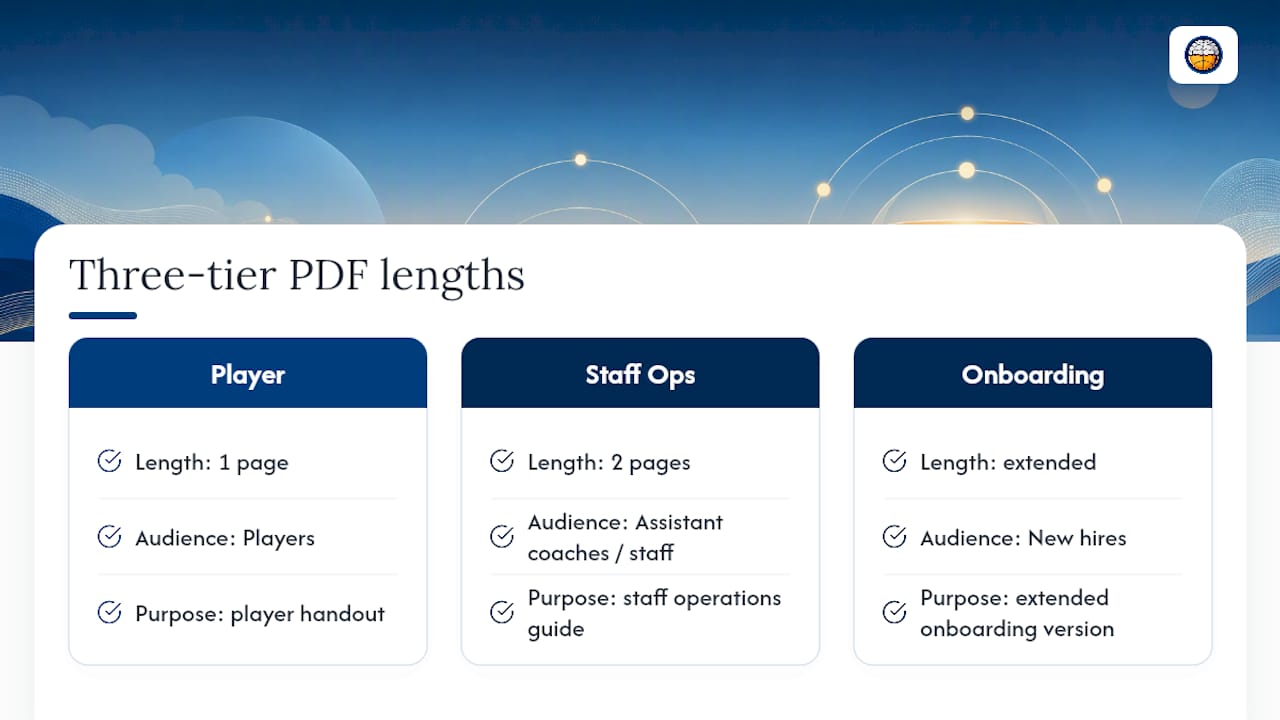
New assistant coaches need more than the player-facing one-pager. The Positive Coaching Alliance’s coaching resource recommends different PDF lengths for different audiences: a one-page player handout, a two-page staff operations guide, and an extended onboarding version for new hires. The copy-ready structure here isn’t a sentence, it’s the three-tier format itself. Build your shortest version first, then expand it twice rather than writing one long document and cutting it down.
9. Small-College Program Legacy Statement
Programs with program history often lean on legacy language: “Every player who wears this jersey inherits a standard, not just a roster spot.” That line works well framed on a wall or included on page one of a longer PDF, but it can feel hollow to a first-year program without history to back it. Skip it if you’re building a brand-new team culture from scratch.
10. Parent Communication Addendum
A growing number of programs attach a short parent-facing addendum to the main philosophy PDF, translating the same values into what parents should expect to see and hear from the sideline. The copy-ready line: “We will always tell you the truth about your child’s development, even when it’s not what you want to hear.” This works only as a very short, standalone half-page, never folded into the longer staff document where parents are unlikely to read it in full.
When you’re scanning any of these for reuse, remember that longer team or staff PDFs from association websites and program pages need trimming before they work as player handouts. A two-page staff document rarely survives intact as a locker-room poster, and trying to force it usually buries the one sentence players actually needed to hear.
Three Fill-In-The-Blank Coaching Philosophy Templates
Instead of starting from a blank page, three templates cover most coaching styles. Each one turns into a printable PDF in under 30 minutes once you fill in the blanks.
Template A: Value-Based List three to four values, then pair each with a specific action.
- Value 1: ______ → Action: ______
- Value 2: ______ → Action: ______
- Value 3: ______ → Action: ______ Sample fill: “Value: Toughness → Action: We finish every practice with a competitive drill, no matter the score.”
Template B: Mission-First Write one mission sentence, then list staff and player commitments underneath. “Coaching is about ______. My approach is ______, helping players ______.” Commitments: “As a staff, we will ______.” / “As players, you will ______.” This structure comes directly from the Co-Active Training Institute’s four-step drafting process, which recommends reflecting on your why, defining values, outlining your methods, then compressing everything into one summary sentence.
Template C: Catchphrase-First Lead with a one-line slogan, then support it with three behaviors that prove it’s real. Slogan: “______.” Behavior 1: ______ Behavior 2: ______ Behavior 3: ______ A one-page PDF with a repeatable slogan speeds up team adoption far more than a dense paragraph ever will, according to entrepreneursHQ’s coaching philosophy guide, which found that coaches adopt philosophies faster when the format stays to one page with a memorable catchphrase attached.

For a one-page layout, budget roughly 20 words for the mission sentence, 40 words for the values-to-actions list, and 15 words for the catchphrase. Anything longer stops being a locker-room document and turns into a staff manual nobody rereads after week one.
Pro Tip: Draft your philosophy around a specific memory, not an abstract ideal. Sports-education research on constructivist coaching development shows that tying your wording to a real impact moment from your own playing or coaching past makes the language land as authentic instead of generic, and players notice the difference.
For a basketball-specific version of any of these three templates, Hoop Mentality’s basketball coaching philosophy guide walks through the same fill-in-the-blank structure with sport-specific example language already built in.
Turning the PDF Into Daily Practice and Game Decisions
A printed philosophy that lives in a binder does nothing. The real test is whether it changes what you say in a Tuesday practice or a fourth-quarter timeout. Here’s how to convert three common values into daily language:
- Composure becomes a practice drill (free throws after wind sprints), a feedback phrase (“breathe, then execute”), and a game heuristic (call timeout before the second missed defensive rotation, not the third).
- Effort becomes a measurable practice check (loose-ball recovery drills scored and tracked), a feedback phrase (“effort is the one thing you control”), and a game heuristic (bench minutes tied to hustle stats, not just scoring).
- Accountability becomes a self-officiating scrimmage rule, a feedback phrase (“own it, then fix it”), and a game heuristic (players report their own mistakes during film review before the coach points them out).
Accountability for the philosophy itself matters just as much as accountability for players. The Positive Coaching Alliance worksheet specifically asks who will hold the coach accountable to the stated philosophy, and most programs skip this question entirely. Build a weekly reinforcement habit around it:
- Monday: staff reviews one value out loud before practice planning.
- Wednesday: players get a one-line reminder tied to that week’s value during warmups.
- Friday: coaches note one specific moment the value showed up (or didn’t) during scrimmage or a game.
A Co-Active Training Institute analysis argues the philosophy’s real value isn’t the coach’s self-reflection exercise. It’s the predictable leadership pattern it creates for players and staff who need to know how you’ll respond under pressure. That predictability is what a philosophy document is actually for. For structured drill work that reinforces these values in repeatable form, Hoop Mentality’s practice plan organization guide breaks down how to build these checks into a standard weekly rotation.
Why Hoop Mentality Builds Ready-to-Use Philosophy PDFs
I’ve spent years around basketball programs where the philosophy lived on a whiteboard nobody read past week two. That’s the gap Hoop Mentality’s resources are built to close: not another abstract values poster, but documents coaches actually pull out during a Tuesday practice plan or a timeout huddle. The playbooks, practice templates, and sample philosophy documents we build come from real seasons, not theory.
A philosophy only earns its place on the wall once it survives contact with an actual practice plan. That’s why our templates pair every value with a drill or a decision rule, not just a word. If you’re staring at a blank page tonight, the basketball coaching philosophy example guide shows exactly how that pairing works in a real program.
— Dejan
Get Your Coaching Philosophy Into a Printable PDF Tonight
Reading annotated samples gets you halfway there. Turning your own values into a finished, editable PDF is the part that eats an entire Sunday if you’re starting from a blank document. Hoop Mentality built three resources specifically to skip that step.

The Basketball Template Bundle For Coaches gives you editable PDF versions of the value-based, mission-first, and catchphrase-first templates covered above, already formatted for print. The Basketball Starter Pack For Coaches goes further, pairing a one-page philosophy document with sample slogans and an integration checklist that maps values to specific practice and game-day habits, so you’re not guessing how to make the language stick. For the drill side of that integration, Skill Improving Infinite Loop Drills gives you repeatable drill sequences built to reinforce the exact values you write into your philosophy, so effort and accountability show up in the reps, not just the page.
Every resource downloads instantly after checkout as an editable PDF, so you can swap in your own team name, values, and catchphrase before your next practice.
Sources
For deeper reading beyond this page, the Positive Coaching Alliance’s coaching philosophy worksheet offers reflection prompts in PDF form. The Co-Active Training Institute’s guide covers the four-step drafting process in more depth, and PositivePsychology’s framework breaks down the three core components further. For basketball-specific samples, see Hoop Mentality’s team culture building guide.
- Coaching philosophy: What is it and how to develop your own?
- How to create a coaching philosophy (Co-Active Training Institute)
- Developing your coaching philosophy (Positive Coaching Alliance PDF)
- 65 Coaching philosophy examples (+3 templates) & 13 niches
FAQ
How do I write my own coaching philosophy?
Start by naming three to four core values, write one mission sentence explaining your purpose as a coach, then pair each value with a specific, observable action for practice or games. Compress the whole thing into a one-page PDF with a short catchphrase for easy recall.
What are the three main components of a coaching philosophy?
Core values, a mission or purpose statement, and documented action steps that connect those values to real practice and game-day behavior. Skip the action steps and the philosophy becomes a poster instead of a working document.
How long should a coaching philosophy PDF be?
A player-facing version should stay under one page. A staff or onboarding version can run two to three pages since it doubles as an operational reference.
Where can I download coaching philosophy PDF templates?
Hoop Mentality’s Basketball Template Bundle For Coaches includes editable PDF templates for value-based, mission-first, and catchphrase-first philosophies, ready to customize and print.
Do coaching philosophies need a catchphrase or slogan?
Not strictly, but a short, memorable catchphrase significantly speeds up team buy-in because players can repeat it in a huddle far more easily than a full paragraph. Programs using acronym-style catchphrases often see faster recall from younger athletes in particular.