

TL;DR:
- Effective basketball practice requires clear goals, flexible structure, and continuous monitoring.
- Incorporating game-like scenarios and agility drills enhances player development across skills and decision-making.
- Culture, communication, and ongoing adaptation are crucial for lasting improvement and team performance.
Most coaches know the feeling: practice ends, players leave, and something still feels off. The drills were fine, the time was there, but the session didn’t quite connect to what the team actually needs for game day. The real challenge isn’t finding drills. It’s building a practice structure that develops skills, strengthens team dynamics, and mirrors competitive pressure, all within a limited block of time. This guide walks you through a clear, step-by-step process to organize basketball practices that actually move the needle, using expert-backed strategies and real monitoring tools to help you plan smarter and prepare your team to compete with confidence.
Table of Contents
- clarify your practice goals and key requirements
- Build a flexible and game-like session structure
- integrate performance monitoring and feedback
- prioritize agility and skill development in your plan
- refine and adapt your plans for continuous improvement
- Our perspective: Why effective practice planning is more culture than checklist
- Take your basketball practice planning to the next level
- frequently asked questions
Key Takeaways
| Point | Details |
|---|---|
| Goal-driven planning | Every practice should start with clear, measurable objectives tailored to team needs. |
| Adaptable structure wins | Flexible, game-like session flows keep players engaged and learning under pressure. |
| Feedback fuels improvement | Regular monitoring and player input let coaches fine-tune future practices for the best results. |
| Skill focus matters | Emphasize agility and real basketball actions to drive true on-court progress. |
clarify your practice goals and key requirements
Every effective practice starts before players step on the floor. You need to know exactly what you want to accomplish. Without clear objectives, sessions drift, and practice structure breaks down fast.
Start by defining measurable goals for each session. Break them into three categories:
| Category | Example objective | How to measure it** | ** |—|—|—| | Skills | improve ball handling under pressure | Count turnovers in drill sets | Team dynamics | run the half-court offense in five possessions | Track successful executions | conditioning | maintain effort level through final scrimmage | coach observation + rating scale
Age and level matter here. A youth team needs repetition and fun. A high school varsity group needs game-speed execution. A college or pro roster needs tactical complexity built into every rep. Your objectives should match where your players are, not where you wish they were.
Get your staff involved early. Assistant coaches see things head coaches miss. Player input matters too, especially from veterans who can tell you when a drill isn’t translating to games. Strategic team planning works best when everyone has a voice in the process.
Before finalizing your plan, check your logistics:
- Space: Full court, half court, or limited gym access
- Staff: How many coaches are available to run stations
- Equipment: balls, cones, resistance bands, timers
- Time: Total session length and hard stop time
As Coach K’s practice philosophy makes clear, practices should reinforce standards and relationships, not just drills. That mindset starts here, in the planning phase.
Pro tip: Write your top three practice goals on a whiteboard visible to your staff before sessions start. It keeps everyone aligned and gives you a quick checkpoint mid-practice.
Build a flexible and game-like session structure
Once your goals are set, it’s time to establish a session flow that allows for both structure and in-the-moment adjustments. A rigid script fails the moment a player tweaks an ankle or a drill isn’t landing. A completely loose plan fails even faster.
Here’s a straightforward comparison of the two approaches:
| approach | pros | cons |
|---|---|---|
| rigid plan | consistent, easy to follow | can’t adapt, misses real-time cues |
| flexible plan | responds to team needs | requires experienced coaching judgment |
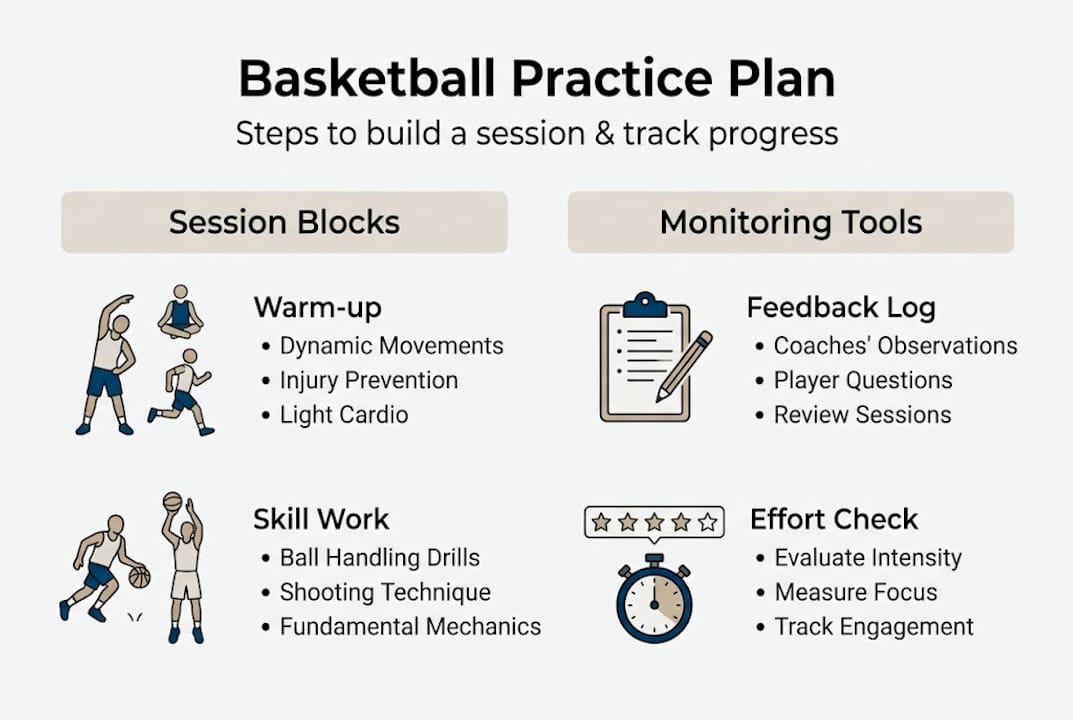
The answer is a structured skeleton with built-in flexibility. Your winning session plans should move through five clear blocks:
- warm-up (8 to 10 min): Dynamic movement, footwork, light ballwork. No standing around.
- skill drills (15 to 20 min): Individual and small-group work. Target your session objectives directly.
- tactical work (15 to 20 min): Team sets, half-court offense and defense, situational plays.
- scrimmage (15 to 20 min): Game-like, continuous play. Use TV timeouts for quick coaching moments.
- cool-down and wrap-up (5 to 8 min): Review what happened. Connect it back to your goals.
The scrimmage block is where most coaches underinvest. Coach K used daily customization and real-time feedback, not rigid scripts, because game situations teach what isolated drills can’t. Game-like continuous practice produces stronger results than drill-heavy, stop-and-start sessions.
Add pressure scenarios: shot clock countdowns, must-score situations, foul trouble simulations. Players need to feel competition before they face it.
Use a practice plan template to map each block with times, coaches assigned, and objectives attached. Print it. Share it with staff before practice.
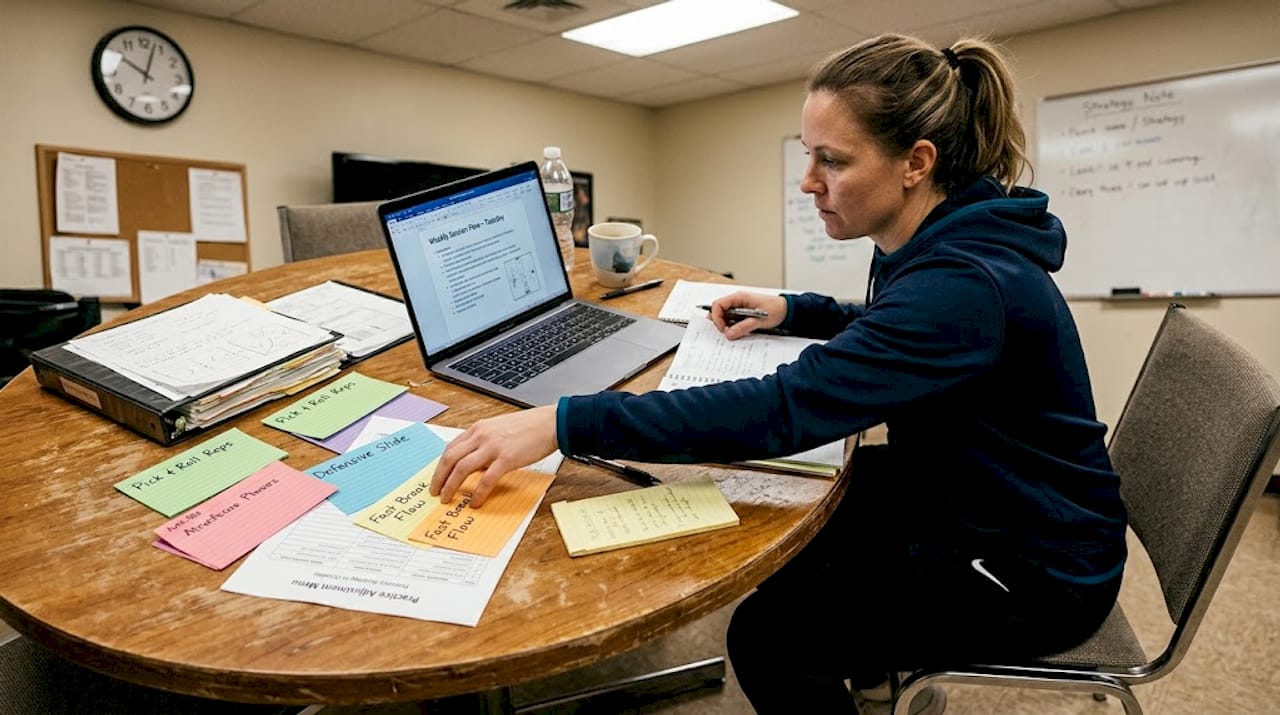
Pro tip: Keep a one-page “adjustment menu” with two or three drill swaps ready if a block isn’t working. Decision fatigue is real during practice, so prepare your options in advance.
integrate performance monitoring and feedback
With a framework in place, the next step is to ensure your practices remain effective by tracking and adapting to player needs. You can’t improve what you don’t measure, but you also can’t measure everything.
Here’s a practical comparison of common monitoring tools:
| tool | what it measures | best use case |
|---|---|---|
| sRPE (session RPE) | player-perceived effort | quick daily check-in |
| Player load (wearable) | physical stress and movement | contact sport intensity tracking |
| Coach observation | engagement, attitude, decision-making | tactical and behavioral assessment |
| sIATE | planned load vs. actual execution | session-level precision planning |
sIATE and coach-planned load are more reliable than sRPE or wearable devices alone for tracking training intensity at the session level. Use them together when possible. Use a simple rating scale (1 to 10) for sRPE right after practice. Ask every player, take 30 seconds.
Feedback loops matter. Coach K collected post-practice player feedback to adapt future plans. You don’t need a formal survey. A quick three-question verbal check works:
- What felt sharp today?
- What felt unclear or rushed?
- What do you need more of before the next game?
Review your key practice plan elements after each session and add a brief written note. Keep it in a shared folder with your staff. Within a week, patterns emerge and your planning gets sharper.
Also check your season planning tips to align monitoring with your competitive calendar. Load management looks different in preseason than in playoff weeks.
prioritize agility and skill development in your plan
Beyond structure and measurement, the actual content of your practice determines player growth and readiness. You can run perfect sessions with poor drill selection and still see flat results on game day.
Agility is one of the most impactful physical qualities in basketball. The research is clear: small-sided games for agility boost agility more than isolated drills alone, with a standardized mean difference of 0.86, which is a large effect in sport science terms. That’s meaningful. It means a 3-on-3 or 4-on-4 game with reaction cues trains agility better than cone drills run in straight lines.
Support it with:
- cone and ladder drills for footwork precision
- lateral band walks and hip activation before agility blocks
- vertical jump and landing mechanics for injury prevention
- box jumps and med ball throws for explosive power (medium effect)
The goal isn’t just moving faster. It’s reacting faster. Players learn agility through game context, not repetition alone.
Balance agility work with tactical and teamwork objectives. If you run a heavy agility block on Tuesday, your Wednesday session should shift toward decision-making and team concepts. See the practice essentials breakdown for how to sequence this through a week.
Schedule skill work by season phase. Pre-season: heavy individual skill volume. In-season: reduce volume, maintain sharpness. Post-season: regeneration and reflection. The practice plan templates available through coaching resources align to these phases directly.
refine and adapt your plans for continuous improvement
To consistently see results, practice planning must be an ongoing, adaptive process. A plan that worked in October may be outdated by January. Your team changes. Your opponents evolve. Your planning has to keep up.
Here’s a repeatable four-step process:
- Record: After every practice, log what you ran, the duration, the load rating, and any notable moments.
- implement: Run your next session using current data, not assumptions from two weeks ago.
- Review: End each week with a 15-minute staff review. What worked? What missed? What’s next?
- adjust: Update the following week’s plan based on the review. Small adjustments, consistently applied, compound over a season.
Involve your assistants. Each coach brings a different view of the session. One might catch that your point guards are getting fewer reps than guards in other positions. Another notices fatigue signs you missed from the sideline. Use the season workflow guide to keep this process organized across your full schedule.
Player input matters in this loop too. Not every decision needs to be player-driven, but knowing what your team feels prepared for changes how you sequence content. Also explore practice planning apps that help you log, review, and update sessions without adding extra admin work.
As staff unity research confirms, wrap-up reinforcement and staff cohesion are essential for sustained progress. The team has to feel the coaching staff is aligned, or the plan loses credibility.
Pro tip: Keep your practice log in a shared digital folder. After five sessions, look for patterns. If the same drill consistently runs long, it’s either too complex or poorly explained. Fix it before it becomes a habit.
Our perspective: Why effective practice planning is more culture than checklist
Templates help. Structure helps. But here’s what we’ve learned working with coaches at every level: the plan itself is almost never the reason a team improves or stalls.
Coaches who get the best results share one thing. They treat practice planning as a living conversation, not a document. They check in with players. They adjust when something isn’t landing. They hold standards without holding grudges when execution falls short.
A checklist gives you a starting point. Culture gives you staying power. When your staff believes in the system and your players feel heard in the process, even an imperfect plan produces results. When culture is weak, even the best-written session falls flat.
The plan template essentials matter as tools, but they only work in the hands of coaches who prioritize relationships and consistency over rigid execution. The best coaches we’ve seen aren’t the ones with the most detailed plans. They’re the ones who adapt fastest and communicate clearest.
Take your basketball practice planning to the next level
You now have a clear process: set goals, build a flexible structure, monitor load, develop agility with purpose, and refine continuously. The next move is putting it into action with tools built for exactly this.
Hoop mentality’s practice plan template gives you a ready-to-use, coach-tested framework you can adapt to any level or session type. Need to sharpen post play and interior scoring? The big man dual action drill is a focused, high-rep tool designed to develop footwork and finishing under pressure. Both resources are built from real coaching experience and ready to use right away.
frequently asked questions
What is the most effective way to structure a basketball practice?
Use a flexible block structure covering warm-up, skill work, team tactics, scrimmage, and feedback, keeping sessions as game-like as possible with pressure situations built into every phase.
How should coaches monitor and adjust training loads?
Combine coach-planned session intensity with sIATE monitoring and short player feedback checks after each practice to stay accurate on load and avoid overtraining.
Which drills best improve basketball agility?
Small-sided games with reaction-based cues produce the largest agility gains, complemented by box jumps, lateral band work, and footwork ladders for full development.
How often should practice plans be adjusted?
Update plans after each practice. Coach K adjusted plans daily using staff observations and player feedback, which kept sessions relevant and performance-focused all season.
What role does culture play in practice planning?
Culture determines whether your plan actually works. Staff unity and leadership create the consistency and adaptability that make any structured plan effective over a full season.
Recommended
- How to develop practice plans for winning basketball sessions – Hoop Mentality
- Basketball Practice Plan Template - Hoop Mentality
- Winning Basketball Season Planning Workflow for Coaches – Hoop Mentality
- 7 Essential Basketball Season Planning Tips for Coaches – Hoop Mentality
- Top 10 Effective Lesson Planning - TEFL Institute