

Most successful American youth basketball programs rely on smart, adaptable planning rather than just talent or luck. For coaches striving to sharpen their teams around the world, effective strategic planning goes beyond drills, shaping everything from skills development to win-loss records. This overview demystifies the strategic concepts used by elite organizations, blending analytic and developmental insights so you can make every practice and game more productive. Over 80 percent of team performance gains link directly to structured planning efforts.
Table of Contents
- Defining Basketball Strategic Planning Concepts
- Key Types and Models of Strategy
- Developing Team Game Plans and Systems
- Integrating Player Development and Practice Planning
- Practical Responsibilities and Avoiding Mistakes
Key Takeaways
| Point | Details |
|---|---|
| Comprehensive Strategic Planning | Effective basketball coaching requires a systematic approach to integrating analytics, player assessments, and tactical insights to achieve competitive success. |
| Diverse Strategic Models | Utilizing various strategic models, such as the Analytical and Adaptive Systems Models, enables coaches to tailor their tactics based on data and dynamic gameplay. |
| Holistic Player Development | A successful player development framework must address technical, tactical, physical, and psychological dimensions to ensure overall team cohesion. |
| Avoiding Common Mistakes | Coaches should focus on individual assessments and flexible strategies to prevent errors like rigid tactics that stifle player growth and performance. |
Defining Basketball Strategic Planning Concepts
Basketball strategic planning represents a comprehensive approach to systematically organizing team performance, resources, and objectives toward achieving competitive success. At its core, strategic planning transforms basketball from a spontaneous game into a methodical pursuit of excellence, integrating detailed analysis, player capabilities, and organizational goals into a cohesive framework. Advanced predictive analytics models have increasingly become crucial in developing these sophisticated planning strategies.
The fundamental components of basketball strategic planning encompass several critical dimensions. These include talent evaluation, performance metrics analysis, psychological profiling of players, tactical system development, and long-term organizational goal alignment. Coaches and management must synthesize complex data points to create adaptable strategies that can respond dynamically to in-game challenges and evolving team compositions. Professional basketball organizations consistently demonstrate that integrated, ongoing planning directly correlates with competitive success.
Effective strategic planning in basketball requires a multilayered approach that balances quantitative data with qualitative insights. This means not just analyzing statistical performance, but understanding player dynamics, team chemistry, individual motivational factors, and potential developmental trajectories. Advanced strategies incorporate psychological assessment, biomechanical analysis, and predictive modeling to create nuanced player development and team optimization frameworks.
Pro tip: Develop a dynamic strategic planning document that can be updated quarterly, allowing flexibility while maintaining a consistent long-term vision for team development.
Key Types and Models of Strategy
Basketball strategic models represent sophisticated frameworks that enable coaches to systematically approach team performance and tactical development. International research on coaching methodologies reveals several critical strategic approaches, each designed to address specific competitive challenges and team dynamics. These models range from data-driven analytical systems to more intuitive, psychological-based strategies that emphasize player potential and team chemistry.
Four primary strategic models dominate contemporary basketball planning: the Analytical Model, the Adaptive Systems Model, the Psychological Performance Model, and the Integrated Development Model. The Analytical Model leverages advanced predictive technologies to quantify player performance, using machine learning algorithms to predict potential outcomes and optimize player positioning. This approach transforms raw statistical data into actionable strategic insights, allowing coaches to make more precise tactical decisions.
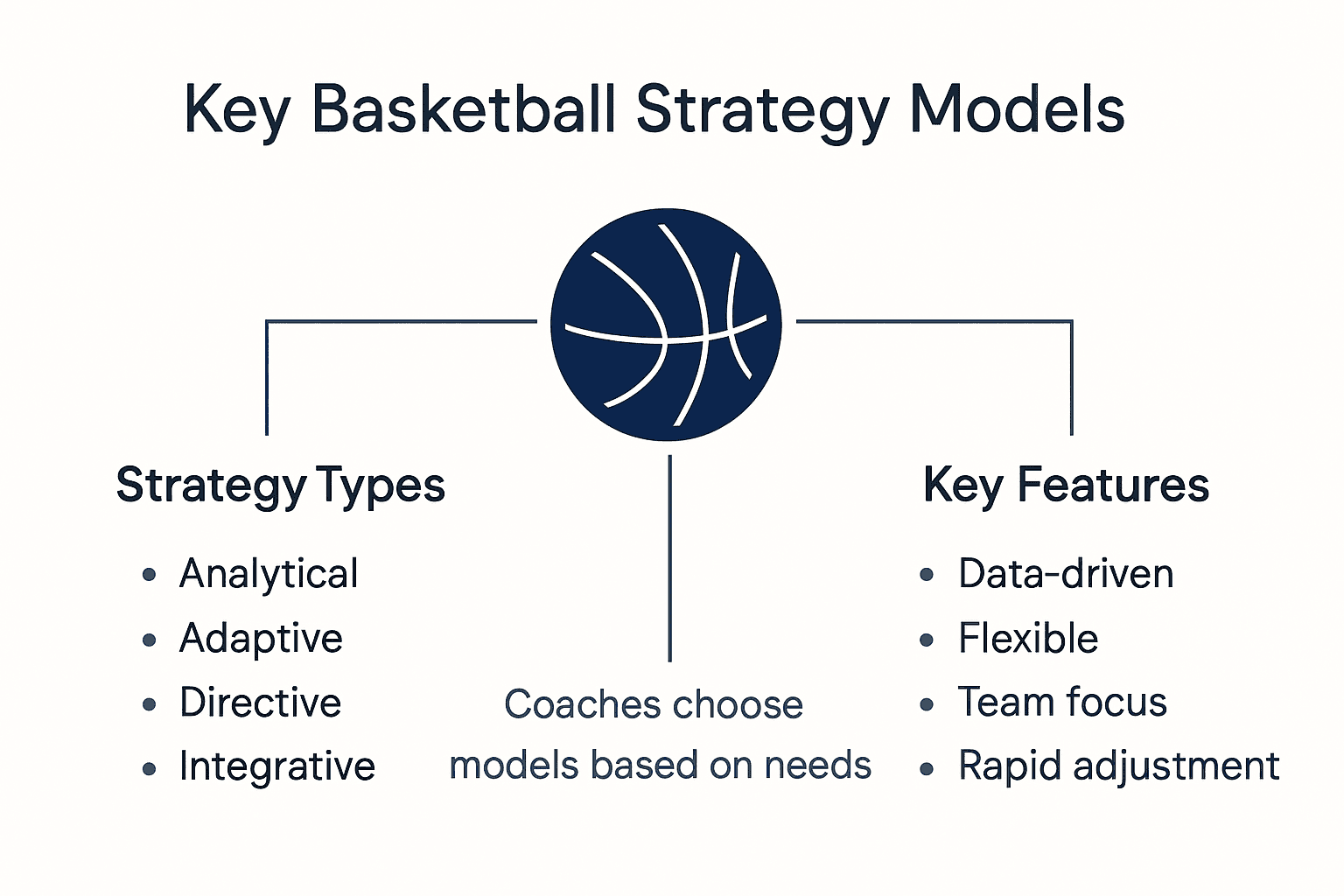
The Adaptive Systems Model focuses on creating flexible strategic frameworks that can rapidly adjust to in-game dynamics and opponent strategies. Unlike rigid tactical approaches, this model emphasizes player versatility, quick decision-making, and the ability to seamlessly transition between different offensive and defensive configurations. Coaches utilizing this model train players to read game situations dynamically, developing cognitive flexibility that transcends traditional positional limitations.
Pro tip: Create a strategic model matrix that maps your team’s strengths across different performance dimensions, enabling more nuanced and personalized tactical planning.
Here’s a comparison of four leading basketball strategic models and their key characteristics:
| Strategic Model | Core Feature | Best Used For | Limitations |
|---|---|---|---|
| Analytical Model | Data-driven predictions | Player optimization | Requires extensive statistics |
| Adaptive Systems Model | Flexible tactics | Rapid in-game adjustments | May challenge team consistency |
| Psychological Performance Model | Mental resilience focus | Enhancing motivation | Hard to quantify impact |
| Integrated Development Model | Holistic player growth | Long-term team success | Time-intensive implementation |
Developing Team Game Plans and Systems
Developing effective team game plans requires a comprehensive approach that integrates advanced analytics, player capabilities, and strategic insights. Advanced machine learning techniques have revolutionized the process of creating sophisticated basketball strategies, enabling coaches to forecast player performance, optimize lineups, and identify precise tactical opportunities with unprecedented accuracy. Modern game planning transcends traditional intuitive approaches, leveraging data-driven methodologies to create dynamic and adaptable team systems.

The core components of successful game plan development involve multiple interconnected strategic dimensions. These include comprehensive player assessment, opponent analysis, situational strategy mapping, and adaptive tactical frameworks. Genetic algorithm approaches have emerged as powerful tools for iteratively refining training plans and game strategies, allowing coaches to systematically evolve tactical combinations that maximize team performance. By treating team strategy as a complex optimization problem, coaches can develop more nuanced and responsive game plans that adapt to changing competitive landscapes.
Effective game systems must balance individual player strengths with collective team dynamics. This requires creating flexible strategic frameworks that allow players to leverage their unique skills while maintaining cohesive team functionality. Coaches must design systems that enable quick tactical transitions, support multiple offensive and defensive configurations, and provide clear guidelines for player movement and decision-making. The most successful game plans create a structured yet adaptable environment where players can execute predetermined strategies while maintaining the cognitive flexibility to respond to unexpected game situations.
Pro tip: Develop a modular game plan template that includes core strategic principles, positional guidelines, and adaptive response protocols to enable more dynamic and responsive team performance.
Integrating Player Development and Practice Planning
Player development represents a holistic process that demands comprehensive and strategic approach to practice planning. Time-motion analysis and recovery strategies have demonstrated that training regimens must be precisely aligned with match-play demands to optimize player performance and well-being. Coaches must design practice sessions that seamlessly integrate physical conditioning, technical skill development, tactical understanding, and cognitive training into a unified developmental framework.
The most effective practice planning approaches recognize the interconnected nature of player development. Comprehensive basketball coach education programs emphasize the critical importance of creating multidimensional training environments that address technical, tactical, physical, and psychological aspects of player growth. This means moving beyond traditional drill-based practices to create dynamic learning experiences that challenge players across multiple skill domains, encouraging adaptive thinking and integrated performance improvement.
Successful integration of player development and practice planning requires a personalized, data-driven methodology. Coaches must leverage individual player assessment data to create targeted development strategies that address specific skill gaps while maintaining overall team cohesion. This approach involves continuous performance monitoring, adaptive training protocols, and a flexible framework that can be adjusted based on individual player progress, team dynamics, and competitive objectives. The most sophisticated player development systems treat each practice session as a strategic opportunity for incremental improvement, carefully balancing skill acquisition, tactical understanding, and physical conditioning.
Pro tip: Develop a comprehensive player development matrix that tracks individual skills across technical, tactical, physical, and psychological dimensions, enabling more precise and personalized training interventions.
Practical Responsibilities and Avoiding Mistakes
Successful basketball coaching extends far beyond court strategy, encompassing a comprehensive set of responsibilities that require technical expertise, psychological acumen, and strategic thinking. Coach education programs emphasize the critical need for thorough theoretical and practical training to minimize coaching errors and maximize player development potential. Coaches must recognize that their role involves complex interactions between technical skill instruction, emotional support, performance management, and strategic leadership.
Common coaching mistakes often stem from overlooking the multidimensional nature of player development. These errors typically include rigid tactical approaches, insufficient individual player assessment, inconsistent communication strategies, and failure to adapt training methods to individual player needs. Effective coaches develop a nuanced understanding of each player’s psychological profile, learning style, and developmental trajectory, creating personalized intervention strategies that address both technical skills and mental resilience.
Practical coaching responsibilities require a systematic approach to player and team management. This involves maintaining detailed performance records, conducting regular individual and team assessments, developing targeted training interventions, and creating a supportive team culture that balances competitive drive with personal growth. Coaches must also navigate complex interpersonal dynamics, managing player expectations, managing team conflicts, and maintaining clear communication channels with players, support staff, and organizational leadership. The most successful coaches view their responsibilities as a holistic process of player and team transformation, continuously learning and adapting their approaches.
Here is a summary of practical coaching responsibilities and typical mistakes:
| Responsibility | Common Mistake | Impact |
|---|---|---|
| Individual Player Assessment | Overlooking skill profiles | Limits targeted growth |
| Communication Strategy | Inconsistent messaging | Reduces player trust |
| Tactical Adaptation | Rigid strategic planning | Less responsive team |
| Supportive Team Culture | Neglecting emotional needs | Poor morale and performance |
Pro tip: Create a comprehensive coaching accountability matrix that tracks your performance across technical, interpersonal, strategic, and developmental dimensions, enabling continuous self-improvement and professional growth.
Elevate Your Basketball Strategic Planning Today
Mastering basketball strategic planning involves navigating complex challenges like integrating performance metrics, adapting game systems, and personalizing player development. Coaches aiming to streamline these processes face the pressure of balancing data-driven models with dynamic in-game adjustments while fostering strong team chemistry and resilience. If you want to turn detailed strategies into winning results with less stress and more clarity then precise tools can make all the difference.
Discover professionally crafted resources tailored to your strategic needs at Basketball Templates - Hoop Mentality.
Unlock a world of practical coaching solutions including customizable strategic planning templates, adaptable practice plans, and proven drills that save time while enhancing your team’s performance. Visit Hoop Mentality now and take control of your coaching journey. Empower your team with confidence and clear direction by exploring our complete collection of Basketball Drills - Hoop Mentality and Basketball Workouts - Hoop Mentality. Start winning strategically today.
Frequently Asked Questions
What is basketball strategic planning?
Basketball strategic planning is a systematic approach that organizes team performance, resources, and objectives to achieve competitive success, integrating detailed analysis and player capabilities into a cohesive framework.
What are the key components of effective basketball strategic planning?
The key components include talent evaluation, performance metrics analysis, psychological profiling, tactical system development, and long-term organizational goal alignment.
How do advanced analytics influence basketball strategic planning?
Advanced analytics allow coaches to make data-driven decisions, optimizing player performance and tactical approaches through predictive modeling and statistical analysis.
What are common mistakes in basketball coaching related to strategic planning?
Common mistakes include rigid tactical approaches, insufficient individual player assessments, inconsistent communication strategies, and failure to adapt training methods to meet the diverse needs of players.