

TL;DR:
- Structured practice planning maximizes efficiency and reduces injury risk through consistent session formats.
- Coaches should set clear objectives, allocate fixed time blocks, and adjust plans based on load and player feedback.
- Flexibility during sessions is crucial; prioritize teaching, remove overpacked drills, and use ongoing data to optimize practices.
Running a disorganized practice is one of the fastest ways to lose your team’s trust. Players stand around, drills run long, and by the time scrimmage starts, everyone is mentally checked out. The good news is that a clear, structured practice plan fixes most of these problems before they start. This guide walks you through the core principles, the tools you need, and a step-by-step method for building sessions that actually move the needle. Whether you coach youth rec ball or a competitive high school squad, the framework here applies directly to your situation.
Table of Contents
- Core principles of basketball practice planning
- Essential elements you need before designing your plan
- Step-by-step: How to build your basketball practice plan
- Troubleshooting and optimizing practice plans
- A coach’s-eye view: What most guides miss about practice planning
- Take your practice planning to the next level
- Frequently asked questions
Key Takeaways
| Point | Details |
|---|---|
| Structure matters | Well-planned practices are proven to boost player performance, enjoyment, and safety. |
| Monitor load | Consistent training loads and simple monitoring tools reduce injury risk and support steady improvement. |
| Adapt for age & level | Modify practice length, drill duration, and competitive intensity to fit your team’s age and skill. |
| Plan, but stay flexible | Great coaches use structure as a guide, not a rigid script—leave room for feedback and adaptation. |
Core principles of basketball practice planning
Structured practice planning is not just about filling time. It is about making every minute count. When coaches use consistent session formats, players know what to expect. That predictability reduces confusion and speeds up transitions between drills. It also creates a measurable baseline so you can track improvement week over week.
Research backs this up. A practice structure guide notes there are no strong empirical benchmarks for a single optimal practice format, but load studies consistently show that consistency in training reduces injury risk. That is a big deal. Protecting your players is just as important as developing their skills.
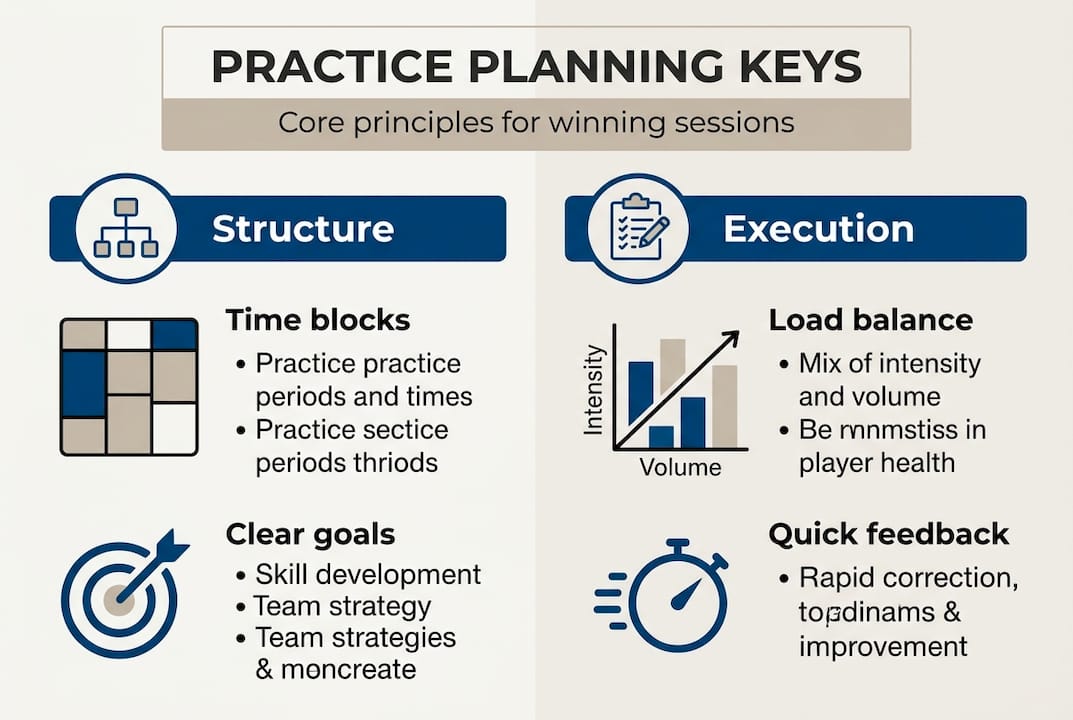
A load monitoring study found that weekly training loads stay consistent regardless of opponent level, location, or game result, with loads tapering as match day approaches. This tells you something practical: your practice intensity should follow a weekly rhythm, not spike randomly based on how you feel that day.
Here is what a standard practice structure looks like, with typical time ranges:
| Section | Purpose | Typical duration |
|---|---|---|
| Warm-up | Activation and injury prevention | 8 to 12 minutes |
| Skill work | Individual technique development | 15 to 20 minutes |
| Team drills | Group execution and communication | 20 to 25 minutes |
| Scrimmage | Live game simulation | 15 to 20 minutes |
| Wrap-up | Review and cool-down | 5 minutes |
For stronger season planning tips, build your weekly rhythm around this structure and adjust intensity based on where you are in the schedule.
- Use the same session format each week so players internalize the flow
- Prioritize skill work earlier in practice when focus is sharpest
- Save live scrimmage for later once fundamentals are reinforced
- Always end with a clear takeaway or team message
“Structured practice is not about rigid control. It is about giving your team the clearest possible path to improvement.”
Essential elements you need before designing your plan
Having established the principles, the next step is to prepare what you need before you ever start outlining drills.
You cannot build a useful plan without knowing who you are coaching and what they need. Start by gathering your roster, identifying your key objectives for the week, and reviewing any notes from your last session. A quick look at player attendance patterns also helps you plan around absences.
Load monitoring tools matter here too. Elite basketball research shows that Coach-Planned Load and SIATE (a metric weighted by time and participation) are the most reliable indicators of internal and external training load. Pair those with session Rating of Perceived Exertion (sRPE), Player Load, and distance data for a complete picture. You do not need to use all of these at once, but picking at least one gives you something concrete to work with.
For youth coaches, the approach shifts. AAU youth practice guidance recommends keeping non-competitive drills to 5 to 8 minutes and allowing free warm-up play before the structured session begins. Fun and fundamentals come before volume at this level.
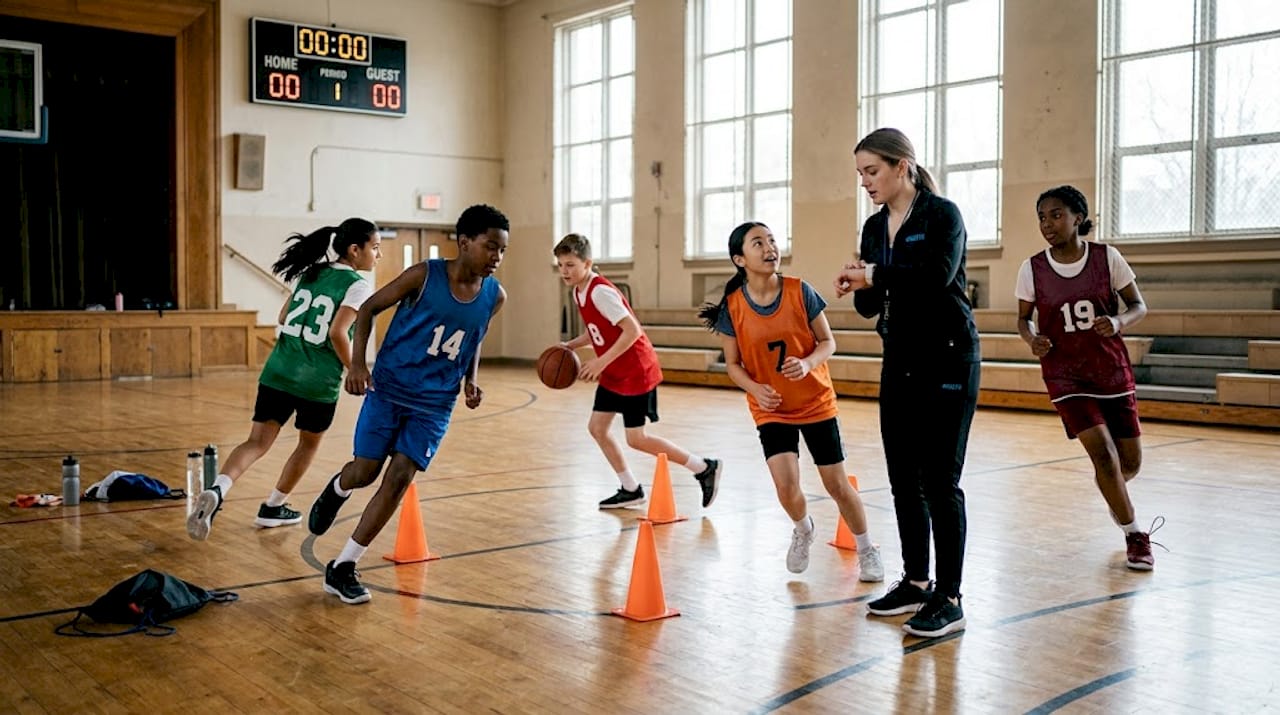
Here is a quick comparison of what youth and advanced teams need going into a plan:
| Planning element | Youth teams | Advanced teams |
|---|---|---|
| Session length | 45 to 60 minutes | 75 to 90 minutes |
| Drill segments | 5 to 8 minutes each | 10 to 15 minutes each |
| Load monitoring | Informal observation | sRPE, Player Load |
| Focus areas | Fun, movement, basics | Tactics, conditioning |
| Feedback method | Simple verbal check-in | Written logs, film |
Before you write a single drill, make sure you have these basics ready:
- Updated roster and position breakdown
- Clear session objective (one or two focused goals)
- Stopwatch or interval timer
- Dry-erase board or digital diagram tool
- A blank practice plan template
- Attendance log for tracking participation
Check out these fundamentals for youth if you need a starting point for your session goals at the youth level. Also, practical advice for youth coaches is worth reviewing before your first structured session.
Pro Tip: Always add five extra minutes to your plan buffer. Teaching moments and player questions happen every session. If you plan to the last second, you will always feel rushed.
Step-by-step: How to build your basketball practice plan
Once you’ve gathered your essentials, here’s a proven method for actually building a plan that works.
- Set your session objective. Pick one or two specific goals, such as improving ball-screen defense or finishing at the rim. Vague goals produce vague results.
- Choose your drills. Match drills to your objective. Browse core drills to find options that reinforce your focus area for the day.
- Assign time blocks. Give each section a fixed window. Write it on paper before practice. This keeps you accountable.
- Adjust for load. According to weekly load research, taper intensity as game day approaches. Keep load slightly higher one day before the game (MD-1), then reduce volume on match day.
- Plan teaching breaks. Build in one or two short pauses for coaching instruction. These are not wasted time. They are where learning actually sticks.
- Add a flexible wrap-up. Reserve the last five minutes for review, Q&A, or a team huddle. Use it however the session demands.
Here is how a 60-minute and a 90-minute plan might break down:
| Section | 60-minute plan | 90-minute plan |
|---|---|---|
| Warm-up | 8 minutes | 12 minutes |
| Skill work | 15 minutes | 20 minutes |
| Team drills | 20 minutes | 30 minutes |
| Scrimmage | 12 minutes | 20 minutes |
| Wrap-up | 5 minutes | 8 minutes |
For youth basketball drills, keep each drill segment shorter and rotate activities more frequently to hold attention. Use practice plan templates to save setup time and keep your format consistent across the season.
Pro Tip: Write your time blocks in ink before practice. Coaches who plan loosely in their heads almost always run over on early sections and cut scrimmage short. The numbers keep you honest.
Troubleshooting and optimizing practice plans
Even the best plan needs adjustment. Here’s how to troubleshoot and keep improving your approach.
The most common mistake coaches make is overpacking a session. You schedule eight drills for a 90-minute practice and spend the whole time rushing. Players never get enough reps to actually learn anything. The fix is simple: do fewer things and do them well.
Structured practice plans are reported by 90% of coaches to boost both player enjoyment and performance. That number is hard to ignore. If your players seem disengaged or your practices feel scattered, the plan itself is usually the problem.
Common issues and quick fixes:
- Overpacking: Cut the drill count by 30% and add reps to what remains
- Weak transitions: Assign a player leader for each transition to keep energy up
- No feedback loop: Spend three minutes after practice asking players what worked
- Ignoring load data: Even a simple sRPE check-in tells you if players are carrying too much fatigue
- Same plan every week: Review strategic planning resources to build variety with purpose
Player and assistant input is underused by most coaches. Your assistant sees things from a different angle. Your players know when a drill feels pointless. Collect that information and use it.
Track a few simple metrics week to week: drill completion rate, scrimmage engagement level, and any reported soreness. Compare these against your load data and you will start to see patterns. Adjust structure based on what you find, not just instinct.
“Consistency in structure and monitoring doesn’t just boost readiness. It protects against injury.”
A coach’s-eye view: What most guides miss about practice planning
Most articles give you a template and call it done. But the coaches who consistently build strong teams do something different. They treat their plan as a starting point, not a script.
Rigid minute-by-minute schedules can actually work against you. When you are locked into a timed sequence and a player is struggling to grasp a concept, you face a choice: stick to the plan or stop and teach. The best coaches stop and teach. Every time. That decision is not a failure of planning. It is good coaching.
Check the practice plan must-haves if you want a structured starting point, but remember that your plan should serve the session, not the other way around.
Teams that build time for player discovery and structured input see higher buy-in and better retention of concepts. That is not a soft idea. It is practical. When players feel like practice is designed with them in mind, they show up ready to work.
The balance to strike: plan for efficiency, but leave intentional gaps. A five-minute unstructured window can become the most valuable part of your session if you use it well.
Take your practice planning to the next level
Ready to put your plan into action? Here’s how you can make the process even simpler.
Hoop Mentality has the tools to make this work immediately. Start with a ready-to-use practice plan template built around the structure covered in this guide. It is formatted, flexible, and ready to fill in before your next session.

Need drills that match your plan? The big man dual action drill is a strong option for coaches looking to add structured post and perimeter work in one efficient segment. Explore the full library for more options that fit your team’s level and goals. Everything at Hoop Mentality is built from real coaching experience, so you can use it right away.
Frequently asked questions
What is the ideal length for a basketball practice session?
Most basketball practices run 60 to 90 minutes. Youth sessions may benefit from shorter 45-60 minute plans to keep focus high and maximize learning per minute.
How can I track practice intensity and avoid overtraining?
Use session Rating of Perceived Exertion (sRPE) as a simple starting point. More advanced options include Player Load and SIATE, which are robust for tracking both internal and external workload in basketball.
How far in advance should I plan my practices?
Plan at least one week ahead. Consistent weekly planning reduces injury risk and gives you time to adjust based on game results, player condition, or upcoming opponents.
What should I do if a practice plan isn’t working during the session?
Adjust on the fly. Drop low-engagement drills, shift time to what is working, and collect player feedback afterward to improve your next session.