

Here are three copy-ready basketball coaching philosophy statements you can use or adapt right now:
- Development-first: “My purpose is to develop every player’s skills, character, and confidence so they leave the program better than they arrived.” Personalize: replace “skills, character, and confidence” with your top three values, and add your age group (e.g., “U12 players”).
- Winning with development: “We compete to win, and we develop the habits, discipline, and teamwork that make winning sustainable.” Personalize: swap “discipline, and teamwork” for the two qualities you prioritize most in your program.
- Culture-first: “Our program holds every player accountable to the same standard of effort, respect, and preparation, on and off the court.” Personalize: name your specific team standard (e.g., “100% effort in every sprint”) and your role (youth coach, varsity head coach).
Pro Tip: Pick the statement closest to how you already coach, then change only the bracketed values. A philosophy that sounds like you will better support clear communication in meetings.
Key Takeaways
A coaching philosophy is most useful when it is short, specific, and built on measurable standards coaches and players can both name from memory.
| Point | Details |
|---|---|
| Write last, reflect first | Complete all eight reflection steps before drafting your final statement. |
| Match format to use case | One-liner for resumes and bios; short paragraph for handbooks and parent meetings. |
| Include one measurable standard | Vague values (“excellence”) are less useful than a specific behavior (“100% effort in every drill”). |
| Collect feedback annually | Ask assistants and players three questions post-season and revise accordingly. |
| Hoop Mentality templates | The Basketball Template Bundle For Coaches provides editable philosophy, handbook, and resume formats ready to publish. |
Table of Contents
- Why does a written coaching philosophy matter?
- How do you build a coaching philosophy in 8 steps?
- Sample coaching philosophy statements by level
- Fill-in-the-blank templates for a fast first draft
- How do you present your philosophy in the right place?
- What are the most common coaching philosophy mistakes?
- A coach’s note on writing and using philosophies
- Hoop Mentality templates get your philosophy published fast
- Sources
- FAQ
Why does a written coaching philosophy matter?
A written philosophy gives players, parents, assistants, and administrators a clear picture of your priorities before the first practice. Without one, every playing-time decision, every practice structure choice, and every parent conversation starts from scratch.
According to research on coaching philosophy development, a coaching philosophy should be built on a set of standards by which a coach influences, teaches, and models behavior for athletes. That framing matters: it shifts the philosophy from a feel-good mission statement into a practical decision-making tool.
Three places where a written philosophy changes behavior in basketball:
- Practice planning: A development-first philosophy means every drill has a skill objective, not just a conditioning purpose. You can defend that structure to an assistant in one sentence.
- Playing-time decisions: A standards-based philosophy lets you point to a written expectation (“players who meet the effort standard earn minutes”) rather than making judgment calls that look arbitrary to parents.
- Parent meetings: A one-page philosophy handed out at the preseason meeting sets expectations before conflict arises. Parents who signed on to a development program are less likely to demand a varsity-style rotation from a 10-year-old’s team.
How do you build a coaching philosophy in 8 steps?
Writing the philosophy is the last step, not the first. Complete the reflection tasks below in order, and the final statement writes itself. This sequence follows the eight-step method developed for coaching-philosophy education.
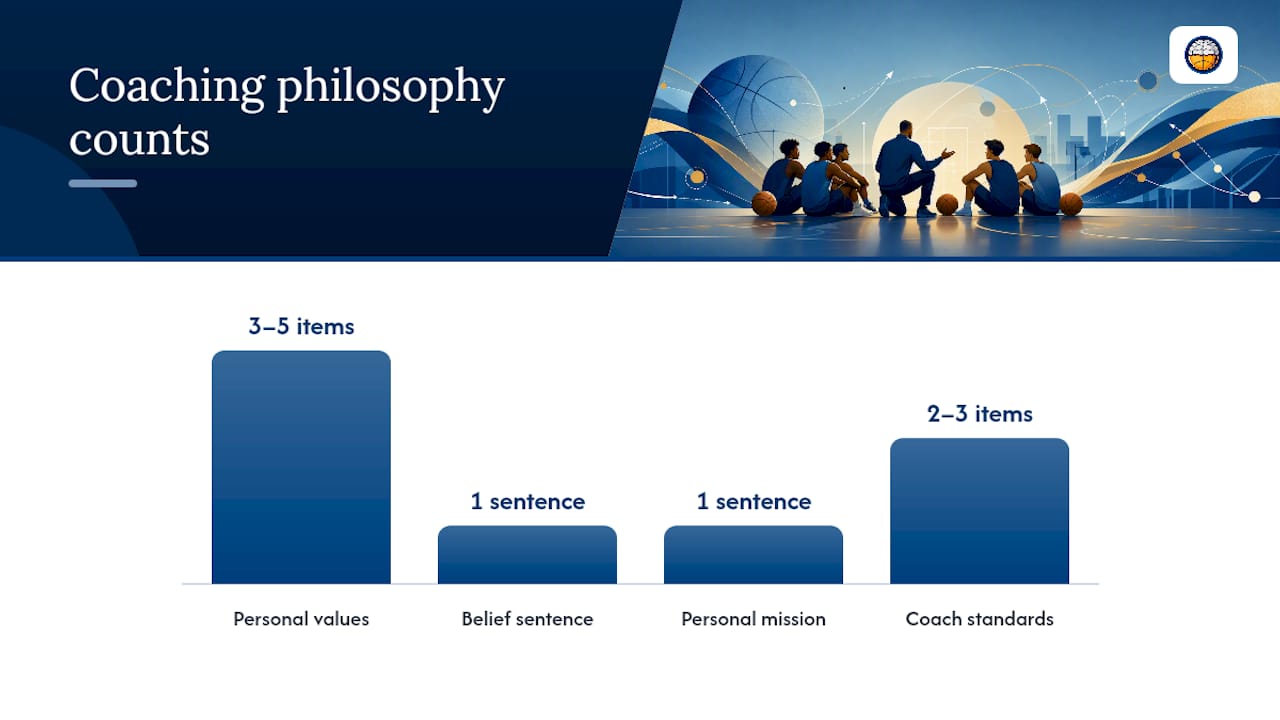
- Identify your values. List three to five personal values that drive how you coach. Prompt: What would a player say about you after five years in your program? Example: accountability, growth, respect.
- Establish your belief system. Write one sentence about what you believe sport does for young people. Prompt: Do you believe competition builds character, or that character enables competition? Example: “I believe basketball teaches life skills that outlast any scoreboard.”
- Develop a personal mission. Combine your values and belief into a one-sentence personal mission. Prompt: Why do you coach? Example: “I coach to give every player a fair chance to grow.”
- Determine personal standards of performance. Name two or three behaviors you hold yourself to as a coach. Prompt: What would you never compromise, even after a tough loss? Example: preparation, composure, honesty with players.
- Identify the purpose of sport. State explicitly whether your purpose is developmental, competitive, educational, or a hybrid. Prompt: What does a successful season look like even with a losing record? Example: “Success means measurable skill growth and zero player dropouts.”
- Develop a team mission. Write one sentence your whole roster can repeat. Prompt: What do you want players to say about this team in 10 years? Example: “We hold each other to a standard of effort and respect every day.”
- Set team performance standards. Convert your team mission into two or three measurable expectations. Prompt: What specific behaviors prove the mission is real? Example: 100% attendance at practice, zero tolerance for disrespect toward officials.
- Write the philosophy. Draft one to three sentences that combine your personal mission, purpose of sport, and team standards. This is the publishable statement.
| Format | Length | Best used for |
|---|---|---|
| One-liner | 1 sentence | Resume, coach bio, social profile |
| Short paragraph | 3–5 sentences | Team handbook, parent meeting handout |
| Extended mission | 1–2 paragraphs | Staff planning, annual program review |
Sample coaching philosophy statements by level
Coaches at every level need both a short version for quick use and a longer version for formal documents. Below are level-specific options you can copy or adapt. For additional annotated examples, see the coaching philosophy examples guide from Hoop Mentality.

Youth level (ages 6–13)
One-liners:
- “Every player on this team learns, competes, and leaves practice better than they arrived.”
- “We build skills, habits, and confidence, one practice at a time.”
Paragraph sample: “My purpose as a youth basketball coach is to create an environment where every child feels safe to try, fail, and improve. I believe sport teaches discipline, teamwork, and resilience more effectively than any classroom. Every player receives equal instruction and honest feedback. My standard is simple: effort and respect are non-negotiable, results are secondary. I measure success by player retention and skill growth, not wins.”
Annotations: Sentence 1 = purpose of sport. Sentence 2 = belief system. Sentence 3 = standard of performance. Sentence 4 = team standard. Sentence 5 = measurable outcome.
- Use for: parent meeting handout, team handbook
- Tone: developmental, warm, firm on effort
High school level
One-liners:
- “We develop competitive players and accountable people, in that order.”
- “This program demands effort, rewards growth, and competes to win.”
Paragraph sample: “I coach high school basketball to prepare players for the next level, whether that means college ball or adult life. My program runs on three standards: daily preparation, coachability, and competitive effort. Playing time reflects those standards, not seniority. I believe a team that holds itself accountable outperforms more talented teams that do not. My goal is a program players are proud to have been part of long after graduation.”
Annotations: Sentence 1 = purpose (hybrid: competitive + educational). Sentence 2 = team standards. Sentence 3 = playing-time principle. Sentence 4 = belief system. Sentence 5 = long-term outcome.
- Use for: resume, coaching application, program handbook
- Tone: high-expectation, direct
A note on coaching styles: An authoritarian, discipline-led approach works when a program has chronic accountability problems or when players are preparing for elite competition. A player-centered, development-led approach fits youth programs and rebuilding situations where trust and retention matter most. Neither is wrong. The philosophy just needs to match the context.
College level
One-liners:
- “We build a program where elite preparation and team accountability produce consistent results.”
- “My standard: every player leaves this program more prepared for life than they arrived.”
Fill-in-the-blank templates for a fast first draft
Three templates, one for each format. Pick the length that fits your immediate need, fill in the brackets, and you have a working draft in under 20 minutes.
Template 1: One-liner “My purpose as a [role] is to develop [value 1], [value 2], and [value 3] in every player, so they leave this program [desired outcome].”
Template 2: Short paragraph “I coach [level] basketball because I believe [belief about sport]. My program is built on [value 1], [value 2], and [value 3]. Every player is held to the standard of [specific measurable behavior]. Playing time is earned through [specific criterion]. My goal is a team that [team mission in one phrase].”
Template 3: Extended mission Use Template 2 as the first paragraph, then add: “As a staff, we commit to [coach standard 1] and [coach standard 2]. We measure success by [measurable outcome], and we review this standard [annually / post-season].”
Quick example fills:
- Youth development coach: “My purpose as a youth coach is to develop confidence, effort, and respect in every player, so they leave this program ready to compete at the next level.”
- High-school competitive coach: “I coach varsity basketball because I believe competition builds character. My program is built on preparation, accountability, and coachability. Every player is held to the standard of 100% effort in every drill.”
Numbered personalization prompts:
- Replace [role] with your exact title (head coach, assistant, club director).
- Choose two to three values from this list: accountability, effort, respect, growth, discipline, teamwork, coachability.
- Name one measurable standard (attendance rate, sprint completion, film review attendance).
- State your purpose type: developmental, competitive, educational, or hybrid.
- Write your team mission in one sentence your players can repeat from memory.
How do you present your philosophy in the right place?
One-liner on resumes and bios. Short paragraph for handbooks and parent meetings. Extended version for staff planning and annual reviews.
Resume placement: Put the one-liner in your professional summary, directly below your name and contact information. Label it “Coaching Philosophy:” so hiring committees find it immediately. The coaching resume templates from Hoop Mentality include a dedicated philosophy line in the header.
Parent meeting script (30 seconds): “Before we talk logistics, I want to share the standard this program runs on. Every player here is held to the same expectation: full effort, respect for teammates and officials, and preparation before every practice. That standard is written down, and you’ll find it in the handbook I’m handing out now.”
Player onboarding script (2 lines): “This is what we stand for as a program. Read it, ask questions, and sign the acknowledgment page. If you commit to this standard, you belong here.”
For guidance on parent communication methods that pair with your philosophy, Hoop Mentality has a dedicated resource.
Collecting feedback: After the first month of the season, send assistants and players three questions:
- Does our stated philosophy match how we actually practice?
- Which standard is hardest to hold consistently?
- What one word would you add or remove?
Revise the statement once per year, post-season, using those answers.
What are the most common coaching philosophy mistakes?
Keep it short, specific, and defensible. Most first drafts fail on one of those three counts.
Editing checklist:
- [ ] Under 75 words for the short-paragraph version
- [ ] Contains at least one measurable standard (not just “we work hard”)
- [ ] Written for players and parents, not a hiring committee
- [ ] No contradictory standards (e.g., “every player gets equal minutes” alongside “playing time is earned”)
- [ ] Tone matches your actual coaching style
- [ ] Every value listed connects to a specific behavior
Red flags with before/after fixes:
- Before: “We believe in excellence, integrity, passion, unity, and continuous improvement.” After: “We hold every player to one standard: full effort and respect, every day.”
- Before: “Our program is committed to developing the whole athlete in a positive environment.” After: “Every player here improves measurably in at least one skill area each season.”
Pro Tip: Read your philosophy out loud to an assistant coach and ask: “Does this sound like how I actually coach?” If they hesitate, the statement is aspirational, not operational. Revise until they say yes without pausing.
A coach’s note on writing and using philosophies
At Hoop Mentality, brief, values-driven statements are the starting point for aligning staff and simplifying decisions across a full season.
A philosophy that fits on one index card is one your assistants can actually use. When every coach on staff knows the two or three standards the program runs on, practice planning gets faster, player conversations get shorter, and parent meetings get easier. The statement does not need to be inspiring. It needs to be true.
One practical tip: pick one measurable team standard and put it in writing before the first practice. Share it with every assistant. When a decision is hard, that standard is the answer. Consistent language across staff is worth more than a beautifully written paragraph no one can remember.
Hoop Mentality templates get your philosophy published fast
Coaches who need a finished, professional philosophy document today have a direct path: the Basketball Template Bundle For Coaches from Hoop Mentality includes editable philosophy templates, practice plans, and handbook pages ready to fill in and publish.
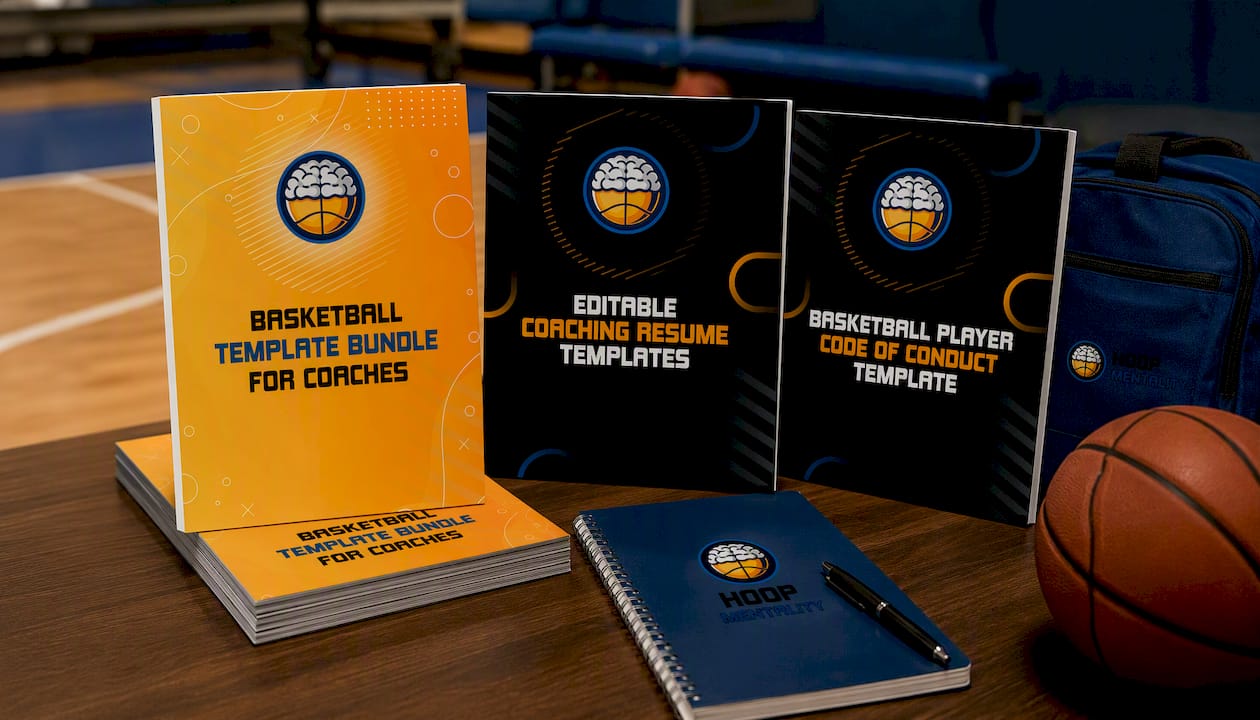
Three products, three specific problems solved:
- Basketball Template Bundle For Coaches: Editable templates for philosophy statements, practice plans, and team handbooks. Fill in your values and standards, export, and share.
- Editable Basketball Coaching Resume Templates: Resume layouts with a dedicated philosophy line built in. No reformatting needed.
- Basketball Player Code Of Conduct Template: Pairs directly with your philosophy to set written team standards players and parents sign.
All three are built from real coaching experience, not generic HR templates. Preview the bundle and pick the format that fits your program.
Sources
The eight-step method in this guide comes from peer-reviewed coaching-education research. The Hoop Mentality resources below are the fastest path to implementation.
- Developing a Successful Coaching Philosophy: A Step-by-Step Approach
FAQ
What should a basketball coaching philosophy include?
A coaching philosophy should include your core values, a belief statement about sport, personal and team standards of performance, and your purpose (developmental, competitive, or hybrid). Keep it under 75 words for the short-paragraph version.
How long should a coaching philosophy be?
One sentence for a resume or bio, three to five sentences for a team handbook or parent meeting handout, and one to two paragraphs for staff planning documents.
What is the difference between a coaching philosophy and a team mission?
A coaching philosophy reflects the coach’s personal values and standards. A team mission is a single sentence the whole roster shares and can repeat from memory. Both come out of the same eight-step reflection process.
How often should you revise your coaching philosophy?
Once per year, post-season, using feedback from assistants and players. Archive each version so you can track how your priorities shift over time.
Can I use a template for my coaching philosophy?
Yes. The Basketball Template Bundle For Coaches from Hoop Mentality includes fill-in-the-blank philosophy templates built for youth, high school, and college contexts.