

TL;DR:
- Post play remains highly efficient and vital for creating mismatches and high-quality shots.
- Developing post skills like footwork, passing, and strength enhances player impact and team strategy.
- Future success depends on evolving post development across all positions within modern, inside-out basketball systems.
Post play is not a relic of old-school basketball. Many coaches dismiss it as slow, predictable, and out of step with today’s pace-and-space game. That’s a costly assumption. Post-ups are now the most efficient half-court play for elite NBA players since the 2022-23 season, and that trend is reshaping how smart coaches build their offenses. This guide covers the fundamentals of post player development, why modern basketball has made it more valuable, how to evaluate progress, and how to embed it into your team’s strategy at every level.
Table of Contents
- How post player development shapes modern basketball
- Core skills every post player must master
- Evaluating and tracking post player development
- Integrating post development into team strategy
- Why the future of basketball depends on evolved post player development
- Take your post player development further with Hoop Mentality
- Frequently asked questions
Key Takeaways
| Point | Details |
|---|---|
| Post play efficiency | Modern post-ups generate more points per possession than most other half-court options. |
| Skill trumps size | Footwork, passing, and strength are now more important than height alone for post player success. |
| Strategic team asset | Developed post players create inside-out opportunities, exploiting defenses and boosting overall team efficiency. |
| Data-driven development | Metrics like BLK%, OREB%, and post-up PPP are key for evaluating and guiding player progress. |
How post player development shapes modern basketball
The narrative that post play is dead has been repeated so often that many coaches stopped questioning it. Three-point shooting dominates highlights. Analytics teams push pace and spacing. So it’s easy to assume the low block is irrelevant. The data says otherwise.
NBA post-up efficiency now averages over 1.03 points per chance, outperforming many standard half-court actions. That number matters because it tells you post play isn’t just surviving. It’s winning. At the youth and college levels, that efficiency advantage is even more pronounced because defenses are less coordinated and help rotations are slower.
“The post isn’t just a place to score. It’s a tool to break defenses, create mismatches, and open up better shots for everyone else on the floor.”
Understanding tactical trends in basketball helps coaches see why post play fits inside modern systems rather than competing with them. Inside-out basketball works like this: your post player catches, draws the double team, and kicks out to open shooters on the perimeter. The defense collapses, and you attack it. That sequence produces high-quality looks at both ends of the floor.
Here’s what skilled post players bring to any team:
- Mismatch creation. A post player who can score forces defenses to send help, which opens three-point attempts for perimeter players.
- Foul drawing. Physical post play earns free throws, one of the most efficient scoring situations in basketball.
- Transition anchoring. Post players who rebound and outlet quickly turn defense into offense fast.
- Defensive anchor. Strong post defenders protect the paint, alter shots, and control the glass.
Applying modern training methods to post development means treating it as a skill set, not a body type. The coaches winning games today know how to build post players, not just find them. And the concept of positionless basketball makes post skills even more valuable because any player who can operate from the low block adds a dimension defenses struggle to cover.
Core skills every post player must master
Size helps. But size without skill is just a body on the court. The players who consistently succeed in the post share one thing: refined fundamentals. Footwork, passing, positioning, and strength are the four pillars. Build all four, and you build a post player who contributes in every game situation.
Footwork is the foundation. Drop steps, jump hooks, up-and-under moves, and pivot reads all depend on precise foot placement. A player who can execute a clean drop step without traveling is already more dangerous than a taller player who can’t. Footwork in basketball separates players who score when they’re open from players who score when they’re guarded.
Positioning comes next. Post players who understand where to set up before receiving the ball get better passes, face less pressure, and have more time to read the defense. Seal work, pin-in reads, and understanding where the help defense is coming from are all positional concepts that don’t require elite athleticism.
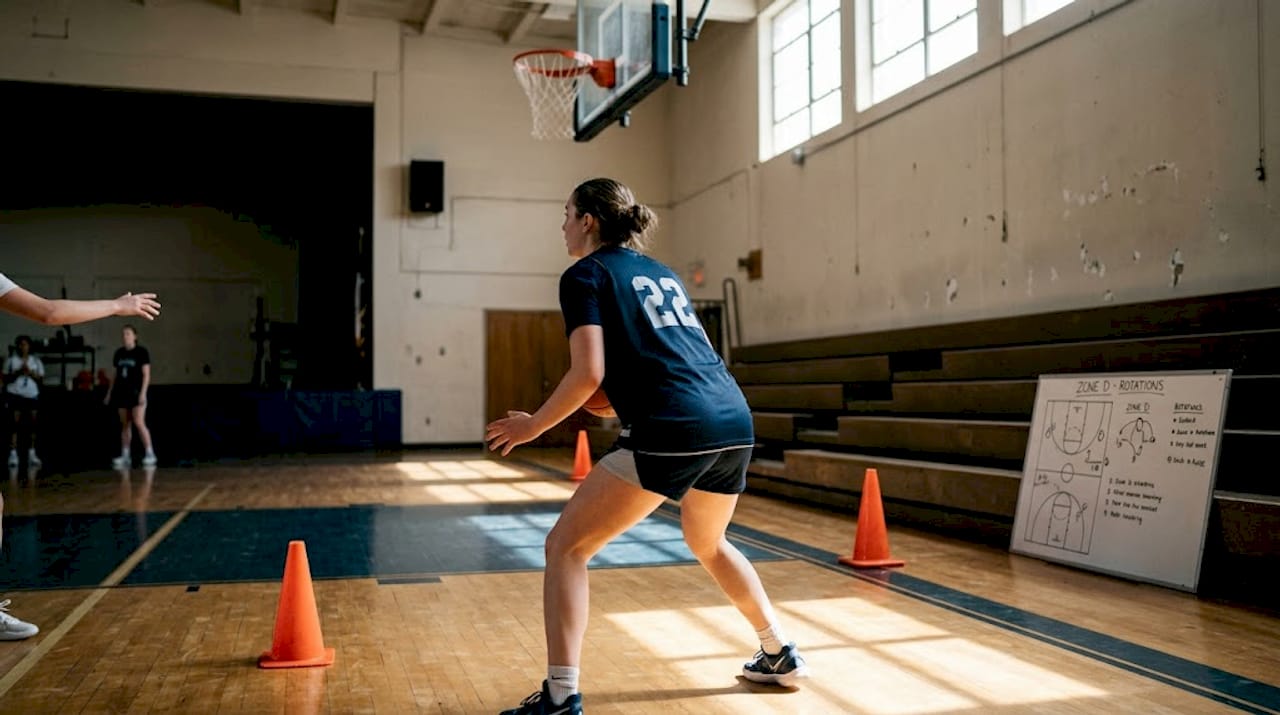
Passing out of the post is a skill most coaches undercoach. When the double team comes, your post player needs to make quick, accurate reads. A player who can’t pass under pressure becomes a liability, not an asset. Run drills on post passing reads regularly so players make those decisions automatically in games.
Strength changes everything. Guards and undersized players with added lower body strength consistently excel in the post, showing that post success is not reserved for traditional big men. A 6-foot guard who can hold position and finish through contact is a matchup problem for most defenses at the youth and high school level.
Key skill areas to prioritize in practice:
- Drop step and counter (left and right)
- Jump hook off both hands
- Post entry pass recognition
- Sealing and holding position against pressure
- Kick-out passing under defensive pressure
Pro Tip: Run 4-minute station drills where your post players receive the entry pass, read a coach’s signal (score or kick), and execute the correct action at game speed. That forces real decision-making rather than scripted moves.
Evaluating and tracking post player development
Knowing what to teach is step one. Knowing how to measure progress is what separates good development programs from great ones. Coaches who only track points and rebounds miss the metrics that actually predict post player impact.
Block percentage, offensive rebounding percentage, and dunks are leading indicators of post success, and post-up points per possession (PPP) is the single most important efficiency measure for your post players. Track these over time and you’ll spot development trends that raw point totals never reveal.
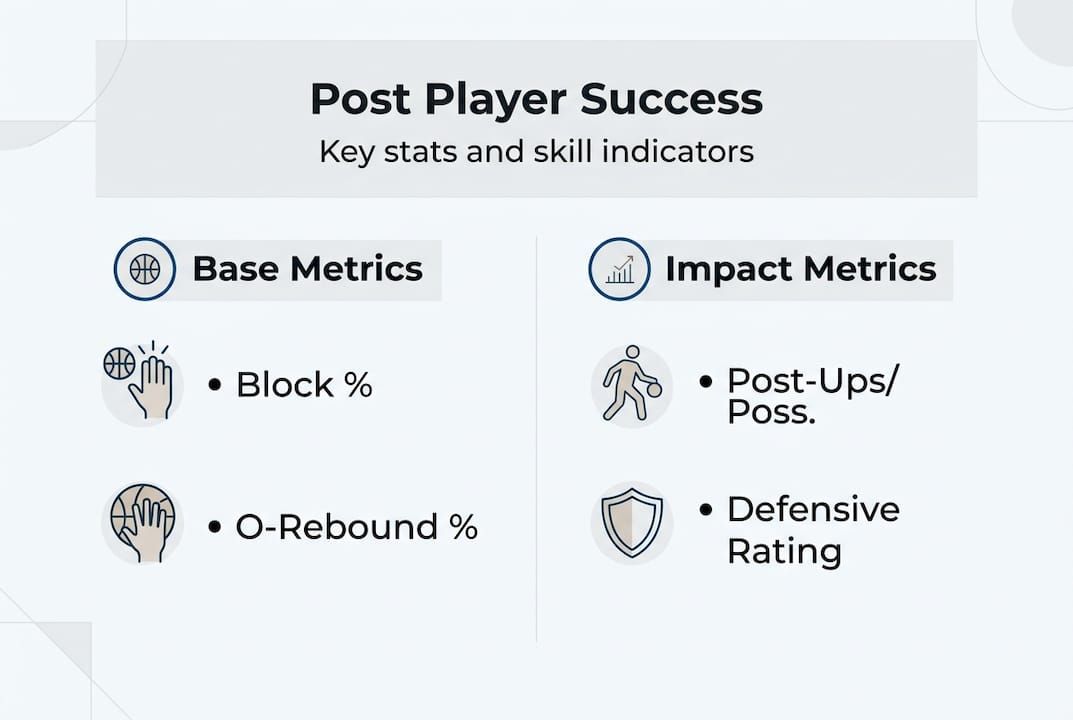
College-level advanced metrics like Box Plus/Minus (BPM) and Defensive Rating Estimate (DRE) also correlate strongly with post player success at higher levels. Even at the high school level, building a habit of tracking advanced stats gives your players a competitive edge in evaluation processes.
Here’s a comparison of common evaluation metrics and their usefulness for post players:
| Metric | What it measures | Usefulness for post development |
|---|---|---|
| Points per game | Raw scoring | Low: ignores efficiency and context |
| Post-up PPP | Scoring efficiency per possession | High: best direct efficiency measure |
| OREB% | Offensive rebounding rate | High: signals activity and effort |
| BLK% | Shot-blocking impact | High: measures defensive presence |
| Turnovers per catch | Ball security | Medium: tracks passing reads under pressure |
Use this player performance evaluation framework to set baseline numbers at the start of your season, then re-measure every four weeks. That cadence shows real development rather than game-to-game variation.
A practical numbered system for tracking post player growth:
- Set individual baselines in week one across all five metrics.
- Film two post sequences per game to review with players weekly.
- Track drill completion speed and accuracy in practice sessions.
- Compare game metrics to practice benchmarks each month.
- Adjust training focus based on which metric is lagging most.
Coaches who use a structured player evaluation guide track improvement more accurately and communicate development expectations more clearly to players and parents. That clarity builds program trust.
Integrating post development into team strategy
Post skills practiced in isolation don’t automatically transfer to team offense. The most effective coaches connect individual development to team system design so that every drill, every rep, and every evaluation point serves a larger strategic purpose.
NBA and high-level teams use post players to draw doubles, collapse the defense, and launch high-efficiency inside-out actions. You can run the same principles at the youth and high school level once your players understand their role in the sequence.
Here’s how post development fits into team strategy across different situations:
| Situation | Post player’s role | Team benefit |
|---|---|---|
| Half-court offense | Catch, read, score or kick | Creates open threes and mid-range shots |
| Transition | Rebound and outlet | Speeds up pace, creates numbers advantage |
| Defensive scheme | Protect paint, contest guards | Reduces opponent’s easy scoring chances |
| Late-game situations | Draw fouls, hold ball | Slows game, earns free throws |
Key ways to embed post development into your team system:
- Design drills that require post players to read help defense before deciding to score or pass.
- Use scrimmage segments where the offense must run through the post before shooting.
- Include post players in pick-and-roll actions as the roll man to build versatility.
- Review player feedback methods to ensure players understand their role clearly after each practice.
Explore positionless team development strategies to see how post skill sets fit into flexible offensive systems that keep defenses off balance.
Pro Tip: Build live 3-on-3 post entry drills where the defense is allowed to double. Your post player must read, pass, and your perimeter players must cut and shoot in real time. That one drill teaches more in 10 minutes than an hour of isolated footwork work.
Why the future of basketball depends on evolved post player development
Here’s the uncomfortable truth most coaches won’t say out loud: the positionless basketball movement has not made post skills less important. It has made them more rare, and therefore more valuable. When every team runs the same pace-and-space system, the team with a skilled post player has a genuine advantage that defenses haven’t prepared for.
Inside-out post play consistently creates the highest-value shots in basketball and unlocks team offensive balance that pure perimeter systems can’t replicate. Following trends without grounding your system in proven inside-out principles is a strategic risk, not a bold choice.
The coaches who will win over the next decade are not abandoning post development. They are evolving it. They are teaching it to guards, small forwards, and versatile bigs. They are using it as the foundation of ball movement and mismatch creation. Check the tactical trends guide to see where the game is actually heading. Post play is not going away. It’s getting smarter.
Take your post player development further with Hoop Mentality
You have the framework. Now you need the tools to execute it.

At Hoop Mentality, we build coaching resources from real court experience. The Big Man Dual Action Drill gives your post players targeted, progressive reps that build footwork and decision-making at game speed. The Game Preparation Guide helps you structure full practice weeks so post development is built into your schedule, not treated as an afterthought. These are practical tools, built for coaches who want to improve their teams right now. Explore our full resource library and get your post players ready to compete.
Frequently asked questions
What are the top three skills for post player development?
Footwork, passing ability out of the post, and strength are the most critical skills. Players with advanced footwork and added lower-body strength consistently outperform bigger players who lack these fundamentals.
How do you measure a post player’s impact on the game?
Track post-up points per possession, BLK%, and OREB% alongside the player’s ability to create open shots for teammates after drawing a double. Block% and offensive rebounding rate are the strongest predictors of post player impact.
Can undersized players succeed as post threats?
Yes. Guards and smaller players with elite footwork and lower-body strength can create mismatches in the post at any level. Guards like DeRozan and Cunningham prove that size is not the deciding factor.
Why is post play still important amid positionless basketball?
Post play forces defensive adjustments that perimeter-only offenses cannot. Inside-out post actions produce the highest-value shots in basketball and create team balance that pure spacing systems lack.
Recommended
- 7 Key Player Development Tips for Coaches – Hoop Mentality
- Player feedback methods basketball coaches use in 2026 – Hoop Mentality
- Player Development: Transforming High School Teams – Hoop Mentality
- Player evaluation guide for basketball coaches in 2026 – Hoop Mentality
- GetOffered - Football Recruiting Platform